
Such was the epitaph on the headstone of Major V.H. de Butts Powell. This Canadian soldier was to have an impact on Canadians and the Western world long after his death on January 2, 1918.
Before Major de Butts Powell joined the Canadian Field Artillery on January 15, 1915 he served as a teaching master at Appleby College in Burlington, Ontario. The school was founded in 1911 and de Butts Powell was one of the original faculty, teaching English, and served from 1911 until 1914. His tenure had an obvious impact to the school’s formative years and a residence, “Powell’s House”, is named for him. The school’s biography states that: “…he passed away on January 2, 1918 of war wounds.”[i]
Sadly, this recollection is not definitive and the records show an alternative fate for Major de Butts Powell than that which Appleby College offers.
Powell had declared previous military experience indicating on his attestation papers involvement with 5th Battalion, Middlesex Regiment (Territorials); Oxford University Officer Training Corp; and 9th Mississauga Horse. His Military Cross citation indicates his valour and bravery: ” For conspicuous gallantry in action. He made a daring reconnaissance under heavy fire, obtaining most valuable information and displaying great courage and ability throughout.”[ii]
But the aforementioned “war wounds” from the Appleby biography appear to be much more serious in its implication to de Butts Powell life than the biography lets on.
He committed suicide.
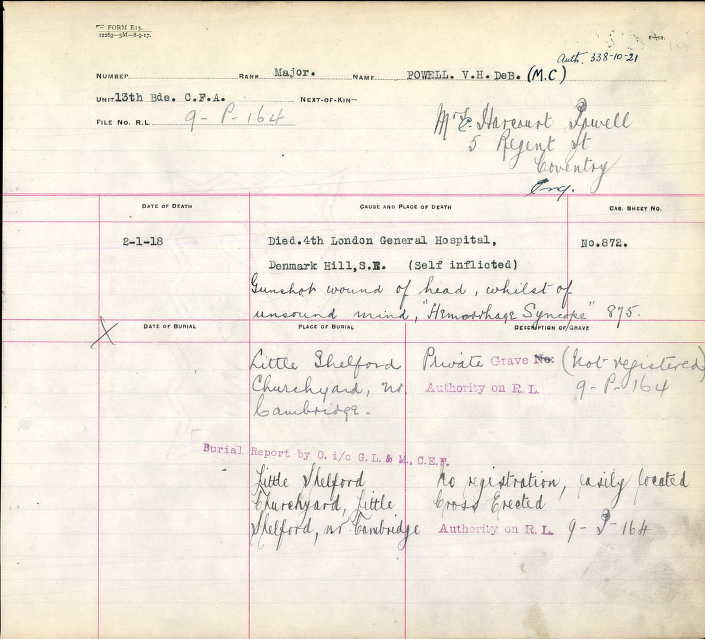
The place and cause of death was registered as: “4th London General Hospital, Denmark Hill, S.E. (Self Inflicted) Gunshot wound of head, whilst unsound mind…” The next of kin on the form is his mother Mrs. Cecil Henrietta Powell. He left her an estate worth $2,413 of which $2,000 consisted of life insurance and the rest in cash.[iii]
It was his mother who picked and is identified with picking the the epitaph on de Butt Powell’s headstone: Now We See Through the Glass Darkly But; Then Face to Face. This is a reference to Corinthians 13:12, King James Version[iv] and is completed with the following phrase: “…now I know in part; but then shall I know even as also I am known.” from the headstone documents.
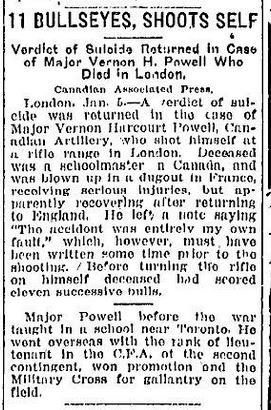
De Butts Powell’s death may have had some notoriety at the time as an undated Canadian Press article outlines de Butts Powell’s death in lurid detail:
11 BULLSEYES, SHOOT SELF
Verdict of Suicide Returned in Case of Major Vernon H. Powell Who Died in London.
London. Jan. 6. – A verdict of suicide was returned in the case of Major Vernon Harcourt Powell, Canadian Artillery, who shot himself at a rifle range in London. Deceased was a schoolmaster [from] Canada, and was blown up in a dugout in France, receiving serious injuries, but apparently recovering after returning to England. He left a note saying “the accident was entirely my own fault.” which, however, must have been written some time prior to the shooting. Before turning the rifle on himself deceased as scored eleven successive bulls.
Major Powell before the war taught at a school near Toronto. He went overseas with the rank of Lieutenant in the C.F.A. of the second contingent, won promotion and the Military Cross for gallantry on the field.
This article indicates a troubled man with premeditation and purpose in staging such a publicly horrific act while expressing a martial skill of target shooting.
But his short life was to have an impact on the school he helped nurture through it nascent beginnings, earning the distinction of having a house permanently named after him at Appleby College. His interest in Dramatics and Theater was to have a life changing impact on another student.
The actor, Raymond Hart Massey was influenced by the teaching of de Butts Powell for his love in drama[v], a career path he was to pursue with notable success and fame after his service with the Canadian Artillery in the First World War. It is not, perhaps, ironic that Massey choose the same branch of service as his former schoolmaster. It is recorded that he attributed “his love of drama” to de Butts Powell. The outcome of this passion was to result in 85 movie roles, of which he portrayed the scion of American politics, Abraham Lincoln, 4 times.
We will never be able to fathom the pain and a psyche ripped by the ravages of war to make such a man, who directly contributed to the joy and entertainment of others through Raymond Massey, that led him to contemplate his own death by his own hand in such a premeditated manner.
Appleby’s legacy for Major Vernon Harcourt de Butts Powell is the safer one. He died of war wounds related to his service. They honour his name as part of their heritage and legacy.
The truth is made more tragic because of the mental anguish this soldier had to endure until he could not take it any more.

As a schoolmaster at Appleby College we have evidence of how he contributed to the lives of others through the art of the Canadian actor, Raymond Massey.
[i] Major Vernon Harcourt de Butts Powell Biography
[ii] The London Gazette Publication date: 14 November 1916 Supplement: 29824 Page: 11080
[iii] Toronto Star, September 28, 1918
Discover more from History of the 18th Battalion CEF, "The Fighting Eighteenth"
Subscribe to get the latest posts sent to your email.
 History of the 18th Battalion CEF, "The Fighting Eighteenth"
Leave a comment