Source: KIA September 1916 at the Somme.
Family Search: When Private George Douglas was born on 3 May 1893, in County Leitrim, Ireland, his father, James Douglas, was 63 and his mother, Elizabeth Farrell, was 54. He immigrated to Canada in 1913 and lived in London, Ontario, Canada in 1914. He registered for military service in 1914. In 1914, at the age of 21, his occupation is listed as labourer in London, Ontario, Canada. He died on 16 September 1916, in Courcelette, Somme, France, at the age of 23, and was buried in Albert, Somme, France.

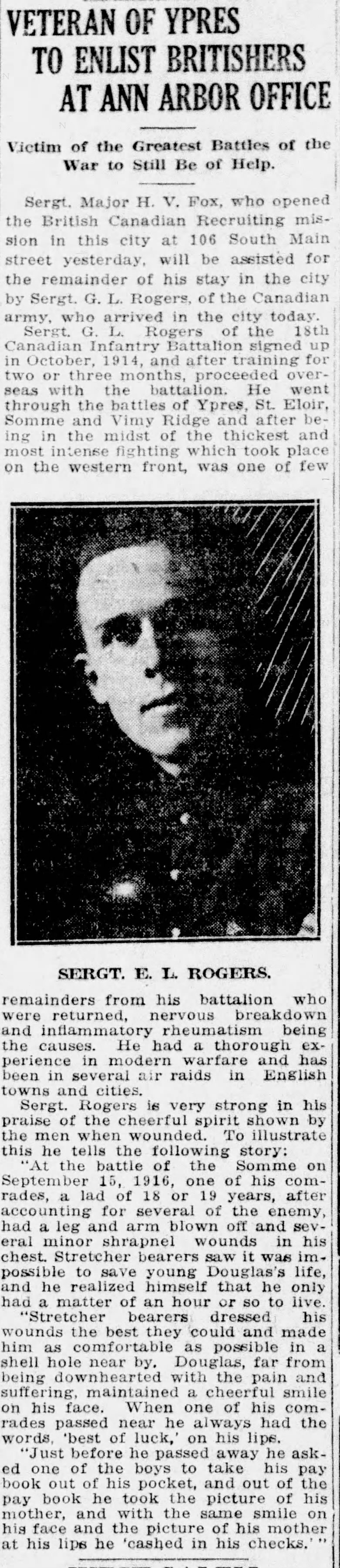
VETERAN OF YPRES TO ENLIST BRITISHERS AT ANN ARBOR OFFICE
Victim of the Greatest Battles of the War to Still Be of Help.
Sergt. Major H. V. Fox, who opened the British Canadian Recruiting mission in this city at 106 South Main street yesterday, will be assisted for the remainder of his stay in the city by Sergt. G. L. Rogers, of the Canadian army, who arrived in the city today.
Sergt. G. L. Rogers of the 18th Canadian Infantry Battalion signed up in October, 1914, and after training for two or three months, proceeded overseas with the battalion. He went through the battles of Ypres, St. Eloir, Somme and Vimy Ridge and after being in the midst of the thickest and most intense fighting which took place on the western front, was one of few remainders from his battalion who were returned, nervous breakdown and inflammatory rheumatism being the causes. He had a thorough experience in modern warfare and has been in several air raids in English towns and cities.
Sergt. Rogers is very strong in his praise of the cheerful spirit shown by the men when wounded. To illustrate this he tells the following story:
“At the battle of the Somme on September 15, 1916, one of his comrades, a lad of 18 or 19 years, after accounting for several of the enemy, had a leg and arm blown off and several minor shrapnel wounds in his chest. Stretcher bearers saw it was impossible to save young Douglas’s life, and he realized himself that he only had a matter of an hour or so to live.
“Stretcher bearers dressed his wounds the best they could and made him as comfortable as possible in a shell hole near by. Douglas, far from being downhearted with the pain and suffering, maintained a cheerful smile on his face. When one of his comrades passed near he always had the words, ‘best of luck,’ on his lips.
“Just before he passed away he asked one of the boys to take his pay book out of his pocket, and out of the pay book he took the picture of his mother, and with the same smile on his face and the picture of his mother at his lips he ‘cashed in his checks.’”
The Ann Arbor News. Thu, Apr 25, 1918 ·Page 2.
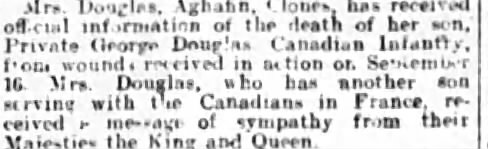
Thu, Oct 05, 1916 ·Page 3.


