Source: Gathering Our Heroes
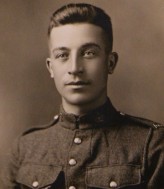
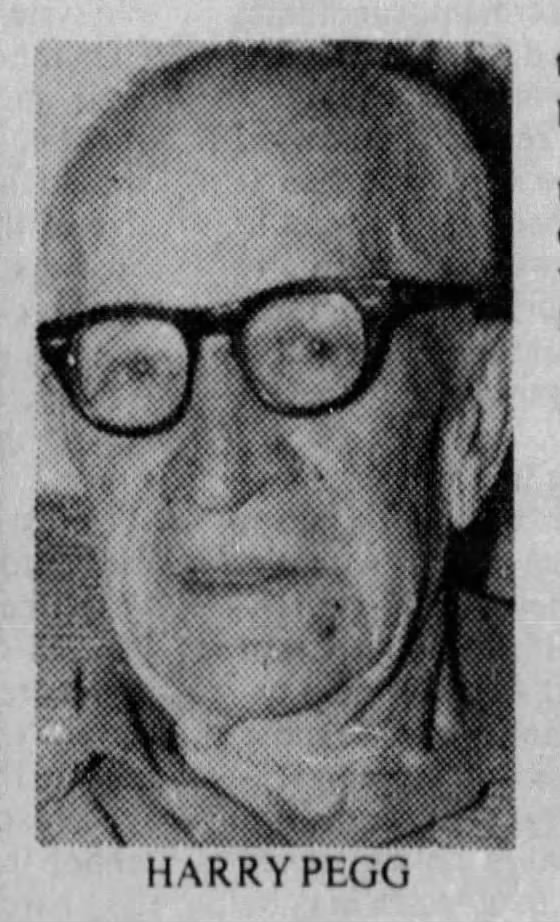
Family Search: When Private Harry Pegg was born on 5 December 1893, in Kent, Ontario, Canada, his father, William Thomas Pegg, was 34 and his mother, Rebeca Lodena Hill, was 31. He lived in Blenheim, Kent, Ontario, Canada for about 6 years and in Harwich, Kent, Ontario, Canada in 1931. He registered for military service in 1916. In 1931, at the age of 38, his occupation is listed as farm labourer in Harwich, Kent, Ontario, Canada. He died in 1980, in Ontario, Canada, at the age of 87, and was buried in Evergreen Cemetery, Blenheim, Chatham-Kent, Ontario, Canada.
Pallbearer at Private Henry Cecil Snow’s funeral.
Brother to Private James Jacklin Pegg, reg. no. 189868.
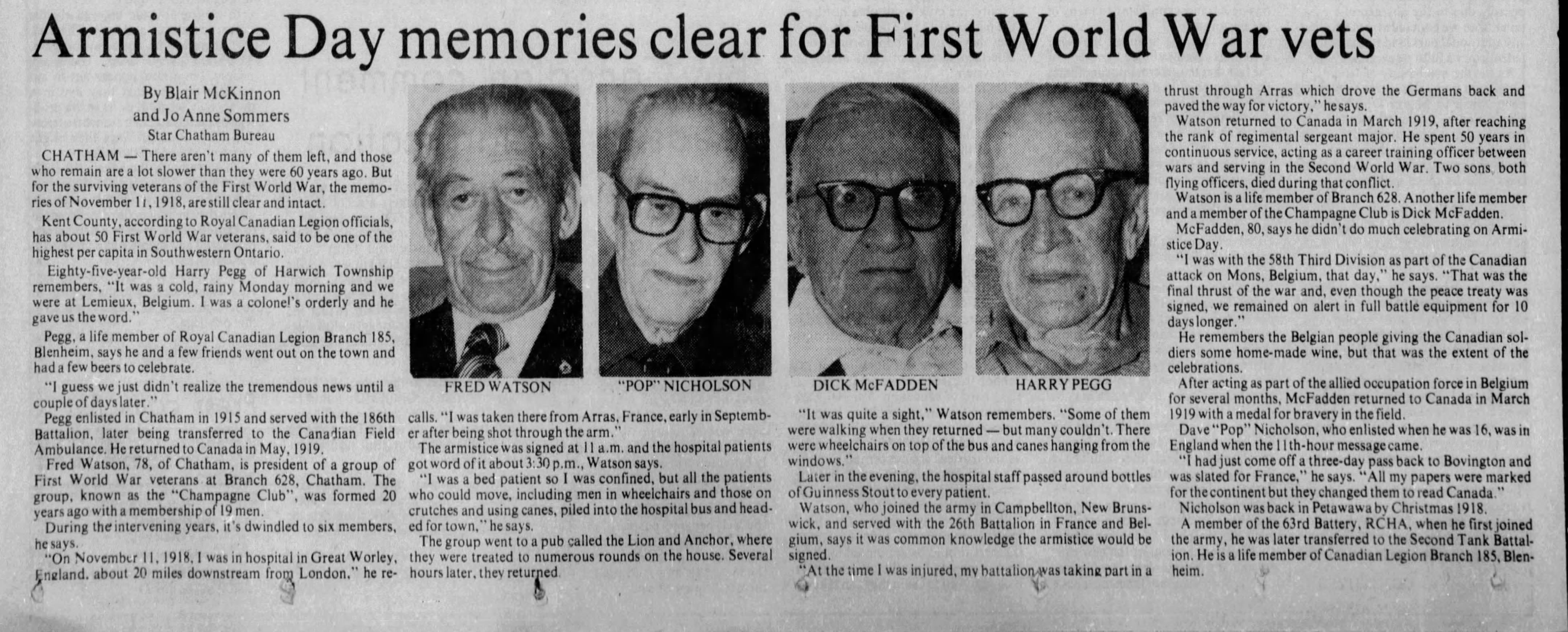
Armistice Day memories clear for First World War vets
By Blair McKinnon and Jo Anne Sommers Star Chatham Bureau
CHATHAM — There aren’t many of them left, and those who remain are a lot slower than they were 60 years ago. But for the surviving veterans of the First World War, the memories of November 11, 1918, are still clear and intact.
Kent County, according to Royal Canadian Legion officials, has about 50 First World War veterans, said to be one of the highest per capita in Southwestern Ontario.
Eighty-five-year-old Harry Pegg of Harwich Township remembers, “It was a cold, rainy Monday morning and we were at Lemieux, Belgium. I was a colonel’s orderly and he gave us the word.”
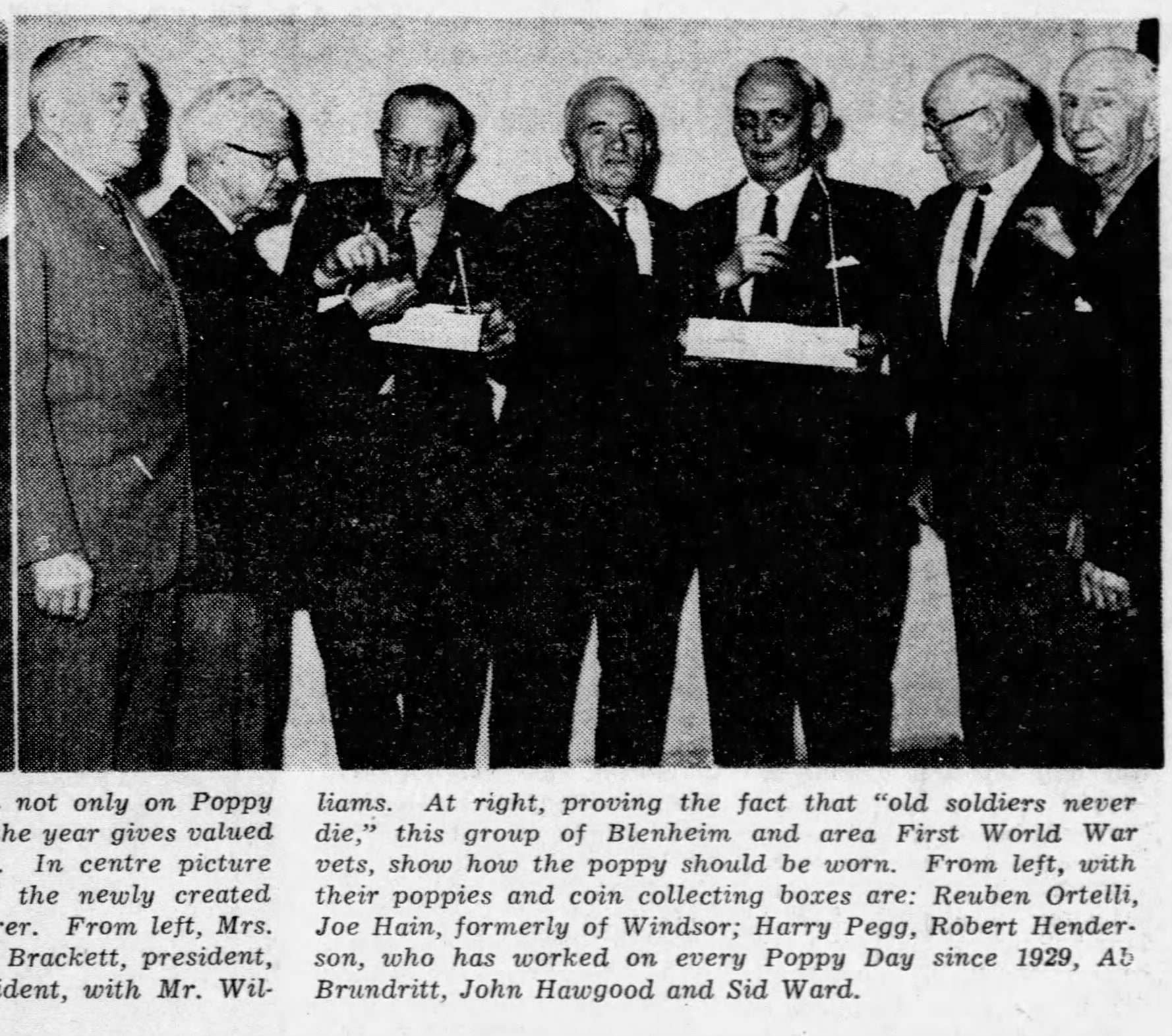
Pegg, a life member of Royal Canadian Legion Branch 185, Blenheim, says he and a few friends went out on the town and had a few beers to celebrate.
“I guess we just didn’t realize the tremendous news until a couple of days later.”
Pegg enlisted in Chatham in 1915 and served with the 186th Battalion, later being transferred to the Canadian Field Ambulance. He returned to Canada in May, 1919.
Fred Watson, 78, of Chatham, is president of a group of First World War veterans at Branch 628, Chatham. The group, known as the “Champagne Club”, was formed 20 years ago with a membership of 19 men.
During the intervening years, it’s dwindled to six members, he says.
“On November 11, 1918, I was in hospital in Great Worley, England, about 20 miles downstream from London,” he recalls. “I was taken there from Arras, France, early in September after being shot through the arm.”
The armistice was signed at 11 a.m. and the hospital patients got word of it about 3:30 p.m., Watson says.
“I was a bed patient so I was confined, but all the patients who could move, including men in wheelchairs and those on crutches and using canes, piled into the hospital bus and headed for town,” he says.
The group went to a pub called the Lion and Anchor, where they were treated to numerous rounds on the house. Several hours later, they returned.
“It was quite a sight,” Watson remembers. “Some of them were walking when they returned — but many couldn’t. There were wheelchairs on top of the bus and canes hanging from the windows.”
Later in the evening, the hospital staff passed around bottles of Guinness Stout to every patient.
Watson, who joined the army in Campbellton, New Brunswick, and served with the 26th Battalion in France and Belgium, says it was common knowledge the armistice would be signed.
“At the time I was injured, my battalion was taking part in a thrust through Arras which drove the Germans back and paved the way for victory,” he says.
Watson returned to Canada in March 1919, after reaching the rank of regimental sergeant major. He spent 50 years in continuous service, acting as a career training officer between wars and serving in the Second World War. Two sons, both flying officers, died during that conflict.
Watson is a life member of Branch 628. Another life member and a member of the Champagne Club is Dick McFadden.
McFadden, 80, says he didn’t do much celebrating on Armistice Day.
“I was with the 58th Third Division as part of the Canadian attack on Mons, Belgium, that day,” he says. “That was the final thrust of the war and, even though the peace treaty was signed, we remained on alert in full battle equipment for 10 days longer.”
He remembers the Belgian people giving the Canadian soldiers some home-made wine, but that was the extent of the celebrations.
After acting as part of the allied occupation force in Belgium for several months, McFadden returned to Canada in March 1919 with a medal for bravery in the field.
Dave “Pop” Nicholson, who enlisted when he was 16, was in England when the 11th-hour message came.
“I had just come off a three-day pass back to Bovington and was slated for France,” he says. “All my papers were marked for the continent but they changed them to read Canada.”
Nicholson was back in Petawawa by Christmas 1918.
A member of the 63rd Battery, RCHA, when he first joined the army, he was later transferred to the Second Tank Battalion. He is a life member of Canadian Legion Branch 185, Blenheim.
Windsor Star. 1 November 1978.


