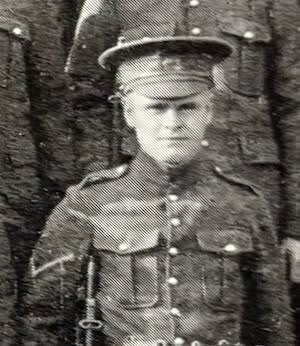
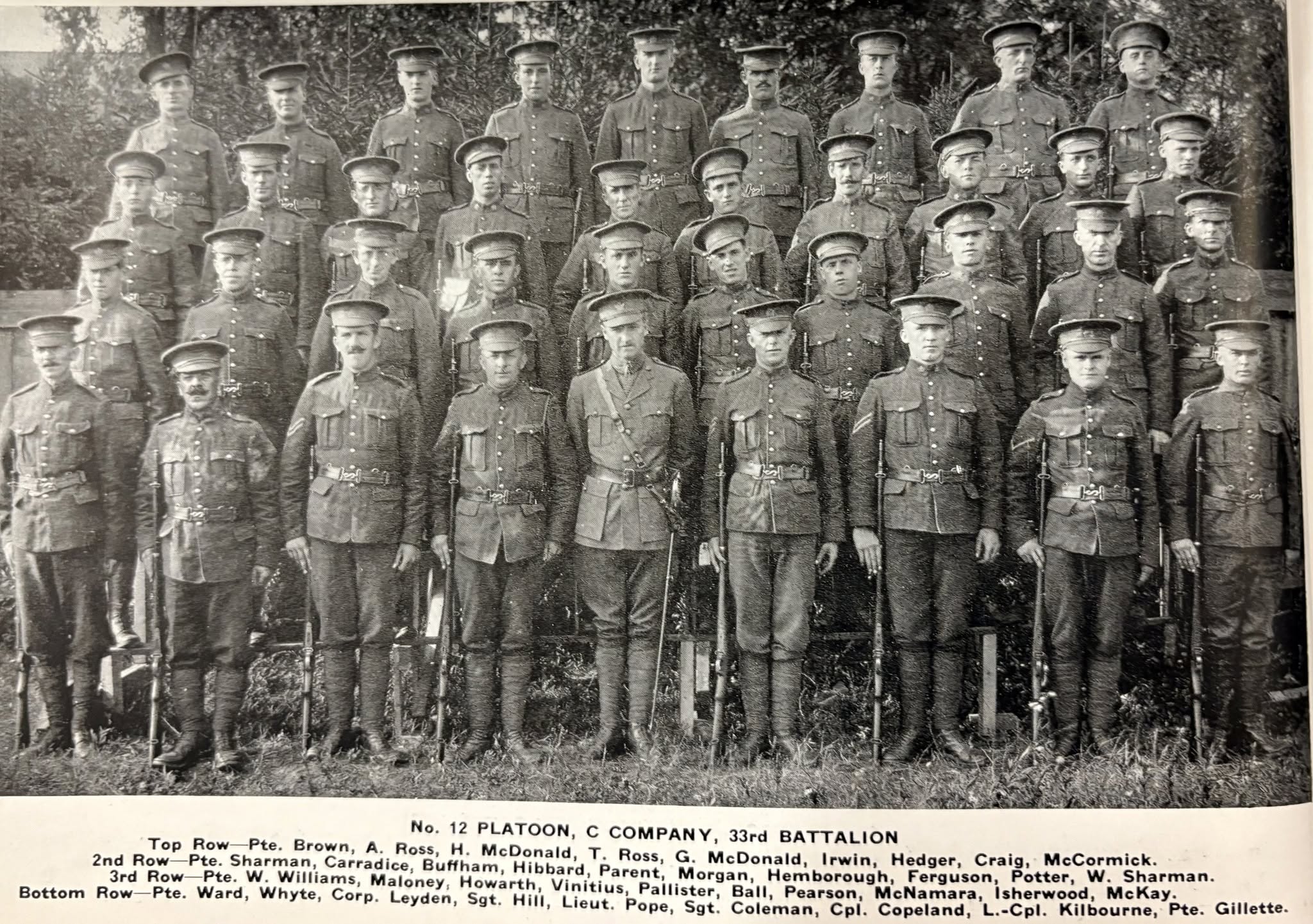
Source: Per record of promotion for William Moggach, reg. no. 675576.
Family Search: When Private Wilfrid Edward Kilbourne was born on 22 March 1894, in Oxford, Ontario, Canada, his father, Byron Kilborne, was 46 and his mother, Alice Maud Teeple, was 25. He married Ruby Elizabeth Smith on 1 September 1928, in Atlanta, Fulton, Georgia, United States. They were the parents of at least 1 son and 2 daughters. He immigrated to Detroit, Wayne, Michigan, United States in 1920 and lived in Tarrytown, Greenburgh, Westchester, New York, United States in 1935 and Baltimore, Baltimore, Maryland, United States in 1940. He registered for military service in 1915. In 1920, his occupation is listed as Chevrolet. He died on 19 June 1988, in Davison, Genesee, Michigan, United States, at the age of 94, and was buried in Crestwood Memorial Cemetery, Grand Blanc, Genesee, Michigan, United States.
This man emigrated to Michigan, USA.
MILITARY MEDAL IS AWARDED TO PTE. WILFRID KILBOURNE
London Man Is Honored for Bravery At the Front.
It is announced to-day that the Military Medal has been awarded to another Londoner, Pte. Wilfrid Kilbourne, son of Byron Kilbourne, 138 Fullarton street. Kilbourne joined the terrible 33rd in London and went with that unit to Quebec and thence to England. He was corporal in England, but reverted in order to go over to France to serve with “a Western Ontario battalion.”
At the Battle of Courcelette he was wounded, returning to the trenches on May 1 this year. He stayed in the trenches three more months, writing regularly and cheerfully to his mother all the time. Towards the end of July his battalion got a short rest, which means that the men worked rather harder than usual on drills, etc., but do not go into the trenches. Generally, however, they are quite within the reach of medium-sized shells from the enemy.
On August 9 they went back into the trenches—and there was going to be “something doing,” Kilbourne wrote to his mother: “I am in a dugout. We have nothing to do until to-night—when we have got to get busy.” “Getting busy” may mean anything, from filling sandbags to going “over the top.” This time it meant going over the top, and Kilbourne knew it. So he wrote home.
Kilbourne did get busy, the British Government admits that. The official report says that he displayed great coolness and daring during a raid on an enemy trench. His section commander was hit in the groin and put out of action, tangled up in the enemy’s barbed wire, so Kilbourne took charge. He “carried his section forward, personally bombed along the enemy trench for a considerable distance” (with a gunshot wound in the right arm, sustained before he took charge, be it noted) and when the word came to retire and the raiders went back, triumphant, it occurred to him that his section commander might like to come along, too. So he stayed behind, disentangled his section commander from the barbed wire and brought him in.
Kilbourne is a Canadian, of this city.