Introduction
In a recent post updating this blog and its progress Marika Pirie posted a picture on Twitter that initiated this post. Hopefully post will help others in their work to discovering soldiers of the Canadian Expeditionary Forces that they are researching. This post will show step-by-step the process taken to create a Soldier’s Page in the blog.
This is not meant to be a comprehensive guide as much as an overview and I cannot stress the value of the work done by Michael M. O’Leary at his web site, “The Regimental Rouge.” At this site is a comprehensive guide about researching Canadian soldiers and he has recently brought this incredible resource to Amazon for the Kindle.
The Source
Marika Pirie posted an image in her twitter feed which, as can be seen, has images of several soldiers who died at Vimy Ridge on April 9, 1917.

Step 1: Finding the Soldier
I keep all my folders regarding research in the cloud using Google Drive. This service works well as it allows you to store the data on your computer hard drive with a copy in the cloud which can be accessed from other devices. For example, when transcribing the War Diaries or long passage of news articles or other information you can have the article up on your tablet as reference while you type. The service also has great search capabilities, drag-and-drop file function, and other tools to keep you organized.
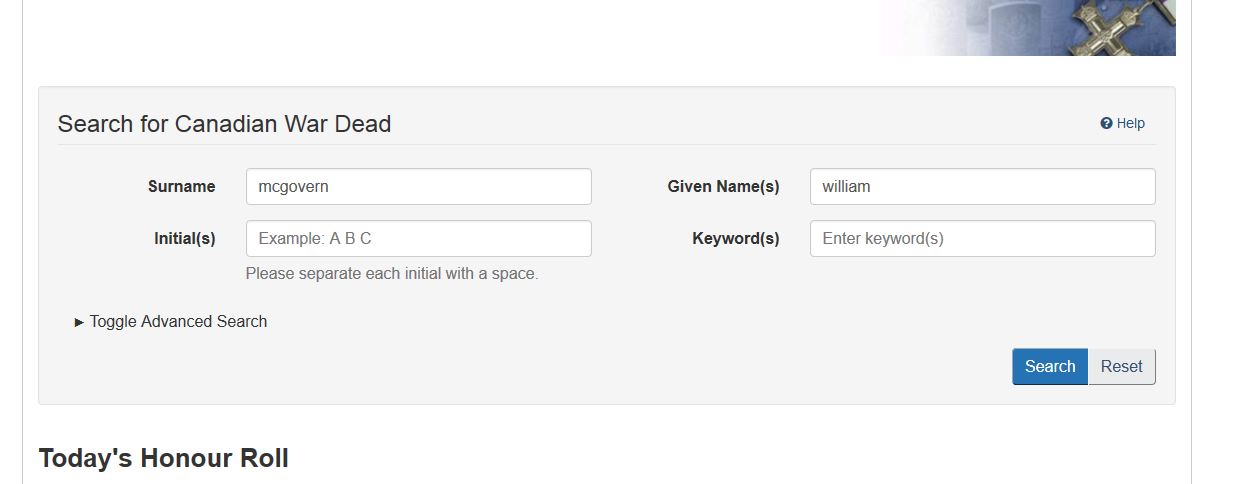
This initiates a search to see if I have any folders with the last name of “McGovern”. By default the folders are listed by Last Name, First Name(s) and the service number or rank of the soldier as a means of recording and collating the soldiers in the cloud.
Step 2: Initial Search
One of the easiest and fastest ways to find a soldier, specifically when they have been killed in action, is to head over to the Canadian Virtual War Memorial (CVWM) site. Sometimes a simple last name and first name search (as in this case) gives you the hit. The image gives you the date of death so if there is more than one soldier of this name one can simply find the corresponding date of death and then you have your soldier.
Note: Often by simply doing a Google search for the soldier’s name will garner a hit from both the CVWM and the Canadian Great War Project (CGWP) site. The problem with common names is that there could be multiple incorrect hits so defining the search parameters to Canadian sites only facilitates finding the soldier you are researching for. If the soldier has a middle name and you have the correct rank the likelihood of a good search hit is very high.
Note that this database has soldiers listed from the Boer War, 1st and 2nd World War so common last and first names can be very problematic. The advantage of going to this site is the site lists some primary information in you search such as service number, battalion, and any images that may have been uploaded by researchers or other interested members of the public.
We know know Private McGovern has a service number of 226609 and the confirmation that he served at the time of death with the 18th Battalion. We also now know his middle name (Mathew).
In the case of a soldier that was not killed in action the search is more involved which will be covered in a later post.
Step 3: Gathering Information form Sources
At this time this data is entered in the database as completely as possible. In the database the Library and Archives link, the Canadian Virtual War Memorial link, and the Canadian Great War Project Page. Note that I do not use the Commonwealth War Graves Commission site initially as the database covers all Commonwealth soldiers and the CVWM site offers, in some cases, images that can facilitate research. The CWGC site comes into play later.
Essentially, if the soldier died during the 1st World War use the CVWM site for your searches, especially if you have a first name or initials of the forename. If the soldier survived the war use the LAC site for searches.
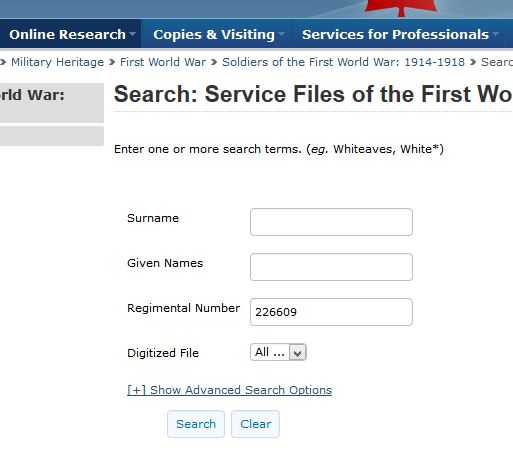

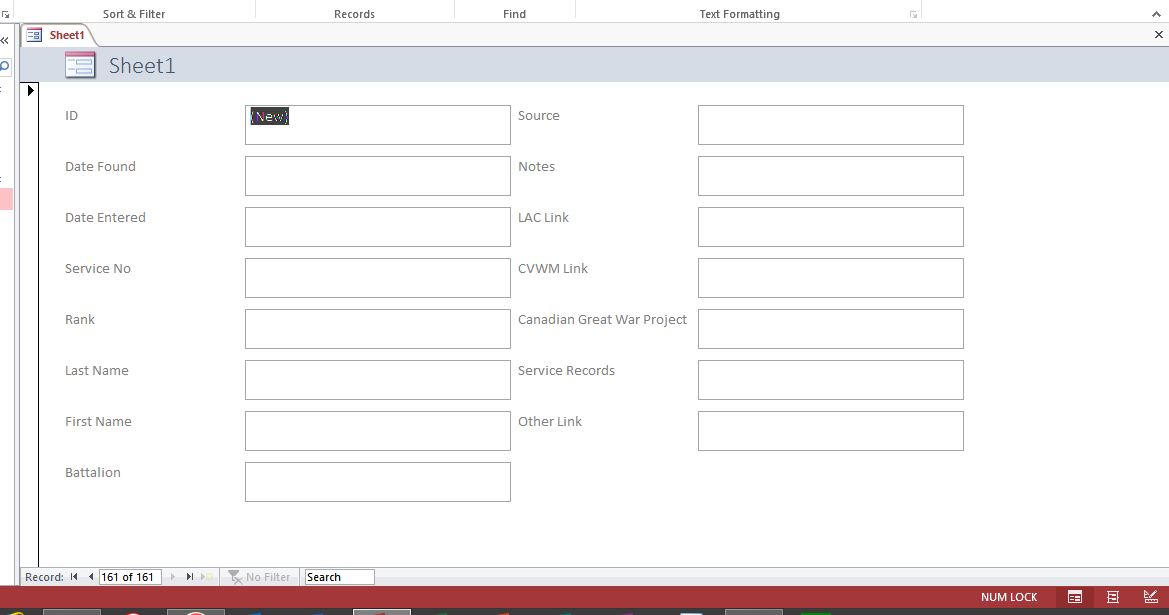
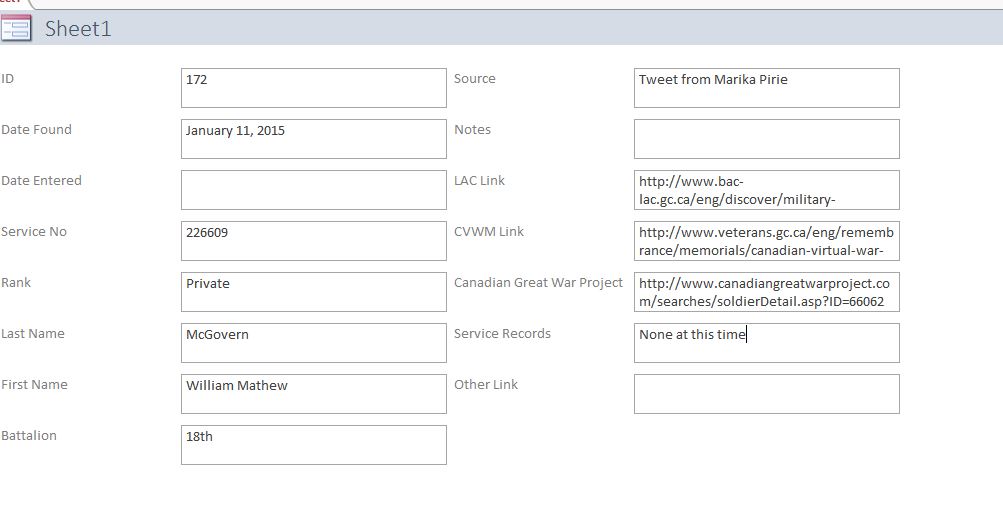
In this case, note that the digital version of this soldier’s service record is not currently available on the LAC site.
Step 4: Circumstances of Death Card Search
At this time the Attestation Papers and any images from the CVWM site are collected and then a visit to the Circumstances of Death Registers, First World War is made. This site is basic grunt work. It is recommended that you bookmark this page as it lists the registers alphabetically and has links to the specific databases for each surname. Note that the database ends with Sim, William and that the cards for casualties after this surname are missing.
A couple of tips: all the primary information is listed on EVEN numbered cards. Generally, I enter the middle number of the data set (for example: total cards = 1,000. Enter 500 and begin the search forward or backward from there by process of elimination).
In this case entered 500, 650, 600, 626, 620, 606, 610, 612 to find the correct record here. Though this process is tedious it can be very rewarding giving incite into the individual circumstances into the causes of a soldier’s death. The cards are by nature very brief in their descriptions but some render more information.
Step 5: CWGC Site and Death Registers
Once this information is collected a visit to the Commonwealth War Graves Commission search section of the site is made. This site is truly magnificent having information on all Commonwealth soldiers who served and lost their lives in the two World Wars and maintains data on 1.7 million soldiers at this site, as well as maintaining cemeteries and memorials at 23,000 locations in 153 countries.
The database is logically set up and has a range of search options. In this case we have Private McGovern’s service number and when searched only one entry comes up. If multiple entries are found a quick review of the search results will generally find the soldier you are researching.
Any searches, such as researching the casualties on a specific date, can be downloaded in CSV format which can be imported or opened in most spreadsheet/database software.
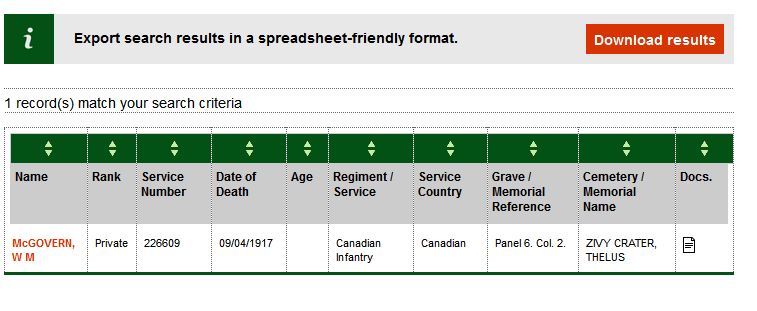
The content available to view and collect differs depending on the circumstances of the burial. In this case Private McGovern was buried in a common grave and memorialized with a plaque at the Zivy Crater, Thelus, France. The site offers a PDF file memorial and other information such as the specifics regarding the creation of this memorial site:
Historical Information
Zivy Crater was one of two mine craters (the other being Lichfield Crater) which were used by the Canadian Corps Burial Officer in 1917 for the burial of bodies found on the Vimy battlefield. The numerous groups of graves made about this time by the Canadians were not named as a rule, but serially lettered and numbered; the original name for Zivy Crater was CB 1.
The crater is essentially a mass graves and contains 53 First World War burials, five of them unidentified. The names of the men buried in the crater, all of whom died in April or May 1917, are inscribed on panels fixed to the boundary wall.
Step 6: Reaching Further
A general Internet search for the soldier using Canadian sources as a primary search area for content and information. Very often this search, as in this case, turns up very few hits but sometimes one will find a memorial page at a county, city, parish, or other site commemorating a soldier. It is my experience that if the soldier died in the war only about 10 percent of the time does such a search garner anymore biographical information.
In this case no further relevant information was found at this time.
Step 7: Putting it all together
Once all the images have been collected any appropriate links are created to the CVWM page and to the soldier’s digitized service records, if available at time of posting. The LAC is working to scan and digitize all the service records of the Canadian soldiers who served during the conflict and hope to have the project done sometime in 2015 – 16.
See Private William Mathew McGovern’s soldier’s page to see the results.
Conclusion
The resources exist online to gather the basic biographical information regarding a soldier you are interested in. The search and collection is made easier if the soldier is listed in the CVWM and many people have worked to contribute digital content in the form of pictures, news articles, and other media that will enhance you experience and understanding of the soldier.
The existence of other 3rd party sources of information such as Ancestry.ca and other to delve deeper into the biographical details of a soldier exist but there is still a lot of on-the-ground research of sources in archives (newspapers, libraries, etc.) to complete a more complete picture.
Creating a systematic approach goes a long way to collecting the information you require and through this process you learn more about those who fought for our country during World War 1.
Discover more from History of the 18th Battalion CEF, "The Fighting Eighteenth"
Subscribe to get the latest posts sent to your email.
 History of the 18th Battalion CEF, "The Fighting Eighteenth"
Leave a comment