The relative ease with which one can find basic biographical information regarding a Canadian soldier that was killed or died during World War 1 available because of the many online resources and databases is in sharp contrast to the work required for a soldier who survived the war.
The original intent of this blog was to primarily recognize those soldiers who were mentioned in the 18th Battalion War Diaries but it became apparent early that the sourcing of the common solider from Privates to Sergeants was going to be difficult.
The problem was exacerbated by the fact that the 18th Battalion War Diaries at the LAC web site had 2 parallel diaries. The purely military war diary extends from the Battalion’s arrival at the European Theater in Spring 1915 to its embarkation back to Canada in the Winter of 1919; and the Medical Officer’s (MO) War Diary which only exists (at least online) for 2 months (September and October 1915). The MO’s war diary entries included many soldiers of the “other rank” (OR) category – those being private soldiers and non-commissioned officers. The military war diary simply does not include the names of the OR category unless they distinguished themselves during the fighting.
MO War Diary Sample form September 1915 with Private William Robb Dewar Entry. This was my Grandfather. Note that the MO lists the soldier’s name and regimental number.Breakdown of the composition of a Canadian and English Battalion. Source: The Regimental Rouge
Therefore, the intent and goal of finding soldiers; creating a Soldiers Page; and linking that information within the war dairy blog entries focused on the transcriptions of the war diary was changed. A Canadian Battalion was comprised of approximately 1,100 men with approximately 30 of those men being officers. Thus, the war diaries of the Canadian Army at this time would but an inordinate amount of focus on the activities of the minority of men in a battalion.
To counteract this it was felt that basic biographical information about ALL soldiers would be done and in a “linear” fashion. That is to say that the activities and research of the blog generated by the transcription of the monthly war diaries and other research would drive the addition of soldiers. This blog deliberately does not intend (at this time) to print out the 1915 Nominal Roll or use the CGWP web site to list all of the 700 plus dead of the 18th Battalion and add them. It is felt that as each month unfold the soldiers names in the diary or found by other means would make my and my followers experience a bit richer.
Doing Research
Sources
Most of the initial sources of the soldiers’ pages was driven by the MO’s war diary but at the latter part of 1915 these war dairies are not available on the LAC. Most of the sources for soldiers that were not killed in action have been related to reader comments, subsidiary research from local sources, and posts on Twitter (primarily from Marika Pirie). Almost, if not all of, the officers who served with the Battalion are mentioned. These war diary mentions are usually related to being taken on strength, taking leave, being wounded and/or killed, and other entries relating to the comings and goings of the officers of the Battalion.
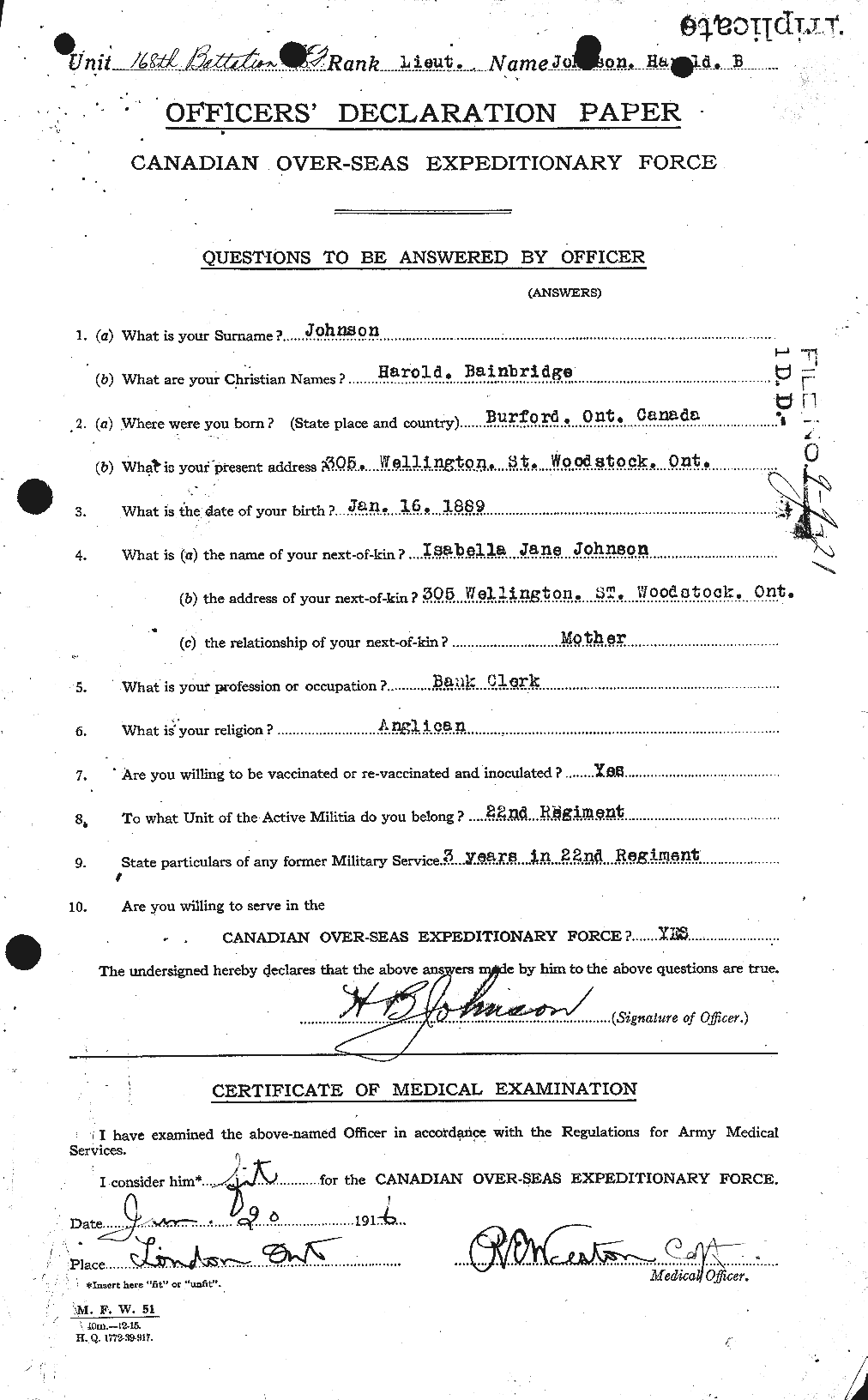
The officer entries are generally a good source because the initials of the officer are usually included with their surname. This is important because an officer’s attestation papers, in the great majority of cases, do NOT have regimental numbers.
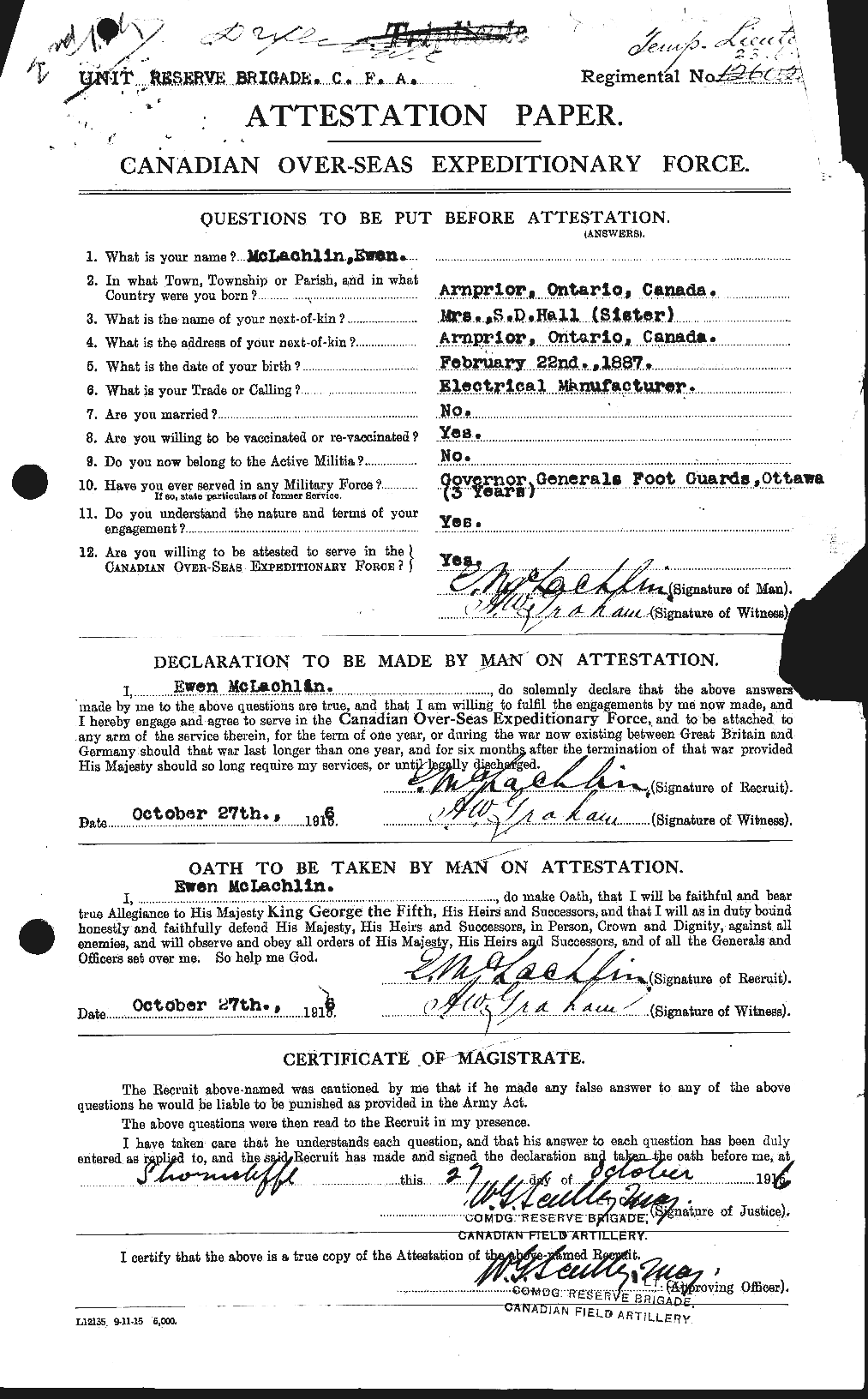
Sample Officer’s Declaration Paper. Note the lack of a regimental number.Early style attestation paper. Note the regimental number has been struck out. Many samples simply have no number or notation of rank.
The April 1915 Nominal Roll has become most valuable finding the officers that originated with the battalion but one has to rely on the War Diaries for subsequent officers.
Referencing the card below the original draft of 1,100 soldiers was supplemented by a further 2,817 reinforcements. Therefore the total soldiers serving in the 18th Battalion equates to 3,917. With 770 that were killed or died in the conflict that leaves 3,147 men to research.
Obverse of a Membership card, The Fighting Eighteen [18th Battalion] Association, Niagara District Branch, n.d.The first point of reference would be the Nominal Rolls. These documents where created as a master list and some are available electronically at archive.org. The nominal rolls can be problematic because of the quality of the scan but there are a good place to start. One of the problems with the nominal rolls is that ready access to them online is spotty. In fact, I cannot currently find the link to the online version of the nominal roll I do have in PDF format at this time.
Below is an example of one of the pages of the 18th Battalion Nominal Roll from April 18, 1915. Note that this nominal roll was created just before the Battalion embarked for England. It contains the registration number, rank, name, former corps (previous military service), next of kin and their address, country of birth and the place and date on which they were taken on strength. This type of document is invaluable but does not come close to representing the role of reinforcements taken on strength (TOS) during the Battalion’s service in Europe.
With this as a basis we have the regimental (or service) number of a soldier and finding that soldier’s LAC reference and page is easy. By entering the service number in the appropriate field the LAC database directs you to their holdings.
Partial Name Searches
Surname Only Searches
War diary entry example showing officers being entered into diary without initials.
In the case where you only have a last name and initials, often found with officers being attached to the Battalion, the challenge to finds a soldier is more involved. In the example below the war diarist does not even record the initials of the officers. As they have arrived as reinforcements they will not be listed on the 1915 nominal roll. Using a surname search offers the following results:
Gerrard: 50 database hits. 4 possible hits as they were officers when they were attested. Excludes a soldier that was commissioned from the ranks. 2 have digitized service files. Possible hit with Lt. Douglas Erskin Gerrard as he attested in London, Ontario with the 71st Battalion to the 91st Overseas Battalion. No service records to confirm. Searching the 2 other soldiers with digitized service files may, by process of elimination increase the level of confidence of Lt. D.E. Gerrard being the soldier mentioned in the passage below.
Cole: 930 results. Sadly, in my experience, the advanced search options at the LAC site do not offer the functionality to drill down to a short-list. This soldier would be entered into the database and further research, primarily from the War Diary may garner a successful result.
Edwards: 1,700 results. As above.
Wittle: No search results. Search using “Whittle” finds 52 records. 2 possible records. James Rhy Richardson Whittle and Charles Albert Whittle (reg. no. 112158 attested in London, Ontario. Served as a Trooper with the 7th Regiment, Canadian Mounted Rifles and the First Hussars, 2nd Canadian Divisional Calvary Squadron according to the CGWP.)
This example shows the difficulty finding a solder using a surname only. The problem is further exacerbated when the surname is a common one. In a case like this a reference is made in the database used to track soldiers and it is hoped that further research, primarily by the transcription of the war diaries will find the officer’s initials.
Note: It is not the intent of this post to expand on the surname only searches but it serves as an example of the hurdles one has to overcome when the soldier/officer has a common surname.
Soldier Searches Using Initials
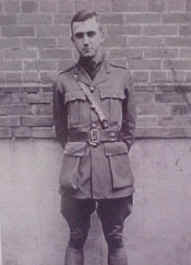
Lt. Henry Norman Bawden in an undated photograph. Source: CGWP site.
On October 4th, 1918 a diary entry lists a Lieutenant H.N. Bawden proceeding on leave.
October 1918 War Diary entry from the 18th Battalion War Diary showing an example of soldier entry with intitials.
In this example, searching for Lieutenant H.N. Bawden is relatively simple. Going to the LAC page simply enter in Bawden into the surname field and then in the Given names field enter in H*. The asterix acts as a search operator that requests any forename that has an H in it. From that search 3 database entries are found out of 19 found if only the surname is used to search.
We now have a high degree of confidence hit but one will notice 3 items from this screen shot. 1.) No date of birth, 2.) No rank, and 3.) No regimental number. This data missing is not of great concern but the majority of officers that were originally attested as officers are listed at the LAC site have the rank field filled in. Of note as will is that the images of H.N. Bawden’s attestation papers are missing but we do have a link to his digitized service records. This is good news as they can be examined in detail.
At this point a check is made at the CGWP site and we are further granted the opportunity to have another source confirm this soldiers participation in the 18th Battalion.
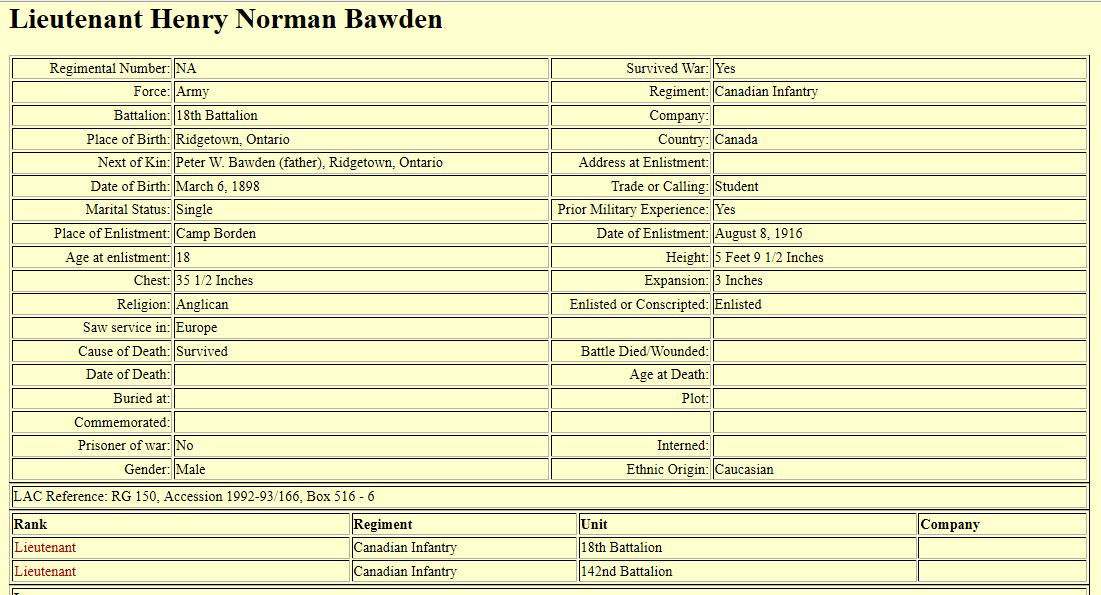
“Private” Henry Norman Bawden’s information page at the CGWP site. Of interest is the given rank of Private when there is almost a certainty that he was Lieutenant in the 18th Battalion.
Note that the data is incomplete because the attestation papers were probably not available at the time of data entry. This discovery generates activity by which the fields are filled out as completely as possible and the addition of updating and including the soldier’s rank as a Lieutenant.
We are also graced with Lieutenant Bawden’s digitized service records so a review of this document will give us more information. Using the attestation papers found herein the data set from the CGWP web site (image above) will be filled out as completely as possible.
After this is complete a general Google search for the soldier is made and, as in the case more with officers who served in the First World War with the C.E.F., some additional information is found.
30294-26 Henry Norman BAWDEN, 28, bond dealer, Ontario, 159 Lascelles Blvd., s/o Peter BAWDEN, b. Ont & Maud PORTE, married Madeline Louise COLWELL, 25, Ontario, 560 Pape Ave., d/o C.A. Edward COLWELL, b. Ont & Anna PILGRIM, witn: Lillian V. HAY of 40 Rose Park Dr & Gordon CAMPBELL of 31 Willcocks, 16 Oct 192
Lieutenant Henry Norman Bawden took six week’s officer’s training course at London, Ontario.
Lieutenant Henry Norman Bawden served as Supernumary with the 142nd. Battalion, leaving for England with a draft of officers August 18th, 1916, and proceeding to France October 26th, 1916, as Lieutenant with the 18th. Canadian Battalion.
So the picture of Lt. Bawden is firming up. He grew up in the Ridgetown area and served with the 142nd and 18th Battalions and upon his return from service in Europe he joined Osgoode Hall to study law.
Using Google to search just “Henry Norman” on Canadian site only brings forth several items of related information.
From Richmond Hill’s municipal web site this is found:
The Bawden Family (1942 to 2007)
The next family to own the property was the Bawden’s who purchased the property in
1942 from the Hilts. Harry Norman Bawden was a well-respected Toronto-based
financier and business man. Soon after purchasing the property, the Bawden’s had the
Hilts House renovated, and which became the family’s permanent residence. The
family used the property as a gentleman’s farm, and raised horses with the assistance
of a farm manger that lived in another small house on the property, which was
constructed by the Bawdens.
Over the course of the Bawden’s ownership the property underwent a series of physical
changes that resulted in the following:
• The removal of a number of smaller shed structures soon after the Bawden’s
purchased the property;
• The construction of the Long Barn (Building 3) in 1947-48;
• The construction of the Shed (Building 2), Root Cellar (Building 6) between 1946
and 1960;
• The addition of a north wing to the main house in the late 20th century ;
• The construction of the Farm Manager’s House (Building 1)
While the landscape surrounding the farm complex has matured substantially, the
character 01 the landscape and the physical/spatial relationship between
Note that the document lists the owner as a Harry Norman Bawden and the fore name is a nickname for Henry. A search for “Harry Norman Bawden” hits the jackpot.
Born in 1898, Harry Norman Bawden joined the 18th Canadian Battalion when he was eighteen. He fought and survived the battlefields of France, Germany and Vimy Ridge. After graduating with a Law Degree from Osgoode Hall in Toronto in 1923 he joined Dominion Securities Corporation, one of Canada’s largest investment banks. Schooled in the world of finance, largely during the Great Depression he eventually became the firm’s President and Chief Executive Officer. Throughout his career Harry Bawden held many prominent positions such as: Director of the War Finance Committee and was an active Board member of Molson’s Brewery Ltd, Dominion Foundries & Steel (2nd largest and most profitable steel company), Toronto Western Hospital, Maple Leaf Milling (large food conglomerate), and others. He maintained an active interest in the corporate and political affairs of the nation until he died in 1976.
Henry “Harry” Bawden in an updated photo. Source Bawden Capital web site.
From one entry comes all this information. Note that this is the exception to the rule. In most cases any private and commissioned soldier research for a combatant that survived the war will not garner such significant resources but from time-to-time a wealth of information can be found online. As have been stated previously in this blog the intent of this research is to focus on online resources only so the quality and quantity of information found online is very inconsistent.
Conclusions
Searching for soldiers that have surnames only without any other identifying information can be challenging. Persistence, further research, and other tools will help in this search but in the case of common surnames an initial search can be daunting.
Searching for soldiers with initials is often much easier and using wildcards (asterisks) and other tools will speed and facilitate the search.
Looking for clues and other information can lead to a real breakthrough.
Discover more from History of the 18th Battalion CEF, "The Fighting Eighteenth"
Subscribe to get the latest posts sent to your email.


![Obverse of a Membership card, The Fighting Eighteen [18th Battalion] Association, Niagara District Branch, n.d.](https://18thbattalioncef.blog/wp-content/uploads/2015/01/18th-bn-2.jpg)




 We now have a high degree of confidence hit but one will notice 3 items from this screen shot. 1.) No date of birth, 2.) No rank, and 3.) No regimental number. This data missing is not of great concern but the majority of officers that were originally attested as officers are listed at the LAC site have the rank field filled in. Of note as will is that the images of H.N. Bawden’s attestation papers are missing but we do have a link to his digitized service records. This is good news as they can be examined in detail.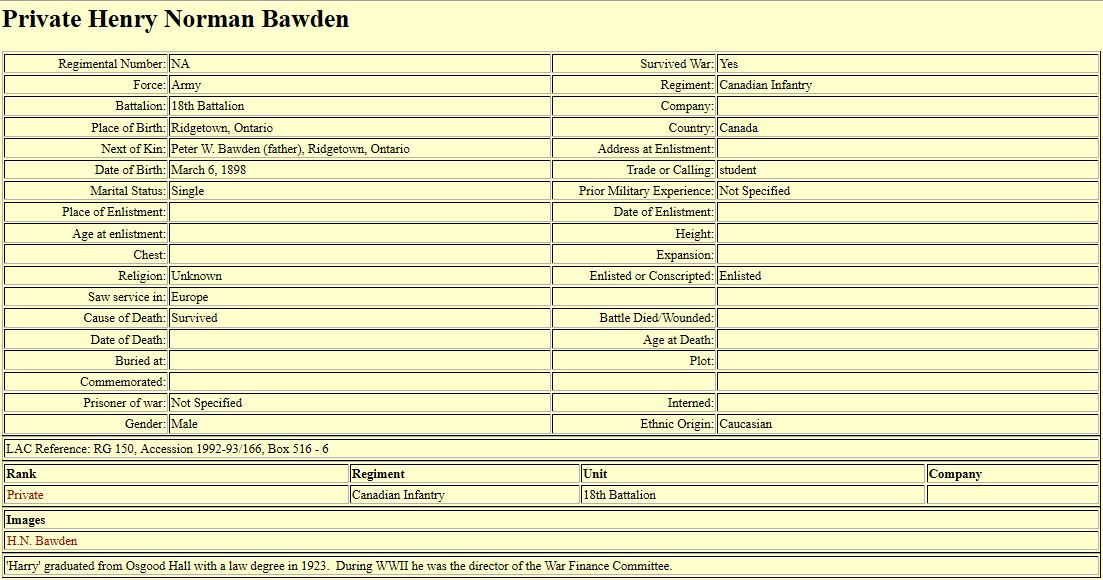


 History of the 18th Battalion CEF, "The Fighting Eighteenth"
I understand tha Part II orders survive for Canadian units. These should list all postings in and out of the unit