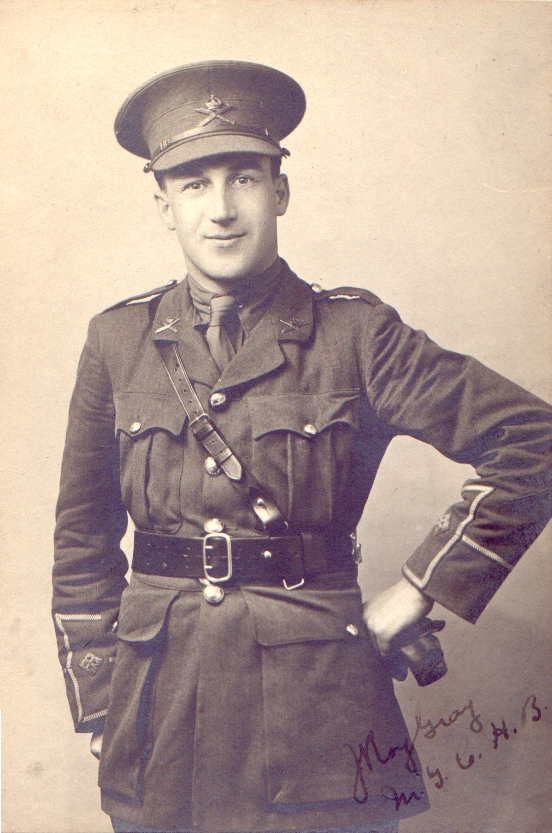
Letters to and from the Front give us a fascinating glimpse of the lives of the people that participated directly and indirectly with World War 1. Below is a letter from James Roy Gray that offers some insight into the experiences of a solider of the 18th Battalion and later as a member of the Tank Corp. The letter outlines Gray’s experiences as a Company machine-gunner during service at an observation or listening post in the front lines. He was still attached to the 18th Battalion at this time in the first letter. He later to transfer and serve in the Tank Corp.
James Roy Gray joined the C.E.F. with the 18th Battalion on November 2nd, 1914 in London, Ontario. It is interesting to note that his attestation paper was signed by a notary public and not in his own hand. The circumstances for this is currently unknown. He was a London, Ontario resident and he attended Queens University from 1907 – 10. His attestation papers list his “Trade or Calling” as a student.
The letter, from analysis of the April and May 18th Battalion War Diaries, appears to have been written before the 20th of May and it was probably sent to his mother and then transcribed and put in the London Free Press newspaper on the 20th. The war diary is not too helpful in determining the time and place of the events in the letter as they deal with the broader aspects of the Battalions activities (and often very briefly too) and it is possible the letter was written in late April 1916 or early May 1916 allowing for the time a letter would take to transit through the postal system and arrive in Canada. It could be concluded that the letter was published by the London Free Press on May 20th and the date the letter was written was some time previous.
Dear Mother
It is a beautiful day and quite quiet. I almost thought this morning that peace must have been signed or an armistice called. No shells, no rifle or machine gun fire, no aeroplanes. One is up now though and a few snipers are working. There goes a shell, one of Heinie’s, way over. Another, some place. The birds are singing quite cheerfully. More shells, all Heinie’s. He must be after a battery. I can hear our own guns firing, but they are not coming this way. Two wompers are in sight. I wish you could hear the different birdcalls and I wish too, that I could distinguish them. I hear a garage truck moving. Seems to be over across the line, but I can’t tell, the sound is so faint. Another wompers. I heard a cuckoo this morning early. It’s about 6 o’clock now, but the day breaks about 2:30. At that time I could see the German front line. Daren’t look now, though. In fact we hardly dare move here during the day. Another womper. Two of us are here with gun, ammunition, tripod, belt, filler and other paraphernalia, under two badly battered pieces of corrugated iron and a couple of trench mats, the latter covered with sand bags. Hope it doesn’t rain. It does look a little hazy though and there is a cool breeze blowing. That last womper was close. Shells going over to Fritzie. Sound leisurely, must be fairly large, 4.5’s likely. I can’t hear them burst. I heard that one, though. Sounds like Heinie’s, in our front line. Two whizzbangs for Fritzi’s front line. Two more, one died. Two more. Heinie’s wompers, our whizzbangs. There must be a reason for that, but it’s hard for the infantry to see it. I fully appreciate their attitude too. It isn’t much satisfaction when a big chap is pelting you with firecrackers to know that your big brother is shooting squibs at his little brother.
Some hours later. It’s over, thank God. Only lasted about five minutes. The first was the closest. I didn’t count them, but I think there were about 10 or 15. I’m not sure whether they were wompers or wooly bears, but I think they were the former. You should have seen us crouched under the trench mats. Some protection anyway. There is one advantage about a position like this. If they do smash it up, at least there is less chance of being buried alive. A strong position smashed up would be a death trap. There is one objection to this position though, besides the discomfort. If anything happened to us here no one would know it until night or if they did, they couldn’t reach us. However, I think this is our last day here. Stewart and Buckley relieve us tonight, and I expect the 6th with take over tomorrow night. Hope so, anyway. We’re supposed to be out resting now, but had to come in here to assist the 5th.
At it again. I wish they’d leave us alone. They have shaken this place two or three times and shrapnel has been falling on the roof. My pen is shaky. Seven so far. Hope it’s the bunch. I think it is. Fritz is getting his too. Here’s Heinie over to see the result of his shelling. He didn’t get much. Well, I like to see him waste them, but wish he’d waste them farther away.
Thanks for your parcels and thank Aunt Lily for the socks. Don’t understand what you mean about the tin boxes. It’s the only way. Any other way and the stuff comes crushed.
Love to grandma and all. I want to write the Rene.
Your loving son,
ROY
P.S. Front line, both sides being womped.
Source: London Free Press via Canadian Great War Project. Transcribed by Bob Logan
One particularly interesting reference is to the fact he is stationed with another man, ammunition, and a tripod. This may be a reference to his service in the Machine Gun Platoon of the 18th as both the Colt machine-gun and the Vickers machine-gun both used tripods when em-placed. The Lewis machine-gun using a bi-pod. It is possible that a transcription error introduced the word “tripod” into the letter but the reference to “belt” may indicate the belt feed method used by the Colt and Vickers in contrast to the pan style ammunition feed method of the Lewis gun. The Colt machine-gun was used early in the Canadian Expeditionary Force’s involvement in the conflict but were replaced by the Vickers machine-gun beginning in the summer of 1916.
There is evidence that Gray served in the 18th Battalion’s Machine-gun company it is likely that he was assigned to a Colt or Vickers machine-gun and since it was em-placed in the line it only needed to be served by 2 soldiers.
Later on in the letter he reflects on the advantages and disadvantages of the different types of trench fortifications and makes a comment: “There is one objection to this position though, besides the discomfort. If anything happened to us here no one would know it until night or if they did, they couldn’t reach us.” This indicates that they were located in a listening post which would have been located in front of the main line and in side No Man’s Land. It may not have been a trench sap, which was connected with the front line trench for access into No Man’s Land.
This information appears to be contrary to what one would think about the role of a machine gun being used in the main line of resistance as a defensive weapon but before Vimy in the latter part of 1916 new tactics using machine-guns came into play by the C.E.F.:
“Machine guns obviously had a role to play in defensive positions, and as the Canadian Corps moved to the base of Vimy Ridge in late-1916/early-1917, it was suggested that the weapon become the linchpin of the new trench works. By then defences were effectively divided into three zones: forward observation posts to warn of an enemy attack and otherwise keep an eye on no-man’s-land; a main defensive trench system to bring such an attack to a halt or from which to launch assaults of one’s own; and reserve trenches from which counterattacks could be sent forward should the enemy succeed in capturing Canadian positions. Machine guns could obviously be very useful in the main defensive areas, but they might also serve further ahead, giving forward observers, who were necessarily few in number, increased fire power with which to defend themselves.”
Source: Technology in Search of a Role: The Machine Gun and the CEF in the First World War
The letter is a fascinating read and appears to be an almost stream of consciousness written reflection of this soldiers service in a listening post while he was on active duty. It certainly makes sense as he would be on duty from sunrise to sunset forward of the main line and trading off sentry duty with the other man assigned to the listening post with him. As he states: “In fact we hardly dare move here during the day.”
Some of the slang terminology describing the artillery is unfamiliar. The description of “wompers” and “wooly bears” appears to refer to two different calibers of German artillery and were not as well-known as the term “whizzbangs” but the use of words that expressively describe the type of artillery being seen or heard reflect the soldiers’ attempt to classify the hazards experienced during combat.
The content of the letter gives a fascinating look into the Canadian infantry man’s role and the activity present for soldiers on active service in an observation or listening post in the front line. An illuminating letter for us now but not very reassuring for his mother, Mrs. Margaret (Westland) Gray knowing that her son was actually in the line, on active duty, while writing her.
Gray’s next letter appears to be published in the London Free Press on December 30. 1917. He has served 7 months in the Tank Corp indicating he left the 18th Battalion early spring of 1917, possibly before the attack in Vimy Ridge. The letter is more reflective and thoughtful and impresses on the reader an almost palpable weariness and a feeling that the war will be unending:
“Despite even greater disappointments and tragedies, though I see friend after friend go west to the land of eternal peace, among the most recent being two who were entitled to wear the 1914 ribbon, though I do not know when my time may come, remembering the story of the pitcher which went too often to the fountain, the will is still to carry on, for unless we carry through our enterprise to triumphant issue then Leslie, Mervyn and the growing lads of today will have to don, in their turn, the uniform of the King and became the soldiers of tomorrow.”
One gets the sense that Gray has had enough of war but the jingoism of the time – the affirmation of eventual victory – remains resonant in his words.
Letter from James Roy Gray, with the Imperial Army Tank Corps C.E.F., to his mother, Margaret (Westland) Gray dated Dec 30, 1917 from somewhere in France.
For the past seven months Lieutenant Gray has been in the most exciting branch of the Imperial service, the Tanks, commanding one of the land battleships, which have struck terror into German hearts by their uncanny abilities to break through all obstacles. His service has been exciting but, as he says himself, it will be a closed book until after the war, the military rules of silence interposing a solid wall between the stories which Lieut. Gray promises to reveal and what can be said in letters.
Service of a year in the Ypes salient stands to the credit of Lieut. Gray. He enlisted here with the 18th Battalion, and went overseas with the famous fighting unit. After promotions to non-coms rank in the 18th he was offered, and accepted, a commission in the Imperial service, and then volunteered for the “tanks” service. That was seven months ago. He is still commanding a “boat”
Letter
You want to know where I am and with whom, but of course it is impossible to give you even a rough idea, as we are G.H.Q. troops, and may be used anywhere. In fact, in the last seven months we have been practically from end to end of the line.
I have not had any mail for two weeks. I must now give up hope of one batch of mail, as it is evident another has gone down. It is disappointing very. Despite even greater disappointments and tragedies, though I see friend after friend go west to the land of eternal peace, among the most recent being two who were entitled to wear the 1914 ribbon, though I do not know when my time may come, remembering the story of the pitcher which went too often to the fountain, the will is still to carry on, for unless we carry through our enterprise to triumphant issue then Leslie, Mervyn and the growing lads of today will have to don, in their turn, the uniform of the King and became the soldiers of tomorrow.
My New Year’s wish then to you and daddie, to all my relations and friends, and to all engaged with us in our great task, is that you may all receive the grace of fortitude to withstand trouble and to carry on cheerfully till victory is ours. We, over here, know that you at home are bearing the heaviest burdens of sorrow and suspense, and we wish you to be happy, as we are, who live from one day to the next, and throw care to the winds.
At present, and for some time to come, we are fairly comfortable and perfectly safe, and are enjoying the Christmas season to the best of our ability. I am in a rough cubicle for two, in a large wooden hut, with an improvised stove, table, beds, seats, washstand, and cupboards. My roommate has just left me for a few weeks so I occupy the mansion alone.
Yours cheerily,
ROY
Captain James Roy Gray survived the war. He died of illness in England on February 18, 1919.
Discover more from History of the 18th Battalion CEF, "The Fighting Eighteenth"
Subscribe to get the latest posts sent to your email.
 History of the 18th Battalion CEF, "The Fighting Eighteenth"
Leave a comment