
Private Arthur Wilfred Hardcastle of Chatham, Ontario, lost part of his right leg on August 28, 1918 at an action at the Sensee River.
The Battalion was located on the Sensee River Line and was involved in an attack on this date. This was a particularly hard day for the 18th Battalion as the War Diary relates:
Zero hour for this days [sic] operation was set for 12.30 noon. Bn. was in support of the 20th Bn. Heavy casualties were suffered in the advance to the slope of the SENSEE RIVER, machine guns nests and wire in the German line being equally heavy. Capt. Mackedie was shot through the head and instantly killed while rushing a German gun post. Lieut. Cole shot through the eye, was afterwards found dead. Major Graham and Lts. Lawrence, Donaldson and Krug were wounded. Under terrific fire the Bn. was compelled to temporarily withdraw and take up a line in the sunken roads fronting the German wire East of the SENSEE RIVER. 52 O.R.s [other ranks] arrived as reif. [reinforcments] 3 O.R.s on leave. approx. casualties all ranks. 10 killed & 70 wounded.
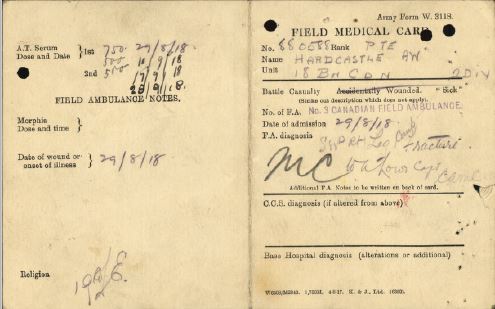
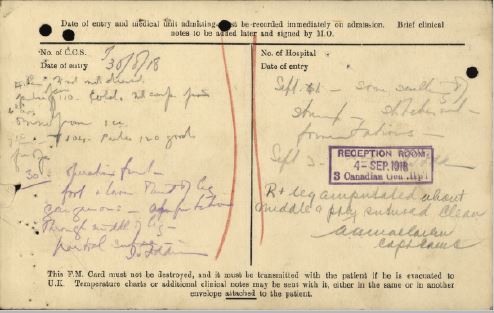
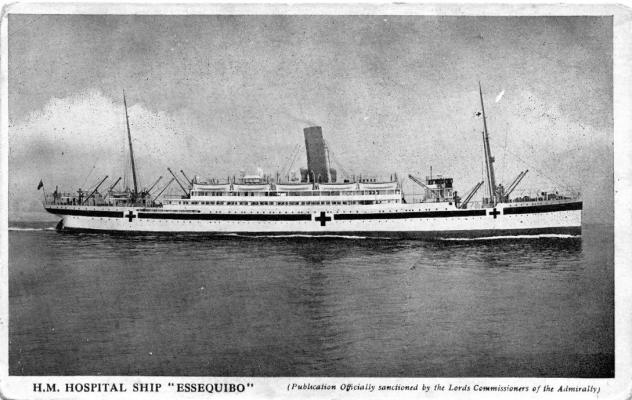
From this action Private Hardcastle was wounded and sent to the No. 3 Canadian Field Ambulance where “FIELD MEDICAL CARD” indicates a shrapnel wound to the right leg, compound fracture. He is administered with anti-tetanus serum and notations are made regarding his pulse and the status of his wound. He is eventually invalided to England and then is transported by the hospital ship H.S. Essequibo from June 10 to the 21st and landed Portland, Maine that date and finally arrived at hospital in London, Ontario where he must have had enough of being under the care of the military and in hospital as he was absent without leave from December 29th, 1919 to the 4th of January, 1920. He was officially admonished and forfeited 7 day’s pay.
The problem was that Private Hardcastle did not only have a physical wound. He was suffering from PTSD. In what is probably the last documents written about his condition it says:
Condition when finally boarded for discharge.
D.C.H. Jan, 19, 1920
#880588 – Pte. Hardcastle, Arthur
- [Subjective]: On Aug. 28, 1918 received shrapnel wound on right leg, causing computer comminuted fracture of the lower third Tibia. Amputation with partial suture on August 30, 1918 in middle third of Tibia and Fibule. Reamputation and flap suture on Nov. 30, 1918. Wound healed without further complications.
- Blown up by shell Nov. 11, 1917 at Paschaendale [sic]. Suffered severe shock. Unable to speak more than a few words for a day or so. Stammering has persisted ever since
- Objective: Right Leg amputated below the knee leaving 3-1/2 inch stump. Flare are lateral. Amputation scar healed, not adherent. End of bones prominent, with a scent pad over them. Movement of stump is full. He has been supplied with satisfactory peg and artificial leg.
- Specialist report attached: Report of Maj. Boyer C.A.M.C., 15-1-20 – “This man has an justipratory [sic] “tic” which is not a disability at all in the majority of his conversation. He denies speech difficulties as a child. He will be in a much better position to master this condition when he gets his discharge and civil life affairs take on a more concrete form. I would recommend his discharge and that he be made an out-patient with the S.C.R. to join a class in breathing and chest exercises which will in my opinion master his difficulty providing he sincerely works at it.” (Sgd.) L.R.R.
Trench feet Nov. 1917 to Feb. 1918. Recovered.
This report is typical. It focuses on the physical and diminishes the psychological aspects of this soldier’s wounds. The statement “He will be in a much better position to master tis condition when he gets his discharge and civil affairs take a more concrete form,” and the subsequent recommendation for “breathing and chest exercises” to address Private Hardcastle’s stammer illustrates how ill-equipped the medical establishment was in dealing with the psychological outcomes and results of wounding.
Private Hardcastle returned to war after he was “blown up buy shell…” and served faithfully until his wounding without any other indications in his service records of any other infractions, save for that in December 1919 Absent Without Leave notation, more than a year after his wounding at the Sensee River. He was finally discharged “medically unfit” on January 28, 1920.
Private Hardcastle’s Service Record
Note: Post amended to reflect the correct location of Private Hardcastle’s wounding resulting in the loss of his leg. Thanks to Patrick Dennis for pointing out the error.
Discover more from History of the 18th Battalion CEF, "The Fighting Eighteenth"
Subscribe to get the latest posts sent to your email.
 History of the 18th Battalion CEF, "The Fighting Eighteenth"
Eric, this is a very interesting piece, but Pte Hardcastle did not receive his leg wound at “Passchendaele” as you note in the opening paragraph, but rather on the Sensee in the Battle of Arras 1918. His shell shock was first evidenced at Passcendaele. As an aside, my grandfather, Hilaire Dennis, was also among the 70 wounded that day. Cheers, Patrick
Thanks Patrick. I will amend my post accordingly!