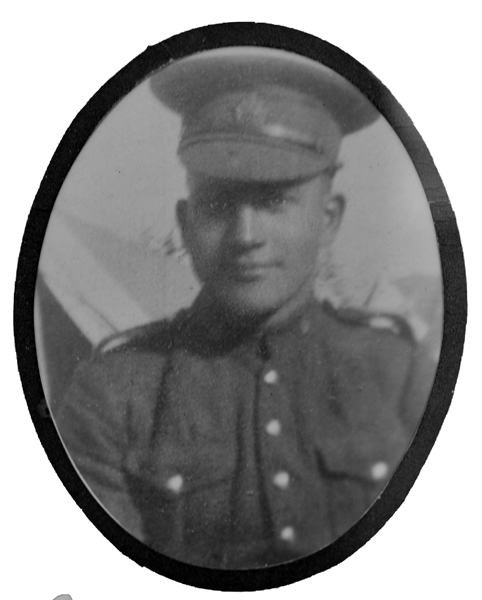
Re-examining the Pantall/Symonds File
This is a post expanding on and correcting a previous post in order to expand on that post and correct some of the initial conclusions made in that post.
Summary
Private Bernard (possibly Barnard) Pantall of the Royal Canadian Regiment was discharged and re-enlisted using his cousin, George Symonds’, identity. He was subsequently killed in action during the attack on Vimy Ridge and at sometime after this his identity the use of an alias was discovered.
The Reason for Re-Examining Pantall/Symonds
During a recent interaction at the Canadian Expeditionary Force Study Group (CEFSG) regarding the Zivy Crater[i], Thelus[ii] near Arras regarding the burial of Canadian soldiers at the crater I happened to read about the case of the two 18th Battalion soldiers buried there that they both joined the C.E.F. under an alias. I was aware of both Privates Lieb/Leary and Pantall/Symonds and had written previously about Private Pantall and his involvement in the 18th Battalion.
During a response made to that post I came to the realization that my original research was wrong. In the hurry to put pen to paper and due to inexperience the original post does not reflect accurately the circumstances of Pantall’s involvement in the 18th Battalion and this post hopes to correct the errors, expand on some ideas, and offer some “facts” in an effort to correct the first post. But this post will not be able to shed as much light on the actual course of events leading to Pantall taking the place of his cousin in the C.E.F. until more research is done.
Comparison of Physical Characteristics From Parchment (Pantall) and Attestation Documents (Symonds/Pantall)
| Parchment Certificate | Attestation Papers | |
| Date of Document | 27 July, 1915 | 4 August 1915 |
| Unit | Royal Canadian Regiment | 33rd Overseas Battalion |
| Place of Birth | Birmingham, England | Birmingham, England |
| Date of Birth | Est. May 1893 | 28 June, 1894 |
| Trade or Calling | Labourer | Labourer |
| Physical Descriptors | ||
| Height | 5”8.5” | 5’9.5” |
| Eyes | Brown | Brown (hard to read) |
| Complexion | Fair | Fair |
| Hair | Lt. Brown | Dark Brown |
| Marks or Scars | Scar from operation for appendicitis. | Appendicitis scar. Tattoo on right arm (Eagle). Left arm (Friendship) |
Initial Indication of Alias
During research into the casualty Private Pantall from a reference at the Regimental Rouge web site the Canadian Virtual War Memorial page had an picture from J. Stephens of the inscription in stone at Zivy Crater that read”
“401335 Private B. Pantall Served as G. SYMONDS 18th BN CANADIAN INF 9th APRIL 1917 AGE 21”

This was the first confirmed case of an alias being used to join the C.E.F. found during the research of the 18th Battalion by this blogger.
Where the Research Went Wrong
Error No. 1
Attached to an image posted at the Canadian Virtual War Memorial was a copy of Private Pantall’s “Parchment Certificate of Discharge” were electronically added inscription (in red text) stating “Wounded in France. Discharged July 27, 1915” led to my supposition that Private Pantall was serving with the Royal Canadian Regiment (R.C.R.) in France at the time of his discharge. This is, most probably, incorrect. The document shows that his discharge was signed in Prospect, Bermuda. The R.C.R. served in Bermuda from September 1914 to August 1915.[iii] As the R.C.R. did not move to France until it increased its complement to full battalion strength in Canada in the fall of 1915.

Therefore, it appears impossible for Private Pantall to be serving in the R.C.R. in France at the time of his discharge.
Error No. 2
An article at InsideHalton.com[iv] further led to more confusion. The article is brief and has a number of errors that were misinterpreted as factual at the time:
“He joined the Royal Canadian Infantry (Western Ontario Regiment), 18th Battalion December 1913.”:
- Pantall joined the Royal Canadian Regiment in December 1913.
- The R.C.R. is a regiment in itself and cannot belong to another regiment.
- The 18th Battalion was part of the Western Ontario Regiment during World War 1.
“His unit fought in the horrific battles in France where he was wounded and later discharged in July 1915 then sent back to Canada.”
- As a member of the R.C.R. he was most likely stationed in Bermuda during its stay there from September 1914 to August 1915. Therefore, he could not have participated in the battles in France until he joined the C.E.F as Private Symonds.
- His discharge document only states: “…in consequence of Being no longer physically fit for war service.” It does not state the nature or cause of this lack of fitness leading to his discharge.
- It cannot be determined the movements of Private Pantall at this time as to his location and timeline vis-à-vis his location in Bermuda and transportation to Canada to London, Ontario.
From these descriptions in the story related by the family member it seemed to corroborate the information on the image at the C.V.W.M. site. As the story is being related over a span of time from one family member to the other there is a chance that “word-of-mouth” relation of facts is further adding noise to the information.
For example, Zivy Crater was a mine crater used to bury Canadian and other Commonwealth soldiers that died on April 9, 1917 and was a crater that existed before the action at Vimy on that date. The story states that Private Pantall died in: “An explosive blast obliterated [that] Bernard’s unit…”
This is contrary to the Circumstances of Death Register for Private Pantall which states: “He was killed by an enemy shell before reaching the first objective at Vimy Ridge.” There is no mention of a mine explosion and there is none in the War Diary on that date.

Further, another article from the Guelph Mercury entitled “Vimy losses include soldier who returned with a new name”[v] relates a similar circumstance:
“… He was with Canadian soldiers stationed in Bermuda in 1914, and in 1915 Pantall was sent to France where he was wounded in action. Many wounded soldiers were sent back to the trenches after recovery, but Pantall’s injuries were serious enough that in July 1915, he was discharged from the army “in consequence of being no longer physically fit for war service.”
Pantall was shipped back to Canada. But he didn’t agree with the doctors, and he evidently healed quickly. In August 1915, Pantall went to the recruiting station in London with identification papers he’d borrowed from a cousin, and signed up as George Symonds. For next of kin, he named Gertrude, who by now was married to Louis Cooper, of Guelph. Bernard Pantall, alias George Symonds, was soon on his way back to the war, and his destiny at Vimy Ridge.”
Bold text mine.
This article reinforced the conclusion made in this blog’s original post. In addition, it expanded on the idea that Pantall served in France the became injured, returned to Canada and re-enlisted. All in the space of 9 days! Though there are many instances of Canadian soldiers being wounded and returning to duty, in general, once they were shipped to England for treatment and recuperation the timeline was much longer than 9 days and could extend into many months. The Guelph Mercury article’s conclusions do not seem reasonable, possible, or even probable.
With this information the original post related circumstances that were not accurate and the conclusions were not a reflection of what may have actually happened.
Bringing the Research Back on Track
With the establishment of the possibility that Pantall did not serve in France until he rejoined the C.E.F. derived from the “Parchment Certificate” and eventual transfer to the 18th Battalion in the guise of his cousin George Symonds and this transfer being confirmed by the Circumstances of Death Register and that of the C.W.G.C. site, a clearer picture of the timeline of this unique situation can be made.
Without an examination of the service records of Private Pantall’s service with the R.C.R. and his subsequent discharge as well as his service records as Private “Symonds” the information that can be surmised is the following:
- That Private Barnard/Bernard Pantall served with the R.C.R. and was discharged from that Regiment on 27th of July, 1915.
- That his cousin possibly resided in Guelph, Ontario and Pantall joined in London, Ontario. This is curious as he attested with the R.C.R. in London, Ontario in 1913 when he first joined the Canadian Army so there was a risk that he would have been discovered in London when he enlisted as Symonds.
- That he took the place of his cousin, George Symonds, and joined the 33rd Overseas Battalion by being attested on London, Ontario on 4th of August, 1915.
- That he served as “George Symonds” until his death with the 18th Battalion and through some manner the information of his actions was revealed or discovered.
- That the official records of the Library and Archives Canada, the C.V.W.M., and the C.W.G.C. reflect the use of the alias and recognizes the sacrifice made by Private Pantall.
What cannot be determined without further research is the exact timeline of Private Pantall’s journey from the R.C.R. to the 18th Battalion under the guise of his cousin, George Symonds. In fact, the re-examination of this soldier’s experience raises some interesting questions.
The Questions
- As there was no Conscription Act in force at this time what motivation would Pantall have for taking the place of his cousin?
- Was there any motivation for George Symonds? Was he even aware that his identity had been taken? As Pantall had listed his sister as his next of kin, according to the Guelph Mercury story, as his sister this is curious as it is unclear as to the connection between his sister and George Symonds. Was George Symonds the son of Gertrude or a sister through marriage or blood relation?
- If Pantall’s level of fitness low enough to lead to e discharged from the R.C.R. how did it improve or be masked so he could enlist later in London, Ontario?
- If this was the case, how did his fitness level change from being unacceptable in Bermuda to being acceptable to the recruiting administration in London, Ontario?
- What was the time-line from his discharge to his enlistment? The document confirming his discharge was signed on 27th of July, 1915 but that does not mean that Private Pantall was in Bermuda on or before this date. This would have allowed him 9 days to transit from Bermuda to London, Ontario to effect this plan.
- What did George Symonds do during the war? As he was “serving” with the C.E.F., assuming he was part of the subterfuge, he physically could not be present as himself in any normal societal context. If he was not aware of Pantall’s actions this would make sense that he could continue to reside and live in Canada without interference from the military authorities.
Answers
Not until we can review the service records of Pantall in the R.C.R. and in the 18th Battalion can this mystery be possibly unraveled. The stories in the InsideHalton and Guelph Mercury articles do not, in my opinion, reflect the actual events accurately, and though a solid alternative theory cannot be posited at this time the main areas of confusion is Pantall’s location when he was discharged and the subsequent relating of his story. There is no doubt he served and made the ultimate sacrifice. His situation is certainly unique and it would do him service to determine with some accuracy the circumstances of his service.
As the records shows that the R.C.R. was in Bermuda at this time and Pantall’s discharge document corroborate this scenario I would contend that Pantall served in Bermuda; was released from the Permanent Force as unfit; used the opportunity to rejoin the C.E.F. and served with it eventually being assigned to the 18th Battalion until he was killed in action during the attack on Vimy Ridge on April 9, 1917.
It will be fascinating to find out more as this information comes to light.
[i] Zivy Crater is located west of Arras, France near Vimy and is a former mine crater used as a mass grave for 53 soldiers of Commonwealth and UK forces.
[ii] http://www.cefresearch.ca/phpBB3/viewtopic.php?f=39&t=13586
[iii] http://thercr.ca/main/index.php/regimental-history/27-regimental-history/1914-1919/179-on-to-bermuda
[iv] 2016, Remembering Our World at War; InsideHalton.com; http://www.insidehalton.com/opinion-story/4732232-remembering-our-world-at-war/ ; Published 01/01/2014; accessed 02/22/2016.
[v] Vimy losses include soldier who returned with new name; Guelphmercury.com; http://www.guelphmercury.com/news-story/5242322-vimy-losses-include-soldier-who-returned-with-new-name/ ; Published 01/05/2015; accessed 02/22/2016.
Discover more from History of the 18th Battalion CEF, "The Fighting Eighteenth"
Subscribe to get the latest posts sent to your email.
 History of the 18th Battalion CEF, "The Fighting Eighteenth"
Leave a comment