On March 12, 1917 in Wallaceburg, Ontario a 19-year-old man by the name of Herbert Royal Herbert, reg. no. 2334321 joined the Canadian Army. He had a dark complexion with dark hair and eyes. He was a glass worker, a unique trade of calling and perhaps he worked at the Dominion Glass Company factory in Wallaceburg.[i].

Just over 2 months later, after a trans-Atlantic voyage from Halifax to Liverpool on the S.S. Justica Private Herbert was were he was assigned first to the Canadian Cyclist Company (30/06/17) and thence to the 4th Reserve Battalion on the same day for training and preparation for his service on the Continent. He then embarked for the Continent and arrived at the Canadian Corps Reinforcement Camp, Etaples, France October 10, 1917 where he was stationed for exactly 2 months when his service with the 18th Battalion began.
Private Herbert served with the 18th Battalion during which he “buried and wounded slightly Nov. 6th. 17”[ii] until January 16th, 1918 when he was moved to the No. 2 Canadian Field Ambulance for treatment of “synovitis of the knee”.
His medical record (attached below) is an interesting comment on his treatment and indicates some of the concerns and fears of medical officers. Of note is the following notation made October 6, 1918: “Strong x self instinct. Many socialistic tendencies. Thinks Officers get their commissions through pulls.”

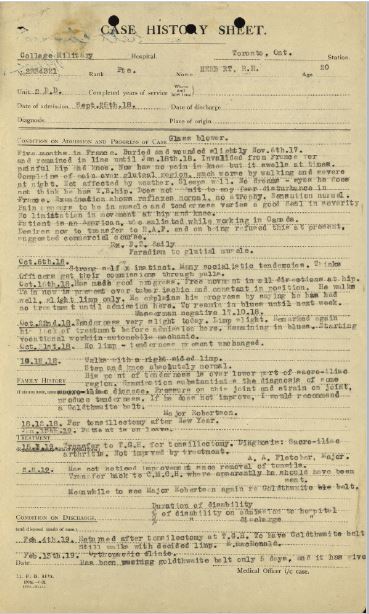
This entry, given the recent international events globally, alludes to a concern about the radicalization of the returning Canadian soldiers from the war to an economy that may not be able to adequately absorb them into a soon to be peace-time economy. The Vancouver General Strike[iii] on August 2nd, 1918 was emblematic with the increasing social and political frustration with the social and economic issues during the First World War in Canada. For example, the cost of living in Canada had risen 75% from 1914 to May 1919, yet wages had only increased 18%.[iv]
It is curious to note the medical officer reporting specifically makes a notation regarding Private Herbert’s “socialistic tendencies” and it would be interesting to know and understand in what form they took during the examination and interview with the Private. There is almost a tone of pique as the medical officer reports that Private Herbert thinks that officers obtain their commission by “pulls” indicating that Private Herbert felt that officers (perhaps including the one examining him) did not earn their commissions through training, experience, and merit but from influence. This appears to be a recognition of class-ism and its role in the Canadian military at the time and perhaps Private Herbert’s expression of these ideas were unusual for the medical officer to hear which led to it being notated in the medical records.
It is unique in all the service records reviewed and examined to date from the members of the 18th Battalion to have an officer make such a statement about a soldier’s political orientation but it may indicate a growing realization by Canadians that the world of before the war in Canada was not going to be. The post-war era would never be the same. Revolution, nationalism, social changes for women and labour, and other factors were beginning to populate the consciousness of Canadians as the war started to wind down. The last “100 Days” of the war were in process and the end of the war was in sight.
The concern for left leaning political movements was one of those issues. The Russian Revolution had come to a climax only a year earlier with the dissolution of the Provisional Government with the Russian Soviets and the subsequent Civil War in Russia as each faction (left and right wing) fought to consolidate power after the vacuum left by the destruction of the Russian monarchy and its replacement, the Provisional Government and the Soviets.
In the background events that would effect the German Imperial Navy in October and November 1918 that would lead to mutiny and then a revolt of naval personnel would become the back drop to the fears and concerns of many as the First World War wound down releasing thousands of trained soldiers into a peace-time society.
Examining the medical record in detail the record is appears not only to be a record of physical symptoms but the medical officer(s) seems to be assessing the psychological make up of Private Herbert. The undated entry[v] before October 6th is peppered with references that allude to the mental make-up of Private Herbert: “Sleeps well. No dreams… Does not admit to any fear disturbance [allusion to shell shock?] in France. Patient is an American who enlisted in Canada. Desires now to transfer to the R.A.F. and on being refused this at present, suggested a commercial course.”
It is interesting to make note of the statement: “Patient is an American who enlisted in Canada.” Private Herbert had indicated on his Attestation Papers that he was born in Wallaceburg, Ontario and not in the United States though his service record shows several connections to the United States. In an undated record entry his current address is listed as 2935 National Avenue, Detroit, Michigan and his mother’s address is in Detroit at the time of his enlistment. Yet his assigned pay as of October 1917 is directed to Box 420, Wallaceburg, Ontario.
Private Herbert’s expression of interest in transferring to the R.A.F. is problematic from a practical stand point as he was no longer in the European Theater but in Canada. With the war winding down coupled with his geographic dislocation from the center of the war, and his medical condition, which ultimately led to his demobilization, such an expectation does not appear to be realistic.
It is also interesting to note that the summary of his “Medical History of an Invalid”. His condition is identified as “Partial loss of function of right leg, due to Rt. sacro-iliac arthritis.” One of the treatments attempted to resolve this was the removal of Private Herbert’s tonsils. Which, by today’s standards, would be a wholly inappropriate surgery for the condition ascribed to Private Herbert.
Private Herbert’s service experience leads to more questions than answers. He appears on enlistment to be Canadian born glass blower, possibly working in the glass industry in Wallaceburg.. He serves overseas and is wounded and repatriated to Canada for medical treatment where the doctors treating this veteran allude through his medical records in their reports that he has socialistic tendencies and these tendencies cannot be attributed to any war related experience, such a shell shock. Private Herbert appears to reclaim his identity by identifying himself as an American even though aspects of his service record contradict this.
The last record of him, as far as his service record is concerned, is a record of his death in a Veterans Affairs Death Notification. A Roy Herbert from Detroit, Michigan reported on the death of Private Herbert who passed away on May 2nd, 1972.
[i] Page 19, “Settlement on the Sydenham”, accessed via http://images.ourontario.ca/Partners/CKPL/CKPL0027491681T.PDF
[ii] Service Record referenced from the Internet at http://central.bac-lac.gc.ca/.item/?op=pdf&app=CEF&id=B4225-S011
[iii] Vancouver General Strike
[iv] Communism and Socialism in Canada. By: Allison Dyer, Twinkle Halvadia, Ralisha Sritharan and Gamini Mohandas.
[v] Possibly the report was entered in on admission to the College Military Hospital on September 25th, 1918.
Discover more from History of the 18th Battalion CEF, "The Fighting Eighteenth"
Subscribe to get the latest posts sent to your email.
 History of the 18th Battalion CEF, "The Fighting Eighteenth"
Leave a comment