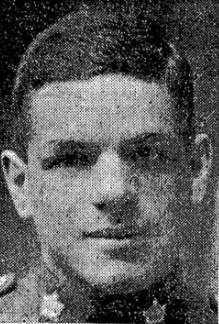
On the 7th of May, 1915 in London, Ontario a young 21 year old Herman Aitken, reg. no. 112168 enlisted in the Canadian Expeditionary Force with the 7th Canadian Mounted Rifles.
In England he was attached to the Fort Garry Horse on January 2, 1916 and transferred to the Continent to join that unit. It appears that this move was not to his liking as witnessed by the following charges in his service record:
25.3.16
In the Field3 days F.P. [field punishment] No 2. (1) Late on parade. (2) Answering back to Officer when checked up for same,
The Fort Garry Horse seems to have had enough of Private Aitken so three days later he is transferred to the “Line Machine Gun Squadron” where three months later he ran into two other disciplinary infractions:
20.5.16
In the FieldSent to 3 days F.P. 2 for insolence today [towards an] N.C.O. [non-commissioned officer].
24.5.16
In the FieldSent to 3 days F.P. 2 conduct prejudicial to good order and discipline. Swearing in parade.
29.5.16
In the FieldSent to 3 days F.P. 2 for conduct to the prejudice of good order and military discipline in that he was expressing in very forcible language his opinion of this unit.
Five months later the Private Aitken was transferred from the Machine Gun Squadron to the 18th Battalion on October 21, 1916 and his service records show that he served without further disciplinary problems until he was killed in action on May 9, 1917.
From these events it appears that Private Aitken was not a model soldier with the units prior to joining the 18th Battalion and a news article in the London Free Press expands on his character, as it was known by his family and friends before his service in the army and gives an idea of the man:
CORPORAL AITKEN, SON OF FIRE CHIEF, DIES FOR EMPIRE
Well-Know Young Londoner Gave His Life for His Country in France
Another of London’s boys has made the supreme sacrifice in the cause of humanity and liberty in the person of Corp. Herman Aitken [Note that the news story erroneously states his rank a Corporal.], of the 18th Battalion, who, according to the official word received on Sunday afternoon by his parents, Chief and Mrs. John Aitken, 170 Bruce street, was killed in action May 9 [1917]. Corp. Aitken enlisted as a Private in the 2nd Divisional Calvary unit raised under the command of Lieut-Col. Ibbotson Leonard and went to England and later France with that unit, but in France he was transferred to the 18th Battalion, which unit he was serving at the time of his death. He was made corporal in the trenches.
From the last letter received by Chief Aitken, written on April 18, it would appear that Corp. Aitken had returned to the trenches from the rest camp only a few days before he met a hero’s fate. In the letter Corp. Aitken says, “You would be glad to know that I have passed through safely so far.” And so far as his parents know he never suffered any sickness in his nearly two years of service.
Besides his parents, Corp. Aitken is survived by three brothers, Pte. Arthur Aitken, of the 241st Battalion (Kilties), not in England; John, of the Grand Trunk Railroad; and George, of the city fire department, and four sisters, Bessie, Irene, Evelyn and Hazel, all at home.
Corp. Aitken was born in London and educated in the public schools and, although he passed his entrance examination, he did not go the the Collegiate Institute. He was a well-known hockey player and was playing with the Western University team when the won the N.H.L. championship in 1914.
The death of their hero son was a terrible blow Chief and Mrs. Aitken. The latter for a time was prostrated, but the chief, who has many times faced death in his capacity as a fireman, concealed his grief. Herman Aitken was a young man of whom any mother might be proud. He was loving and kind to all, and was the soul of fair play in the sports he took part in.
When the members of the Irish Benevolent Society heard the sad news, their condolences and sincere sympathy poured into the bereaved couple. Chief Aitken has for many years been a prominent worker in the society, and his hear is chairman of the committee.
Mayor Stevenson and other prominent Londoners also expressed their deepest sorrow at the early death of this heroic young Canadian.
Source: Possibly London Free Press. Circa Mid-May 1917.
Private Aitken’s death by shellfire is commemorated on the Vimy Memorial as there was no known grave.
Discover more from History of the 18th Battalion CEF, "The Fighting Eighteenth"
Subscribe to get the latest posts sent to your email.
 History of the 18th Battalion CEF, "The Fighting Eighteenth"
Leave a comment