The understanding of what we would not call PTSD during the First World War was minimal and fraught with a range of mostly inappropriate connotations about a person’s mental and moral upbringing. Many of this blog’s posts reference shell shock and one may find this article from the Daily Telegraph recorded in the June 5, 1915 edition interesting.
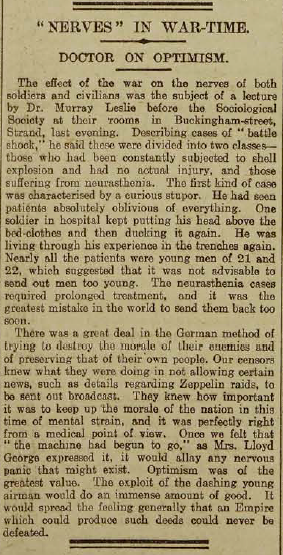
NERVES IN WAR-TIME.
DOCTOR ON OPTIMISM
The effect of the war on the nerves of both soldiers and civilians was the subject to a lecture by Dr. Murray Leslie before the Sociological Society at their rooms in Buckingham-street, Strand, last evening. Describing cases of “battle shock,” he said these were divided into two classes — those who had been constantly subjected to shell explosion and had not actual injury, and those suffering from neurasthenia. The first kind of case was characterised by a curious stupor. He had seen patients absolutely oblivious of everything. One soldier in hospital kept putting his head above the bed-clothes and then ducking it again. He was living through his experience in the trenches again. Nearly all the patients were young men of 21 and 22, which suggested that it was not advisable to send out men too young. The neurasthenia cases required prolonged treatment, and it was the greatest mistake in the world to send them back too soon.
There was a great deal in the German method of trying to destroy the morale of their enemies and of preserving that of their own people. Our censors knew what they were doing in not allowing certain news, such as details regarding Zeppeplin raids, to be sound out broadcast. They knew how important it was to keep up the morale of the nation in this time of mental strain, and it was perfectly right from a medical point of view. Once we felt that “the machine had begun to go,” as Mrs. Lloyd George expressed it, it would allay any nervous panic that might exist. Optimism was of the greatest value. The exploit of the dashing young airman would do an immense amount of good. It would spread the feeling generally that an Empire which could produce such deeds could never be defeated.
The article is illustrative of the concern a medical condition that was sapping the resources of the medical facilities of the Allied armies. The numbers for the Canadian Army indicate that 10,000 soldiers suffered from identified “shell shock” but that number probably under reports the condition given its implications to a soldier and his life. The earlies record of a potential shell shock case with the 18th Battalion may have been Lieutenant F.G. Newton. The Medical Officer’s War Diary notes on October 2, 1915: Lieut. F. G. Newton in a shocking condition as a result of [‘nerves’?] + sent to hospital. Lieutenant Newton was to return to service and this case illustrates the impact the scale of mechanized war had on the soldiers fighting it.
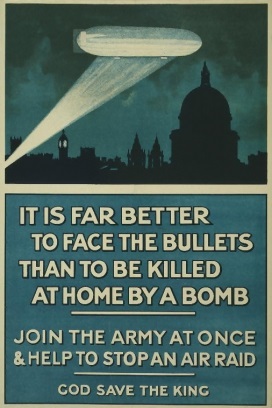
The reference to “civilians” clearly delineates the change in the perception of the fighting and how new weapons and tactics impacted the morale and war experience of a civilian population. The German Navy had attacked Scarborough, Hartlepool and Whitby in December 1914 and had extended their attack using strategic airpower with Zeppelin raids that had been approved by the Kaiser in January 1915 with the first raid being effected the night of January 19/20, 1915.[i]
The reference to neurasthenia indicates the state of medical thinking at the time with the relation to psychological symptoms being caused by a physical actor, such as the concussion of the shells a soldier would experience in the front line. The issue of shell shock is one that is still being grappled with even today. Dr. Murray Leslie’s perspective shows how little was known about the psychological effects of combat stress on combatants.
The comment on censorship is interesting as, particularly with German Zeppelin raids, the reportage of the impact of the raids was often minimized to influence the American perception of the war by maintaining the perception of Britain was winning the war.[ii] The strong bias of the reporting is evident.
The summation of the article ends on an optimistic note with reference to “the dashing young airman” with their exploits, as yet of the date of this article, unproven against the Zeppelins as no Zeppelin had been lost to the Royal Flying Corp over England at that time. It was not until the night of September 2/3 that Lieutenant Leefe Robinson would shoot down Schütte-Lanz SL 11 from which he was gazetted with the Victoria Cross.
The article is a brief glimpse into the attitudes of the Home Front in England at the time and echoes the misconceptions of shell shock commonly held at the time. It would take another war for these attitudes to begin to start and change.
[i] Private Arthur Bailey Atkin, brother to 18th Battalion member Private Herman Aitken, was wounded during a Zeppelin raid on Folkestone.
[ii] See “Censorship and News Control as a Method of British Propaganda in the United States: 1914 to 1917.” Masters Thesis by Glen D. Jesse.
Discover more from History of the 18th Battalion CEF, "The Fighting Eighteenth"
Subscribe to get the latest posts sent to your email.
 History of the 18th Battalion CEF, "The Fighting Eighteenth"
Leave a comment