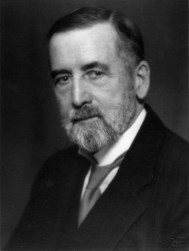
by James Russell & Sons, published by J. Beagles & Co, postcard print, 1914
“GALLANT GENTLEMEN.”
BISHOP’S TRIBUTE TO CANADIANS.
In a speech at the annual meeting of the British Columbia and Yukon Aid Society[i] at Church House, Westminster, yesterday, the Bishop of London[ii] [The Right Reverend Arthur Winnington-Ingram] spoke of the great debt of gratitude which the country owed to the men from[iii] Canada, and said that one of the things he would remember best of all, perhaps, in connection to his visit to Flanders was his address to 10,000 Canadians in a certain market town.
“As I went out at the end of the long day, and found these men waiting in the market square, I shall never forget the shout of welcome that wen up from those 10,000 throats. They were there in their thousands to live for us, to fight for us, and to die for us, and when I think that of those sixty officers that sat around me in that market square twenty-two are dead, and that out of the multitude of men 6,000 have fallen, it gives a pathos to the meeting such as no one can ever can forget. We owe a debt of gratitude to those 6,000 gallant gentlemen, who have fallen in battle that we can never repay.
One way in which they could help to repay the debt, the bishop continued, was to give to the young men in British Columbia early in life the religion they would need in the day of trial. It was not fair to leave them to get their religion on the battlefield.
[Sir] George H. Perley. Source: Library and Archives Canada/MIKAN 3544530Sir George H. Perley, High Commissioner for Canada, said that Canada, though her men who were fighting as heroes of old, and through the baptism of blood they had had in Flanders, had come to manhood. (Cheers).Source: The Daily Telegraph. Wednesday June 15, 1915.
Well, the Right Reverend was right about one thing. Many Canadians had fallen. From the beginning of the war until the date of this news story 3,575 men and women of all branches of the Canadian military had died. 6,000 thousand dead and wounded during the four days of April 22/25 at the Battle of Second Ypres.
From the context of a hundred years hence the jingoistic and paternalistic tone of this news article is evident. The explanation of “cheers” being inserted at the end of the article capping the story with, at that time, appropriate sentimentality of the time.
As related in “The Unholy Spirit” the Bishop of Birmingham wrote September 1914 just after the retreat at Mons and the Aisne battle:
“I know the delights of being at the front and I confess a great longing to be there again…My young clergy think that I am hard because I disapprove of them becoming combatant soldiers…but the clergy are serving England bravely when they minister comfort to the soldier’s widow wife or mother, when they help to send out to help fight for their country, young men who fear God and fear no-one else.’”4
Dead at Aisne
German dead at the retreat at the Battle of Aisne
The word “delights” needs context but one would think that ministering to the dying, the bereaved, the scared, the afraid, the repentant sinners afraid of dying before absolution and atonement would engender an adjective more appropriate other then the word “delight”. The duty and value of spiritual guidance and console is an important aspect of the Canadian military ethos since just about every soldier that enlisted or was drafted indicated a religious affiliation. The War Diary of the 18th Battalion mentions the social engagement by the soldiers in Church Parades and we can forget in the present time how important church was to the social and religious fabric of Canada one hundred years ago.
The Right Reverend appears to be a controversial figure and even today people are examining his work during the war. One can see from this brief article a man with a determined set of values and beliefs who used their legitimacy and position to extolled the virtues of a militant Christianity, made more militant by the act of war.
If one compares this rhetoric to the actions and ministrations of the much loved by Canadian troops, Canon Frederick Scott, who served dutifully and actively in the 1st Division until his wounding later in the war. As Private Donald M. Cleal related in a letter published in the Toronto Star on August 30, 1917:
“We have a chaplain here, Canon Scott,2 of Quebec, who has several medals. He earned them too. He is the Divisional Chaplain and entitled to stay in the rear. But no matter how thick the fight is, he is always to be seen wherever the boys are. I wish the slackers could hear him speak.”[iv]
But Private Cleal also speaks to the bigger issue of the morality and ethics of war with a simple, illuminating statement, putting into contrast the bombastic religious propaganda of others:
“Of course, I never forget the old and trusted saying, ‘Judge not, that ye be not judged,’ but oh, to see men dying all around you, men with wives and children, also old men, all dying for principle, and these men your comrades — you can’t help seeing things from one side only. It hardens a man, and at the same time softens him. You learn what fear is, and you learn to conquer. It makes some men, breaks others, and changes them all.” [bold and italics mine]
The debt owed by the Mother Country and those like the Right Revered Arthur Winnington-Ingram will never be repaid.
The Right Reverend had his point of view and his conception of religion and how it operated at that time in place in history. Mores the pity that this example of the use of religion to effect change and affect the decisions of others to join a combat arm that is so often in contradiction of the true values of that religion. Sounds familiar does it not?
Private Cleal makes a simple, eloquent statement. It is not couched in sentimental religious terms. It is a concise clarion declarative statement. The soldiers experience war and they react differently to the stress of combat and regardless of the outcome “…it changes them all.”
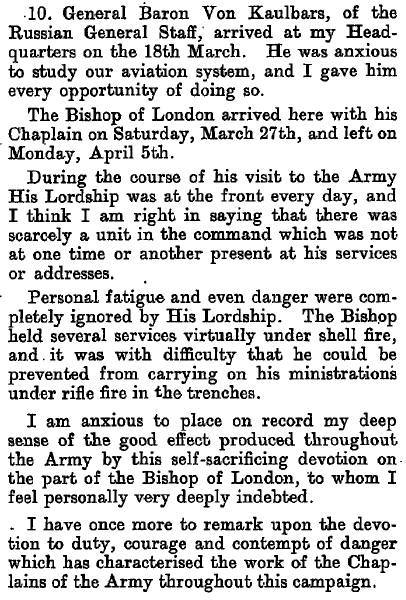
Guy Vernon Smith wrote a detail exposition about The Right Reverends visit to the front between March 27, 1915 to April 5, 1915 entitled The Bishop’s Visit to the Front. It is written with a strong positive bias to militant Christianity and its expression by the Right Reverend. An audience would now find it terribly sentimental. It is instructive to read this document to get the tone of how religion and militarism co-existed during World War 1 and many contemporary Canadian letters and newspaper articles reflect this philosophy.
The debt will never be repaid. Not if one does not learn from the lessons of history and work to overcome the methodology and acceptance of of violence and terror as a means to effect change, be it non-state or state sponsored.
The debt can be repaid if society works to values that engender peace.
[i]Per Memory BC The British Columbia Church Aid Society, based in London, England, was formed in 1910 as an organization to represent the interests of and raise support in the home country for the British Columbia dioceses and institutions such as the Anglican Theological College. It unified into a provincial scope the work of the various existing diocesan missionary societies: the Columbia Mission, founded in 1859; the New Westminster Association (later called New Westminster and Kootenay Missionary Association) founded in 1880; and the Nishga Union (later called Caledonia Missionary Union) created in 1905. The former diocesan organizations retained their identity as diocesan committees of the larger organization. In 1913 the Diocese of Yukon was added to the Society’s activities resulting in a new name, British Columbia and Yukon Church Aid Society (B.C.Y.C.A.S.). The Society’s long-time serving General Secretary was the Rev. Canon Jocelyn Perkins who remained active in office from the Society’s beginning until after the Second World War.:
 by James Russell & Sons, published by J. Beagles & Co, postcard print, 1914


 History of the 18th Battalion CEF, "The Fighting Eighteenth"
Leave a comment