

Two news articles give some context to the experiences of soldiers from the Windsor area. The 18th Battalion had been in the line as of the latter part of September 1915 and had experience its first Christmas on the Continent. The Battalion had experienced light casualties, in regards to men killed, with 34 men who perished due to all causes from September 1915 to February 1916.
But March and April of that month were different. 19 men were lost in March and almost the total number of men lost between September 1915 and 1916 where lost in the month of April with that months tally amounting to 29 men dead. The Battle of St. Eloi Craters engaged the 4th Canadian Infantry Brigade with its battalions (18th, 19th, 20th, and 21st ) and this increase in deaths was a precursor to the actions at the Somme in the coming Fall.
The men of the 18th Battalion would not know this as it was to be their future. They have been bloodied in Belgium and their first major action led to recrimination and replacements of key battalion staff of the 18th Battalion.
The “other ranks” suffered in their turn and the Windsor Star relates some of the details of the men of the area.
TWO LOCAL MEN KILLED IN ACTION: EIGHT WOUNDED
Many Casualties suffered by Western Ontario Units in Recent Fights.
Pte. R. Williams, at present attached to the 18th Battalion writes from West Sandling Camp, to inform Windsor residents of the death of Pte. C.A. Batten, No. 215058 [213038], 99th Battalion, who was killed in action at Combes Ridge on Sep. 2.
Pte. Batten had no living relatives. He boarded at 53 Sandwich street[i] east before enlisting in the Essex county battalion. “He was my pal,” writes Pte. Williams, “ but he went to France on one of the first drafts. He was well known in Windsor.”
Lance-Corpl. Walter G. Kent, formerly of Walkerville, was reported killed in action on September 15th in a telegram received today by his brother-in-law, H. Clyde, 72 Janette avenue [probably 72 Jeanette Avenue, Hamilton, Ontario]. Kent was about 24 years old and enlisted in the 18th battalion. Mr. Clyde, who received the message moved to the city a few years ago from Hamilton.
Source: Windsor Star. Circa September 1916.
This news article has some interesting elements.
Private R. Williams
Private R. Williams, as yet not identified, does not appear to be part of the original nominal roll of the 18th battalion and the article he is “attached to the 18th Battalion,” indicates he was part of another battalion’s draft. He is writing from West Sandling Camp so there is the possibility he is part of a reinforcing draft, yet to be assigned to a combat unit. It is unclear his relationship to Pte. Batten.
Private Charles A. Batten
Private Batten appears to have survived the war. There is no record of him being killed on September 2, 1916 or at any time during World War 1. In fact, no soldiers of the 18th Battalion died on that day. A Charles Albert Batten reg. no. 2075671 was killed in action on August 28, 1918. It is unclear at this time where this erroneous information came from but research into this soldier’s service file cannot be done at this time as the PDF file at the LAC is corrupt. Note too that the article got the reg. no. of Batten wrong and a search of the LAC using the incorrect number results in a null search result. No soldier was issued with that regimental number in the C.E.F.
It looks like Private Williams’ friend survived the war.
Combes Ridge
There is no geographical feature name that from World War 1 that I can be found at this time.
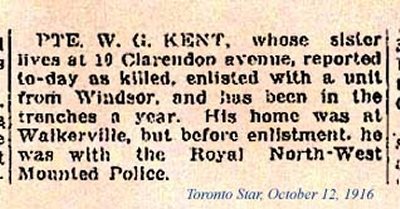
Lance-Corporal W.G. Ken reg. no. 54185 enlisted February 4, 1915 in London just over a month before the Battalion left for England. He was part of the “Originals” but he enlisted relatively late as most of the Battalion enlisted in October to December of 1914. His previous experience with the 21st and 48th Regiments, as well as his service with the North-West Mounted Police probably assured a place on the Battalion.
He is commemorated on the memorial at Vimy Ridge as he was killed during the attack on Courcelette and many 18th Battalion dead on that date have no known grave.
The next news article states:
In Rouen Hospital
William Butler, of the Customs staff, received word Saturday morning that his son, Lance-Corpl. Leslie Butler, has been wounded in the thigh and is now in a Rouen hospital. Butler live at 11 Aylmer avenue, enlisted in the Winter of 1914 with the 18th Battalion. Shortly after the arrival of the unit he was taken ill with pneumonia. He did not fully recover until a short time ago, when he was sent to France.
Others who enlisted in Windsor reported wounded in the official casualty list issued at Ottawa Saturday morning are as follows: Ptes. A.M. Freeman[ii] and J. Price, formerly of the 99th Battalion; Ptes. Jack Fisher[iii] and F. Thomas[iv], formerly of the 33rd Battalion, and Sergt. Richard Drew, and Ptes. Frank Remington and Alfred G. Austin of Windsor.
Source: Windsor Star. Circa October 1916.
Lance-Corporal Leslie Butler
Lance-Corporal Butler, reg. no. 53322 was one of the “Originals” and enlisted in the Fall of 1914 on October 29, 1914 in Windsor. He was an American citizen. He was wounded on October 5, 1916 and rejoined his unit on December 23, 1916. 2 months later he was wounded with a G.S.W. to thigh and buttocks and these wounds led to his eventual discharge from the Army as “medically unfit.”
Sergeant Richard Drew
Sergeant R. Drew, reg. no. 53221 was an “Original” member of the Battalion and was an American citizen enlisting in Windsor on October 27, 1914.
Regardless of being issued with 20 days of Field Punishment No. 1 for being drunk on duty in the trenches on November 26, 1915, he was regarded well enough as a soldier to be promoted Corporal on March 1, 1916 and then to Sergeant on the 19th of that month.
He is wounded October 10, 1916 with a shrapnel wound to the back and this wound results in his discharge as medically fit on January 9, 1917 with the curious notation on this soldier’s Proceedings of Discharge. It states: “Joining American Forces. H2649D3630 / 4-7-17 Medically fit for service” It appears that some act of cooperation between the C.E.F. and the U.S. Army was at play to allow this to occur.
Private Frank Remington
Private Remington, reg. no. 54228, was one of the “Originals” and was also an American Citizen. He enlisted on February 12, 1915 and was an unmarried labourer. As there are no service records digitized for this soldier but we do know he was “Previously reported Wounded and Missing, now Killed in Action” on October 9, 1916.
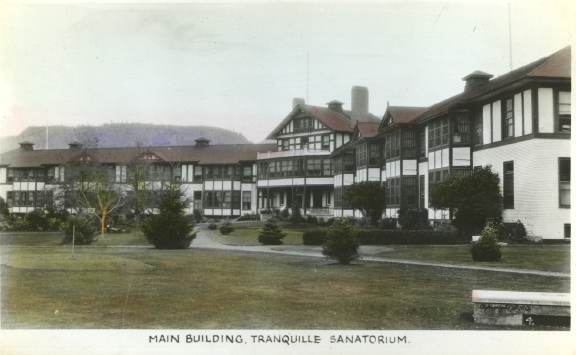
A Gowen-Sutton postcard from c. 1915. From Vanishing B.C.
Alfred George Austin
A.G. Austin, reg. no. 53312, was to survive the war. He was one of the “Originals” who enlisted Windsor on November 2, 1914. He was a tall 5’10” man of 21 years old at enlistment and was born in Belfast, Ireland.
He had previously been treated for shell shock and was wounded with a G.S.W. to the left hand on October 3, 1916.
Private Austin was offered employment March 27, 1919 in his native Belfast by William McComb Limited as a “bakehouse labourer” and McComb Limited as a bakery and confectioner. He was to die at the King Edward “Tranquille” Sanatorium[v] of pulmonary tuberculosis on September 18, 1931 and is buried in the Kamloops Cemetery according to his “Farm Record” card.
_____________________________
[i] Note that another soldier of the C.E.F. listed his address at enlistment as 53 Sandwich Street, Windsor, Ontario. Private Blaze Carabez, reg. no. 270133 listed this address on his attestation papers. He is honoured at the doingourbit.ca web site. This soldier attempted to join the C.E.F. four times, being rejected at least 3 times for medical reasons pre-existing his enlistment. Note that the building does not seem to exist anymore, being replaced by a more modern structure.
[ii] Unknown at this time.
[iii] Unknown at this time.
[iv] Unknown at this time.
[v] This link has an extensive and interesting article about this sanatorium.
Discover more from History of the 18th Battalion CEF, "The Fighting Eighteenth"
Subscribe to get the latest posts sent to your email.
 History of the 18th Battalion CEF, "The Fighting Eighteenth"
Leave a comment