
Walter Perry, of Highland Creek, Ontario, decided to join the Canadian Army. His previous military experience consisting of serving three-and-a-half years as a Bugler. He joined the 81st Battalion in Toronto, Ontario on September 18th, 1915 and was assigned the regimental number 157659. From this point in time he served and trained in Canada until he was shipped overseas on April 24, 1916 aboard the S.S. Olympic. Two months passed while he awaited an active duty assignment and he was granted one with the 18th Battalion on June 29, 1916. Private Perry then transferred to the Canadian Base Depot in France and finally joined his unit on July 14, 1916.
Private Perry served dutifully until he was wounded with a gunshot wound the face October 3, 1916. The exact circumstances of his wounding are not known but that bullet started a process that would affect him for the rest of his life.

The bullet entered his mouth from the right side, taking out two teeth and then shattering his lower left jaw. The medical record records an “extensive fracture” with “large bone loss” during a medical assessment and surgery after his admission on October 10, 1916 to the Aldershot Cambridge Military Hospital. This hospital was the first institution to perform “plastic surgery” and developed its expertise during the First World War, particularly during the Somme Offensive in the summer and fall of 1916. The surgeons attempted an unsuccessful bone graft using one of Private Perry’s ribs and noted there was minute metal particles in the soft tissue, in the area of the wound.
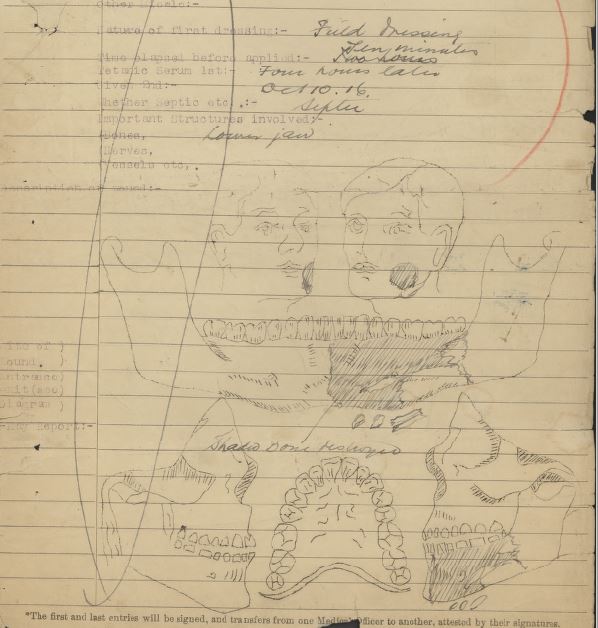
Private Perry is then transferred (September 11, 1917) to Queen’s Hospital, Sidcup where treatment is reported December 1, 1917 as having now been moved to the Canadian Section of this hospital. This institution specialized in plastic and restorative surgery and was under the direction of Harold Gillies. The hospital medical report gives more details as to Private Perry’s treatment at Aldershot. On April 3, 1917, a surgery was done creating a bone graft from one of Private Perry’s ribs and this was not successful. To address the fact the bone graft did not take, Private Perry had this graft removed May 18, 1917.


No further treatment is noted on this record until February 27, 1918 where it is noted that there was to be another attempt at “plastic operation L side of face to correct deformity and provide connective tissue [to] feed [skin and bone] graft” but this was not done as Private Perry had contracted influenza which then complicated into pneumonia. It was advised that a wait of six-month be made before another attempt at the surgery be made. Surgeon Major Carl William Waldron appears to have done some exploratory surgery to determine the progress and condition of Private Perry’s wounds but did not proceed with a more extensive procedure due to the Private’s illness.
One day after the war ended it was recommended that Private Perry be invalided home. He was admitted to the 16th Canadian General Hospital, Orpington, [January] 4, 1919 and was invalided home for further treatment, first to Davisville Medical Hospital and finally arriving at the Dominion Orthopaedic Hospital, Facial Section, in Toronto, Ontario. Private Perry was finally home. He would be one of the 185 facial cases this hospital would treat.

At the Dominion Orthopaedic Hospital Surgeon Major E.F. Risdon performed a bone graft April 20, 1919. No further reports on Private Perry’s condition are offered but he earned a two-month furlough beginning June 29, 1919. After returning from leave Private Perry was transferred to Ste. Anne-de-Bellevue Military Hospital and was attended to by Surgeon Major Carl William Waldron. This is of note at this surgeon had attended to him in England and was under the command of Harold Gillies. It may be that Major Waldron wanted to follow up as part of the development of facial reconstructive surgery.

A medical board was held on September 27, 1920 in preparation for discharge and it noted the following:
157659 Pte. Perry, W.
D.O.H. 27-9-20 Condition when finally boarded for discharge.
Wounded Oct. 2nd, 1916. Courcellette [sic]. To Dressing Station. No. 11 Scottish General, Rouen. Aldershot M.H to Sidcup, Queen’s. To 16th Can. Gen. To Canada. Davisville M.H. and D.O.H., Toronto. St. Anne de Bellevue the D.O.H. Toronto.
- [Illegible] – recent bone-graft , successful, still wearing interdental splints.
- Facial disfigurement – considerable, of left cheek destroyed. Scars, etc., and depressions.
- Pain in right chest on lifting weights (some rib was taken in an English Hospital for bone-graft which failed.
Subjective: Pain in right chest at time on lifting and inability to chew food.
Private Perry was discharged from service October 11, 1920. He had served 1,851 days in the C.E.F, of which 1,470 (79% of his service) days involved medical treatment and care. He planned to live on Warden Street, Mimico[i], Ontario. His discharge papers indicate that he is still married to Lucy Manning Perry
Private Walter Perry was now a civilian. The minority of his military service left him with permanent physical and mental scars. Perhaps he continued his pre-war trade as a printer but perhaps the missing rib made it too painful to perform the physical labour involved and he would have to adapt to his external wounds and the inability to chew food.
He lived until the age of 67, passing away at Sunnybrook Hospital for a coronary occlusion.
His wife, Lucy, was still with him.

[i] Mimico was an independent municipality located to the west of the Humber, River. It is now part of Etobicoke, Toronto, Ontario.
Discover more from History of the 18th Battalion CEF, "The Fighting Eighteenth"
Subscribe to get the latest posts sent to your email.
 History of the 18th Battalion CEF, "The Fighting Eighteenth"
Leave a comment