Private (later Lieutenant) Wesley Strang Caldwell was yet to earn the Military Medal for his actions at Courcelette, the Somme, when this letter was published in the Huron Expositor on March 10, 1916. He was 20-years old, just shy of his 21st birthday by 40 days. He was a combat veteran claiming to have served continuously, along with his Battalion and his Brigade, for 137 days. This number is accurate as the Battalion entered the lines in the Ypres sector on the night of September 23, 1915 and the total days in active service until the date of the letter (written February 6, 1916) is precisely 137 days. Perhaps it was this attention to detail that would help him earn promotion to the rank of lieutenant.


His letter relates to the Battalion’s experiences before the battle at St. Eloi Craters as the Battalion is stationed in the Ridgewood Sector of Ypres during the latter half of January. 1916 and is full of interesting points:
From the Front
The following letter was written by Pte. Wes. Caldwell, of the 18th Battalion, and whose home is in Hensall. He is well known in Clinton, having attended the Collegiate Institute there, before enlisting for overseas service. The letter is dated Belgium, Feb. 6, 1916[i], as follows:
Dear Friend, — Am sitting beside a machine gun in a redoubt about 200 yards from the front line. Was transferred to the section about 10 days ago. We spent six days in the front line, then the next six here in the redoubt followed by another six in the front line, then we got into divisional reserve for the next six; thus taking twenty-four days for the round trip.
Our last term in the front line was rather exciting. Our bomb throwers had been aggravating the Germans all one night and they began to retaliate just before dawn. In all they must have sent over 150 rifle grenades and ball bombs on a frontage of 100 yards. Our gun was right in the midst of it, but fortunately none of the crew was injured. The parapet was blown flat in two places, but was speedily built up again that night.
The German rifle-grenade is much feared as it not only contains a very high explosive but also much heavy shrapnel. Their hand grenades are not so dangerous. There was a ball bomb exploded within ten feet of me one night but I was only scratched in a couple of places. The explosion lifted me clear off my feet but I came to earth again almost unhurt. The narrow escapes that some fellows have are nothing short of marvellous.
There is no danger of the Germans ever advancing any farther on the Western front. We are holding them with the greatest possible ease by a triple line that cannot be broken.
Our supply of munitions is fast mounting up in a supply which will be inhaustable [sic] before long; then the great offensive will commence, which will make the world sit up and take notice.
The cost of attempting to advance without the necessary munitions and supplies to back it up has been proven before. The people at home are wondering why we are not making more headway. The reason for that, is that, the Allies have already lost too many good men of account of the lack of artillery and shells. We are only waiting the time when nearly all the defences can be blown to pieces by artillery fire, when a general advance is made. Destructive bayonet charges are soon to be a thing of the past. Our artillery is now vastly superior to that of the enemy, in fact, the German batteries are almost afraid to open up for fear of the awful retaliation given them by our batteries.
Sniping is a great feature in trench warfare. We have one old sniper who is a regular Indian at the game. I believe he would scalp his victims if he could.
Am feeling as well as can be expected but the whole brigade is in need of a rest. We have created a new record for continuous service in the trenches. We have held this frontage for 137 days, which is 20 days longer than any brigade in the British Army has ever served without a rest, and we are still holding it.
Hoping you are well, I remain,
Sincerely,
W.S. Caldwell
Huron Expositor March 10, 1916. Page 1.
The letter is addressed to a “friend” giving the only clue to who the audience is. The letter is pretty frank as to the experiences Private Caldwell has, even relating a close call with a German grenade. Perhaps it is a friend from the Clinton Collegiate? It is, perhaps, more casual and informative than a letter written to his parents and one wonders what they thought, if this was the case, if they read the letter in the newspaper.
Though the letter is dated February 6, 1916 this date may refer to a post mark. As Private Caldwell states, specifically, that he is “…sitting beside a machine gun in a redoubt about 200 yards from the front line,” it can be surmised that the writing of the letter occurred while the Battalion was in the line in the La Clytte/Vierstraat sector and that the letter was posted when the Battalion went off the line into Brigade Reserve at Ridgewood on February 2, 1916. He relates the nature of the rotation of the battalions from front line to support lines (redoubt), and reserve lines though it appears that the Battalion cycled back and fort between front and support lines twice before it was moved to divisional reserve.
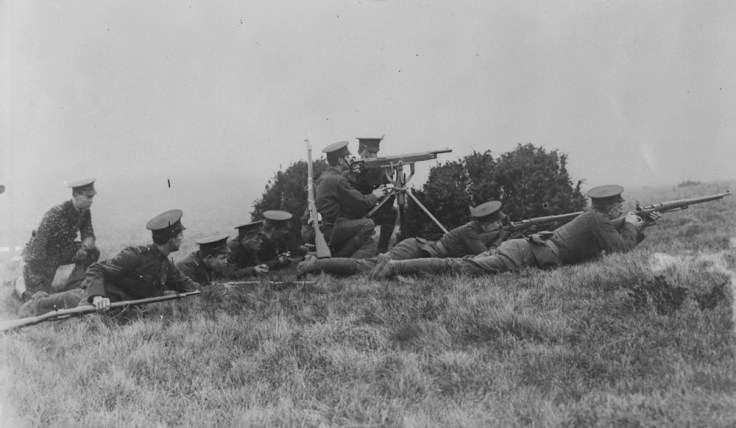
From this and the following paragraph it appears that Private Caldwell has been assigned to serve a machine gun. It is not clear if Private Caldwell is serving a Colt Machine Gun or a Lewis Gun. The Colt was maintained as an active weapon until completely replaced by the Vickers Machine Gun after the attack on Vimy Ridge. The Lewis Gun did not become part of the equipment of a Canadian Battalion until July 1916. It is possible that Private Caldwell was part of a Colt Machine Gun crew.


He relates, in some detail, an incident where the 18th Battalion was interdicting the German trenches with grenades. It is not clear why type of grenades being “thrown” by the Canadians but, as the grenades sent by the Germans in reply for the ‘aggravation’ created by the men of the 18th, it appears that the distance between the Canadian and German lines was such that the Canadian probably were using rifle grenades or some method to launch percussion grenades. The Germans replied with their Karabingranate M 1914 rifle grenade and the “ball bomb” Kugelhandgranate 1915 (a round grenade fired with launchers and timed fuses). It is interesting to note that Private Caldwell, or other men of the Battalion could identify the nature of the grenades during the action.[ii] The Karabingranate M 1914 rifle grenade, “…is much feared as it not only contains a very high explosive but also much heavy shrapnel,” while the Kugelhandgranate 1915, “…is not so dangerous.” Yet, it is this exact grenade whose, “…explosion lifted me clear off my feet but I came to earth again almost unhurt.” [empahis mine] A touch of youthful bravado, and perhaps concern for those at home may take this last story to heart has Private Caldwell relate that this is, apparently, part of a serious of “narrow escapes” and that their number makes these escape “marvelous”.
Private Caldwell then touches on his assessment of the war to date and predicts accuraltey on the aspect that the First World War will be, essentially to achieve tactical success, a war of artillery. His statement: “Destructive bayonet charges are soon to be a thing of the past,” seems oddly out of place given that he is, for all intents and purposes, a combat veteran and the use of the bayonet has been superseded by other weapons of war in trench fighting, such as pistols, shovels, and grenades. Perhaps the inculcation during training of the bayonet through the bayonet courses to encourage aggression and élan in combat was so strong and influentual to the soldiers of C.E.F. that the concept of the bayonet in the hands of a soldier as a weapon of fear is slow to die. Even after two years of war.
His reference, albeit, brief, to sniping, is of interest and the reference to, “…one old sniper who is a regular Indian at the game,” is not clear in its meaning. Is the sniper an aboriginal soldier or is the soldier that is sniping acting like a “regular Indian” in his use of tactics, concealment, and shooting. Note that sniping developed into a 2-man team based role and Private Caldwell does not reference another member of the team.
He is obviously proud of the 4th Brigade’s achievement in reference to the total time in the line. This constant exposure to the weather and the stress of combat would require the C.E.F. to later modify the rotation of battalions and brigades as the war progressed. During this time (September to February) the 18th Battalion suffered 34 men fatalities, almost all due to combat. It was a precursor to the experiences the Battalion would experience at St. Eloi and the Somme.
Private Caldwell was to survive the war and several other letters from him were published in the local papers. This letter is rich in detail and information and allows one to experience part of his past.
[i] The Battalion was in Brigade Reserve at Ridgewood, Ypres Sector, Belgium when this letter was written. The 18th Battalion war diary relates for that day: -Ditto- [Routine] Communion service was held at 11 a.m. CAPT. HALE proceeded on leave.
[ii] The author is almost CERTAIN he would be under cover and would not make any effort to identify the type of grenade being used against him.
Discover more from History of the 18th Battalion CEF, "The Fighting Eighteenth"
Subscribe to get the latest posts sent to your email.
 History of the 18th Battalion CEF, "The Fighting Eighteenth"
Leave a comment