In a post entitled “The narrow escapes that some fellows have are nothing short of marvellous”: A Letter from the Front the, then, Private Caldwell relates in some detail a battle between the 18th Battalion, C.E.F. and it opposite German numbers:
“Our last term in the front line was rather exciting. Our bomb throwers had been aggravating the Germans all one night and they began to retaliate just before dawn. In all they must have sent over 150 rifle grenades and ball bombs on a frontage of 100 yards. Our gun was right in the midst of it, but fortunately none of the crew was injured. The parapet was blown flat in two places, but was speedily built up again that night.”
This rather robust method of conflict offered a glimpse into the variety of weapons used at the Western Front during the First World War.
Recently I acquired “Trench: A History of Trench Warfare on the Western Front” by Dr. Stephen Bull. From it two photographs of rifle grenades used by the B.E.F. and the German Army offer a further insight to the method and application of this weapon system.
British Expeditionary Force

This image shows what appears to be a local adaptation and offers a rudimentary method of aiming a rifle grenade since the base of the rifle butt is not affixed to any manner of fixed or adjustable base. It appears that the rifle bomber sat in a scrape, or funk hole, at the rear of the trench. Using another soldier to sight and estimate the fall of the grenades the base would be rotated right or left and the rifle’s angle adjust up or down to affect the trajectory of the grenade, which determined its range.


It is possible that the design and contruction of the rifle grenade firing stand was standardized. The general “finished” look of the wood used to construct the stand; the strapping resting on the base-board by the seat of the operator (its purpose is uknown); and the metal bracket at the juction of the vertical stand and the angled length of wood, in particular, has a manufactured look to it.
The No. 3 Hale rifle grenade had its production halted in January 1915 and was replaced by the improved No. 20.
German Imperial Army
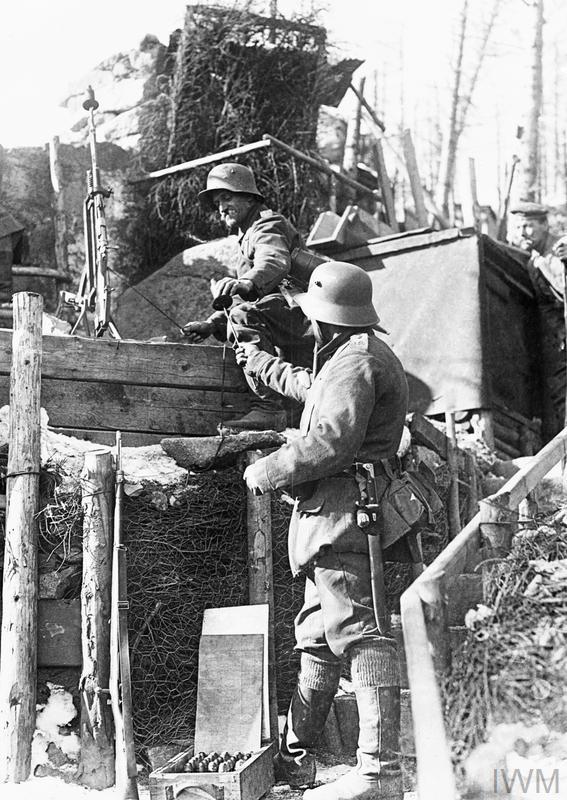
The German application of the stand is more compact, and potentially more precise to aim and launch. The photograph is rich in detail, though it appears staged. Note that the soldier accepting the next rifle grenade has yet to launch the grenade in the rifle. Further, the box of grenades on the trench floor need to be attached to the rod before it can be loaded and there is no evidence of any rods in the picture. They would be “ready” for use, as are the grenades to which they attach.

The soldier crewing the weapon has a lanyard in his right-hand used to fire the rifle and from the angle of the photograph it is impossible to see how the stand is affixed into it position. This would prevent its movement and allow consisent aimed shots without the repeated need to oberve and “zero in” the weapon. The grenade being used is a Karabingranate M 1914 with range limiter cupola attached at the bottom of the grenade (it is obscuring the soldier’s fingers of his left hand).
Note the differences in trench construction in the two photographs. The German trench is better organized and revetted, where as, the rear of the British trench has not been revetted and is subject to in-falling of the earth through the effects of wind, rain, and the affects of shelling.
Conclusion
These two photographs illustrate the application of rifle grenades on the Western Front during the First World War and how two armies applied solutions of firing fixtures to improve the aim and consitency of that aim during the use of rifle grenades. These fixtures were designed for static trench warfare and not active advancing or defence during a strategic withdrawal.
Though we cannot know how the soldiers of the 18th Battalion C.E.F. applied the tactical use of rifle grenades with any certainty one can see that efforts were made by both sides to make this weapon more accurate.
Discover more from History of the 18th Battalion CEF, "The Fighting Eighteenth"
Subscribe to get the latest posts sent to your email.
 History of the 18th Battalion CEF, "The Fighting Eighteenth"
Leave a comment