This is a follow up post from a prior post entitled A Swim Binds Two Soldiers in Time in which the experiences of two members of the Battalion is examined. Further research has illuminated that there were three men of the 18th Battalion involved in this incident and this article is a response to the new research.
One of the challenges with personal and unit history is the impersonal nature of the information related in service records or war diaries. This information, by its official nature, is often succinct and brief in its relating of the details of a soldier’s or a unit’s experience during the war. It does not offer much opportunity to appreciate the personal nature of the relationships between comrades in arms.
Yet, from time-to-time, small glorious nuggets of information are found, often quite by accident[i], that bring a soldier, or in this case, soldiers, to life.
Three soldiers.


One from Paisley, Ontario, a small town in the Grey-Bruce region of Ontario with rolling hills of trees and farmer’s fields. One from rich agriculture fields surrounding Fergus, Ontario in which winds the Grand River. The last from the urban environs of Toronto. Two of the men were in a technical trade; one being a tinsmith and other a steam fitter, while the man from Fergus was a farmer. Two of the men were “originals” of the Battalion, and, ironically, are the men this story that survive the war. The reinforcement from Toronto would serve dutifully until wounded and then healed and then return to fight and be killed during the Battle of Hill 70.
The first soldier, Private Blue[ii], has previously been written quite extensively about. He was an original member of the 18th Battalion and his service reflected some of the typical experiences of a Canadian soldier during that era. Luckily, Private Blue and others saved some of the documents and newspapers clippings of Private Blue, which gives a fascinating look in some detail of the life of one man of the 18th Battalion.
The second soldier, Private Graham[iii], was, at 22 years old, five years younger than Private Blue upon enlistment in September 1915 and was part of the soldiers that joined battalions in Canada to be shipped to England for further training at reinforcement battalions until he joined the 18th Battalion in the field on March 9, 1916.
The third soldier, Private Rymal[iv], was the youngest. A farmer by trade, he was representative of rural nature of the recruits of C.E.F. and he was American by birth.
They served in the 18th Battalion and there is no indication from their service records of they were aware of each other. Battalion Companies were often, at the original formation of the Battalion in Canada, assigned by the geographic region of the recruits (i.e. Windsor recruit in “A” Company) so it is unknown of these three soldiers had any awareness of each other.
And as soldiers of the 18th they did share the trials, tribulations, small joys and rare comforts of soldiers in active service. They also shared in the risks of war and both Private Blue and Graham would be wounded and sent for treatment to England for their “blighties”. In contrast, Private Rymal was to suffer from myalgia, and later epilepsy, and required treatment in England for these conditions.
Very early in the Battalion’s service on the Continent on November 4, 1915, Private Rymal had an onset of myalgia. On June 30, 1916, Private Blue suffered a G.S.W. to the chest. Two and a half months later on September 17, 1916, Private Graham suffered a G.S.W. to the face. Both wounds required treatment in England and their wounds were of such a nature that this treatment allowed them to gain fighting fitness and be returned to service.
It is during the return to service that these soldiers of the 18th Battalion are put together and that perhaps their mutual unit identification and service experience led to them being charged with an offence under military law.
Private Graham had joined this battalion earlier in January 1917 at West Sandling and moved to Bramshott with the Battalion in April 1917. Privates Blue and Rymal are specifically placed with the 4th Reserve Battalion at Bramshott, England. It is likely that these men were placed in living quarters together as they were all from the same unit and if this was not the case one can assume that by their uniform dress with their shoulder patches, collar and cap badges that the men of the same battalion would congregate towards each other.
These three men then left for the Canadian Infantry Base Depot at Etaples, France on May 26, 1917 and would arrive at their destination two days later. Whatever the circumstances the service records of Privates Blue, Graham and Rymal offer definitive proof that they knew each other in a rather unusual way: They were charged with the same offence that occurred on the same date and location.

These soldiers’ service records offer to history the following entry dated June 8, 1917: Forfeits 2 day’s pay, 8/6/17, for “When on Active Service, (1) Breaking away from training camp, (2) Bathing in the River Canche (contrary to E.A.D.R.O. 1479 [at] 14.5.17), 6/6/17.


With this we can place them at the same place and time. They left the C.I.B.D. camp at Etaples for a swim on a summer’s day. Perhaps their status of veterans made them chaff at the rules and regulations of the camp? Or the long recuperation and lack of action led to the need to simply do something outside the bounds of military regulation and propriety. Their motivations cannot be deduced with certainty but give that Private Blue was older, a more experienced soldier, and had several demerits in his service record it could the theorized that the older soldier influenced the younger men which led to their “skipping” out on the camp for their swimming adventure.
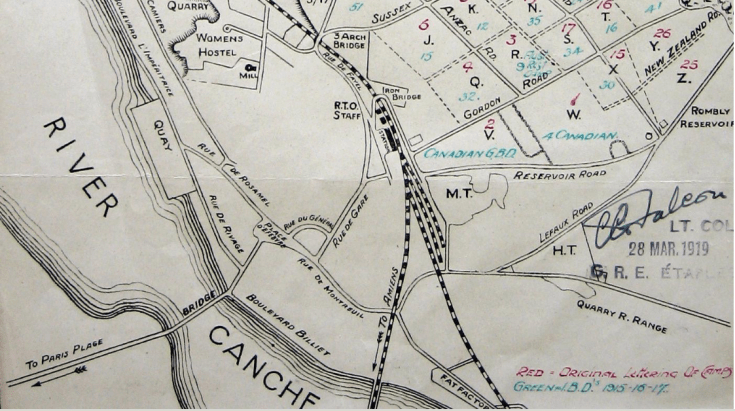
The Canadian section of the Etaples complex was located at the southern end of the camp. As the detail of the map shows that the distance to the River Canche from the Canadian Camp was very close to the camp, thereby offering an opportunity for the Privates to slip out of the confines of the camp for their swim.

Perhaps the conditions and circumstances of being a soldier at Etaples can be understood in the context that a mutiny occurred at the Camp on September 9, 1917. The poet Wilfried Owen wrote:
“Last year, at this time, (it is just midnight, and now is the intolerable instant of the Change) last year I lay awake in a windy tent in the middle of a vast, dreadful encampment. It seemed neither France nor England, but a kind of paddock where the beasts were kept a few days before the shambles. I heard the revelling of the Scotch troops, who are now dead, and who knew they would be dead. I thought of this present night, and whether I should indeed – whether we should indeed – where your would indeed – but I thought neither long or deeply, for I am a master of elision.
But chiefly I thought of the very strange look on all the faces in that camp; an incomprehensible look, which a man will never see in England. Though wars should be in England; nor can it be seen in battle. But only in Etaples.
It was not despair, terror, it was more terrible than terror, for it was a blindfold look, and without expression, like a dead rabbit’s.”[v]
One can get a sense of the bone and brain wearying drudgery of the camp at Etaples. Owen wrote this to his mother on December 31, 1917 as the year turned to the last year of the war. Owen equates being based at the camp as being worse than in battle. That the camp acted like a type of military purgatory that sapped the spirit and life out of the men that were based there, often waiting for the next stage of their military service.
The poet Siegfried Sassoon further expressed a similar sentiment and theme in his poem[vi] “Base Details”:
If I were fierce, and bald, and short of breath,
I’d live with scarlet Majors at the Base,
And speed glum heroes up the line to death.
You’d see me with my puffy petulant face,
Guzzling and gulping in the best hotel,
Reading the Roll of Honour. ‘Poor young chap,’
I’d say—’I used to know his father well;
Yes, we’ve lost heavily in this last scrap.’
And when the war is done and youth stone dead,
I’d toddle safely home and die—in bed.
Whatever the conditions these Privates experienced they were willing to risk military justice and punishment by slipping out of camp and taking a swim. One can imagine their disappointment of being discovered by the Provost Marshalls and being processed in the military justice system to receive their loss of two day’s pay. It was, perhaps worth it.
Privates Blue and Graham would be reunited with the 18th Battalion on the same day, June 15, 1917 at Barlin, France where the Battalion was in the rear resting and training. Private Rymal was allocated temporarily to the 2nd Entrenching Battalion and was reunited with his Battalion on August 20, 1917 after the Battle of Hill 70.
Two months later, Private Graham was killed in action on August 17, 1917, though the War Diary makes no mention of any casualties on that day. The circumstances of his death are not known and his body was never found. He is memorialized at the Vimy Memorial and his parents suffered a double tragedy as his brother, Private John Wesley Graham, reg. no. 192512, perished earlier in the war on September 16, 1916.
Private Rymal[vii], perhaps wishing to return to his homeland, returned to the United States and died September 5, 1947 at the age of 54. Private Blue survived the war and lived to the age of 60 years old, passing away June 2, 1958. One wonders how Privates Rymal and Blue remembered that summer day in 1917 when he shared a forbidden swim in the River Canche with his fellow soldier and battalion member Private Graham.
[i] This article was created by the review of the service records of Privates Blue and Graham. The author had written a previous series of articles. When review Private Graham’s service records the entry regarding the forfeiture of pay was reminiscent to a previous soldier of the 18th. Further research found the same entry in Private Blue’s service record.
[ii] Blue, Alexander Edward, reg. no. 54004. Note that there is a series of 5 blog articles regarding this soldier from the materials available at the Bruce Remembers web site. They make interesting reading.
[iii] Graham, Robert Henry, reg. no. 163346.
[iv] Rymal, Milton James: Service no. 53408.
[v] Gill, Douglas, and Gloden Dallas. “Mutiny at Etaples Base in 1917.” Past &Amp; Present, no. 69, 1975, pp. 88–112. http://www.jstor.org/stable/650297.
[vi] Etaples Mutiny via https://en.wikipedia.org/wiki/%C3%89taples_mutiny
[vii] Other information places his burial at Waterdown Municipal Union Cemetery, Flamborough East, Wentworth.
Service Summary
| Private Blue, reg. no. 54004 | Private Graham, reg. no. 163346 | Private Rymal, reg. no. 53408 | |
| Enlisted | October 27, 1914 | July 29, 1915 | November 3, 1914 |
| Joined Battalion | On enlistment. | February 19, 1916[i] | On enlistment. |
| Wounded | June 30, 1916. G.S.W. to chest. | September 15, 1916. G.S.W. Face at the Somme.[ii] | November 4, 1915. Admitted hospital suffering from myalgia. |
| T.O.S. 4th Reserve Battalion, Bramshott | February 13, 1917. | January 4, 1917 (West Sandling) | April 20, 1917 |
| T.O.S. 18th Battalion and proceeding to France | May 26, 1917 | May 26, 1917 | May 26, 1917 |
| Arrives 2nd Canadian Base Depot, Etaples, France. | May 28, 1917 | May 28, 1917 | May 28, 1917 |
| Charged per Service Record | June 8, 1917 | June 8, 1917 | June 8, 1917 |
| Rejoined Battalion | June 15, 1917 | June 15, 1917 | August 20, 1917 after serving with then 2nd Canadian Entrenching Battalion |
| Killed in Action | August 17, 1917 | ||
| Discharged | September 16, 1919 | February 1, 1919 |
[i] Officially transferred to the 18th Battalion and joined the Battalion in the field on March 10, 1916.
[ii] Private Graham appears to have been wounded on September 15, 1916 and not removed from the field until two days later for treatment. His medical records state: “Cause: Over the parapet in a charge. [S]truck by bullets.” Though the wound appears to be minor he does not return to the Battalion until June 15, 1917.
Discover more from History of the 18th Battalion CEF, "The Fighting Eighteenth"
Subscribe to get the latest posts sent to your email.
 History of the 18th Battalion CEF, "The Fighting Eighteenth"
Leave a comment