
Major Sale was an active and influential member of the Goderich, Ontario community as a dentist. He was active in the Canadian Militia with the 33rd Regiment and joined the 18th Battalion as a captain shortly after its inception in October 1914. He served his Battalion diligently and was earned a promotion to major in March of 1915, shortly before the Battalion left for Europe. He then served with the Battalion and a letter[i] that he sent to the Reverend James Boath Fortheringham offers some insight to the conditions the 18th Battalion experienced during its baptism of fire when it arrived in the trenches of Flanders in the latter part of September 1915. The letter was dated September 29, 1915, just four days after the officers of the Battalion entered the trenches for “instruction” and the very day the first casualty from combat for the Battalion occurred when Private Herbert John Logan was killed[ii].
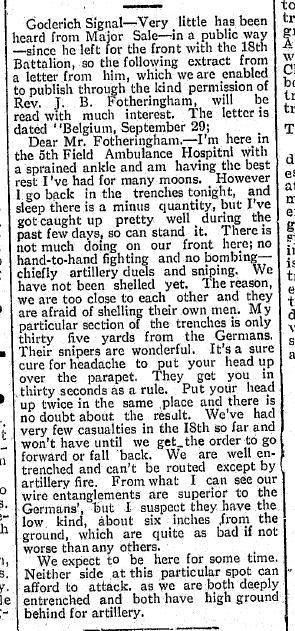
Dear Mr. Fotheringham, — I’m here in the 5th Field Ambulance Hospital with a sprained ankle[iii] and am having the best rest I’ve had in many moons. However I go back to the trenches tonight, and sleep there is a minus quality, but I’ve caught up pretty well during the past few days, so can stand it. There is not much doing on our front here; no hand-to-hand fighting and no bombing – chiefly artillery duels and sniping. We have not been shelled yet. The reason, we are too close to each other and they are afraid of shelling their own men. My particular section of the trenches is only thirty-five yards from the Germans. Their snipers are wonderful. It’s a sure cure for headache to put your head up over the parapet. They get you in thirty seconds as a rule. Put your head up twice in the same place and there is no doubt about the result. We’ve had very few casualties in the 18th so far and won’t have until we get the order to go forward or fall back. We are well entrenched and cannot be routed except by artillery fire. From what I can see our wire entanglements are superior to the Germans’ but I suspect they have the low kind, about six inches from the ground, which is quite as bad if not worse than any others.
We expect to be here for some time. Neither side at this particular spot can afford to attack. As we are both deeply entrenched and both have high ground behind for artillery.
The letter, in combination with the War Diary, allows one to see into the world of an officer in a Canadian C.E.F. Battalion at the front.
The 18th Battalion had only been in Belgium since the Brigade arrived in the Danourtre, Belgium sector on September 18, 1915 and in only 11 days Major Sales’ impression about the impact of the noise of shelling is evident for in the rear area he is, “having the best rest I’ve had in many moons.” It appears that even with such limited exposure to the affects of shelling has made a significant imprint on him and he expresses this in his letter. In fact, as he states, “we have not been shelled yet,” which makes his description about the psychological impact of shelling much more powerful. The Battalion has not had direct experience with shelling, yet Major Sale begins his letter relating about how the shelling affects his sleep. It illustrates the factors that impinge on a soldier and are part of the continuum of stressors that lead to combat exhaustion and post traumatic stress.
His description of the proximity of the trenches in his sector of being within 35 yards with his account of the modified warfare that occurred in a sector configured with two opposing trench lines so close to each other. Sniper fire appears to be the most prevalent threat and there is an interesting note that there has been no “bombing” experienced by the Battalion. The use of grenades and mortars would be well suited for this type of warfare. On October 3, 1915 the War Diary of the Medical Officer relates that Private H.R. Aikenhead was hit in the head by an experimental “bully beef tin” grenade being developed locally to combat the Germans with. It is evident that at the time of the letter Major Sale had not had enough experience to be subject or participate in this method of combat.
A sample of macabre trench humour[iv] enters the letter as Major Sale relates the merits and skill of German snipers. The use of snipers by the German Imperial Army was part of their military doctrine early in the conflict. These snipers, to which the Canadians had not developed an effective counter, had such impact to the Major that he included this new form of combatant in his letter with the warning that if you left your self exposed for 30 seconds or exposed yourself in the same spot twice you were sure to have a “cure for headache.”
He reassures Reverend Fotheringham that the cost in casualties has been “few” and this is from the static nature of the warfare and lack of artillery fire to which the Battalion is experiencing. This is reflected in the casualties the Battalion suffered. Men who were killed in action or died of wounds totalled thirty-one from September 1915 to January 1916.
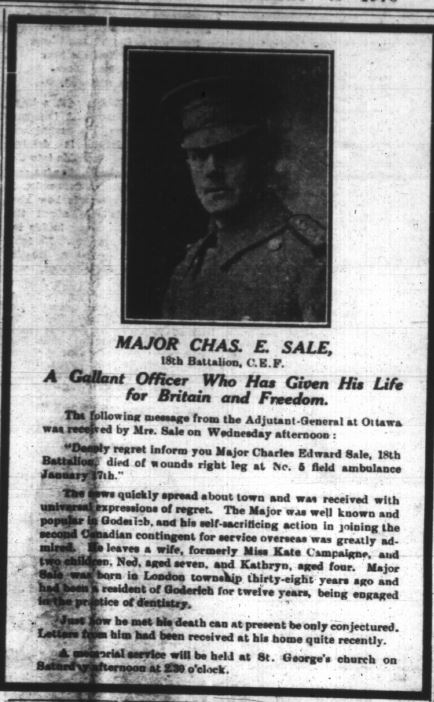
Sadly, Major Sale was to be wounded and died of those wounds January 18, 1916. One of the tools of war used to offset the inability to use artillery led to his death. He was wounded by a German rifle grenade on January 16 and succumbed to his wounds two days later. He was wounded so badly that he was not transported past the 5th Canadian Field Ambulance for further treatment. He was buried on the 19th at the Bailluel Communal Cemetery Extension at Nord, France. The General Officer Commanding for the Army Corp and the 4th Canadian Infantry Brigade, along with its officers and those of the 18th Battalion attended the grave side service.
Major Sale was well regarded by his adopted community. He was a dentist and fully engaged in community organizations and his church.

His letter is an important addition to the understanding of the early military experience of the 18th Battalion because the War Diaries are extremely sparse of detail at this time. Major Sale writes about his experience and the content gives the reader some clues as to the impact of artillery on the psychology of a soldier and his description of the trenches gives us an appreciation for how military units adapt to local conditions. The German sniper presence was of such impact and import that Major Sale writes about it in some detail.
[i] The letter was published in The Clinton New Era. October 28, 1915. Page 2.
[ii] Private Logan’s Circumstances of Death Card relates: “Died of Wounds.” In the Field, Belgium. While on duty at a listening post thirty yards in front of our lines, at about 9.30 P.M. September 29th, 1915, he was wounded in the stomach by enemy rifle bullet and died shortly afterwards.
[iii] Major Sale was admitted for this condition on September 26 and released on September 30, 1915.
[iv] See Tim Cook (2013) ““I will meet the world with a smile and a joke” Canadian Soldiers’ Humour in the Great War,” Canadian Military History: Vol. 22 : Iss. 2 , Article 5. Available at: http://scholars.wlu.ca/cmh/vol22/iss2/5
Discover more from History of the 18th Battalion CEF, "The Fighting Eighteenth"
Subscribe to get the latest posts sent to your email.
 History of the 18th Battalion CEF, "The Fighting Eighteenth"
Leave a comment