Private Frank Edward Wrightsell sits in an ornate chair. He looks at the camera and it appears his body is tight and tense. Perhaps he is trying to portray stern confidence that a soldier newly minted from his enlistment with the 186th Battalion would have. He enlisted on March 9, 1916 at Chatham, Ontario. He is a young man from a farm near Blenheim, Ontario who has had recent tragedy strike his family. Perhaps the look is one a indecision. He is leaving his recently widowed mother to fend at their farm. The Wrightsell family has had a double tragedy with Private Wrightsell’s father dying accidentally in early November 1915 and then that tragic death was followed by the accidental shooting of his 14-year old brother Thomas in December of the same year..
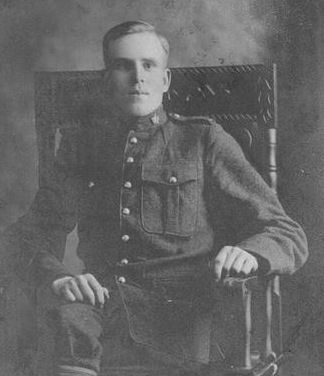
He was a typical Canadian. As each new battalion was formed, these battalions would reflect the demographic of Canada in this new century. Private Wrightsell was Canadian born, and this reflected the increasing proportion of the recruits enlisting in 1916. He came from a large farming family with nine children though the family had lost two siblings. The recent death of his brother Thomas a sure reminder of the passing of his sister Anna 10 years prior. He was 5’5” tall and 136 pounds at his enlistment, close to the average of the men of that era.
His early military service was punctuated by, what appears to be, a sudden onset of appendicitis on April 13, 1916 required an operation that day. It took Private Wrightsell until May 4, 1916 to recover sufficiently. Certainly, his mother Elizabeth received word from him or a member of the Battalion relating this condition, only adding to her worries about her boy getting ready to “go over there.” She must have been happy to see him on his embarkation leave in early March 1917 as the Battalion prepared for departure to England.
The hope would be that the soldiers of the 186th Battalion would be held whole and serve together, but the need for reinforcements for the four existing divisions of the C.E.F. on the continent required that this was to be. The Battalions in Canada, fighting declining enlistments, would arrive and be broken up. There is no indication of close friends from the service records but it would not be unusual for Private Wrightsell to bond with his section and wish to serve with the men he knew and trusted.
Two common tasks are completed before Private Wrightsell embarks for England: He completes his will and assigns a portion of his pay. In both cases his mother is the beneficiary of the will and the $20.00 per month he assigns to her. This leaves approximately $13.00 a month of pay for his use while overseas.
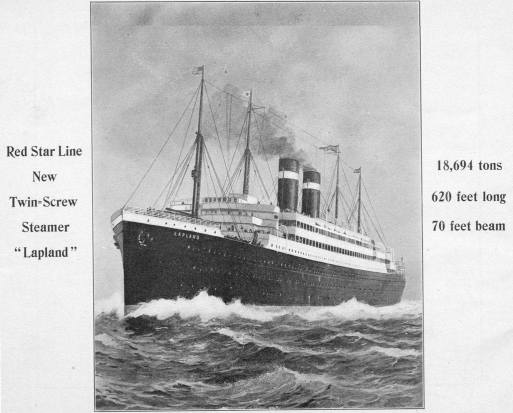
The S.S. Lapland leaves Halifax on March 25, 1917 and the next stage of Private Wrightsell’s service begins.
The road has been long. Private Wrightsell has a clean record and since his enlistment an entire year has transpired. He has been trained at London, Ontario and Base Borden and can expect more training and familiarization and the Battalion arrives at Bramshott, England and he is transferred to the 4th Reserve Battalion. On April 18th, 1917 the War Diary relates: “18 Officers and 450 other ranks reported from 186th Bn.” With that the cohesive unit from Chatham, with many of its sons, was, in effect, no more.
From that time these men knew that they were headed to the front.
The fall of 1917 progressed and on June 16, 1917 a draft of 50 other ranks left for the Canadian Infantry Base Depot at Etaples, France at 9:45 PM. Into the darkness of an English summer they marched to a train station and embarked to, perhaps, Folkestone, to be transported across the Channel to France and onto the C.I.B.D. Arriving the next day Private Wrightsell waited until July 8 to be assigned to the 2nd Canadian Entrenching Battalion. 48 other men assigned to the 18th Battalion arrived at Hersin, France for duty. The entrenching battalion was engaged in a range of activities from assisting a gunnery ranges, reserve area laundry, and other miscellaneous duty. Other than a short stint serving with the Canadian Corps Supply column, it appears that on July 31, Wrightsell was one of 19 other men who left for the front-line. This unit was close enough to the front that it gave the new soldiers some familiarization as to the activity and noise in an area of active combat operations.
Now he is in the thick of it. One wonders what a photograph would look like now. He served faithfully with the 18th Battalion until his death only 19 days after being transferred. He had no time to learn anything of the skills and abilities to survive in combat. There is a good chance that, given the high intensity and fluidity of the combat at Hill 70 being a veteran was not a guarantee of survival. The 18th Battalion War Diary appendices has numerous messages written during the battle and though not a cohesive narrative it shows how hectic and stressful combat was. In these documents is the first, and perhaps only, record of military fratricide where a grenade thrown by a soldier kills an officer of the 18th Battalion.
Another indication of the intensity of the engagement is, out of the sixty-six soldiers to perish August 1917, twenty-five (38%) have no known grave and are honoured on the Vimy Memorial, including Private Wrightell.
The news of the death in action of Private Wrightsell came swiftly to his home in Harwich. He was listed as killed on August 16, 1917 and the news must of arrived within three days as the local newspaper published an article relating his death:
Two Young Soldiers Give Their Lives.
Flag Half-Masted Sunday and Mondy in Honour of Harwich Boys
“It never rains but it pours.”
…Monday the same dread message of death came to Mrs. Wrightsell near [placename illegible], announcing the death in action of her son, Pte. Frank J. [E] Wrightsell of the 18th battalion. He was 21 years of age and had lived all his life in Harwich. He enlisted in the 186th battalion and is the first from the ranks of that battalion so far as we know to have been killed in action. To his mother, whose cup of sorrow seems to be well filled, much sympathy will be expressed. During the past two years, bedsides the present bereavement she also suffered the loss of her husband following an accident in which he sustained a bad fall, as well as the death of another young son who was accidently shot while playing with a schoolmate and afterwards died.
The town flag was half-masted Sunday and Monday in honor of the sacrifice these brave young men have made.
Source: The Blenheim News-Tribune. August 20, 1917 (Wednesday). Page 1.

Private Wrightsell was to perish in the crucible of combat that was the 18th Battalion’s experience from August 13 to 24, 1917. His death added further to the tragedies of the Wrightsell family and the $180.00 War Service Gratuity and Silver Cross was inadequate compensation to Private Wrightsell’s mother, Elizabeth. For her, perhaps, there is some compensation that no other son served in the C.E.F. and the fact that her family is keeping her son’s memory alive 100 years later.
With thanks to Nicole Ramsdale, without whom this article would not be possible.
Supplemental Images


Discover more from History of the 18th Battalion CEF, "The Fighting Eighteenth"
Subscribe to get the latest posts sent to your email.
 History of the 18th Battalion CEF, "The Fighting Eighteenth"

From:
Eric, this is another sad and very moving story about the journey of an individual Canadian soldier to his fate on the Western Front. Thoughtful and well-written, once again you give new meaning to the words “we will remember them.’ Thank you.
Cheers,
Patrick
Yet another soldier for the Lives site. https://livesofthefirstworldwar.org/lifestory/5800855