On June 6, 1955 in Syracuse, New York, Mrs. Rose B. Scott became a widow.
Almost a year passed and on May 8, 1956 she sent an inquiry through the mail to the “Department of Records, National Defence” in Ottawa, Canada regarding her husband’s military service with the Canadian Expeditionary Force. Her husband, Dennis Scott, enlisted with the 59th Overseas Battalion and his active service was with the 18th Battalion. Suffice to say that Private Dennis was not a model soldier as he was subject to military punishment (see end of article for record summary) throughout his military service. But he was discharged in good standing and received the balance of his pay without penalty.
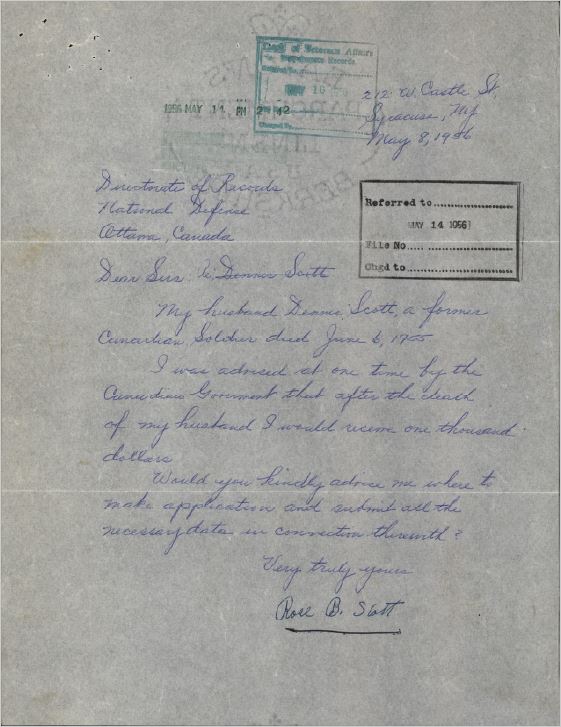
Her inquiry states:
“Dear Sirs Re. Dennis Scott
My husband Dennis Scott, a former Canadian Soldier died June 6, 1955.
I was advised at one time by the Canadian Government that after the death of my husband I would receive one thousand dollars.
Would you kindly advise me where to make application and submit all the necessary data in connection therein?
Very truly yours,
Rose B. Scott”
As she had not furnished any other identifying information other than her husband’s name the inquiry needed to be first forwarded to the appropriate government department and then a search made to determine to what soldier this prospective benefit would be assigned to. Ironically, there was only one Dennis Scott. Out of the 1,893 “Scott”s who enlisted there is only one “Denis” Scott.[i]

A short note in the service record to a Major Strange dated May 18, 1956 notes:
“re Dennis Scott
Herewith the only Dennis or Denis Scott in C.E.F.”

From this discovery Mrs. Scott’s inquiry can be answered and on May 22, 1956 the Director of Pay Services responds:
Dear Madam:
Your letter in May 18th, 1956, addressed to Directorate of Records, National Defence, Ottawa, has been forwarded to this department for attention.
As you did not quote any regimental or service number, or give any family details, it is extremely difficult to identify your deceased husband, as a member of the Canadian Armed Forces.
Your query regarding money grants to families of deceased ex-service men has been noted and it is regretted to advise you that there is no such grant payable to anyone.
On discharge from the forces in 1919, those who had entitlement to Gratuity, were immediately paid and pay accounts closed. No further grants or bonuses have been granted by the Government for service in the forces.
Your truly,
[Signed]
for: Major, DIRECTOR OF PAY SERVICES.
This must have been disappointing for Mrs. Scott. One-Thousand dollars in 1956 is approximately equivalent to $9,000 U.S. dollars in buying power in today’s dollars, not an insignificant sum. Whatever her disappointment it appears from Private Scott’s service record that no other inquiries were made and the pursuit for the elusive $1,000 ended.
This is an interesting insight into a very specific post-war experience with Mrs. Scott having to deal with her husband’s estate and eventually finding time and taking effort to make an inquiry in regard to her husband’s military service. It would be interesting to note where the idea of the thousand-dollar payout came from. She states quite deliberately that it was from the “Canadian Government” who advised her of this benefit. As seen, her inquiry was successful in finding out the answer, but it was to the negative.
One wonders what stories about his service Private Dennis Scott related to Rose and others. His service record is ripe with charges, convictions and punishments leading to a total of 334 days of incarceration out of 1,286 days of military service, a whopping 26 percent of his time in service. The potential time served if his crimes had not been commuted would have resulted in 1,095 days of imprisonment and hard labour.
A fluke of history means that there is, definitively, only one Dennis Scott, born in Grand Falls, New Brunswick, who most likely lived in Carthage, New York with is father, and travelled to Toronto, Ontario to enlist in the CEF to eventually serve, on and off between punishments, with the 18th Battalion.
Below is a summary of Private Scott’s punishments. To view a more detailed information please see his service record.
| Charges and Description |
| 3 charges before being sent overseas. |
| Fined $2.00 for being drunk. |
| 7 days Field Punishment (FP) No. 2.[ii] |
| Fined $2.00 for being drunk. |
| 7 Days FP No. 2. |
| 7 Days FP No. 2. |
| Restricted Pay for being Absent Without Leave (AWL) |
| Fined $6.00 for being drunk. |
| 16 Days FP No. 2 for being drunk. |
| 35 days FP No. 1 for being drunk. |
| 28 days FP No. 1 for being drunk, breaking arrest, and insolence to a N.C.O. |
| 14 days FP No. 1 for being drunk on active service on parade in the trenches. |
| 35 Days FP No. 1 for breaking arrest and being drunk. |
| 1 Years Imprisonment with Hard Labour (IHL) commuted to 91 Days FP No. 1 for breaking arrest and being drunk. |
| 2 Years IHL commuted to 91 Days FP No. 1 for escaping and being drunk. |
[i] The service records record her husband’s name incorrectly, though the documents have the correct spelling.
[ii] Field Punishment No. 2 involved the shackling of the wrist and/or legs for a proscribed amount of time. Unlike Field Punishment No. 1 which required the soldier to be affixed to a stationary object, sometimes in view of other solders, FP No. 2 did not involve the soldier being tied to any object. For more information see this link.
Discover more from History of the 18th Battalion CEF, "The Fighting Eighteenth"
Subscribe to get the latest posts sent to your email.
 History of the 18th Battalion CEF, "The Fighting Eighteenth"
Leave a comment