There were more than 7,052 men of the C.E.F. and Royal Newfoundland Regiment with the surname SMITH.
This is the story of one of them.
Percy Smith was a farmer who worked at the Havelock Farm in the Woodstock, Ontario area. He joined 168th Battalion in May 1917 and by September 1917 he was assigned to the 18th Battalion arriving June 12, 1917 while the Battalion was stationed at Barlin. He was one of the 42 other men who arrived as reinforcements that day.
His service with the Battalion would be short lived.
Thirty-seven days later during a rainy day on July 18, 1917, while cleaning his Lee-Enfield rifle it accidentally discharged, wounding him in the arm. The bullet caused a “compound comminuted fracture of the left ulna.” In other words, the bullet hit the bone with such force the bone shattered into many small pieces near the left wrist bone. Being wounded in this way was serious and Private Smith was transported to No. 6 Canadian Field Ambulance were the diagnosis indicated a “GSW (Bullet) Arm L. Fracture Self Inflicted.” From there he moved on to the 57 Casualty Clearing Station, Special Hospital. He was listed as “dangerously ill” on July 26 and suffered a second haemorrhage which necessitated the amputation of his left arm below the elbow. This condition was dire, and he had a “collapse under opiate.”
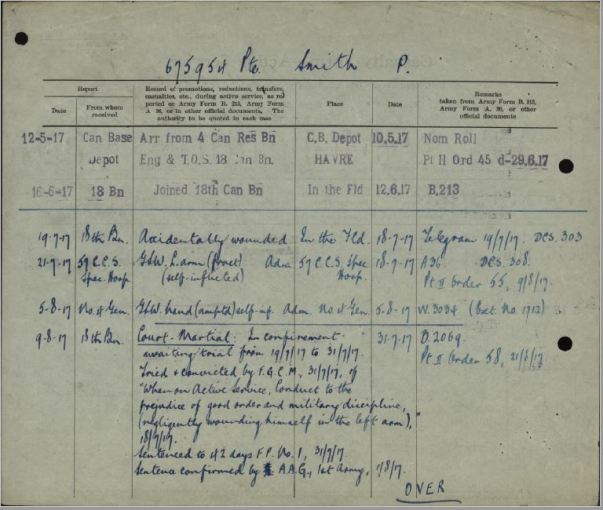
Private Smith was to recover but his ordeal was not over. He was charged under martial law for the events that transpired on that day in July. He was essentially held in “confinement” from the day after his wounding until July 31, 1917 and then tried under a Field General Court Martial charged with, “While on Active Service, Conduct to the prejudice of good order and military discipline, (negligently wounding himself in the left arm).”
Private Smith’s evidence was succinct:
“I was cleaning my rifle and forgot I had it loaded.
I do not know how it went off as I do not remember touching the trigger.”
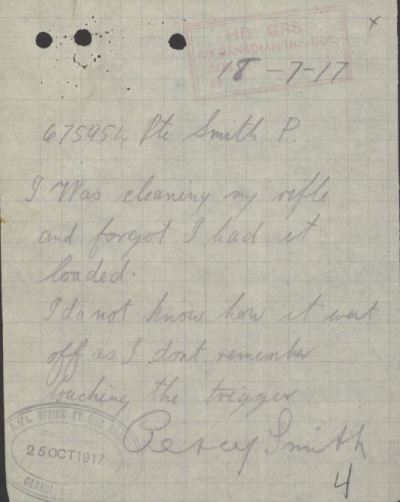
There is no question that Private Smith broke a cardinal rule about cleaning a firearm. Regardless of the circumstances of the discharge he is the only one responsible for the safe operation of a weapon and its maintenance.
The statement appears to be made out on the day of the incident and signed by Private Smith, an interesting circumstance, given that he had his left arm damaged by a bullet with a compound fracture on that very day. This is not necessarily surprising. The Battalion’s need to action, determine, and report on accidents had been proactive in the past, such as when Lieutenant William Orimston Brown was killed during a training accident.
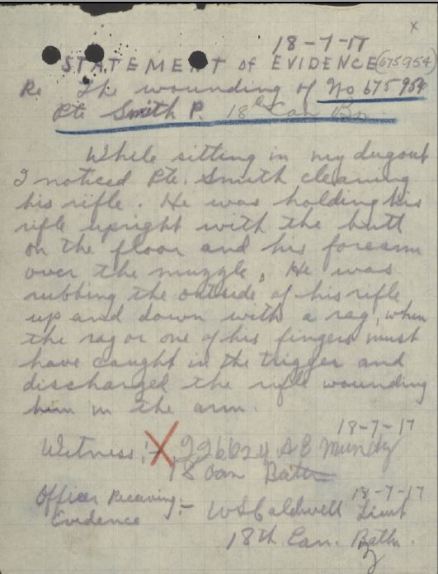
A Statement of Evidence was given by Private A.B. Mundy:
“While sitting in my dugout I noticed Pte. Smith cleaning his rifle. He was holding his rifle upright with the butt on the floor and his forearm over the muzzle. He was rubbing the outside of his rifle up and down with a rage, when the rag or one of his fingers must have caught in the trigger and discharged the rifle wounding him in the arm.”
The circumstances and the evidence resulted in a conviction. Private Percy Smith, new to the Battalion, but not the army, having 6-months prior experience with the 4th Oxfords and Bucks Light Infantry before he emigrated to Canada, was punished with 42-days of Field Punishment No. 1 effective July 31, 1917 and confirmed by the Army Adjutants General, 1st Army, British Expeditionary Forces. One wonders how the authorities had envisioned meting out this punishment. There is a good chance that the Court and the A.A.G. was not aware of the subsequent events leading to the amputation. It does give the appearance of an unfeeling bureaucracy driven by process and procedure. Perhaps Private Smiths punishment was modified given this condition. The only hint of this is a note in his service record stating he was “in confinement” awaiting the court-martial.
He is treated, eventually receiving an artificial arm at Denmark Hill Hospital and returned to Canada for further treatment.
Ironically, after suffering a painful wound and an amputation resulting from same and then being punished for his negligence he was discharged, and his character is rated as “Very Good” by the officer effecting his discharge in Toronto, Ontario on October 28, 1918. In a further irony, given the eagerness and energy of the military justice process to punish Private Smith, he would end up with a Wound Stripe (Gold Stripes One). Under military regulations accidental wounding was exempt from this award.


Private Percy Smith, former Kingham Hill boy and farmer, passes into history. One wonders what trade he practiced now that he had an artificial arm and what other impacts to his life his military service had on his life.
Discover more from History of the 18th Battalion CEF, "The Fighting Eighteenth"
Subscribe to get the latest posts sent to your email.
 History of the 18th Battalion CEF, "The Fighting Eighteenth"
Leave a comment