
You look like you filled out and put on weight in your uniform in the picture. You stand slightly cocked to one side beside your brother, which makes you appear shorter than your brother more than the 2 and ¾ inches between you. Perhaps a year’s worth of training allowed your 19-year frame to grow a bit and the physical training exercises have but some mass to your muscles. Remember how much you weighed when you joined the army back November 1915? 122 pounds. Time has passed, and you have met up with your older brother. Somehow you both swung the opportunity to meet up to take a photograph. It looks like your brother, William, or as the family called him, Bill, is well and fit after long convalescence in England after taking a “blighty” in the left thigh back in October 1915. Of course, it was almost two-weeks after Bill’s wounding that you joined the army. Was his wounding the impetus to you volunteering for the army just two-weeks after your eighteenth birthday?
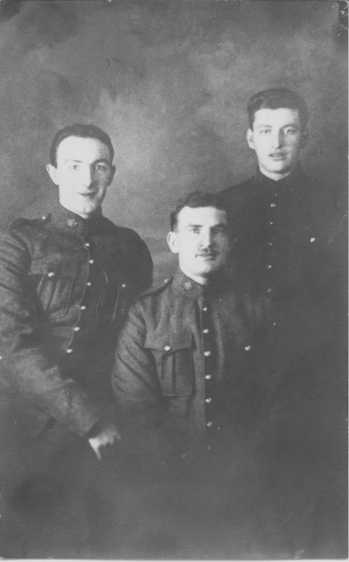
But now in the late fall of 1916, you were able to organize a moment in time, all those years ago, to meet your older brother. You only had been in England a month since arriving in October. You were destined to go to France and active service “over there” at the end of November that year and you had your baptism of fire in early December arriving with a draft of 101 soldiers at Grouy-Servins, France, were the 4th Battalion was stationed, at that time.
What was the conversation like between you and Bill? He was the veteran, having served in France and Flanders for a month before being wounded. Apparently the first man in the Battalion to be so. The picture keeps that secret. You both stand together, oddly separated and spaced from each other as that other soldiers sits in the center of the frame. The secret of what you shared is safe in time. But one can be sure you both spoke of home and your family back in Canada.
Would this be the last meeting between brother Bill and John? Your battalion served in different brigades and divisions but perhaps the strength of your bond allowed you both to keep such touch as necessary to meet personally again. Bill came back to France in May 1917 and your service in France overlapped with his until he was wounded a second time in July 1917 and he had to suffer another long convalescence in England which led to his medical discharge in April 1918.
April was going to be a significant and tragic month for the Dewars.
The 2nd Canadian Field Ambulance was located at Dainville, France and at some time during the night of March 31/April 1, 1918 it received the casualty of a private soldier by the name of Private John Taylor Dewar.

You had been hit by shrapnel which had penetrated your young body in the legs, chest, left arm and buttock. It was from at least one German shell and occurred as your Battalion passed through the village of Beuarains. It had been billeted at Dainville during where it “stood to” in preparation to return to the front in the Telegraph Hill Sector south-east of Arras on the night of March 31, 1918. The Battalion departed at 7:00 PM and marched 18 kilometers to the village of Beuarains where the German shell(s) stuck. It is not clear if it was a single shell of harassing or interdicting fire, but the shot fell during the twilight of that night and its affects were as follows: In “C” Company it killed two of your companions outright and wounded 20. One soldier of “D” Company was wounded. That was you.


Your condition was such that you were transported, most likely by motorized ambulance, after battlefield first aid was rendered, to the 2nd Canadian Field Ambulance post located back in Dainville. From the condition of your wounds it appears that you were triaged to be stabilized for further treatment or palliative care as you were too injured to move on to a casualty clearing station where you would have been assessed further and eventually transported to a base hospital. But, that was not to be. You were very badly wounded and perhaps the medical team at the post determined that comfort and pain management was all that could be offered to you. You lay, not alone, but lonely, separated by your comrades in arms and by a distant family in Canada unaware of your condition.
Four days after your wounding you died.

You lie buried at the Faubourg D’Amiens Cemetery, Arras, France along with 2,677 other Imperial troops that perished during the war. It is a fitting resting place and very beautiful and peaceful, as are many of the cemeteries managed by the Commonwealth War Graves Commission. There is no epitaph on your headstone, perhaps because the family was too wrought with mourning to think of anything fitting to place there. You were remembered in a “Peace Booklet” published in Waterloo County post-war with a small picture of you, and then later, your name is inscribed on the memorial at Queens Square in Cambridge, Galt, Ontario where the name of Dewar almost melds with the flat grey of the stonework.


You are not, however, forgotten. The family visited your grave in September 2015 and paid their respects and this article is a very small token of our love and respect for your brave service and sacrifice.
Rest easy Uncle John.
Discover more from History of the 18th Battalion CEF, "The Fighting Eighteenth"
Subscribe to get the latest posts sent to your email.
 History of the 18th Battalion CEF, "The Fighting Eighteenth"
Leave a comment