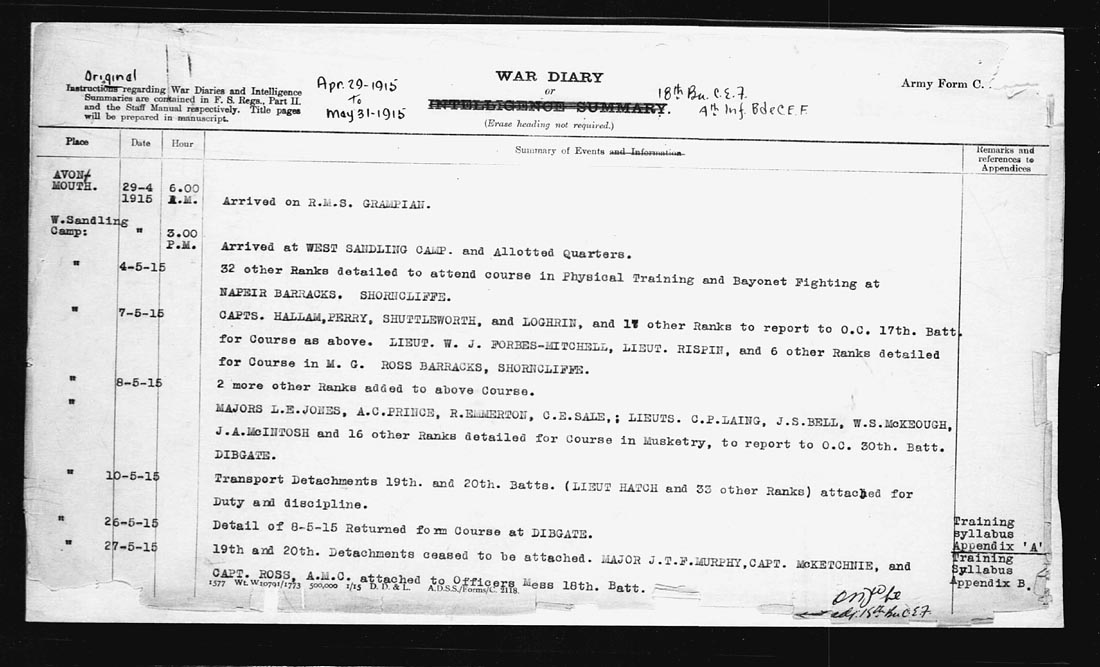
The 18th Battalion trained in England from May to September 1915. It was based at West Sandling Camp near Shorncliffe Military Base and the 18th Battalion War Diary does not do a good job in relating the activities of the soldiers while they trained there. It is epic in its brevity. Twenty-five of May’s diary entries are blank.
Thus, getting a sense of the activities of the soldiers is difficult with the diaries.
Almost less is known of the activities of the individual soldiers during and after training. Compiling all the sources of the one-thousand odd members of the 18th Battalion is impossible but the contemporary news clippings from the hometown papers give us a glimpse into the men’s lives.
Thankfully, the St. Thomas Journal (St. Thomas, Ontario) relates two incidents that help fill in the experience and lives of the common soldier and officers of the Battalion.

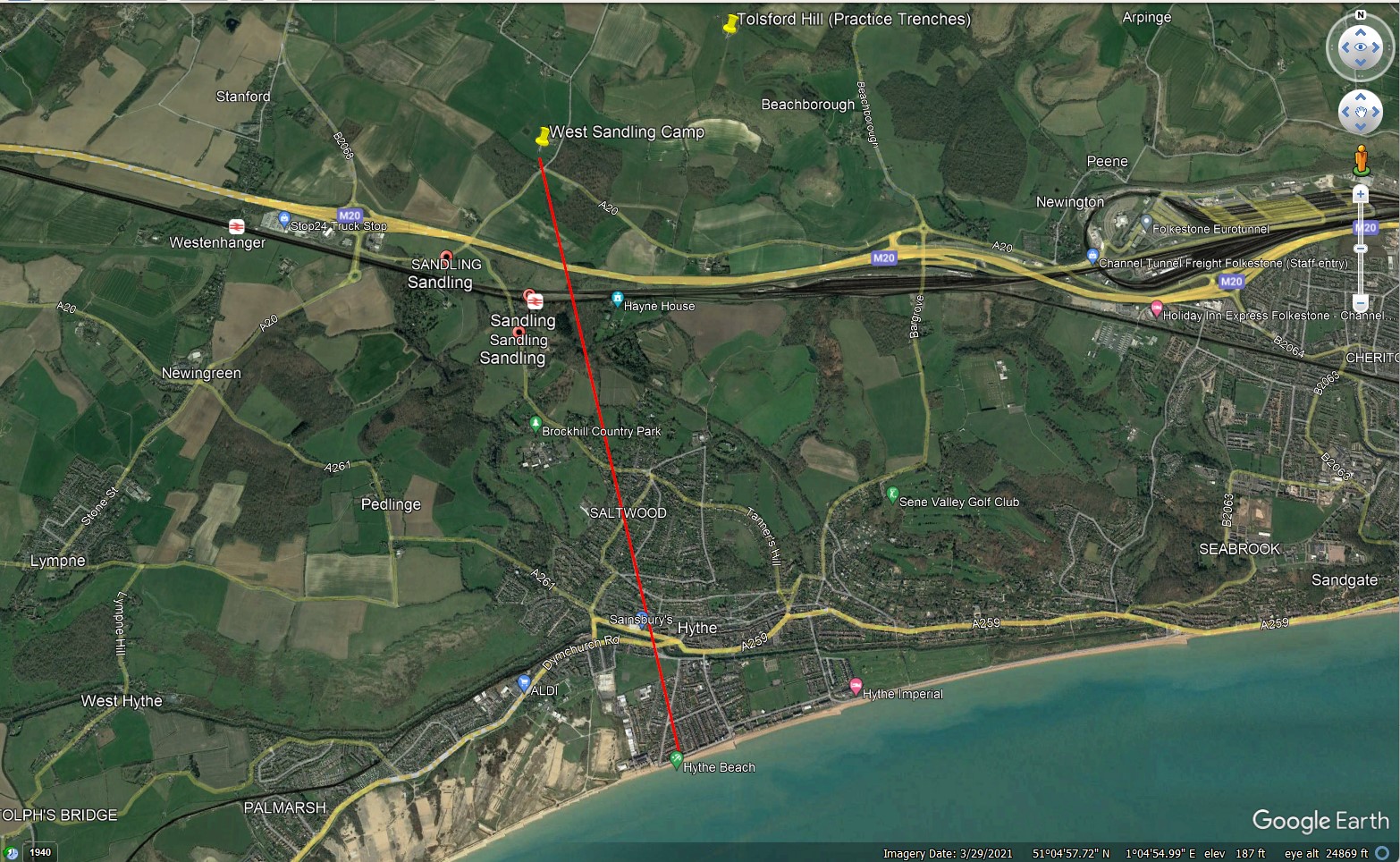
West Sandling Camp was located near Cowtye Road with Tolsford Hill being immediately north-east of the camp. Today the M20 divides the location of the camp with the town of Sandling and it was approximately 2.5 statute miles to Hythe Beach. The fastest way to the beach would be a walk from the camp south-west on what is now the A20 to the Sandling Road. Following that road it turns into School Road, then Tanner’s Hill then east along the current A259 to Twiss Road and south to the beach.
It had been noted that the that summer in 1915 offered some fine hot weather.[i] This, coupled with the hard work of training the Battalion and the other units of the 2nd Canadian Division, made for the need for relief from the physical stresses of the marching and other drills, coupled with the heat of summer, incented the men of the 18th Battalion to search out relief in the form of a cool swim in the English Channel.
The article relates an incident where a soldier of the 18th Battalion not only saved a fellow member of the 18th Battalion, he is credited with saving the life of a local resident. An earlier article dated 12 August 1915 in the St. Thomas Times only relates that the potential drowning victims were male and female. As the article relates,
“Four Battalions, the 18th, 19th, 20th, and 21st where brigaded and marched from Sandling Camp to the Channel, a distance of a quarter of a mile.[ii] The men numbering perhaps five thousand, gaily disported themselves in the cooling waters, for they had just returned from a strenuous route march. Pte. Grieves, who was swimming with the others, perceived Pte. Cook in the deep water, struggling with cramps, and without hesitation went to his rescue, bringing him safely to shore. Pte. McCausland had nothing but the highest praise for Pte. Grieves’ heroism,
Saved Woman Before
This is the second life Pte. Grieves has saved since his battalion landed in England. A short time before he plunged into the waters of Shorncliffe and dragged a drowning woman to the shore.[iii]”
Sadly, this act was offset by the previous month with the tragedy of Private Hugh Marshall[iv] who was killed when he was struck by a vehicle in Glasgow on 22 July 1915. The news story relates how these men (Grieves[v], Cook[vi], McCausland[vii], and Marshall) were connected, as they are members of No. 3 Platoon, “C” Company, 18th Battalion and shared a “shack” at the West Sandling Camp.
The survivors took the time and effort to purchase a memorial wreath for their fallen friend and “sent them to the funeral”. Of note, the news article mentions that three officers of “C” Company went to Scotland to attend the funeral, a strong gesture of unit cohesion and how each soldier is valued by the unit. Any family attending that funeral must have felt the comfort of this man’s officers attending his funeral.
The news article goes on to mention that Grieves would “probably receive a military decoration for his valorous acts.” This was not to be. Private Grieves was probably more than satisfied to have saved two people’s lives. The act was award enough.
Private Grieves would be wounded in action on 9 May 1916 in Belgium Having suffered a GSW[viii] to his left foot he was returned to England for treatment and was discharged as not being fit for further service. He returned home to St. Thomas, and he moved to Windsor and there is a record of him emigrating to the United States in 1923. He passed on 29 April 1955 at the age of 64 and is interred at Greenlawn Memorial Gardens, Oldcastle, Ontario.

The man he saved from drowning, Private Cook, would earn a Military Medal during the confusion and horror of the Battle of Flers-Courcelette at the Somme on 15 September 1916. He would be promoted Corporal (18 October 1916) and then appointed a Lance-Sergeant the next day, obviously making up for losses of the non-commissioned officers of the 18th Battalion lost during its tour of the Somme.
Cook would miss the big show at Vimy Ridge as he was sent to England on an Officers Course on 3 April 1917. He would return to the 18th Battalion on 4 September 1917 and would serve with the Battalion until April 1919 earning a Military Cross during is service. He married in England, and he is buried with his wife at St. John’s Anglican Church Cemetery, Windsor, Ontario having passed in 1964.
The Canadian born sailor, McCausland would serve with the 18th Battalion and be wounded twice. The first wounding occurred on 1 March 1916 when he sustained GSWs to face, head, and right shoulder. They healed in just over a month’s time and he was back with his Battalion on 6 April 1916.
Not six days later he received his second wound, much more serious this time. He had GSWs to his left buttocks, left thigh and hand, and damage to his sciatica nerve. This required treatment in England and he was slated to convalesce at home in Canada and discharged as medically unfit on 31 March 1919. His wounds indicated a disability pension of 70% and the pension documents were not sure if the results of his wounds would be permanent, and they made no estimate on the time it would take the wounds to heal. One can assume that this man suffered permanently from the second set of wounds he sustained for our country.
McCausland would die on 14 February 1963 and is buried at Luton Cemetery, Malahide, Ontario. He was 79 years old when he died.

[i] Contemporary accounts read by the author.
[ii] As seen by the map this is not accurate.
[iii] St. Thomas Journal. 12 August 1915. Via Allan Millar, 18th Battalion Facebook Group.
[iv] Private Hugh Marshall, reg. no. 54266.
[v] Private John Ezra Grieves, reg. no. 53681.
[vi] Private Charles Cook, reg. no. 53663 (MM, MC). This man was the only soldier with the surname of Cook in the entire nominal roll of the 18th Battalion as an other rank.
[vii] Private John Gillespie McCausland, reg. no. 53708.
[viii] GSW: Gunshot Wound. A generic term to indicate any would by a penetrating object such as shrapnel or a bullet.
Discover more from History of the 18th Battalion CEF, "The Fighting Eighteenth"
Subscribe to get the latest posts sent to your email.
 History of the 18th Battalion CEF, "The Fighting Eighteenth"
Leave a comment