TRIGGER WARNING: This blog post relates the experiences of a combat soldier that may not be appropriate for all readers.
The 18th Battalion’s role and experiences during the 15 September 1916 Battle of Flers-Courcelette are not officially well documented. The War Diary for that month is bereft of detail to the point that someone printed on the war diary documentation saved at the Library and Archives Canada “NOT MUCH HELP TO A HISTORIAN”. This sentiment is further reflected in William F. Stewart’s Canadians on the Somme, 1916: The Neglected Campaign. This comprehensive work has virtually no references for the 18th Battalion as Stewart did not have the primary or secondary resources to flesh out a narrative for this unit.
The 18th Battalion War Diary entry for that day is literally:
“6.24 am. Battalion attacked German front and second lines to depth of 1,200 yds. And held the position gained (both objectives gained).”[i]
But, sometimes, luck intervenes, and eyewitness accounts come to light that help illuminate the events of that terrible day.[ii]
On 29 December 1916 the Toronto Star published an article regarding a letter an 18th Battalion soldier[iii] sent to his former employer. In it he relates aspects of the battle that are illuminating and personalize the experience of the men of the 18th Battalion by giving one person’s eyewitness account of that action of that battle, so poorly represented by the official war diary of the 18th Battalion.
The news clipping relates:
SO MANY SURRENDERED IT RESEMBLED ATTACK
Letter From Toronto Man, Since Dead, Tells of Tanks’ Work.
HOW OFFICER DIED
Pointed for Gunner’s Benefit and Attracted Enemy’s Attention.
On the eve of an operation in a London hospital John Creasy, a former employee of John C. Green & Co.[iv], Toronto, wrote to his employers the letter which is printed herewith, giving particulars of the engagement in which he received his wound. Information has been received that Creasy did not survive the operation, as it was reported today that he died on December 12th, the letter follows:
No. 6 Ward,
University College Hospital,
Gower Street,
London, S.W.
Dec. 5, 1916
Dear Mr. Green:–
This afternoon I’m having my operation[v], so I must write to you right now, or you won’t hear from me for three or four weeks.
No doubt you heard all there is to be heard concerning myself, and perhaps that’s the only reason I haven’t written to you before.
Now I’ll just give you a few facts as to what really did happen on the day I was wounded.
The Fight on September 14.
On September 14th at 9 p.m., we, that our battalion, started from A—[vi] for the trenches and arrived withing a few hundred yards of the reserve line by about 10 p.m.; here we were told we should remain until about 4 a.m. the next morning, a 5 hour’s wait with no overcoats and a bitterly cold night. Sleep was out of the question for there was no shelter at all, so we just walked about to keep ourselves warm. The guns were thundering all around, and if anything, the Germans were sending over more shells than we were. Well, eventually 4 o’clock came round and we started to make a move for the communication trench; by this time the Germans were sending over a terrific lot of shells, and they began to burst all around us, so we had to go pretty carefully. Well, we managed to get into the communication trench all right, but further than this we could not get. The trench was packed full of men, some trying to get in and some trying to get out.
Eventually, those who were coming out had to go overland. It was an awful crush, one could neither move forward or back. Presently word came down that all bombers and bayonet men must go up at once. Fritz had taken our front line and it must be taken back at once.[vii] We were all ordered to prepare for action, and as it was dark, and we couldn’t see, we didn’t know which way the trenches lay and didn’t know which was to expect Fritz to come from, this being our first trip in. The result was that there was a general mix-up. Well, soon it began to get light and we began to wonder if we’d reach our positions in time to advance – half-past five and the advance was to start at six sharp, and still we were in the communication trench. Fellows who were wounded were trying to get out, and, of course, we had to make way for them. You may imagine what a job it was with a machine gun[viii] and ammunition to carry and only just enough room for two infantrymen to pass one another. Well, about a quarter to six we began to make a move. Word came down that Fritz had been ejected from our trenches.
Long Time Between Meals.
We, that is our gun crew, reached our position at five minutes to six.[ix] We hadn’t had a bit to eat since the previous evening, about 7 p.m., but one thing we did have was our rum. We all had a good swig of it and were quite warmed up when our artillery opened fire. Things began to get exciting then, and it really was a magnificent spectacle to see our shell bursting over Fritz’s line. There couldn’t have been a yard that wasn’t covered. Exactly six o’clock and you couldn’t see Fritz’s front line for shells. Then a little thing happened which, had I had time to think, would have made me sick. The fellow next to me was hit by a shell, and he must have taken the full weight of it, for I didn’t even feel the shock. All I saw of the poor fellow was his two legs, one lying at my feet and the other in front of me lying on the parapet. Thank God I didn’t have a moment to think about him or I would have flunked it. Presently our lieutenant gave to signal to advance, and up we jumped and ran about 50 yards. Our crew, by the way, was in the 5th wave, we that we came in for a deal of shell fire, for by the time we left our trenches, Fritz’s artillery was aware of what was happening and put up a curtain of fire.
Well, again we got to order to push forward, and this time we went about 150 yards. We flopped down in the nearest shell home and watched our gun in case our fellows had to fall back. We only stayed there for a couple of minutes and then pushed on another 100 yards or so. By this time were nearing a ridge which had to be taken. Our lieutenant[x] had gone forward to locate a position for our gun. Presently he came back to take us to a shell hole which he had thought was a good place. He just reached us when we saw on our right a bunch of Germans, on the British front, about two hundred yards away.
Pointed and Was Shot.
At this time he was kneeling on the ground. Unfortunately, he pointed with his arm in the direction which he wanted our gunner to fire. This action on his part, undoubtedly attracted the attention of some German and the very next instant he rolled over next to me, with a bullet through his head. Death was instantaneous. We remained for a few minutes where we were, and whilst lying in the shell hole I saw was I thought was a counter attack by the Germans on the British front, and I told our gunner; thereupon he told me to look again. I did and this is what I saw – I saw a tank sitting on top of a German trench and firing right down it. What I thought was a counter attack, was a wholesale surrender of Germans running towards the British with their hands up.
Soon the Germans started to lift their barrage, and as it appeared to be coming nearer to us we made up our minds to push forward again. By this time we had covered four or five hundred yards, and now we had to be very careful. Germans who had surrendered were coming along in large numbers and it was necessary to see they had not arms on them, so we stopped quite a few and made a hurried search but never found any weapons on them, most of them having thrown away their equipment as well.
Well, eventually we reached our objective, a distance in all of 1,200 yards, and immediately started to dig ourselves in. Our position was about 100 yards behind our new front line on the right flank, and our duty was to hold on to the position, and should it be necessary four our front line troops to retire we had to cover their retreat. Fortunately, they did not have to retire.
Carried Heavy Load
You may imagine by the time we reached our position we were pretty well tired out. Anyway I was, for I had been carrying for most of the way 500 rounds of ammunition for the gun[xi], 120 rounds for my own uses, and adapter for the tripod weighing 20 lbs., and my rifle and equipment. Quite a load, I can assure you. Digging ourselves in 6 feet deep did not lessen my fatigue, and I was indeed dead beat when I sat down in our new trench for a little rest, and it was whilst I was sitting down that I got it. Fortunately for me there was a Red Cross man near by, and he soon had be bound up. As you probably have heard I got it in the stomach, the shrapnel coming to rest on a bone in the groin (two inches deep as they found out this week). Of course, I lost the use of my leg and couldn’t walk by myself. One of our fellows got an infantrymen to help me, and we started off overland to the dressing station, which was in our old trench, 120 [1,200] yards away. You see thought we were in much danger where we were as we would go overland, so I determined to get back somehow. It was 10.30 a.m. when I got hit and the stretcher bearers could not get up until dark, so it was no use waiting for them. How we crossed that 1,200 yards I scarcely know. It was impossible for us to jump across the old trenches, so I had to slide down one side and let the fellow pull me up the other.
All this time the Germans were putting up a heavy barrage to keep the reserves from coming up. Shells burst all around us, even within 10 yards of us, but we didn’t get hit. It is impossible for you to imagine the danger we were in. The fellow who took me back certainly deserves some recognition, but unfortunately I don’t know who he was and I guess I was feeling too bad to ask him his name.
Well, eventually we reached the dressing station, where there was heaps of hot tea; I can tell you I was might glad to get some. After waiting for an ambulance and taken to A— where they took particulars of my wound and my name etc. From there I wasn’t sent to a casualty clearing station, where I remained for one day. The next night I was put into a train and sent to Boulogne, where I remained for four days as my temperature was up to 102 degrees. From there I came up here where I have been for nearly eleven weeks.
Now I must close as I am going to the operating room.
Your sincerely,
JOHN CREASY.

This letter is full of precious details. It relates how the weather; the confines of the trenches; how being witness to a horrible death, and other stimuli affected Private Creasy. The letter stands on its own and bears witness to the actions of that day were so many men of the 18th Battalion fought and perished.
There are several events that enhance our understanding of this action from this Battalion’s perspective.
The first is the involvement of tanks. This battle is famous for its introduction of armour as an arm of modern combat forces, but the overall description of its involvement from the infantry’s point of view. The 21st Battalion war diary relates “The Battalion advanced well ahead of the Tanks, and the final objective was gained before Tanks overtook them. One Tank which advanced along SUGAR TRENCH to r.30.c.5.3 then advanced in front of our final objective, then turning SE to BAPAUME ROAD after which time it was not seen by our Front Line troops. Nothing was seen of the other tanks.”
From this unit’s perspective the war diary relates the movement of the tanks but does not elucidate any of their actions – how they impacted the battle space.
Creasy, on the other hand, bears witness to this:
“I saw a tank sitting on top of a German trench and firing right down it. What I thought was a counter attack, was a wholesale surrender of Germans running towards the British with their hands up.”
This event was most possibly the actions of a tank called “Cordon Rouge” commanded by Second John Allan who was awarded a Military Cross for his actions that day:
“For conspicuous gallantry in action. He maneuvered his ‘Tank’ with great skill under heavy shell fire over difficult and unknown ground, and brought it into a good position for enfilading the enemy’s trenches, which he succeeded in doing with good effect.”[xii]
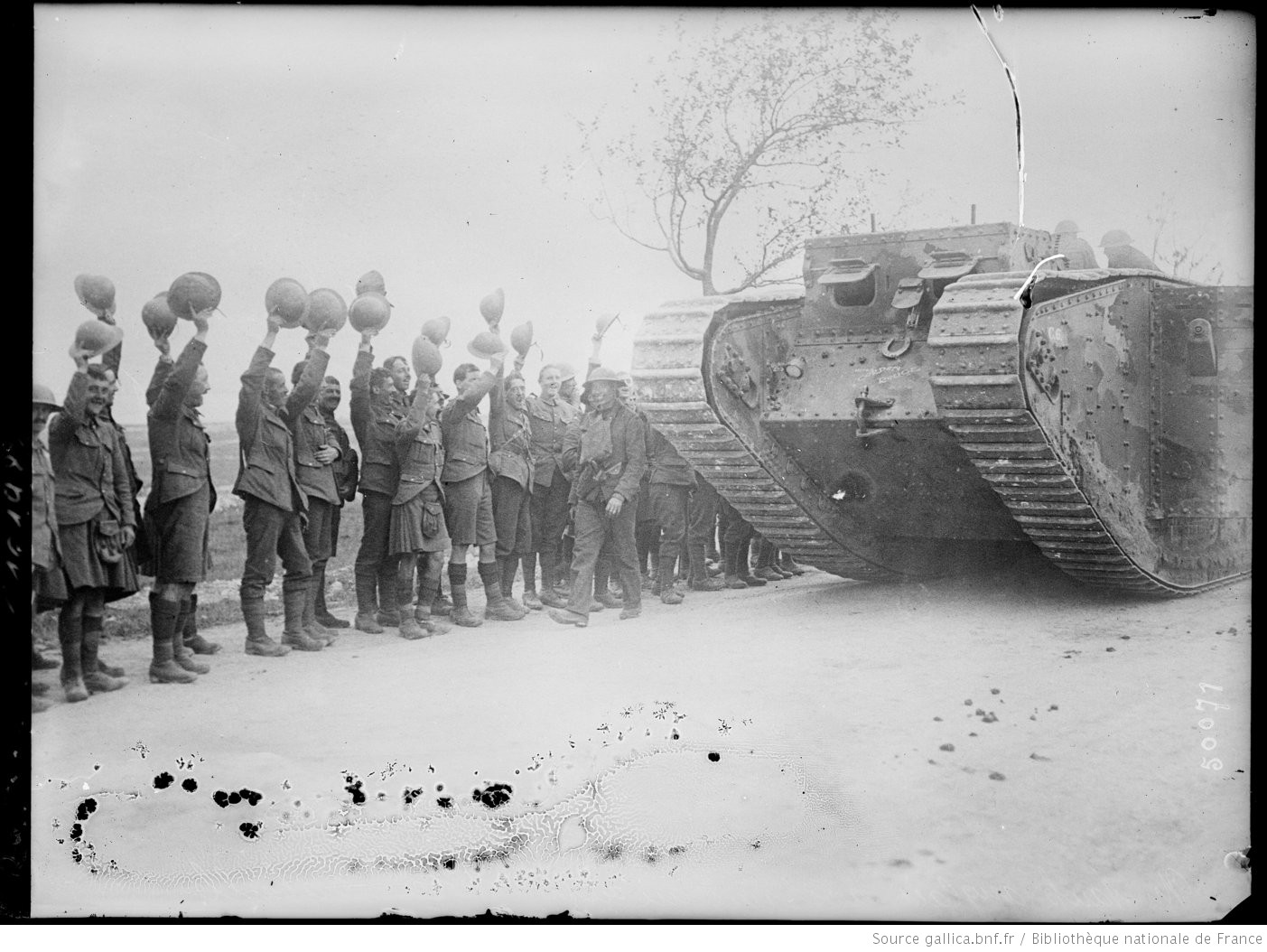

Thus, the utility of this new weapon of the 20th Century was confirmed as it helped the infantry to realize its success on that day. Creasy’s eyewitness account experienced in the crucible of battle helps give an immediacy and presence of the experiences of the men of the 18th Battalion on that day.
He also gives evidence that the 18th Battalion was still using the Colt Machine Gun during this operation with reference to the weight and configuration of the mechanism used to lay the gun. A Colt used a tripod, while a Lewis Gun used a bipod. The bulkiness of the Colt Machine Gun insured that it would not be used in future operations and reflects the constant implementation of new weapons and tactics for Imperial forces with the Imperial Army (and its subject units) realization that the infantry needed local machine gun support in the front line in offense and defense.
His wounding and the description of the help of the “Red Cross” man is emblematic of the care and sacrifices the stretcher bearers of this Battalion took to help their wounded comrades and the War Diary reflects this at the end of the War Dairy with a list of men who earned Military Medals, many of them stretcher bearers.
For Creasy, his wounding at Flers-Courcelette ended his war.
As he relates, he is transported to No. 13 General Hospital at Boulogne on 17 September 1916 and is in England at University College Hospital, Gower Street, London, England on the 21st. He is treated there and a news clipping from Toronto Star dated 17 November 1916 relates that Creasy met the Duke of Connaught while walking in Hyde Park with his mother.

Within a month Creasy would be dead.
As the letter relates upon its opening, Private Creasy was about to go into surgery. The surgery would, ultimately, lead to his death as he suffered a hemorrhage two-days after, and the artery involved was ligatured to no avail as he “…died shortly after returning ward.”
He is remembered at Islington and St. Pancras Cemetery, London, England and his inscription reads “BEYOND THE SMILING AND THE WEEPING”. His mother, Mary Brock Creasy, is buried with him.[xiii]
Creasy’s letter lives on beyond the man who wrote it. It is a narrative that helps us to bear witness to the past and gain some idea of what it was on that day over one-hundred years ago.
[i] In contrast, the 21st Battalion War Diary for that day runs for 1.5 pages for the same date.
[ii] See Bivouac of the Dead: The 18th Battalion’s Experience at the Battle at Flers-Courcelette for more information.
[iii] Private Leopold John Creasy, reg. no. 404049. Enlisted with the 35th Battalion at Toronto, Ontario 15 April 1915. He joined the 18th Battalion 4 February 1916.
[iv] John C. Green & Co. Wholesale Millinery based in Toronto with an officer in Montreal. At the time of Creasy’s enlistment, he was a salesman with this firm.
[v] This date may be in error. Creasy died on 12 December 1916, two days after his surgery according a note in his service file.
[vi] Albert, France. The 18th Battalion bivouaced at the “Brickfields” 9 September 1916 and suffered from enemy shelling on the 13th.
[vii] Excerpt from the 4th Canadian Infantry Brigade summary of operations during 10 to 17 September 1916: “From copies of his [German] orders for this operation, subsequently captured, it appears evident that the enemy had carefully planned an attack at this point. On the right he was mot by vigorous bombing and rifle fire, and did not succeed in getting into our trenches. He left many dead and some wounded who were afterwards brought in. A young subaltern, Lieut. Hugh N Sykes, 18th Battalion, promptly organised his Bombing defence and effectually maintained his position on the Right. The enemy were unable to gain access to our trenches on that flank. On the left Flank at a point where the trenches converged, and the lines were only a few yards apart, the enemy succeeded in rushing a party into our trenches. It would appear that this was to have been but the preliminary to a more determined attack to follow if the rush proved successful. Prompt action on the part of Lieut. Gidley, 19th Battalion and a party of 19th Battalion bombers, assisted by parties from the 20th Battalion, quickly drove out the enemy and enabled us to complete plans for our advance.”
[viii] Creasy attended a course in instruction of “machine gun work” at Shorncliffe, England on 12 August 1915.
[ix] Zero Hour for the attack was set for 6:20 a.m.
[x] The author is not able to determine who this officer is. All the officers that were killed in action on this day where killed under different circumstances.
[xi] This is the M1895 Colt Machine Gun. It used a tripod weighing 24.5 kg. A Canadian battalion in 1914 was issued with two Colt machine guns, until the Lewis Gun replaced it later in the war. The Lewis Gun had been issued to the 18th Battalion and is in evidence as being in service during the battle. See the Military Medal citation for Private Egan.
[xii] The Edinburgh Gazette. Issue 13012. Page 2069. 16 November 1916.
[xiii] Mary Brock Creasy, born 1877. Died 22 September 1938.
Discover more from History of the 18th Battalion CEF, "The Fighting Eighteenth"
Subscribe to get the latest posts sent to your email.
 History of the 18th Battalion CEF, "The Fighting Eighteenth"
Thank you for the article, but why the trigger warning? Someone has got to be pretty stupid if they think reading about World War One is not going to be graphic and gruesome. They need to use their brain if they don’t want to be upset. Don’t read these articles then! Why are we catering to these people?
As I am the author of this article I will do what I believe is right. Sorry if it offends you.
I don’t need an apology. I’m not mentally weak and I don’t get “offended”. The soldiers of World War One would be laughing at this. They were mentally tough, even those who suffered from shell shock, after what they saw.