There are some places in this world that are simply peaceful. Imagine green fields of corn and mixed forest abutting those fields teeming with wildlife. The sky, like the land, seems to run forever and if you do not move there is no sound but the rustling if the leaves or an errant “caw” from a big black crow.
It is in this land and place that rests a former member of the 18th Battalion.

Victor W. Clem (Clemm) was born at the small community of Aylesford, Nova Scotia on 10 February 1894 to his father, Nathan Byard Clem (1855 – 1924) and Effie Celestria Rand (1857 – 1941). The delivery was attended to by a midwife.
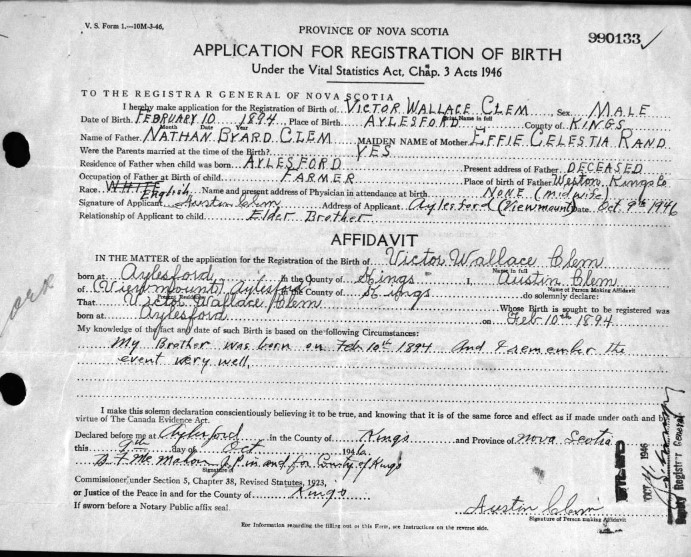
Victor had a choice of careers, farming and logging being available near his home, but he decided to become a “mariner”. [i] This led him to travelling on the Eastern seaboard and he met and wed 17-year-old Florence Rushton on 9 June 1915 at St. John, New Brunswick. They would take up residence at 172 Wentworth Street.
The timing could not be better as he enlisted 9-days later.
Newly married Victor Clem enlisted with the 55th Battalion on June 16, 1916, as Sussex, New Brunswick. He had no prior military experience. His reg. no. was 444968.
It is not clear as to why Clem decided to enlist at Sussex as it is a town inland from the sea. Perhaps this was the closest active battalion taking on enlistees.
His service card recording his service in Canada prior to embarkation to England shows a clean record, though his Separation Allowance[ii] pages show him absent without leave on 5 January 1916, though no deduction in the allowance were made for this infraction.
In preparation for his service in England he set his assigned pay of $15.00 to his wife, who was currently living His will was made out to his brother Austin, of Burlington, Kings County, Nova Scotia.
His unit left for England on 30 October 1915 and arrived in England aboard the SS Corsican on November 9, 1915. He then was stationed in England and assigned to the 39th Reserve Battalion (7 April 1916) at East Sandling where he was eventually transferred to the 18th Battalion for active service effective August 27, 1916.
He was sent overseas and arrived at the Canadian Base Depot on 28 August 1916 and was with the 18th Battalion as a replacement on 16 September 1916, one day after the intense action at Flers-Courcelette where the 18th lost approximately 100 men to death and wounds in action. This would have been a grim circumstance to arrive to for Private Clem.
He served the 18th Battalion and was granted a 10-day leave to Paris effective 26 June 1917 and returned to service to find that he was awarded the Military Medal on July 28, 1917 and was given a bar to this medal later.

He rose to the rank of Sergeant being promoted in the field on September 1, 1918.
He was discharged on April 14, 1919, at Sussex New Brunswick.
Returning from war he returned to his peacetime life, and it appears that he had no children with Georgina.
There is a curious reference on his gravestone to a F. Irene (b. 1894, d. 1973). It is not known if he divorced and remarried but no references for this person have been found at time of publication.
Sergeant Clem rest with at least twelve other people with the surname Clem. The relations to these people are not known.
The cemetery is well maintained set in flat land and is divided by a gravel road. Access is easy and it is peaceful, save for the odd vehicle passing by. A corn field abuts the cemetery on the west side and a forest of deciduous trees on the east side.

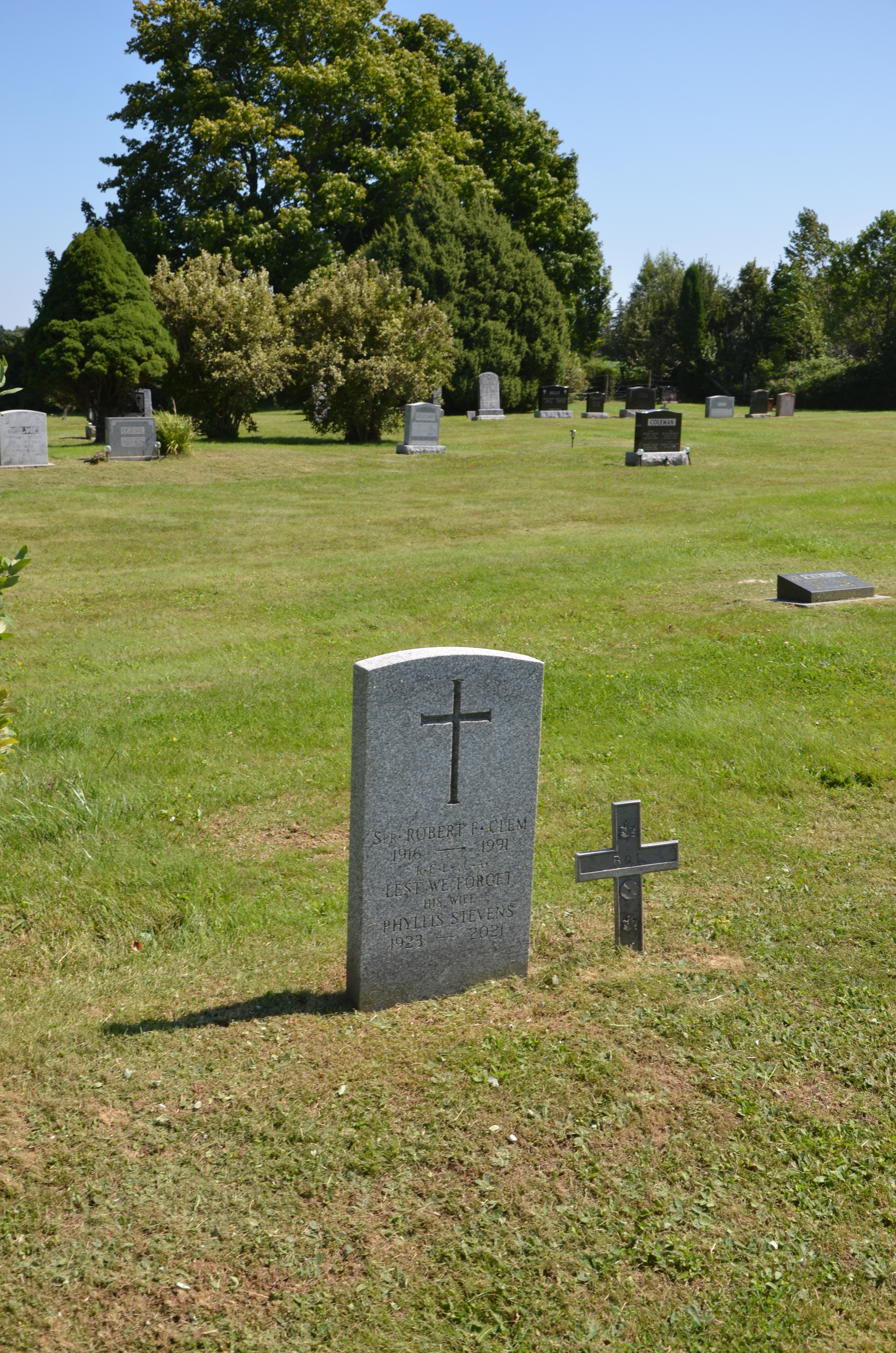

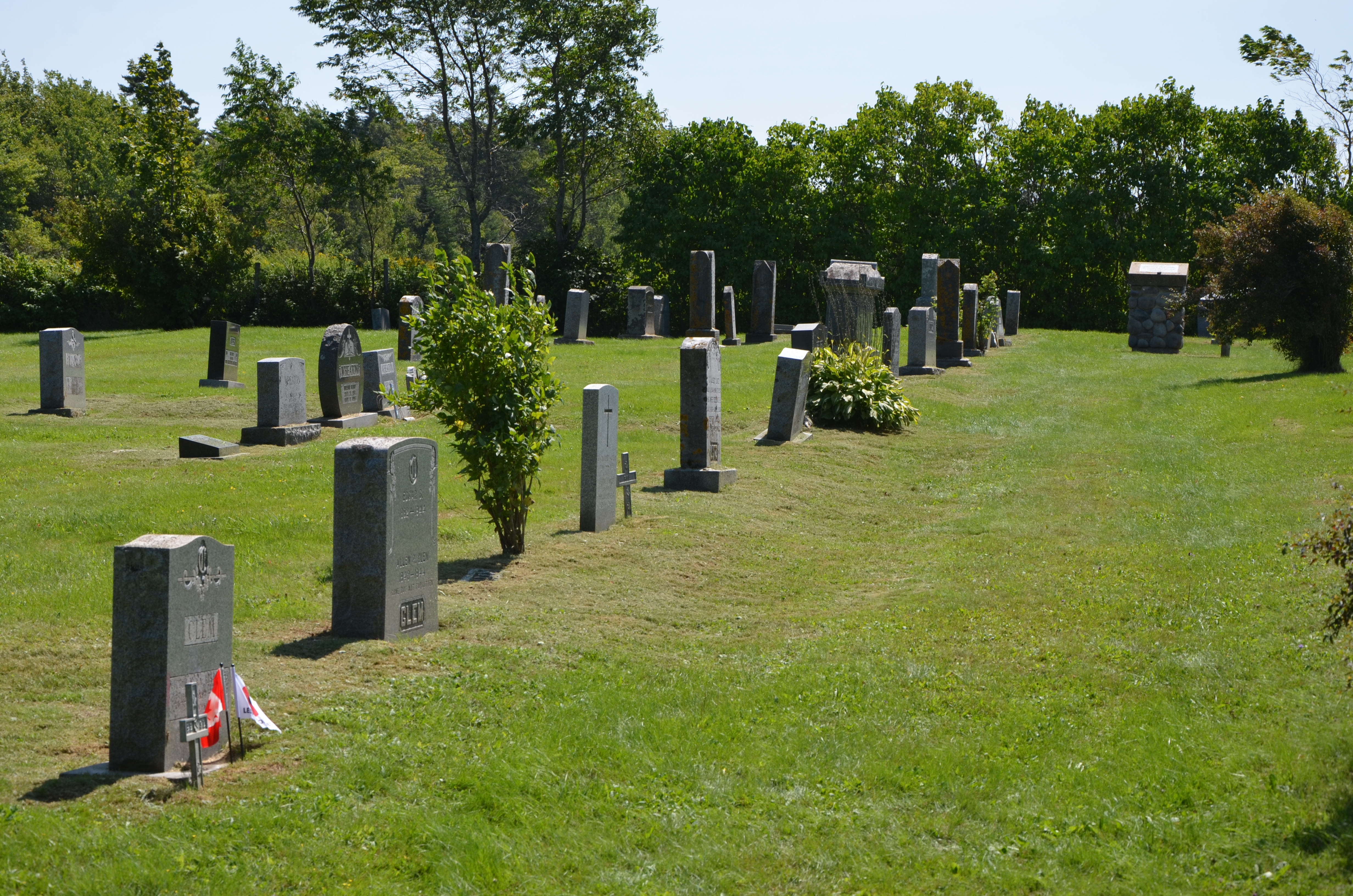
His stones are in good condition and there is a gray metal cross with the initials B.E.S.L. a reference to the Royal Canadian Legion’s original title on its founding (1925) as the Canadian Legion of the British Empire Services League.
The Canadian and Poppy flags are placed to honour this man and to let him, and those that visit his grave, that he is not forgotten, and his memory lives on.

[i] The distinction of the meaning of this word compared to the use of sailor and can be considered interchangeable. After the 1800s its use declined.
[ii] The payee, his wife, was living at 172 Wentworth Street, St. John NB, then Apple River, Cumberland County, Nova Scotia, finally setting at 49 Patterson Street, Amherst, Nova Scotia.
Discover more from History of the 18th Battalion CEF, "The Fighting Eighteenth"
Subscribe to get the latest posts sent to your email.
 History of the 18th Battalion CEF, "The Fighting Eighteenth"
Leave a comment