Two cemeteries in Halifax, Nova Scotia abut each other. The Fairlawn Cemetery is noted for its burial of some of the victims of the SS Titanic Disaster and St. John’s which is the Catholic Cemetery. Both sit adjacent to two busy roads, the 111 leading over the Dartmouth Bridge which is a major arterial artery leading in and out of Halifax. The area is close to the Bedford Basin and would almost be bucolic in its beauty if it was not for the ever-present drone of vehicular traffic. It contains the grave of a former member of the 18th Battalion, and I wanted to find him.
The first visit to this grave was not successful.
It was a wet, rainy day and using information gleaned from Find-A-Grave I looked in vain for his grave. Up and down, I walked in Section C of St. John’s Cemetery, my feet sliding in the rain-slicked grass of the uneven ground. The rain was so persistent it soaked through my windbreaker, and I abandoned the search after a fruitless half-hour.
Disappointed I drove on thinking that was a chance missed.
As luck would have it I modified my recent trip to Nova Scotia to try again.
This time I stopped in at the administrative offices of Fairlawn and was helped by the staff. They were able to inform me that from their documentation I should be on the lookout for a large family plot as the documentation showed that it was adjacent to more than one grave, it had, in fact, nine graves in the plot.
Armed with that information I was able to determine within minutes where the grave was and that it probably was not in Row 23 of Section C. Or, at least, the designation was correct, and I had counted the rows wrong.
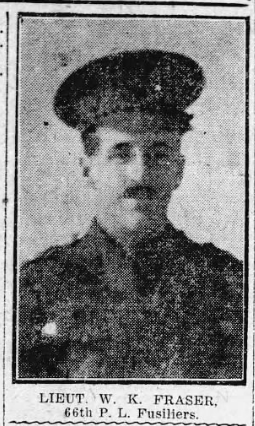
With the grave found the Canadian and Poppy flag were planted as a sign of remembrance for Lieutenant William Kenneth Fraser.

This man, known as Kenneth, was born on 2 December 1886 to James (1852 – 1896) and Fredrica (nee Swicker, 1856 – 1932) in Halifax, Nova Scotia.
When this man enlisted at Halifax on 28 December 1915, he was a single Civil Engineer residing at 213 Coburg Road[i] with his mother in Halifax. He was a Christian following his faith through the Church of England and had prior military experience with the 66th Regiment, Princess Louisa’s Fusiliers.
After his enlistment, he was sent over to England within a month. He arrived in England on 22 January 1916 by May 1916 he was assigned to the 18th Battalion, arriving “in the field” on 11 May 1916 while the 18th Battalion was on the front lines in Belgium near Voormezeele, Belgium.
Less than two months later his artificial eye became infected, and he was removed from active service for treatment on 2 July 1916 being transferred to the 5th Canadian Field Ambulance at Reningelst. Within days he had passed through No. 10 Casualty Clearing Station (CCS) to No. 7 (Dalhousie) Stationary Hospital at Le Harve. As this hospital was formed in Nova Scotia Lieutenant Fraser was well at home and, no doubt, met with people he knew while he was treated there. By the 19th he was discharged for duty and returned to the Battalion on 28 July 1916 after an interim stay at the Canadian Base Depot at Le Harve.
With this infection resolved, Lieutenant Fraser served with the Battalion until he was stricken with a case of influenza serious enough to remove him to England for treatment. On 14 October 1916, he was transferred to No. 10 British Red Cross Hospital and thence to England aboard the HS Formosa on 16 November 1916.
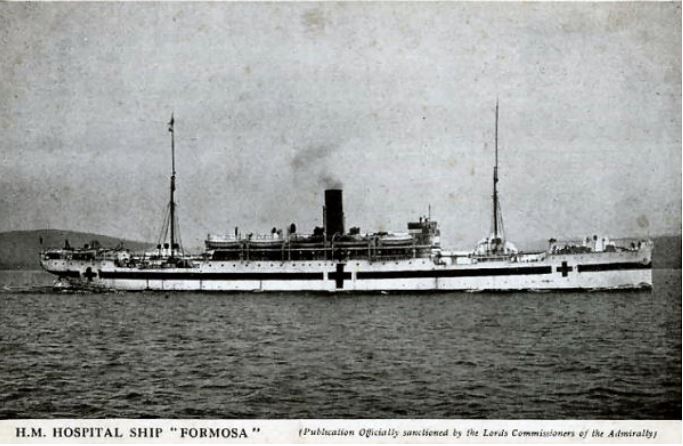
Two days before going to England, the London Gazette recorded the assignment of the Military Cross. The citation reads:
“For conspicuous gallantry in action. He repelled with great gallantry an enemy bombing attack. He subsequently led his platoon forward and captured the enemy trenches, displaying unusual coolness throughout.”[ii]
The 18th Battalion’s War Diary is bereft of the details of the action to which this citation refers, but it is possible this refers to an action that took place on 15 September 1916 at the Battle of Flers Courcelette were the 18th fought off a spoiling attach by the Germans before the Canadian attack started.[iii]
The 4th Canadian Infantry Brigade War Diary relates the following:
“04:00 am
Hostile bombing attack on right and left blocks, repulsed. Attack somewhat delayed, our forming up parties, wind N.W.”
It is probably in this action that Lieutenant Fraser earned his Military Cross.
Now that he was in England, Fraser was sent to Miss Pollack’s Hospital for Officers for treatment on 17 November 1916 and he was finally discharged on 7 February 1917.
His medical exam dated 6 February 1917 at 76 Strand Street, London, England, related that he had not only suffered from influenza but this condition was complicated by pneumonia and the loss of his hearing in both ears. His condition was considered related to his service in the war and a subsequent infection.
He would then suffer from hemorrhoids and required treatment for that condition and was slow to recover.
His health, now compromised, would prevent a return to active duty.
His war service once discharged from the hospital involved postings in England. After several postings to reserve battalions, he was finally sent home to Canada on 3 December 1918 and discharged due to demobilization on 13 December 1918 upon returning to Canada.
A news clipping from the Halifax Evening Mail dated 15 February 1919, relates that Mrs. Regan entertained Fraser’s new wife at a tea. She was Doris Smith, recently from London, England and her son married Doris on 2 October 1917 at St. Paul’s Church, Harringay Middlesex.[iv]

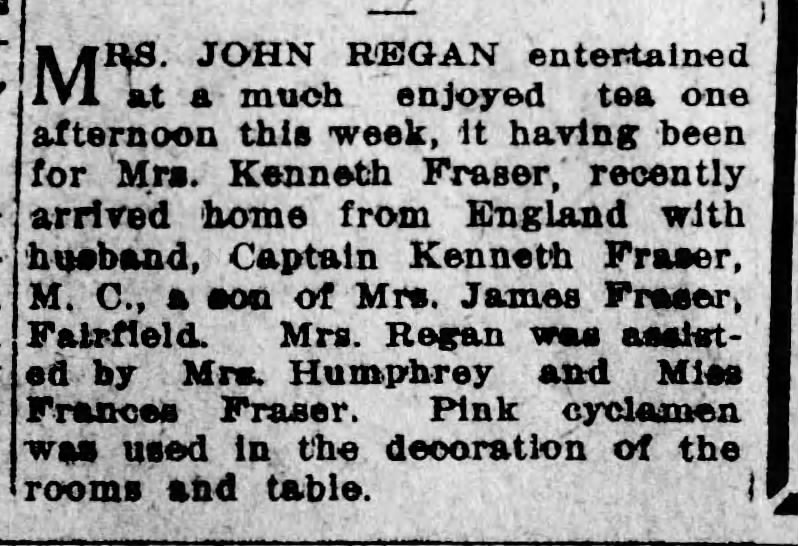
It is not known when this man became mayor of Wolfville, Nova Scotia, but a medal card used to track the location of veterans indicates that he may have moved to Wolfville before April 1921. An address is not given, and his address is recorded at Post Office Box 206. The 1921 and 1931 Canadian Census confirms his residency.[v]
A news clipping states he was a former mayor of Wolfville, and his death certificate shows his residence to be the same, though death occurred after a 6-week stay at a hospital in Halifax. Fraser died due to carcinoma which was a condition that he had suffered from for 21 years.
He was survived by his wife and his daughter, Muriel Fraser of London, Ontario, and two sisters.
Doris would live until 1974 and their daughter until 2007. They are all buried in the same plot.


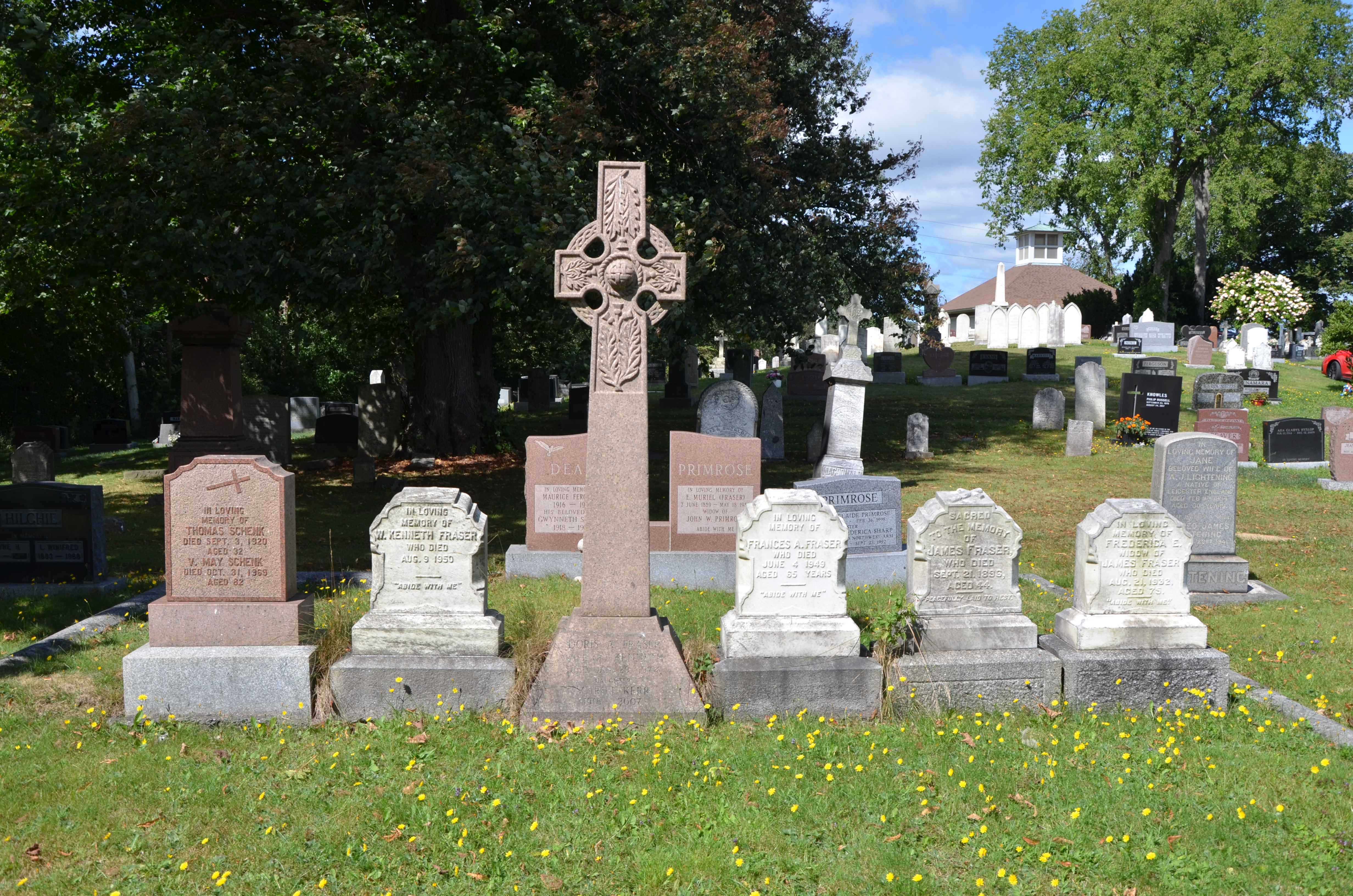
Lieutenant William Kenneth Fraser contributed to the safety of the men of the 18th Battalion during the Battle of Flers Courcelette, no doubt saving the lives of the men associated in his command and the other units of the Battalion by breaking up a German spoiling attack. His interest in community led to him becoming the mayor of Wolfville where he raised his family.
We owe a debt to him.
[i] (1915). McAlpine City Directory – Halifax, Nova Scotia (p. 236). McAlpine. https://archives.novascotia.ca/pdf/mcalpine/1914-1915-McAlpine-Halifax.pdf
[ii] London Gazette issue 29824 page 39 of 72 (11077).
[iii] Government of Canada (1916, September 30). War Diary of the 4th Canadian Infantry Brigade, September 1916. Libary and Archives Canada. Retrieved October 2, 2024, from https://recherche-collection-search.bac-lac.gc.ca/eng/Home/Record?app=fonandcol&IdNumber=2005800
[iv] Fulford, A. (2024, October 5). Twitter Notification. X Formerly Called Twitter. Retrieved October 5, 2024, from https://x.com/avidgenie/status/1842424314773250420
[v] Ibid.
Discover more from History of the 18th Battalion CEF, "The Fighting Eighteenth"
Subscribe to get the latest posts sent to your email.
 History of the 18th Battalion CEF, "The Fighting Eighteenth"

Leave a comment