A recent query at the 18th Battalion Facebook Group regarding two photographs asked if two men in two separate photographs could be identified. The common denominator in each photograph is the presence of Private Alexander McCalmont (reg. no. 880093) who died of wounds received in action at No. 3 Canadian Stationary Hospital.
Photographs of soldiers and nurses were quite common in World War 1. The access to a photographer was available in many small towns and, once overseas in England, photographers made a booming industry of souvenir photographs of the soldiers in the form of mail-able post cards which varied in content of the sublime to the ridiculous with many photo studios offering fantastical backgrounds showing the soldier in a patriotic light.
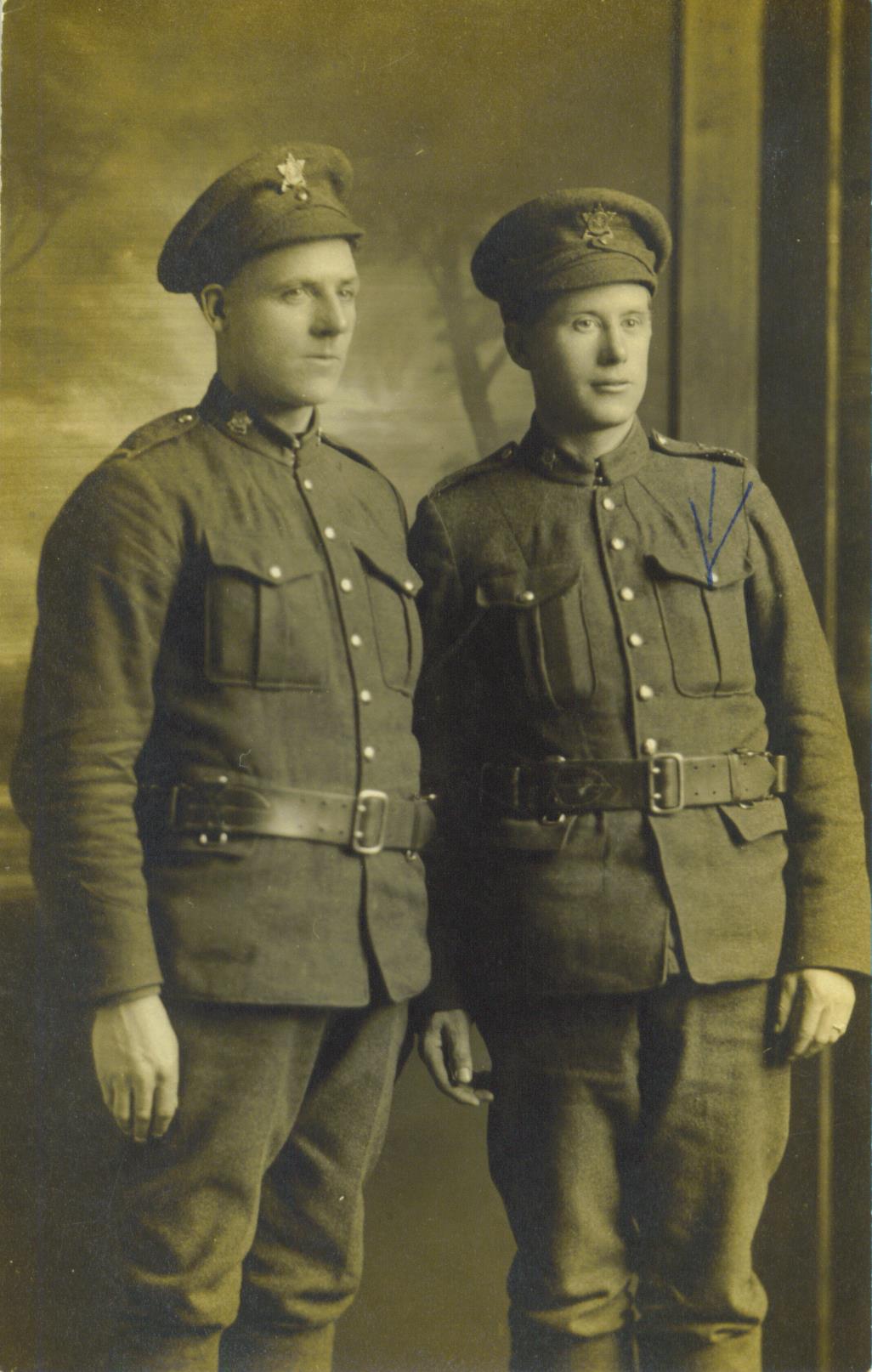
The first photograph is of two men who are in the same battalion, the 186th Overseas based out of Chatham, Ontario. The cap badges appear to be the design of that battalion and both men are in 7-button uniforms of the CEF, which were issued in Canada and later replaced with a modified design when the soldier got overseas and need a new tunic.
They are standing indoors and there is a diorama or large picture in a frame hanging behind them. They appear to be privates as no rank insignia is present.
This may be a studio photograph taken in Canada or, later in England before McCalmont was transferred to the 18th Battalion, where he actively served in combat until his wounding and death. He had enlisted on 25 February 1915 at Chatham, first with the 91st Battalion, and was later transferred to the 186th Battalion on 28 February 1916. McCalmont arrived in England 7 April 1917 and left for the Continent for active service with the 18th Battalion when he posted to duty, leaving England for the 2nd Canadian Base Depot Camp on 6 September 1917.
Thus, if the photographs were taken in Canada they had to be taken between 25 February 1916 and 28 March 1917, the date the unit sailed for England. If the photographs were taken in England they would have to have been taken between 7 April 1917 and 6 September 1917.
It is unlikely that the interior photographs were taken behind the front lines, as McCalmont would have been wearing 18th Battalion badges, not that of the 186th Battalion.
The date is unknown.
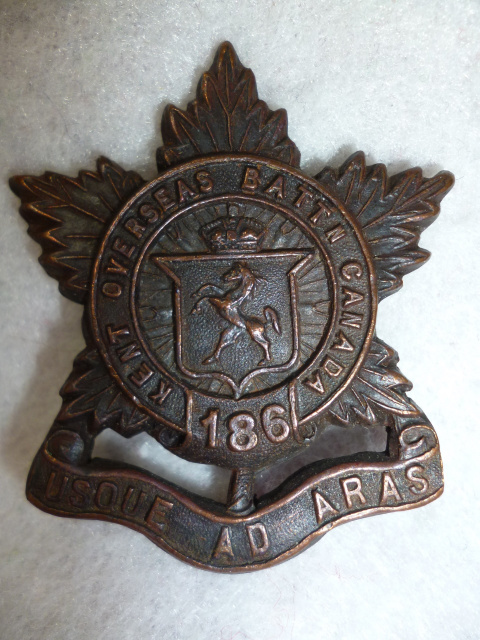
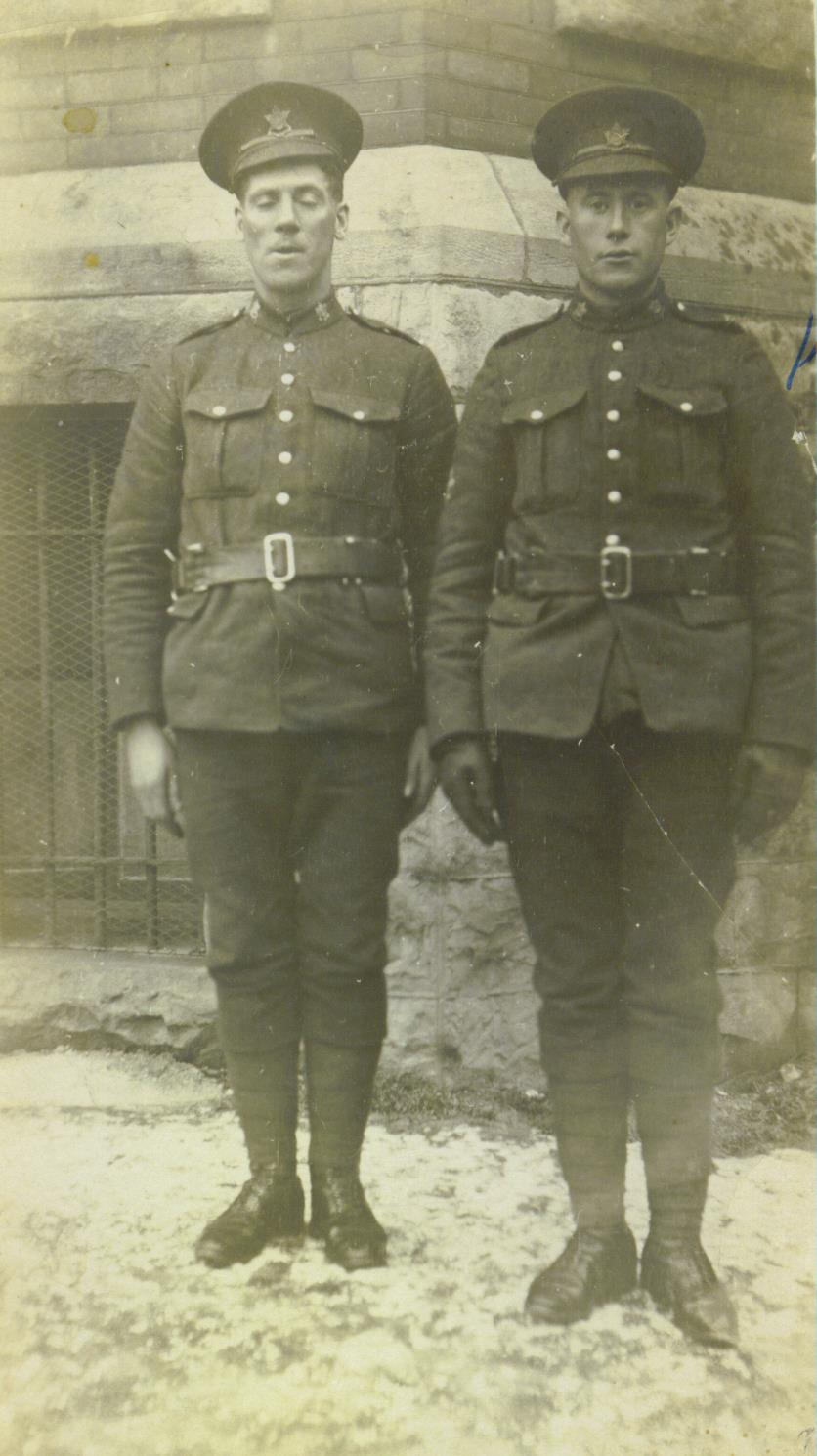
The second photograph is outdoors and appears to be taken in the winter as there appears to be light snow on the ground and the Private McCalmont is wearing gloves (possibly leather). The design of their hat insignia is notable for it has the bottom ribbon that contains the Battalion motto, “USQUE AD ARAS”.
As with the first photograph, the details of the soldiers’ uniforms are the same with no notable differences.
The strongest hint of when and where the photograph was taken is the building and the snow. Perhaps this photograph was taken in Chatham, Ontario.
In the quest to determine who these two men are the photographs doe does not lend many hints in making a determination of their identity.
The first step in trying to connect these unknown men to McCalmont is to find out some personal information about him.
An examination of his wedding records shows two witnesses, A Mrs. John McInnes and a W. D. McInnes of Thamesville, where McCalmont was living at the time, are witnesses to the wedding. A search of the 91st and 186th Battalions’ nominal rolls does not find any soldier with the surname McInnes.
To date, there is no record of any soldier with the surname serving with the 186th or 18th Battalions.
His service file has a will witnessed on 27 February 1917 just before the 186th went overseas, by an R. H. Small who is listed on the 186th Battalion nominal roll as Private Roland Harry Small (reg. no. 189483) and Private David Earl Vickerman (reg. no. 880039). Private Small also served with the 18th Battalion while Private Vickerman served with the 1st Battalion overseas.
Wills were not necessarily witnessed by men close to the man completing this formality and from previous research there does not appear to be any other means of connection between these three men.
Coincidentally, McCalmont’s regimental number ends with ‘39’, while Vickerman’s ended with ‘93’.
If the photographs are cropped, thereby isolating the unknown soldiers, a reverse image lookup does not offer any credible solution to both soldiers.
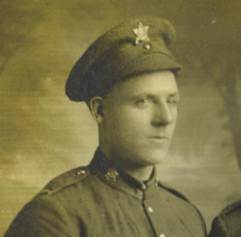
No results were found for this soldier.
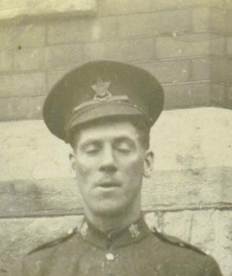
No results were found for this soldier.
One possibility to consider is the review the sequential regimental numbers of the man who enlisted before and after Private McCalmont. Thus, regimental numbers 880092 and 880094 may yield two men who may have been in either photograph.
A comparison of the data from each man’s attestation paper reveals the following:
| Regimental No. | 880092 | 880093 | 880094 |
| Date Attested | 26 February 1916 | 28 February 1916 | 28 February 1916 |
| City Attested | Chatham | Chatham | Chatham |
| Resident City | Bothwell | Thamesville | Chatham |
| Religion | Methodist | Presbyterian | Salvation Army |
Regimental number 880092 finds a Private Percy Lugg. A quick trip to the Gathering Our Heroes site finds his profile, but there is no photograph of the man. Private Rowe, regimental number 880094 was not assigned to the 18th Battalion and was released from service due to medial reasons on 20 May 1917. A search at Gathering Our Heroes does not net a photograph of this man.
Lugg was to survive the war and his service record matches McCalmont’s until 25 September 1917 when Lugg is sent overseas, for service with the 18th Battalion, one month prior to McCalmont’s transfer.
This does not eliminate Lugg as a photograph contender as he was present at the same time with the 186th Battalion offering opportunities to have a photograph taken with McCalmont in Chatham, or as a souvenir once over in England.
Regrettably, the ability to identify either solder with certainty is outside the skills of this author. It begs the question of whether the resources will exist in the future to make this type of identification possible. It comes down to how well the photographs are documented when they are taken and as time passes and the people connected to the photographs die the ability to connect the images with the people in them dwindles to impossible very quickly.
Perhaps someone will read this and solve this mystery?
Discover more from History of the 18th Battalion CEF, "The Fighting Eighteenth"
Subscribe to get the latest posts sent to your email.
 History of the 18th Battalion CEF, "The Fighting Eighteenth"
Leave a comment