A 33-year-old hotel porter stood in line on 5 January 1916 with the 124th Battalion. He was a native of England and served 7 years with the 1st Sussex as a Bandsman. He was born and lived in Brighton, in Sussex, and the chance to join the war, go home and fight for his country and Empire was a strong motivation for a man of his station. The date was 5 January 1916.
He, along with the rest of the 124th Battalion, embarked at Halifax, Nova Scotia, on 7 August 1916 and arrived in England at Liverpool 11 days later aboard the SS Cameronia.
He was stationed at Bramshott Cam,p and though many battalions like the 124th hoped to fight as a cohesive unit, its men were used as replacements, making up losses from battle and illness. Private Kite was transferred to the 18th Battalion on 10 October 1916 to make up for the losses of the 18th Battalion from its action at the Somme when it was engaged in operations in mid-September. Its losses up to that date had been 140 men killed in action or died of wounds.
Private Kite was not to arrive at the 18th Battalion until 18 March 1917, having been attached to the 2nd Canadian Entrenching Battalion, then No. 5 Field Company Canadian Engineers, and back to the 2nd Cdn. Entrenching Battalion.
Once he arrived with the 18th, his service record is non-descript. He got a leave and had no entries relating to disciplinary actions – he was a good soldier. He served with the 18th Battalion until he was discharged due to demobilization, along with the remainder of the men of the 18th Battalion, when the battalion returned to London, Ontario and was disbanded on 24 May 1919.
The now civilian, Arthur Ernest Hedley Kite, then appears in Midland, Ontario, circa 1921 and whatever opportunity that did not pan out then led to his return to Toronto, where he became a window washer.
This would be the death of him.
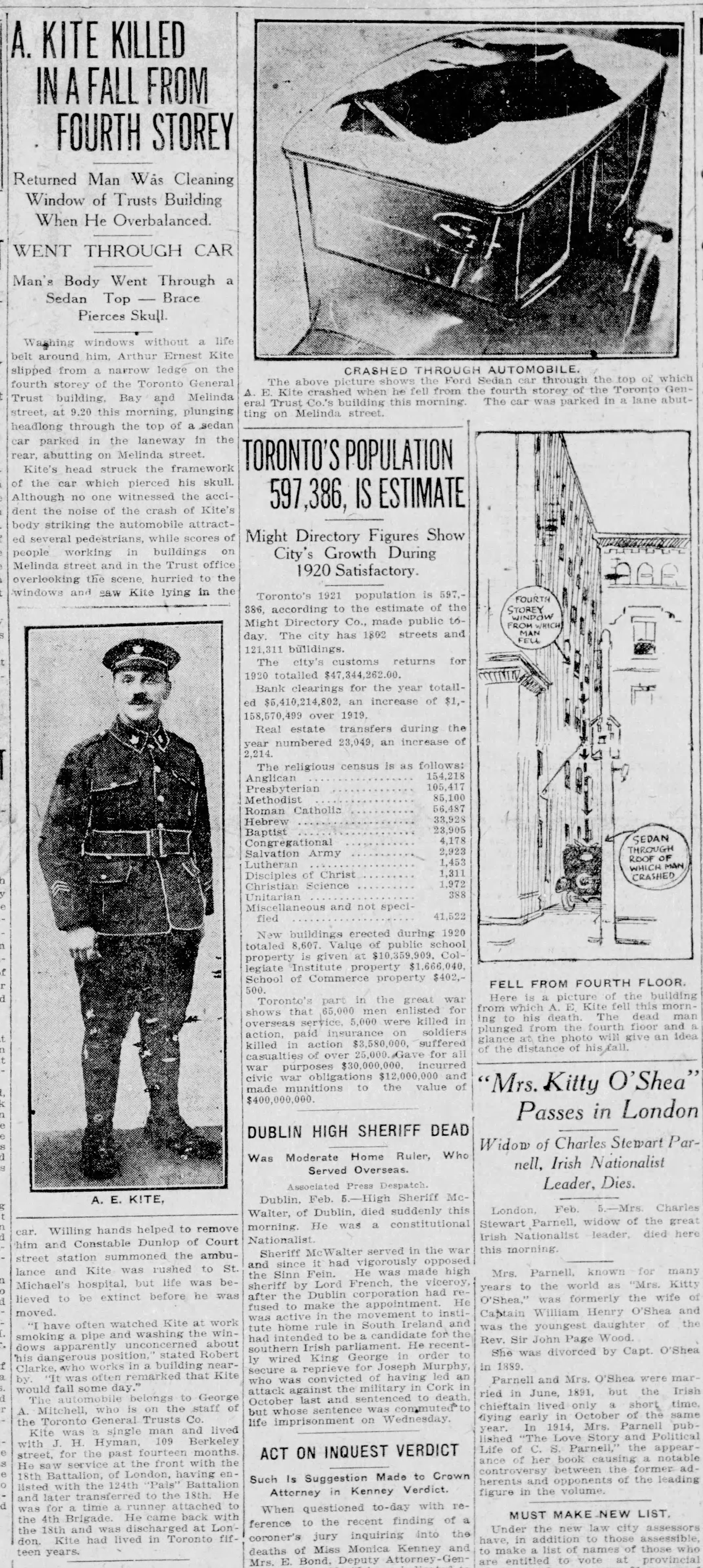
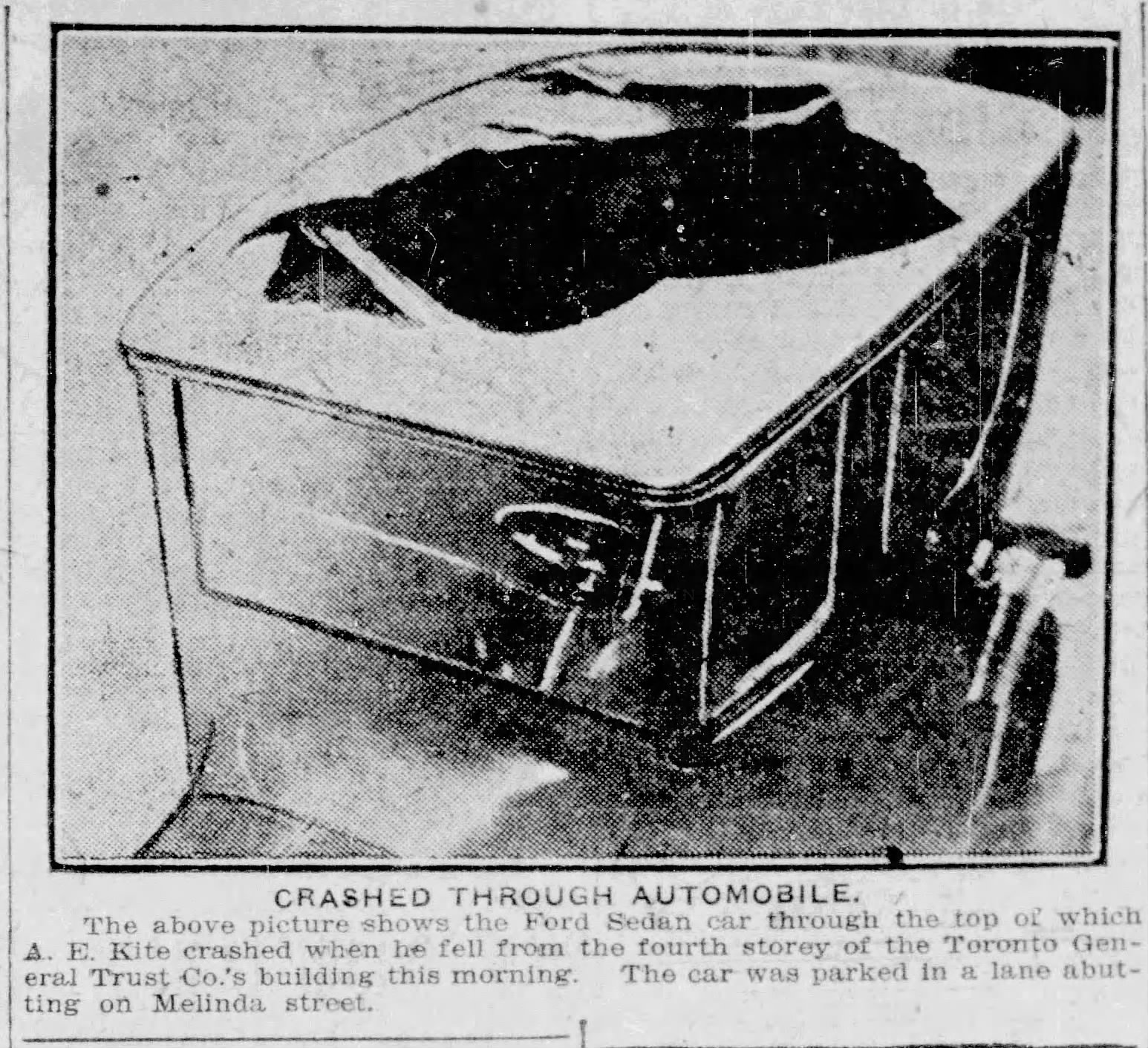
On 5 February 1921, he fell to his death while cleaning windows at the Toronto General Trust building. Falling from the 4th floor, he hit a car parked below him, and the force of the fall broke the roof of the car. It was discovered he was not using a safety belt or restraint of any sort, and it was the sound of him crashing into the vehicle that informed passersby that something had happened, and they followed the source of the sound to find Kite’s body. The framework of the roof pierced his skull, making his death immediate.
He was removed by ambulance to St. Michael’s Hospital, but it was reported that his life had expired even before the ambulance was called.
One witness stated, “I have often watched Kite at work smoking a pipe and washing the windows, apparently unconcerned about his dangerous position. It was often remarked that Kite would fall some day.”
The head of the window cleaning company, William Rennie, had a different perspective as ‘he was a careful man’ and, “I have often watched him at work,” he said, “and he was always careful. I don’t know, apparently, how it happened. It must have been an accident. I can’t understand it.”
He was a member of the First Toronto Great War Veterans Guard, and J. H. Elliott, the secretary of the Guard, related, “A. E. Kite was a very good soldier. He was a member of the guard for a long time. He was very faithful. He was a member of the old 12th York Rangers before the war. He went overseas with the 75th Battalion. My home has been with the 75th ever since the war. He was killed at Toronto Trust.”
Sadly, the secretary’s details were wrong. He may have served with the 12th York Rangers, though this is not listed on his attestation papers, and he never served with the 75th Battalion according to his service file.
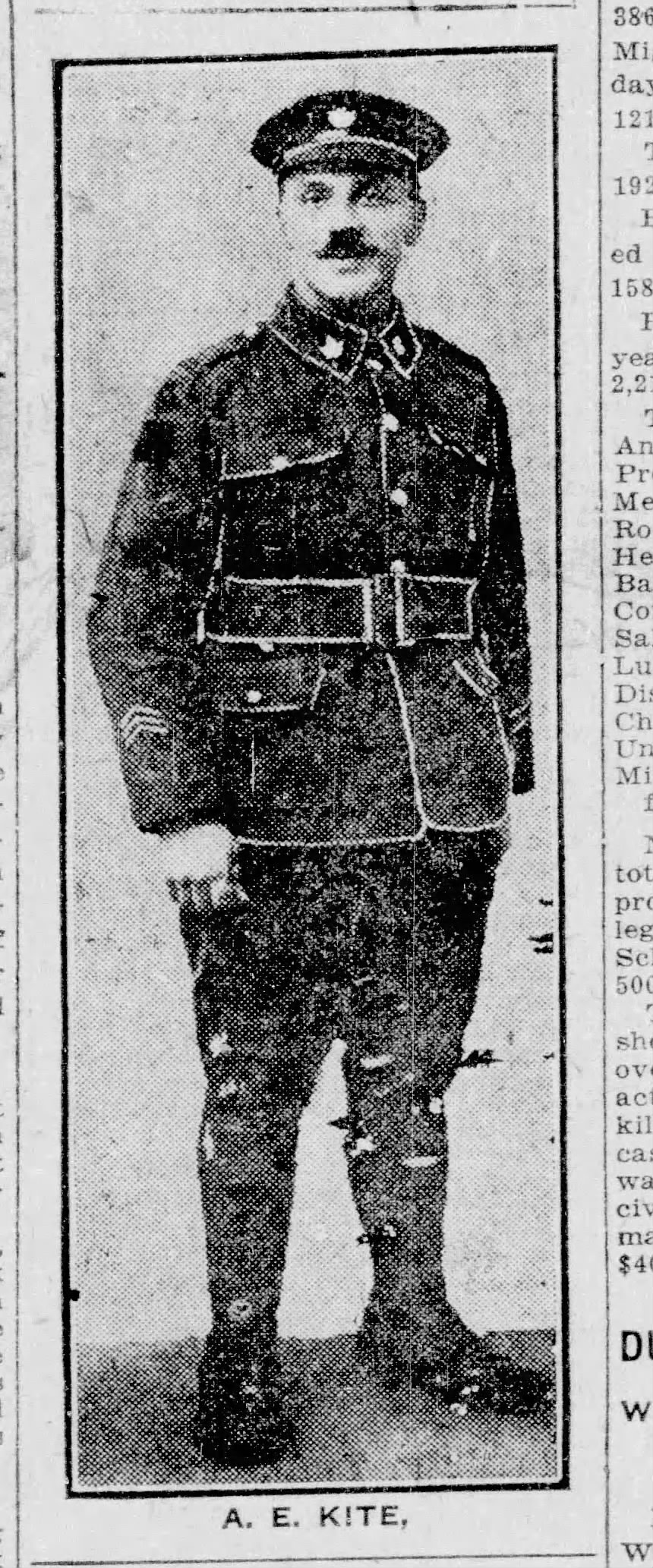
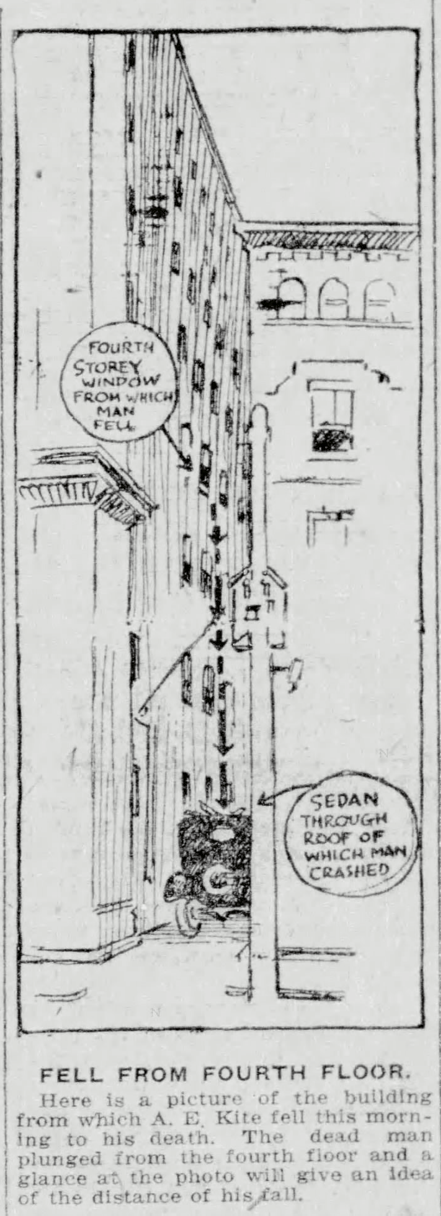
The Toronto Star sensationalized this fourth-page story of death with a photograph of Kite in uniform; it added an additional photograph of the car involved in his death with its damaged roof and a sketch diagram of his fall.

Kite may have died tragically, but this only motivated the veterans in Toronto to attend his funeral, and it was a military with a gun carriage bearing the casket and full honours were accorded to Private Kite. Many members of the Grand Army of United Veterans (G.A.U.V.) attended in support for a fellow brother and member, as Kite was treasurer of this organization.
Kite had accumulated a significant estate, as was reported in the Toronto Star (3 May 1921), the following details:
“Arthur Ernest Hedley Kite, window cleaner, who also fell from the Toronto General Trust Building on February 13, 1925, left an estate valued at $2,951, which will be inherited by his widow, Nellie Kite, of 122 Willis England. The estate included $2,206 insurance, $195 in cash, $475 war certificate and $75 in cash. Kite made a will on July 21, 1916, which was witnessed by E. J. Lennox.”
This is equivalent to between $58,000 to $78,000, depending on how the CPI is calculated. A substantial sum at the time and a nice inheritance for his widow, who went to England after his death.
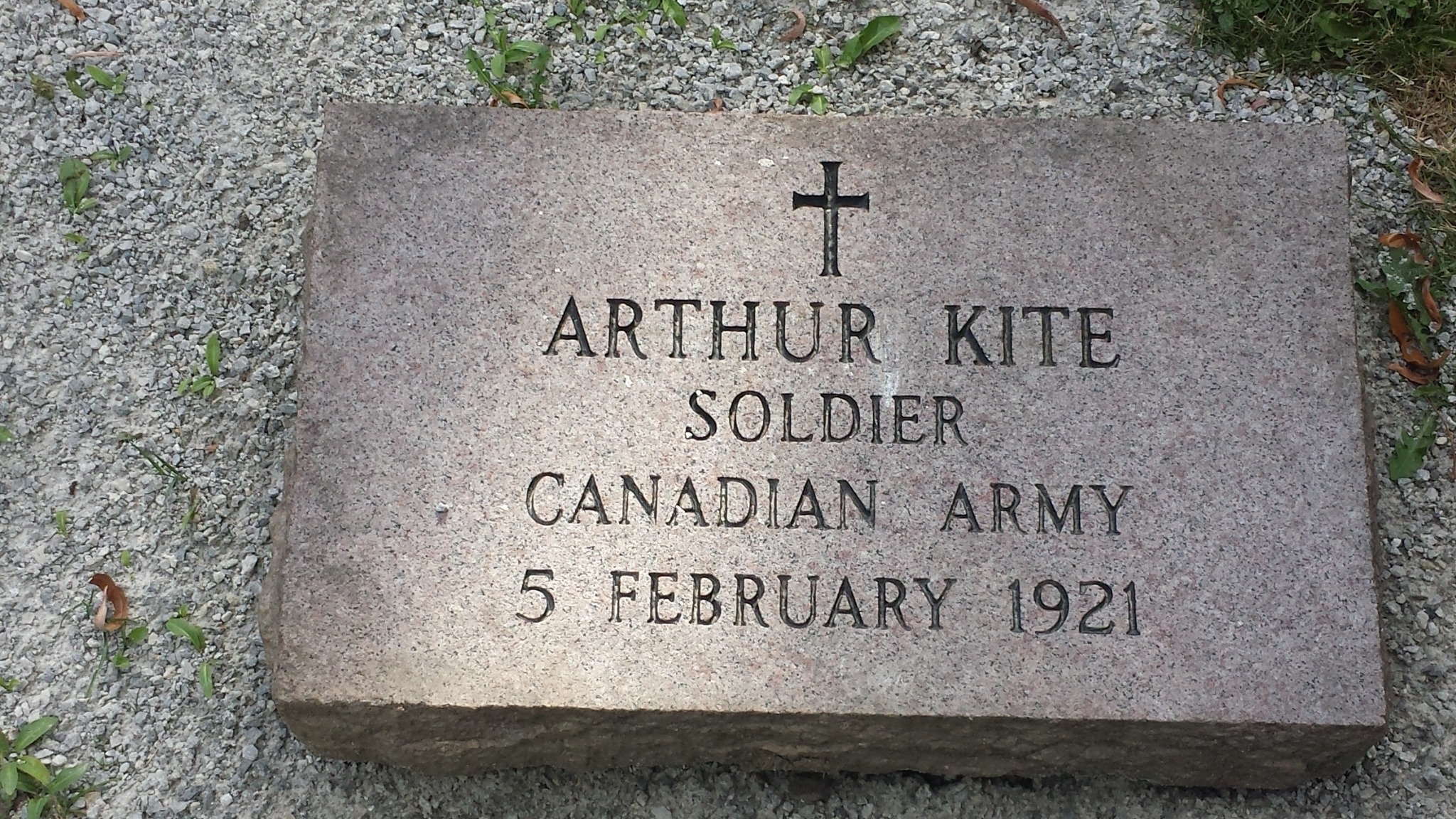
Private Arthur Ernest Hedley Kite rests in peace at Prospect Cemetery, Toronto, Ontario. He is not alone or forgotten, as there are at least 49 other members of the 18th Battalion buried there.
Discover more from History of the 18th Battalion CEF, "The Fighting Eighteenth"
Subscribe to get the latest posts sent to your email.
 History of the 18th Battalion CEF, "The Fighting Eighteenth"
Great story – thank you for sharing!