On 18 July 2025 Lieutenant Raymond Earl Rouse MM MC grave was visited.

This man served with the 18th Battalion, earning two decorations for valour, one as an enlisted man, and one as an officer.
His military service started with his enlistment with the 18th Battalion on 27 October 1914, at Woodstock, Ontario. He was a 23-year-old steam engineer and probably was living in Tillsonburg, Ontario at the time of his enlistment, but the first opportunity to enlist for him was probably at Woodstock, Ontario. At that time, he had two railway companies to choose from to get to Woodstock by train. He enlisted very early on the 18th Battalion’s history as it had only been established for recruiting at the end of October with some men enlisting on October 20.
His enthusiasm for military service was not due to previous military experience, as his attestation papers show he had none. Being born in Canada, he was probably motivated by his support and patriotism for the British Empire.
A lack of military experience did not hamper Private Rouse, as he was appointed a Lance-Corporal on 26 May 1916 after 7 months combat experience in Belgium. After the horrible casualties sustained at the Battle of Flers-Courcelette, he was promoted to Sergeant on 21 September 1916 as a replacement to Sergeant Lindsay Clarence Vogan[i], who was appointed as a Lieutenant.
The newly minted Sergeant Rouse served with the 18th Battalion from that date, got some leave, and was wounded in the head with a gunshot wound (GSW) 9 August 1917 necessitating medical treatment that required convalescence in Cayeux, France at No. 5 Convalescence Depot. He returned to duty on 19 September 1917, and during his absence was awarded the Military Medal “for bravery in the field”.[ii] The London Gazette entry does not give any specifics of this man’s heroic actions, nor the date of the actions that resulted in this recognition of his bravery.
This medal was awarded for actions during the 9 April 1917 attack initiated by the Canadian Corps at Vimy and the medal card reveals the extent of Sergeant Rouse’s valour on that famous day:
“For conspicuous gallantry and devotion to duty in action. This N.C.O. while in charge of a platoon made a personal reconnaissance of the frontage penetrating to a depth of 1200 yards in front of his position. While on this patrol his party met with some opposition and he himself covered the retirement of his party. Throughout the entire operation this N.C.O. displayed the greatest coolness and resource and was a splendid example to his men.”

With this example of exemplary leadership his ability to lead soldiers would be recognized.
Rejoining the 18th, he only served for 11 days before being sent on a Cadet (officer) Course at Bramshott Camp, in England where he waited until despatched to Officer’s Training Course at Bexhill.
On 26 January 1918, a newly minted Lieutenant was created. Lieutenant Rouse was attached to the 4th Canadian Reserve Battalion (Bramshott) the next day he served there until appointed to the “Y.S. Battalion” and put “On Command” with the headquarters unit of the 4th Reserve Battalion, effective 11 February 1918. This duty lasted to 26 June 1918, where upon he was transferred to proceed “Overseas” back to the 18th Battalion, arriving 15 August 1918, just as the Last 100 Days was getting into full swing.
At some point during this tour of duty, Lieutenant Rouse would earned a Military Cross and the citation relates the circumstances of his valour:
“Lt. Raymond Earl Rouse, M.M., 18th Bn., Can. Infy., Western Ontario R.
After the company commander had become a casualty and the attack was held up he took command of the company in a very difficult situation, and within a short distance of the enemy lines he reorganized the men with admirable skill, and later on went out under heavy fire to bring in some wounded, thus saving may lives. His gallantry and devotion to duty were conspicuous examples.
London Gazette no. 31119 dated 11/01/1919, page 664.”

There is no mention of the action in which Lieutenant Rouse earned his medal in the 18th Battalion War Diary and an examination of his service record indicates the action accord after his return to the Battalion and the end of the war.
This vacuum about the exact circumstances of the action in which he earned both medals is frustrating. Though, it does not take away from the value and importance of his actions during his service, a more complete appreciation of his actions would help us truly appreciate them.
Certainly, the men, whose lives he saved, appreciated his valour.
His return to civilian life official started on 25 May 1919, and he returned to Tillsonburg and worked as a stationary engineer.
However, it appears that his return to civilian life was affected by his military service. There is a note at this source that records that he “had drinking problems” and was “kept on” despite this. Without other corroborating sources this cannot be confirmed, but it would not be outside the realm of possibility given the psychological effects of combat on our soldiers.
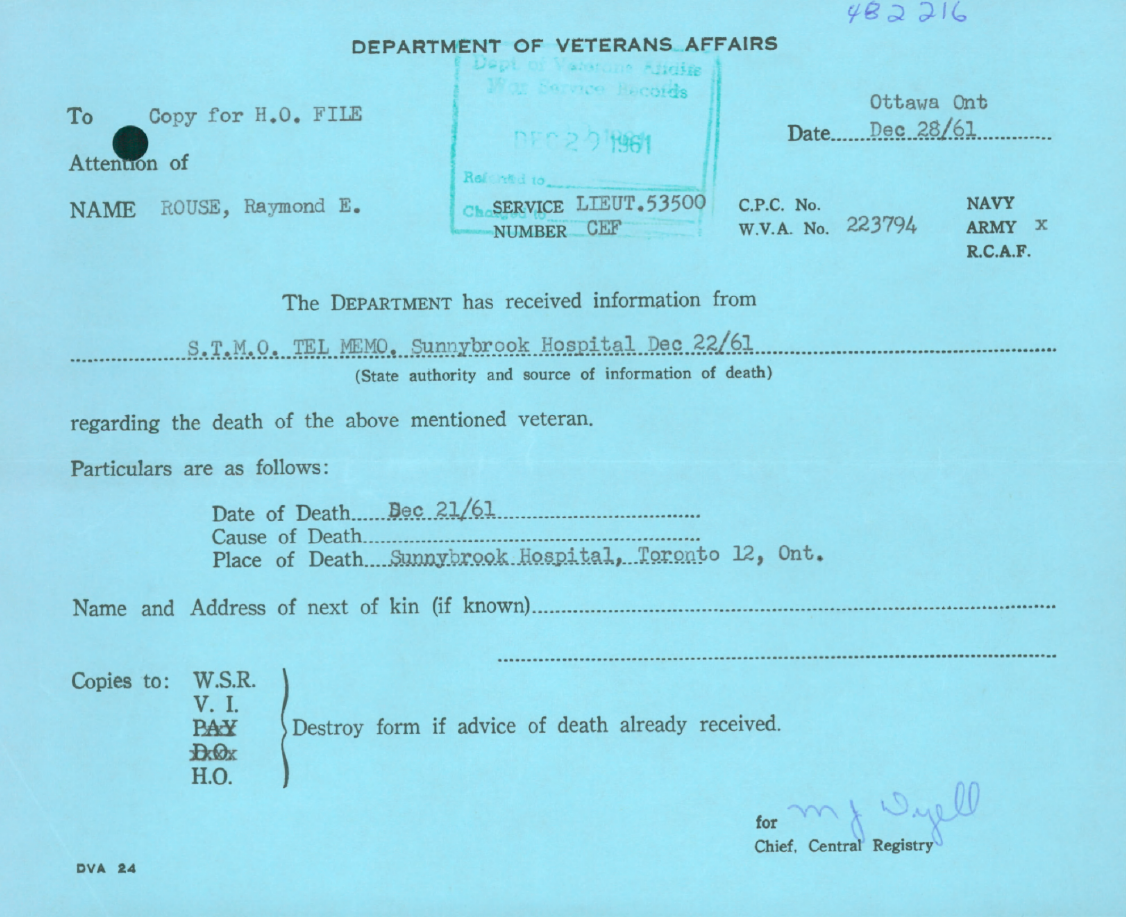
He lived until 21 December 1961, when he died at Sunnybrook Hospital, Toronto, Ontario. He is buried at the Tillsonburg Cemetery on a small hill and his stone was remediated and flags place commemorating his service to Canada.
We thank him for his service and remember him.
[i] Lieutenant Vogan was to later lose is life dying of his wounds while serving with the 13th Middlesex Regiment, an English unit.
[ii] London Gazette. No. 30172. 9 July 1917. Pg. 6843.
Discover more from History of the 18th Battalion CEF, "The Fighting Eighteenth"
Subscribe to get the latest posts sent to your email.
 History of the 18th Battalion CEF, "The Fighting Eighteenth"
Leave a comment