
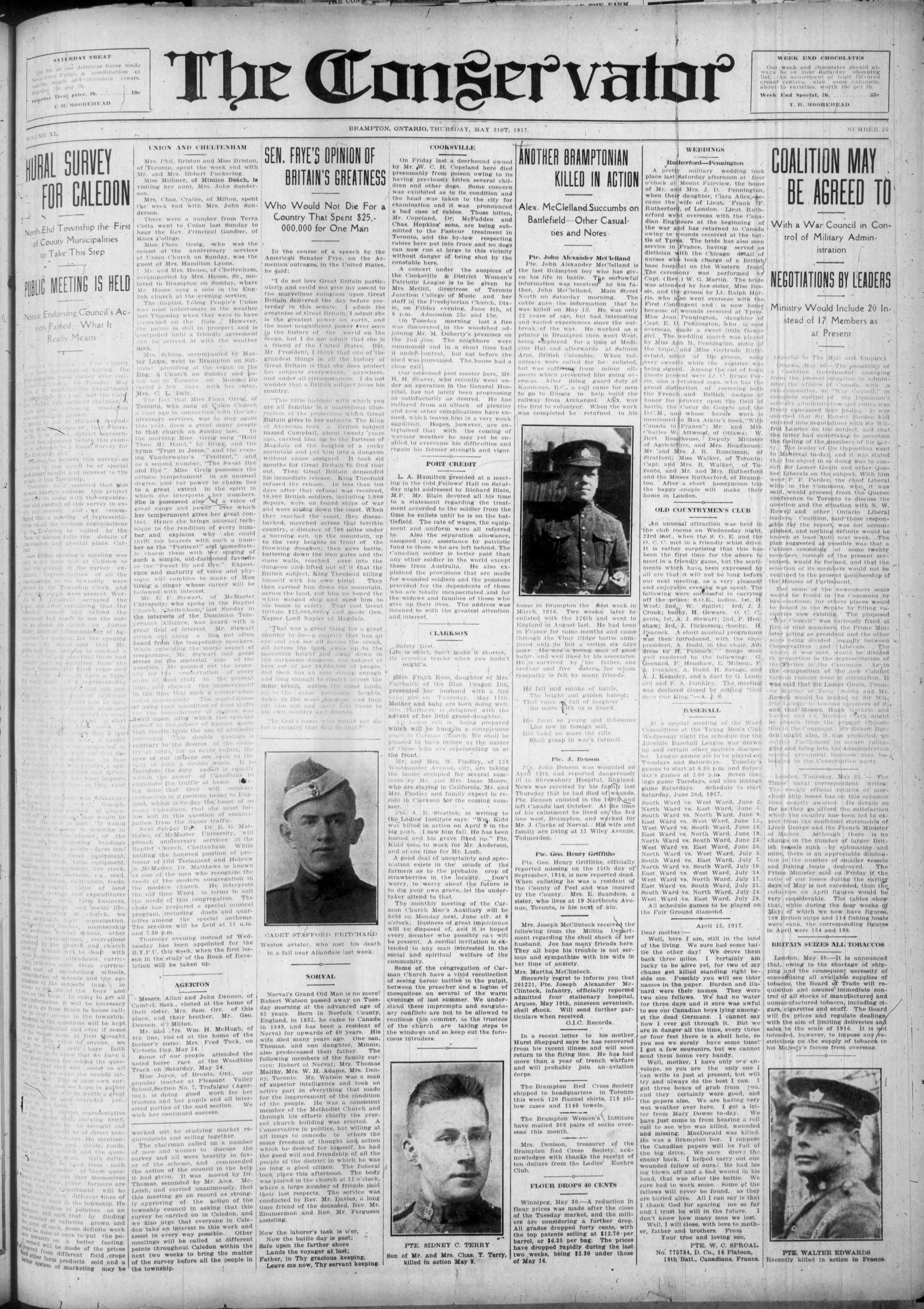
With the images and sounds of the now famous Battle of Vimy Ridge present in his 22-year-old mind, Private Sproal took time to write his mother while the 18th Battalion was “resting”[i] in billets at the camp located at Bios-des-Alleux[ii].
His letter, transcribed in full below, describes his experiences during the battle[iii].
April 15, 1917.
Dear mother:—
Well, here I am, still in the land of the living. We sure had some battle the other day! We drove them back three miles. I certainly am lucky to be alive yet, for two of my chums got killed standing right beside me. Possibly you will see their names in the paper. Burden[iv] and Bunard[v] [Burnard] were their names. They were two nice fellows. We had no water for three days and it sure was awful to see our Canadian boys lying amongst the dead Germans. I cannot say how I ever got through it. But we are in danger all the time, every three or four feet there is a shell hole, so you see we surely have some time! I got a few souvenirs, but we cannot send them home very handy.
Well, mother, I have only one envelope, so you are the only one I can write to just at present, but will try and always do the best I can. I got three boxes of grub from you, and they certainly were good, and the papers also. We are having very wet weather over here. I got a letter from Mary Dowse to-day. We have just come in from hearing a roll call to see who was killed, wounded and missing. MacDonald[vi] was killed. He was a Brampton boy. I suppose the Canadian papers will be full of the big drive. We sure drove the enemy back. I helped carry out one wounded fellow of ours[vii]. He had his leg blown off and a bad wound in his head, that was after the battle. We sure had to work some. Some of the fellows will never be found, as they are buried alive. All I can say is that I thank God for sparing me so far and I trust he will in the future. I don’t know how many men we lost.
Well, I will close, with love to mother, father and brothers. From
Your true and loving son,
PTE. W. C. SPROAL. No. 775784, D. Co., 16 Platoon, 18th Batt., Canadians, France.


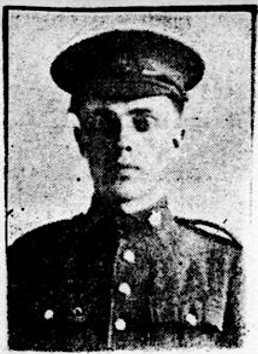
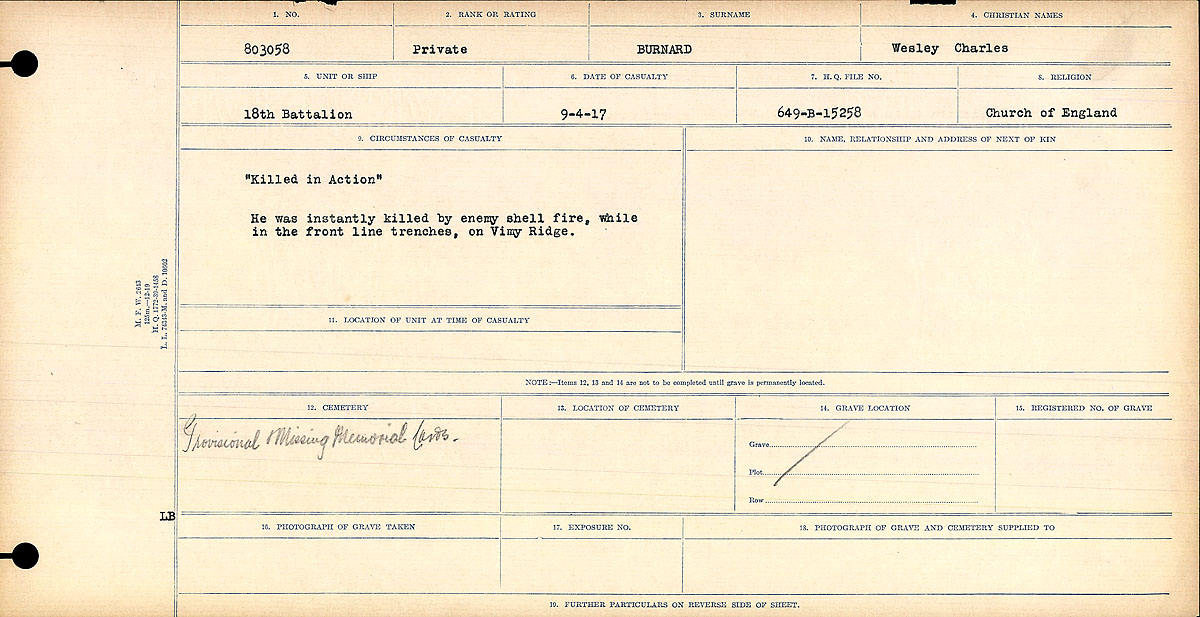
He relates the deaths of two of his “chums”, Privates Burden and Burnard. Burden’s death is recorded as being “Killed in Action”, while Burnard’s death is described as ‘”Killed in Action” He was instantly killed by enemy shell fire, while in the front line trenches, on Vimy Ridge.’ The letter gives no context for the timeline of the deaths in relation to the battle on that day, but the circumstances of their death led to their burial in an unknown grave as both soldiers are commemorated on the Vimy Memorial. It is possible that the text on Burnard’s “Circumstances of Death” card was related to the military bureaucracy by Private Sproal. His letter attests that he witnessed the deaths of both of these men.
In the case of the friendship between Sproal and Burden, it may have begun before they were assigned to the 18th Battalion as replacements. They both were at Witley Camp some time before they departed for the Continent on 28 November 1916, as they are recorded to both have departed for their line battalion on that date. In addition, they arrived “in the field” on the same day, 29 November 1916.
For the friendship between Sproul and Burnard, it would have begun some time after 3 December 1916, as that was the date that Private Burnard arrived “in the field” with the 18th Battalion.
Burden and Burnard were both originally from the 135th Battalion, and they both enlisted in London, Ontario; therefore, they were likely friends and certainly knew each other.
Another salient fact is that all three men practiced the Methodist faith, which served as another link in the chain that formed these three men into friends.
Thus, from early December 1916 to 9 April 1917, these three men were chums, serving together with “The Fighting 18th”.
One can see why Sproal considers himself lucky, as of the three men, he was the only one to survive that day. He was an eyewitness to his friends’ death, and his simple assertion that he was lucky speaks volumes to the vagaries of combat and one of its outcomes for some of the soldier of any action.
Private Sproal relates some of the logistical challenges as the men of the 18th Battalion consolidated their gains after the battle and waited for much-needed supplies, such as food and water. The 18th Battalion War Diary describes some of the challenges it faced during the three days on which Sproal relates, and the diary entry from 11 April 1917 gives some idea of those challenges:
“Position of Battalion as shown yesterday. This proved to be a very difficult and trying tour, the enemy constantly shelling our defences and putting up frequent barrages. The position being a very commanding one the enemy did not attempt a counter-attack although we found it necessary several times to call for retaliation[viii], with was always promptly given and satisfactory.”[ix]
His letter also attests to the intensity of the German shelling as he relates to his mother the concentration of shell holes in his vicinity, and there is a wonderful reference to the invariable souvenir hunting all soldiers seem to partake from time immemorial.
As a soldier fights on their stomach, Sproal is happy to confirm that the “grub” sent by his mother for his consumption has arrived safely, and is much appreciated, along with the copies of the local newspaper that allow Sproal to keep in touch with the happenings of his hometown – a common comfort for many Canadian soldiers at the front.
He reports on a local boy, Private McDonald, who was killed in action during a relief of the Battalion by German shellfire. Again, this soldier would have no known grave, another testament to the intensity of the German shell fire. It was so intense it prevented the timely recovery of casualties, both the wounded and the dead, during the battle. He further reiterates this as he relates, “Some of the fellows will never be found, as they are buried alive.”
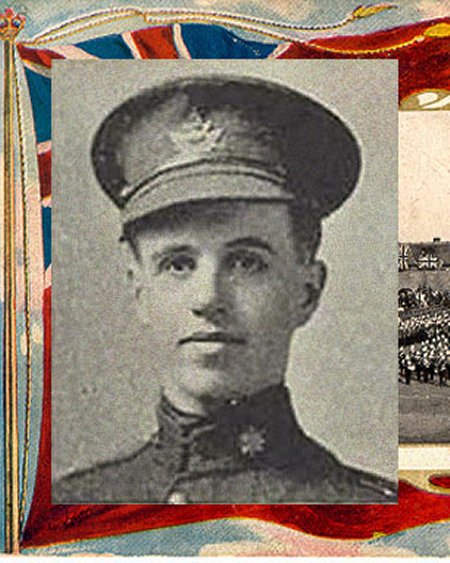
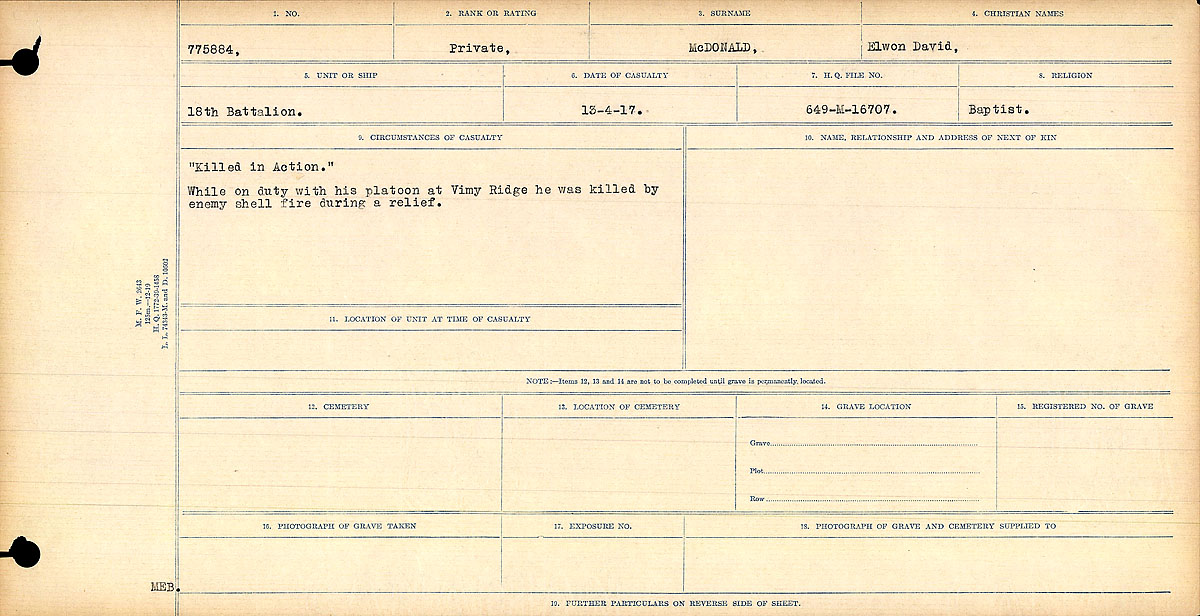
The irony about Sproal’s intimation that the paper was full of the details of the Vimy Battle, though true, was not reflected by the other articles on the Conservator paper’s front page on that date. It detailed the death of no less than six Brampton area residents who died due to their service with the armed forces.
Sadly, the Sproal family would suffer its own tragedy when on 21 August 1917, he was killed in action during the 18th Battalion’s engagement in the fighting at Lens during the Battle of Hill 70. His death was particularly poignant as he, along with 22 other men of the 18th Battalion, were obliterated by a German shell falling on the road they were marching on as they were returning from intense action covering from the 13 to 19 of August 1917. A further 30 men were wounded. This shell brought the total casualties for the Battalion up until that day to 220 men killed or wounded.

The Sproal family, father Thomas, mother Mary Ann, and his sister May[x], and brothers Charles, Albert, and John would grieve their lost son and brother. The Sproal family would print memorials in the Brampton Conservator on the anniversary of his death, starting on 22 August 1918. There are three memorial entries, and all express the family’s loss with a poem.

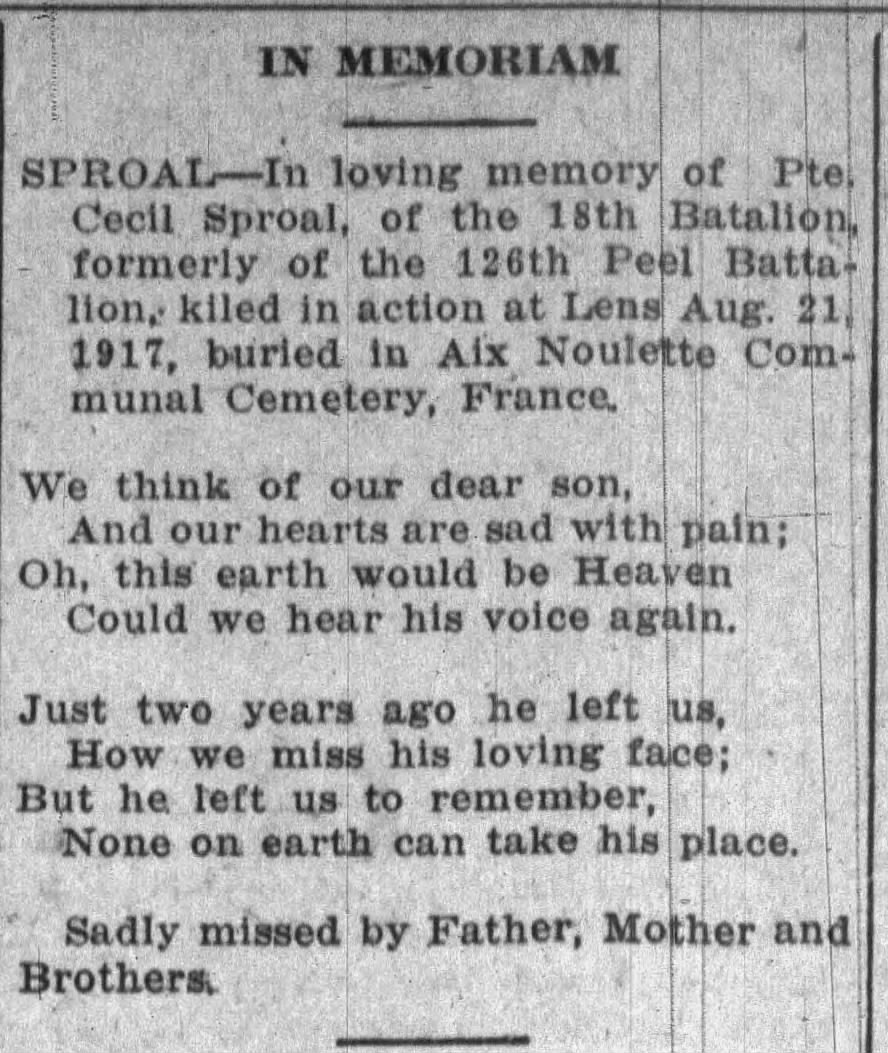
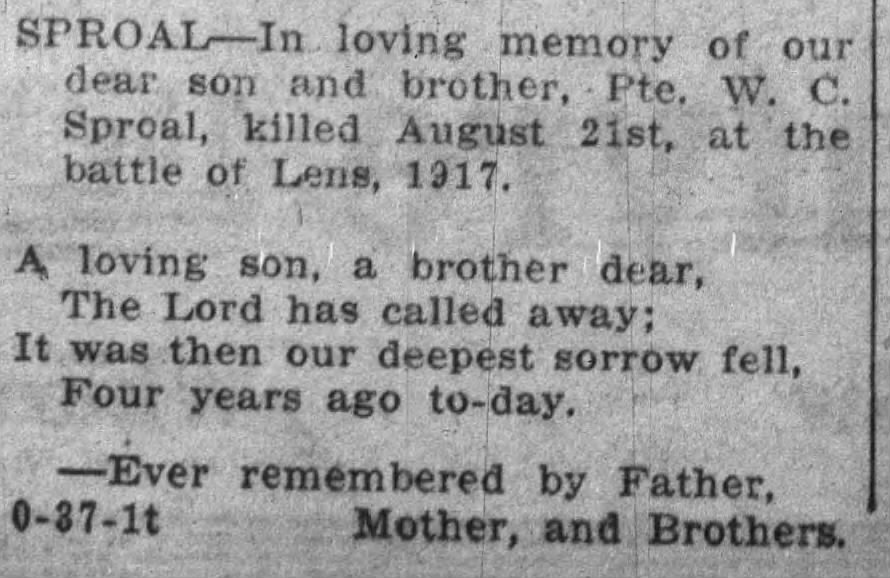
From Private Sproal’s letter, we can see that he lost at least four men who were “chums”, and he would be lost in one of the 18th Battalion’s most horrific incidents, the shelling that took so many men in an instant. He felt comfortable sharing his experiences and appreciated the support of his family with their care packages of “grub”, small reminders of the home that was so dear to him.
The loss the family suffered is reflected in their need to post memorials in 1918, 1919, and 1921. There appears to be no further memorials printed after 1921, and the reason that they stopped will never be known. Suffice to say, the family’s loss required them to acknowledge the loss of their family member. One hopes that they did not learn of the way he died, as several men recounted in letters the need to use sandbags to collect what was left of some of the men killed that day.
The origin of the poems is unknown. Each appears to be a personal expression of the family’s grief, and all reflect the thoughts of the thousands of Canadians who were left to remember the fallen.
“We think of our dear son,
And our hearts are sad with pain;
Oh, this earth would be Heaven
Could we hear his voice again.
Just two years ago he left us,
How we miss his loving face;
But he left us to remember,
None on earth can take his place.”
Private Sproal’s letter to his mother, though short, expands over time, sharing the details of the deaths of three of his friends, and also shows his need for the comfort that the “grub” sent to him connects him with his family, so far away in distance and circumstance. The quiet wind swept fields around the fertile fields of Brampton would whisper to the wheat, while the whine and crash of shells ever reminded soldiers that many of them lived on borrowed time.
[i] Per 18th Battalion War Diary Transcription. https://18thbattalioncef.blog/2016/12/03/war-diary-of-the-18th-battalion-april-1917/
[ii] The Bois de Alleux was approximately 9 kilometres west of Thelus. It is adjacent to the village of Mount St. Eloy. It is north-west of the village. Coordinates 51c.F.2.c.2.8. Source Western Front Association Trench Mapper.
[iii] The Conservator (Brampton, Ontario). 31 May 1917. Page 1.
[iv] Private Gordon Gideon Burden, reg. no. 802604.
[v] Private Wesley Charles Burnard, reg. no. 803058.
[vi] Private Elwon David McDonald, reg. no. 775884.
[vii] Private Gordon Harrison. Ref. Toronto Evening Telegram. 7 September 1917. This soldier was not found in the Library and Archives Canada.
[viii] The War Diary refers to calling up Canadian and/or British artillery resources to shell the German guns.
[ix] Published by Eric Edwards (2016) War Diary of the 18th Battalion: April 1917, History of the 18th Battalion CEF, ‘The Fighting Eighteenth’. Available at: https://18thbattalioncef.blog/2016/12/03/war-diary-of-the-18th-battalion-april-1917/ (Accessed: 09 January 2026).
[x] Interestingly, the memorial clippings only identify the brothers, making no mention of her. Her date of death is not known.
Discover more from History of the 18th Battalion CEF, "The Fighting Eighteenth"
Subscribe to get the latest posts sent to your email.
 History of the 18th Battalion CEF, "The Fighting Eighteenth"
Leave a comment