| With thanks to the contributor of this photograph to the 18th Battalion Facebook Group. |
The war was over. And the boys were going home. But what to do with a thousand young men fresh from occupation duty in Germany?
Soccer was one such diversion.
Thanks to the Ley and Lois Smith War, Memory, and Popular Culture Research Collection[i] – Western University, one can glimpse a moment in time, allowing the reader to discover another social aspect of the experience the men of the “Fighting 18th” shared with each other as they served during World War 1.
The role of sport had an important function in battalion life. It maintained the physical and mental well-being of the athletes and spectators. It was a rallying point for battalion morale and pride, as well as a diversion from the soldiers’ military duties and existence.[ii]
Sports, in the form of baseball, were so important that the battalion was secreted from its billets in brigade reserve to the rear by military railway to watch a match.[iii]
But Association football or known in the colonies and the United States as soccer, did not hold quite the hallowed place that baseball did. The 18th Battalion and the Canadian Corps had almost a fetish for baseball, with inter-battalion games, brigade-level competitions, and Canadian Corps champion contests throughout the Canadian Expeditionary Forces’ involvement in the war.
The first mention of football/soccer is in the February 1917 War Diary when the diarist writes, “Football final. Hqr. versus A Coy.” Sadly, no mention of the final score is made.
A mention on 1 May 1917 gives a good account of the role of soccer when it relates, “Battalion parade and company training. During the afternoon, recreational exercise such as Football, Baseball etc. was in order.”
An examination of the War Diaries shows that football was another sport that occupied the attention of the men of the 18th. The War Diary records[iv]:
- 18th Battalion Divisional Champions against the 4th Machine Gun Company at a Sports Day held at Coupigny on 17 June 1917.
- 18th Battalion fought to a draw of 1-1 with the 20th Battalion for the Brigade Championship.
- 18th Battalion wins the Canadian Corps Sports Day contest 2-0, 1 July 1917.
- 2nd Division Football contest at Villers Camp was held on 29 September 1917.
The 18th Battalion would host an inter-squad contest during February 1919, and from that contest, which resulted in this outcome, ‘The “Q.M.” Stores were victors over “A” Co’y. in a football game played on the Y.M.C.A. Grounds this afternoon. The score being 2 – 0.’ This contest was held in Fosses, Belgium, where the 18th Battalion was quartered for February 1919, before it returned to England for disposition in preparation for its return to Canada.
We have a photograph of the Quartermaster Stores team. In it, we twelve men stare stolidly at the camera. The man on the right in uniform must be the team coach. The team has 11 men in it, so no substitutions during a game, assuming that no men were missing from the photograph when it was taken.
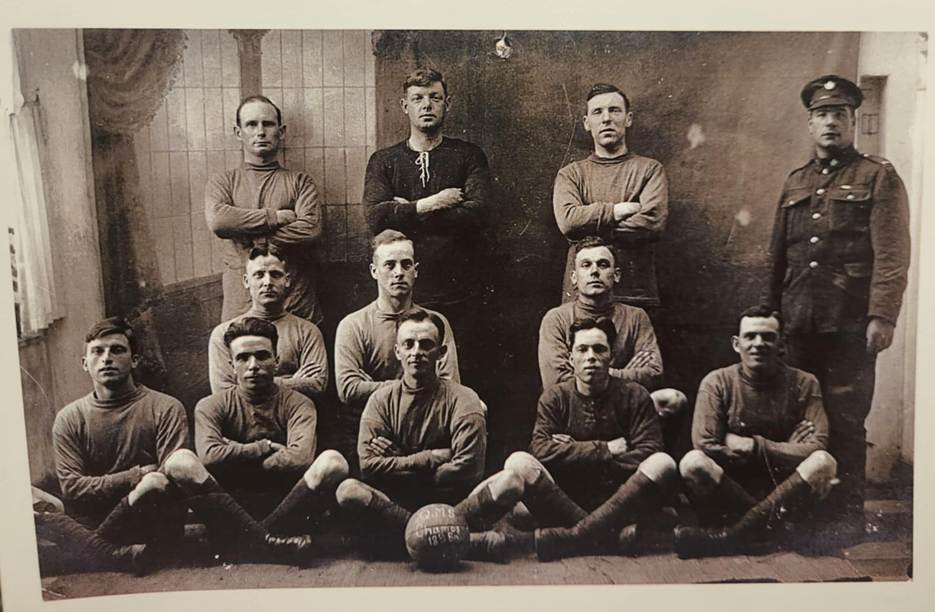
QMS Champs, 18th Battalion, Fosses, Belgium (left to right)
Rear: 54021 Norman Huck, 53740 Harry Stansfield, Wallace, 53908 William Stephen Farr
Centre: 775918 Alfred William Brightwell, 54005 Herbert Cartwright, Sheppard
Front: 53950 James Patient, 53976 Thomas Wade, 54220 Bertram Croome, Boyd, 53656 Robert Henry Brackstone
The accompanying information about this photograph names the men with either their name, regimental number and city of enlistment or simply by the soldier’s last name. Thus, this documentation allows context to be derived from the image and the accompanying text, identifying these men.[v]
Of the men identified with regimental numbers, eight of the men were original members of the 18th Battalion (reg. nos. beginning with 5), while one is a member of the Battalion that joined late (Private Alfred William Brightwell, 775918), with two men only identified with their last names.
A basic analysis of the service records of the identified men shows some interesting insights.
| Name | Wounded | Decorated | Court Martialed | Leaves | Pages | |
| 54021 | Norman Huck[vi] | No | No | Yes | 0 | 40 |
| 53740 | Harry Stansfield[vii] | No | No | Yes | 3 | 46 |
| 53908 | William Stephen Farr[viii] | No | No | No | 3 | 40 |
| 775918 | Alfred William Brightwell[ix] | Yes | No | No | 2 | 57 |
| 54005 | Herbert Cartwright[x] | No | No | No | 3 | 37 |
| 53950 | James Patient[xi] | No | No | No | 3 | 48 |
| 53976 | Thomas Wade[xii] | No | No | No | 3 | 48 |
| 54220 | Bertram Croome[xiii] | No | No | No | 3 | 52 |
| 53656 | Robert Henry Brackstone[xiv] | No | No | No | 4 | 40 |
It is interesting to note that only one of the identified men, Brightwell, was wounded. Though this is a small sample size, this matrix does not represent the experience of the combatants of the Canadian Expeditionary Force. Of the 236,618 men who served in line battalions and units, the percentage wounded was 73%. Note that this percentage does not discriminate as to the number of wounds each soldier received. The real number would be less, but it stands as a stark reminder of the risk these men experience during their service. The men of the football team had a 10% rate of wounding.[xv]
This wounding percentage differential, along with the long service life of the majority of the men of the Quartermaster Stores of the 18th Battalion, may point to the relative “safety” these men experience during their service supporting the logistics of the Battalion. This is not to disparage their service, as they performed a vital role in the support of the sharp end of the Canadian Corps. However, the discrepancy is noted, though no definite conclusion can be made without more research.
It does harken to the term “bomb proof jobs” referring to military assignments that were of such a nature that they prevented exposure to the risks of combat. By definition, these men did not have the protections a bomb proof job afforded; the documented experiences of these men indicate they were possibly in positions of relative safety, compared to their comrades in the combat trades, such as bombers, snipers, machine gun crews, and infantrymen.
Another area of interest is leaves.
The majority of these men also received more than one leave of absence during their service. An other-rank soldier would generally not receive leave during their service. It was the exception, not the rule. Receiving multiple leaves was more common with officers. As this matrix shows, this group of men averaged almost 3 leaves during their service.
Granted, they were long-serving members of the 18th Battalion (save Brightwell), the number of leaves cannot be explained by an examination of their service records. None of these men earned medals of valour or other commendations. No Good Conduct Badges and, in the case of Stansfield, he was court-martialled thrice – The first infraction occurred at La Clytte [De Klijte, Belgium] and resulted in 8 day’s Field Punishment No. 1 for the acts of theft and damaging private property; the second infraction was 14 day’s Field Punishment No. 1 for being “Drunk while on Active Service”; and the last 7 day’s Field Punishment No. 1 he was absent without leave while on Active Service for 31.5 hours. Yet he gets three leaves, amounting to 38 days away from the dangers of war. Poor Private Noman Huck got no leaves during the entire war.
Without this photograph, the members of the Quartermaster Stores football team would lie undiscovered. With the names attached to the photograph, the place, time, and context can be placed to these men. Their service records only show a part of their service, whereas this image allows us to see how and why these men were connected. They served and played together, rather successfully too, while representing the “Fighting 18th ‘s” prowess at another sport that was popular for the men of the Canadian Expeditionary Force.
[i] University of Western Ontario. (2024, May 29). First World War Postcard Project connects past to present. Western News. https://news.westernu.ca/2023/11/first-world-war-postcards/
[ii] Horrall, A. (2001). “Keep-A-Fighting! Play the Game!” Baseball and the Canadian Forces during the First World War. Canadian Military History | Journal of the Laurier Centre for the Study of Canada | Wilfrid Laurier University. https://scholars.wlu.ca/cgi/viewcontent.cgi?article=1090&context=cmh
[iii] Edwards, E. (2021, March 12). The Deliquency of an Entire Battalion. History of the 18th Battalion CEF, “The Fighting Eighteenth.” https://18thbattalioncef.blog/2018/09/24/the-deliquency-of-an-entire-battalion/
[iv] Edwards, E. B. D. (2024, March 24). 18th Battalion War Diary transcription ver 2.3 : 18th battalion CEF on behalf Canadian Government : Free Download, borrow, and streaming. Internet Archive. https://archive.org/details/18th-battalion-war-diary-transcription-ver-2.3
[v] The author was not able to determine the positive identity of soldiers Wallace and Sheppard.
[vi] Canada, L. and A. (2026, February 2). Huck, Norman (3 Digital object(s)) genealogy / military / first world war personnel records. Library and Archives Canada. https://central.bac-lac.gc.ca/.redirect?app=pffww&id=472026&lang=eng&ecopy=406893a
[vii] Canada, L. and A. (2026b, February 2). Stansfield, Harry (3 Digital object(s)) genealogy / military / first world war personnel records. Library and Archives Canada. https://central.bac-lac.gc.ca/.redirect?app=pffww&id=247810&lang=eng&
[viii] Canada, L. and A. (2026a, February 2). Farr, William Stephen (3 Digital object(s)) genealogy / military / first world war personnel records. Library and Archives Canada. https://central.bac-lac.gc.ca/.redirect?app=pffww&id=378649&lang=eng&
[ix] Canada, L. and A. (2026a, February 2). Brightwell, Alfred William (3 Digital object(s)) genealogy / military / first world war personnel records. Library and Archives Canada. https://central.bac-lac.gc.ca/.redirect?app=pffww&id=64197&lang=eng&
[x] Canada, L. and A. (2026b, February 2). Cartwright, Herbert (3 Digital object(s)) genealogy / military / first world war personnel records. Library and Archives Canada. https://central.bac-lac.gc.ca/.redirect?app=pffww&id=91492&lang=eng&
[xi] Canada, L. and A. (2026e, February 2). Patient, James George (3 Digital object(s)) genealogy / military / first world war personnel records. Library and Archives Canada. https://central.bac-lac.gc.ca/.redirect?app=pffww&id=571529&lang=eng&
[xii] Canada, L. and A. (2026e, February 2). Patient, James George (3 Digital object(s)) genealogy / military / first world war personnel records. Library and Archives Canada. https://central.bac-lac.gc.ca/.redirect?app=pffww&id=571529&lang=eng&
[xiii] Canada, L. and A. (2026c, February 2). Croome, Bertram (3 Digital object(s)) genealogy / military / first world war personnel records. Library and Archives Canada. https://central.bac-lac.gc.ca/.redirect?app=pffww&id=126560&lang=eng&
[xiv] Canada, L. and A. (2026a, February 2). Brackstone, Robert Henry (3 Digital object(s)) genealogy / military / first world war personnel records. Library and Archives Canada. https://central.bac-lac.gc.ca/.redirect?app=pffww&id=59583&lang=eng&
[xv] 1914-1918 International Encyclopedia of the First World War. (2024, July 9). War losses (Canada) / 1.0 / handbook – 1914-1918-online (WW1) encyclopedia. War Losses (Canada). https://encyclopedia.1914-1918-online.net/article/war-losses-canada/
Discover more from History of the 18th Battalion CEF, "The Fighting Eighteenth"
Subscribe to get the latest posts sent to your email.
 History of the 18th Battalion CEF, "The Fighting Eighteenth"
Leave a comment