Company Sergeant Major Richardson wrote a letter home on 12 January 1916 from the relative safety of La Clytte[i], Belgium (now known as De Klijte), which was a camp used as a Divisional Reserve for the units of the Imperial Army. The 18th Battalion has spent Christmas[ii] in the trenches after arriving with the rest of the 2nd Canadian Contingent in the middle of September 1915 to buttress the Imperial British Army as it fought the Germans in Belgium.
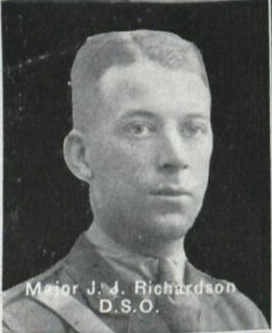
Richardson was an 18th Battalion original, enlisting on 26 October 1914 at Galt, Ontario. As he had prior military with the “Berlin Regiment”, the 29th Waterloo Regiment[iii], which had Companies in the towns of New Hamburg, Galt, Waterloo, Cross Hill, Berlin, and Ayr. Thus, he had knowledge of the men who served in the Regiment, and he would share this knowledge of some of the men in a letter to Orie Thiel.
The tone of the letter is conversational, though it shares the information of the deaths of two of his comrades, while giving a look into the interaction of the Home Front with the Front lines during World War 1.
It is not clear the reason for the relationship between Thiel and Richardson, but they were close enough that Thiel sent a care package to Richardson, and Richardson shares details of men in a tone that indicates that Thiel knew of, or knew the men mentioned in the letter.
It is a short letter with three paragraphs covering a lot of ground.
Letters From The Front
The following letter was received by Mr. O. Thiel[iv] from Comp. Sgt. Maj. Jack Richardson, C.E.F. written somewhere in Belgium. Jack relates some of his experiences in the trenches and thanks the boys for the good things sent him. The letter:—
Somewhere in Belgium, Jan. 12, 1916
Dear Orie, I just write you these few lines to thank you very much for your kind parcel which I received in excellent condition. As Dutch[v] is not here now, being in a hospital, I gave the cigarettes to Frank Orazek [Oraszek][vi] and Ben Bayliss[vii]. I divided up the summer sausage with Jack Gehl[viii], it certainly was all right. You might also thank the other fellows who put something in the parcel. I certainly appreciate anything from Berlin. I suppose you heard all about Jack Gerbig[ix], and young Eric Carthy[x] being killed. I saw them in the morgue. I was also at the burial services, we keep their graves nice and green, putting evergreens on when we get a chance. They are buried in our own Canadian cemetery away behind the firing lines.
By the way, Orie, I have been promoted to Coy. [Company] Sergeant Major so if you write me again you will have to address me as such. I am getting along fine out here, and might get a commission one of these days. I wish the war was finished, I have seen enough, now, they can send me back any old time they like. I am now the senior non-commissioned officer in D. Company, and over Q.M. Sergeant Lawrance[xi]. All the Berlin boys are well and wish to be remembered to you.
Well Orie I think I’ll go to bed now, don’t forget to write soon to your old pal Jack. C. Sergt. Maj.
Best regards to your Dad.
Berlin News Record. 1 February 1916.
By explanation, Richardson briefly mentions each of the soldiers in his Battalion, and the lack of detail is tantalizing, as it speaks so little to so much.
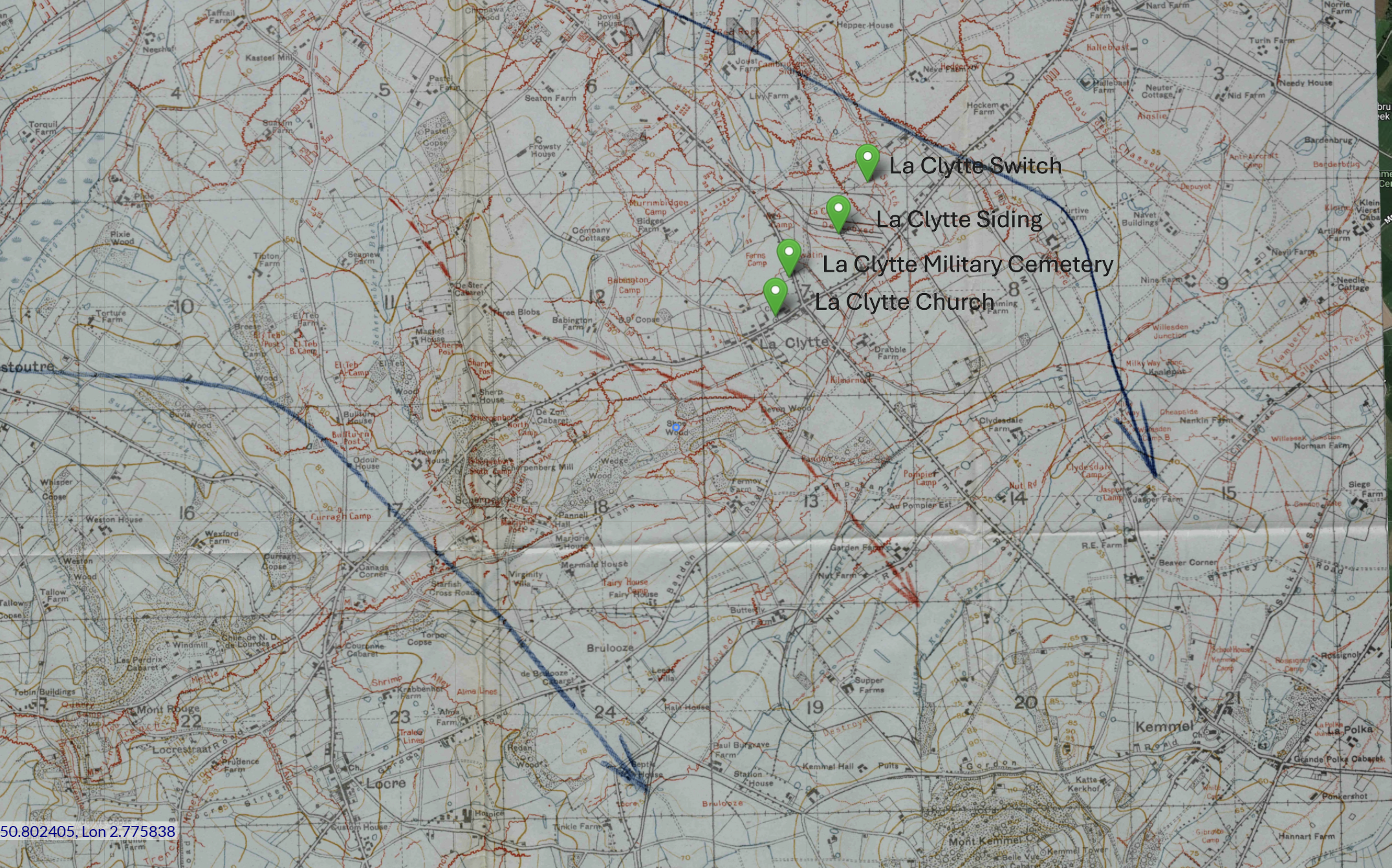
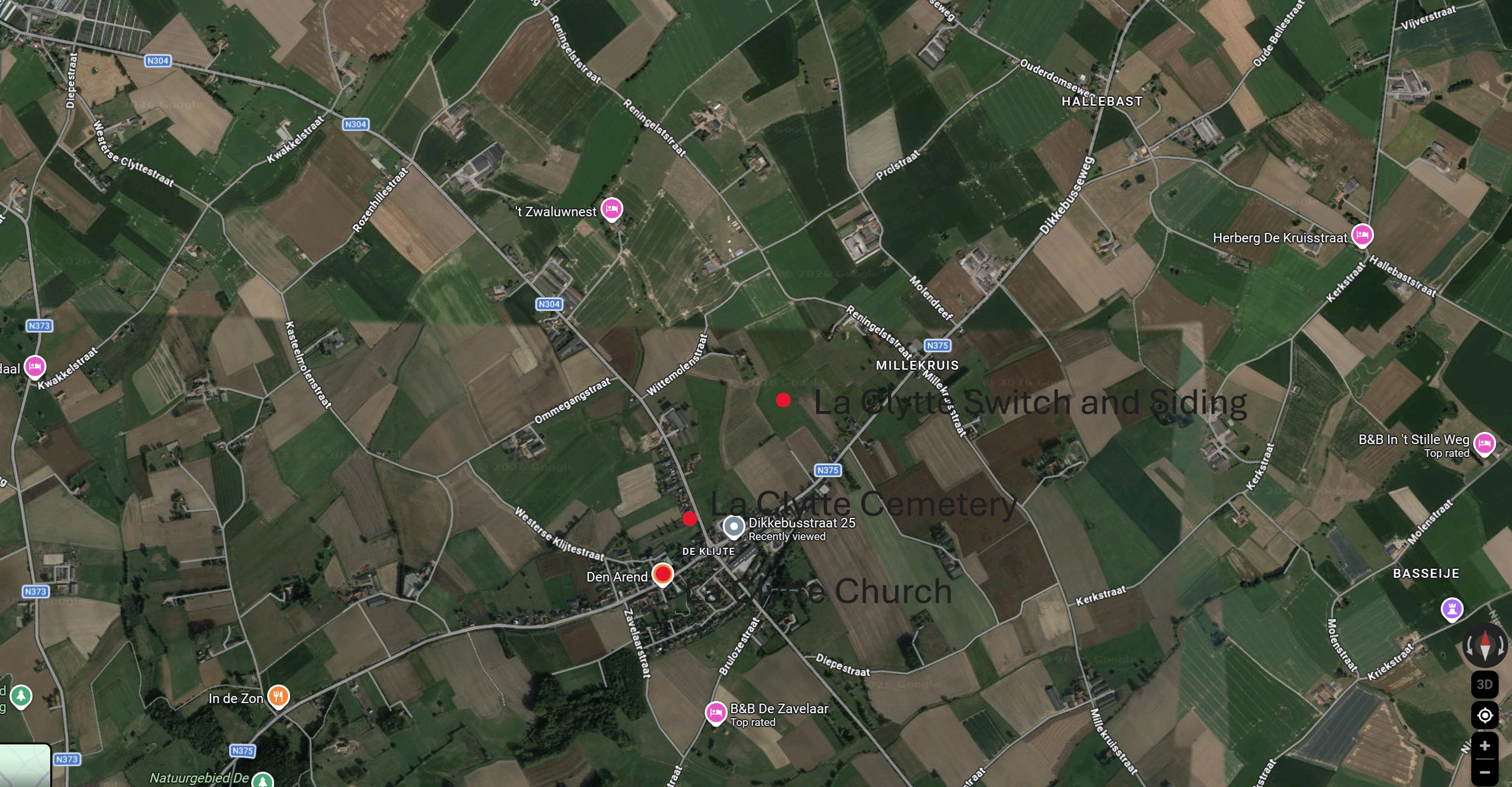
This is a comparison between the 1918 trench map (left) and Google Earth (2026) of La Clytte. The camps were located to the north-west of the village near the train siding and switch. The outskirts of Ypres are 6 KM to the north-west along the N375, which passes through the village from west to east.
Source: 28 SW 1 – 1:10,000 -Kemmel – 5A Local – Trenches Corrected to 13 September 1918. via the Western Front Association Trench Mapper.
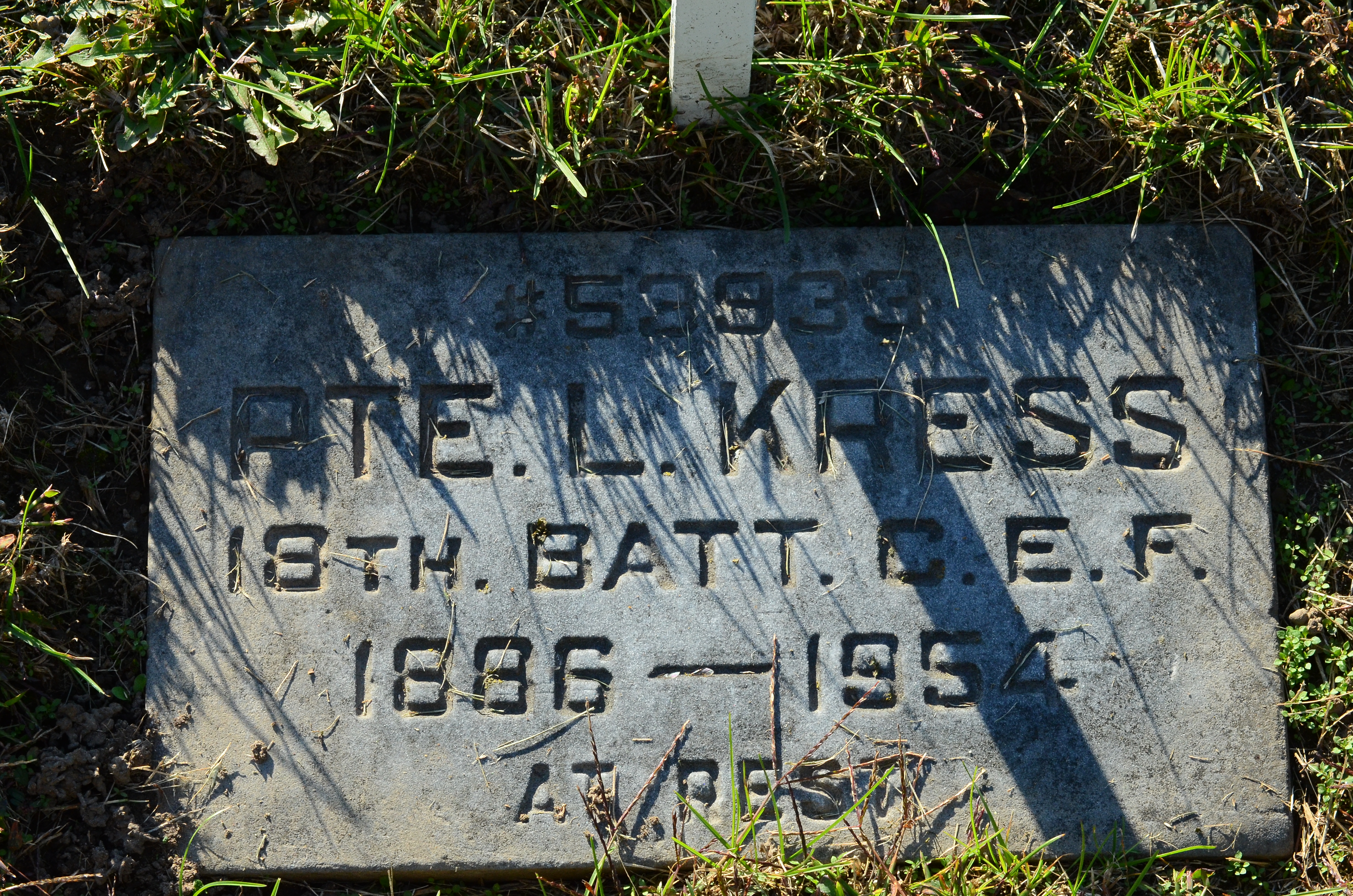
“Dutch” Kress was not present at the time of the letter. He was from Galt and was known for his athleticism. He was an avid baseball player, becoming the Manager of the Galt Terrier Baseball Team[xii] after the war. He was suffering from synovitis of the knee and was admitted to the 5th Canadian Field Ambulance on 29 December 1915. He rejoined the 18th Battalion just the day before Richardson.
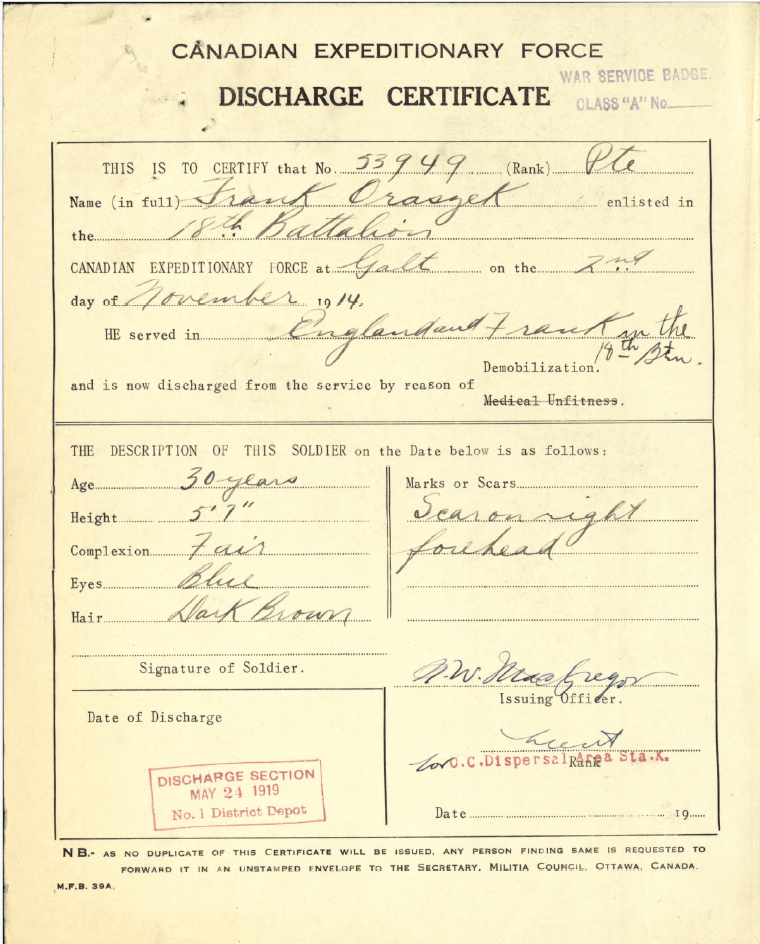
He then refers to Frank Oraszek, probably from Berlin, as his mother lived there. He was originally born at Detroit, Michigan, but had emigrated to Canada as a young boy (1891), so his ethos was that of a Canadian, though his father, Andrew (1846-1909) had been born in Germany. Obviously, his sympathies lay with his adopted country, as he served out the war having suffered from Shell Shock and a GSW to his back.
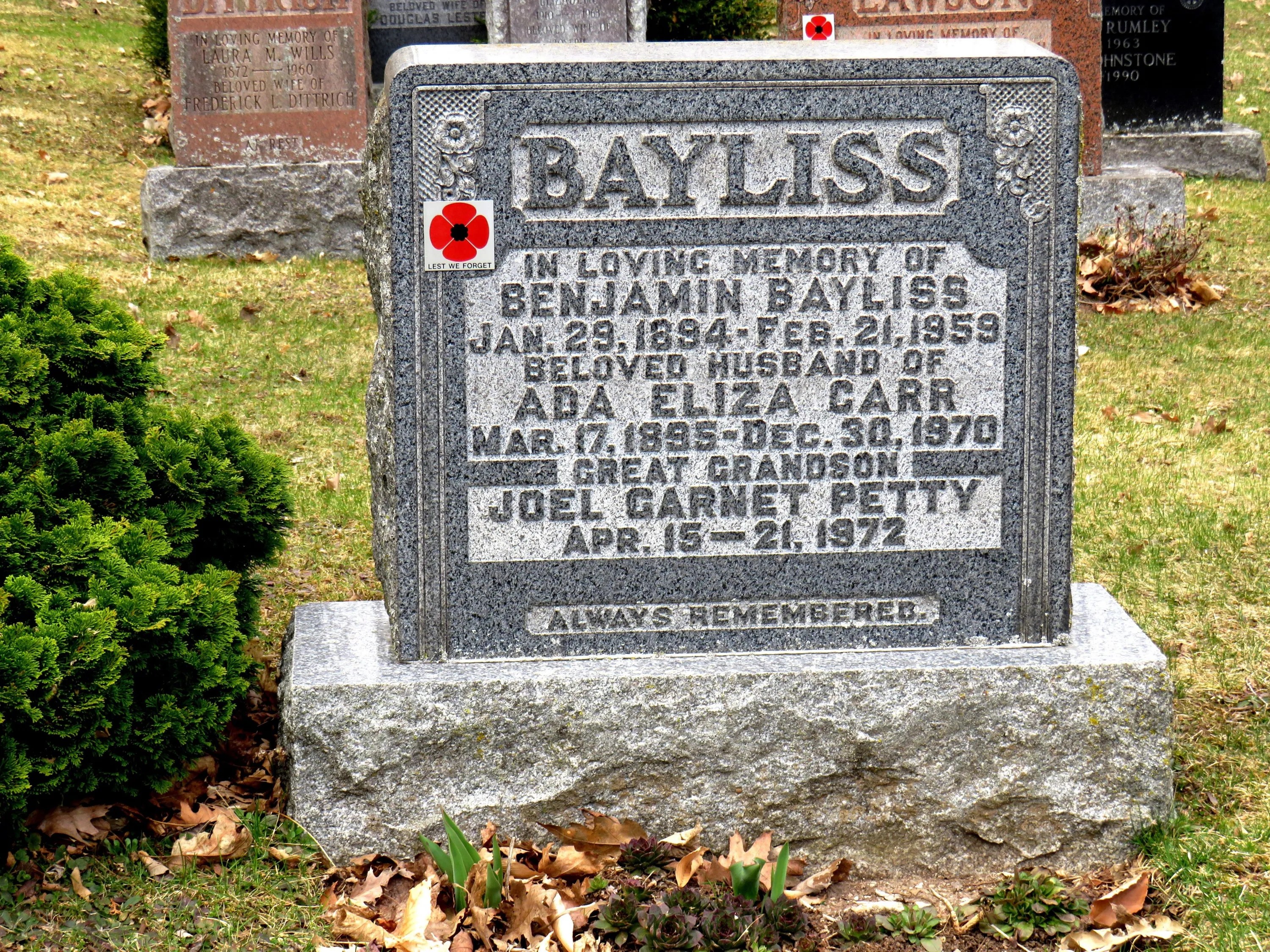
The other smoker, Bayliss, was a Berlin boy with a recorded address on Breithaupt Street. He was a bit younger than the previous men, being 20 years old when he enlisted. His young age did not deter him from earning a Military Medal and a Mention in Despatches. He would suffer from a GSW to his left thigh in March of 1916, which was minor, but he would suffer a concussion and burns at Passchendaele on or about 13 November 1917, from which he did not return to active combat service, being posted in England for the duration of the war.
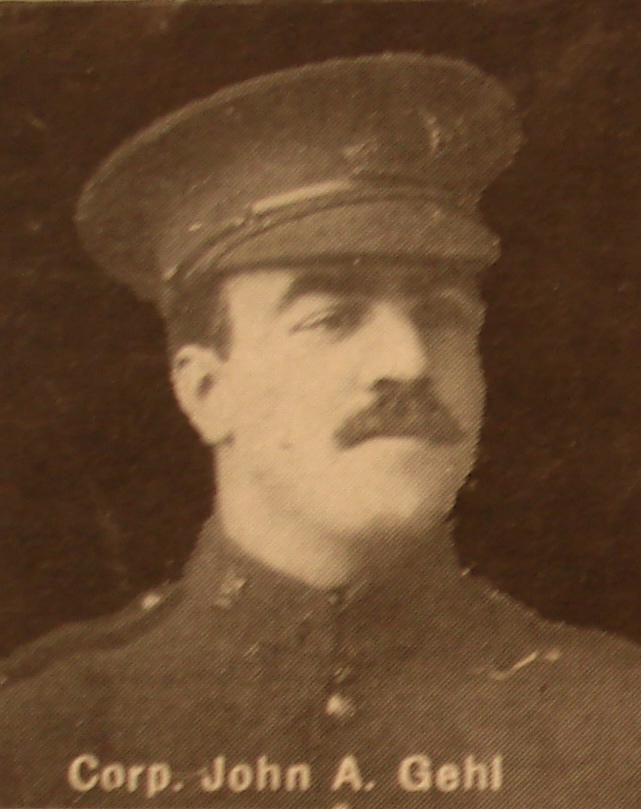
Jack Gehl, lucky recipient of the sausage, would also receive a promotion to Corporal on the day this letter was written. It was a close-run thing for Gehl, as he suffered from a hernia while he was training in England, having a successful operation for a left inguinal hernia on 24 June 1915. Sadly, his promotion was short-lived. He was killed in action on 24 April 1916 when he was hit in the head by the fragments of a shell or grenade while out on a wiring party. He, too, wrote a letter published in the Berlin News Record on the same day that Richardson’s letter was published.
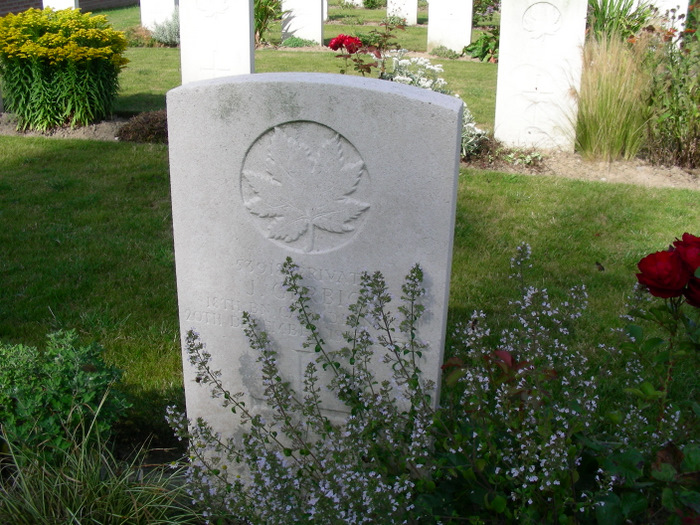
Private John Gerbig, 27, was killed in action on 20 December 1915. The Circumstance of Death Card and service records do not give any details of this soldier’s death. The 18th Battalion War Diary makes no mention of any casualties on that day. He, too, was from Berlin and of German heritage, having both parents born in Germany. He, however, was born in Canada and stepped up to serve his Country and Empire, making the ultimate sacrifice.
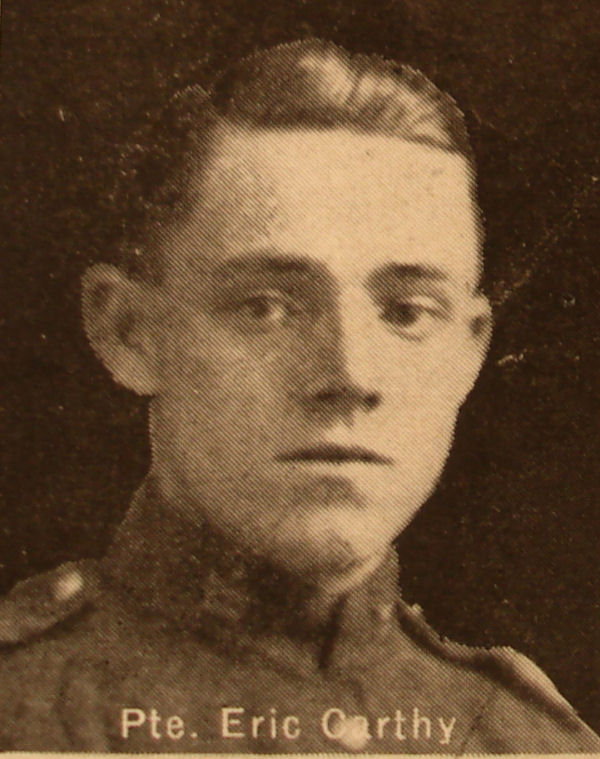
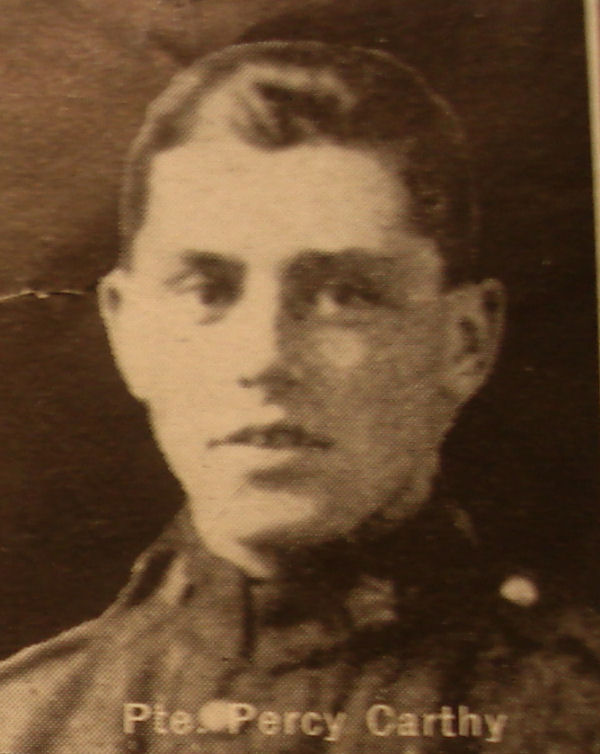
Private Carthy’s death, in contrast, was documented in detail by his brother, Percy in a letter published in the Berlin newspaper.
Belgium, Dec. 27. [1915]
Dear Father and Mother,
I suppose you will have heard of our bad luck. Eric was hit as he was going in the trenches last night. He never suffered at all as it was instant. It happened just as he was going in. Some one had sent a fatigue party with trench mats out. This party should have waited until the relieving company had got in and the relieved company out. But instead of doing so, the fatigue party got misled with the company and there was a man with a trench mat near him and the German sending a flare up, saw the white wood which made a good target and they turned a machine gun on the road. That is what they caught Eric with. Well dear father and mother please do not take it too hard, it would have been worse if he had been wounded and died after it, for as it was he never knew what had hit him. His major telephoned down to our company as soon as it happened. They told me at first that he was wounded and said I could go to see him. I went up to his lines expecting to see him alive but when I got there the stretcher bearers had taken him into a dugout and one of his officers was in with him. I came out of the trenches just after they had brought him out and stayed today to see him buried. He was buried in a little cemetery behind the lines near Dichebusch [Dickebusch], which is not far from Ypres. It is a nice little place; I will send you a picture or two of the village near. I will look after the grave whilst I am able. Well I have very little to say now. Hoping you are all in the best of health. I will try and write oftener. You will be getting a letter from his officer and from the chaplain, Capt. Carlyle.
The weather has been pretty bad, all rain and mud. The officers are sending Eric’s personal effects over to you, so let me know when you receive them. I remain
Your loving son and brother,
Percy.
Berlin News Record. 15 January 1916. Page 1.
Eric was only 19 when he died. Tragically, his brother Percy would perish in the hell that was to be the Battle for Fler-Courcelette on 15 September 1916. They, too, were from Berlin.
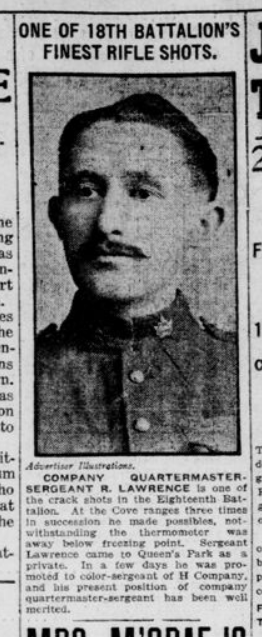
The last soldier mentioned, Quartermaster Sergeant Lawrance, was the oldest of the bunch. Enlisting at 37 years old, he had 8 years 11 months of military experience in England with the 2nd Dorset Regiment and with the 108th Regiment of Waterloo County[xiii]. He lived in Berlin with his wife when he enlisted. After the war, he moved to Halifax and worked with the Royal Canadian Regiment. He would be widowed, but remarried in 1942, at the tim,e a Canadian Pacific Railway Policeman.
This short three-paragraph letter shares a sweeping range of information relating to eight members of the 18th Battalion. It demonstrates a range of social interactions that are part of the experiences of a soldier in the Canadian Army during the Winter of 1916.
The 18th Battalion had experienced its baptism of fire doing yeoman service in the trenches of Flanders, and as of the date of the letter, a total of 27 soldiers of the Battalion had been killed in action or died of wounds.[xiv] Obviously, Richardson felt each loss, but of those men he knew personally and socially, the loss would be that much more bitter.
In some ways, the matter-of-factness of the tone of the letter belies an acceptance of the situation he finds himself in. The three months of service experience give Richardson some idea of what to expect in the future, making the tone of the letter conversational, as if he is relating day-to-day occurrences, especially to passing comment about losing Privates Gerbig and Carthy. We can see this contrast from the detailed letter by Private Percy Carthy published two weeks earlier in the same newspaper. Richardson may have been aware that Carthy’s letter was published in the local newspaper, so he did not dwell on the details. But if one did not know about this, they may be taken aback by the casual mention of the deaths.
Taken in total, the letter shows the close relationship between the men from Berlin and how their geographic place in Canada shapes their perspective. Taking the letter in isolation, the information has meaning. Delving deeper into the connections between these men – their place and time – shows the tight bonds of comradeship during war.
It also emphasizes the normalization of death. On its own, it takes only 11 words to convey the deaths of two men, when those experiences alone involved so much more, as Private Percy Carthy’s letter shows.
Richardson probably never forgot these men, and neither will we.
[i] Edwards, E. (2018, February 6). War Diary of the 18th Battalion: January 1916. History of the 18th Battalion CEF, “The Fighting Eighteenth.” https://18thbattalioncef.blog/2014/08/05/confidential-war-diary-of-18th-canadian-battalion-2nd-canadian-division-from-1st-january-to-31st-january-1916-volume-5/
[ii] Edwards, E. (2020, January 4). War Diary of the 18th Battalion: December 1915. History of the 18th Battalion CEF, “The Fighting Eighteenth.” https://18thbattalioncef.blog/2014/07/18/confidential-war-diary-of-18th-canadian-battalion-2nd-division-from-1st-december-to-31st-december-1915-volume-4/
[iii] Wikimedia Foundation. (2025, April 18). Highland Light Infantry of Canada. Wikipedia. https://en.wikipedia.org/wiki/Highland_Light_Infantry_of_Canada
[iv] Oriel Thiel, unknown. Reference to Mr. and Mrs. Oriel Thiel on 14 June 1914 re. birth of a son in the Berlin News Record.
[v] Private Lorenze “Dutch”Marquis Kress, reg. no. 53933.
[vi] Private Frank Oraszek, reg. no. 53949.
[vii] Private Benjamin Baylis, reg. no. 53886.
[viii] Private John Andrew Gehl, reg. no. 53916.
[ix] Private John Gerbig, reg. no. 53918.
[x] Private Eric Carthy, reg. no. 54209.
[xi] Quartermaster Sergeant Reginal Ernest Lawrance, reg. no. 53873.
[xii] The Windsor Star. 8 May 1923. Page 19. See his page for image.
[xiii] Authorized on 21 September 1914.
[xiv] Author’s research. See spreadsheets for September to December 1915, and January 1916 casualties.
Discover more from History of the 18th Battalion CEF, "The Fighting Eighteenth"
Subscribe to get the latest posts sent to your email.
 History of the 18th Battalion CEF, "The Fighting Eighteenth"
Leave a comment