Approximately 10 years ago, the author purchased a packet of items that belonged to this man. This is a review of what was in the package. This does not include the book in the packet titled Infantry Training (4-Company Organization), 1914 issued by the General Staff, War Office.
This document is designed to give some context to these items.
Record of Scanned Documents
Private Edward Frederick Zimmerman. Reg. no. 651151
S.S. “Metagama” Accommodation Assigned
Item Details[i]
Name: S.S. “Metagama” Accommodation Assigned
Production: Unknown.
Classification: Visual and Verbal Communication, official documents
Materials: paper, ink
Techniques: Printing
This card shows the sleeping assignment for Private Zimmerman as he transited to England from Halifax on 17 October 1916, arriving 28 October 1916. It refers to a berth, but it cannot be determined if it was a bed or a hammock.
He would have been accompanied by the rest of the 160th Battalion during the journey.
The significance of this object lies in its ‘typicality’ as illustrating processes and experiences undergone by many thousands of Canadians during the First World War.
Notes
- There is writing on the reverse of the card.
- Legible writing: “Went overseas on this Boat and came back on the Belgic.
- Illegible writing: Possible references to other ships.
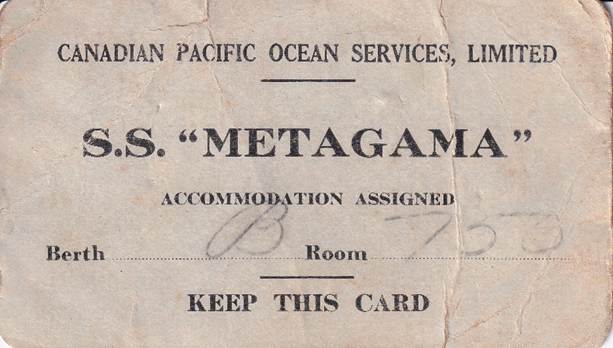
Figure 1: S.S. “Metagama” Accommodation Assigned, front.
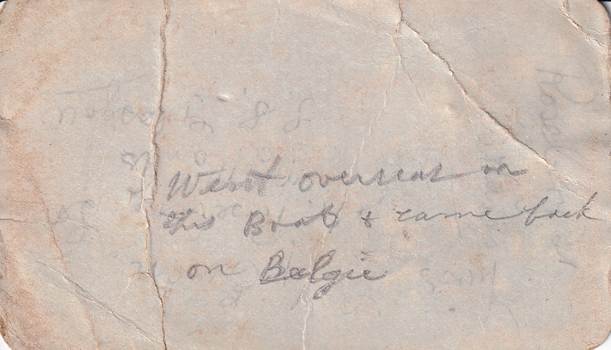
Figure 2S.S. “Metagama” Accommodation Assigned, back.
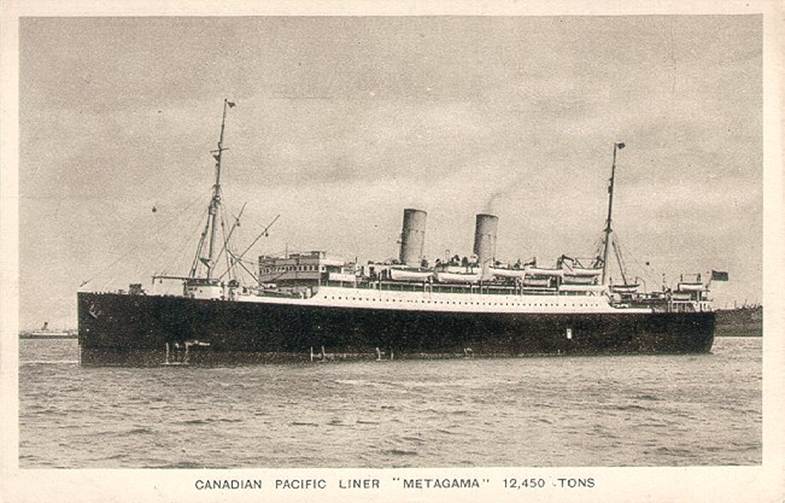
The SS Metagama was a CPR ship, built in 1914, and carried passengers and soldiers during her service during the war.
SLEEPING QUARTERS Card
Item Details[ii]
Name: SLEEPING QUARTERS Card
Production: Unknown.
Classification: Visual and Verbal Communication, official documents
Materials: paper, ink
Techniques: Printing
This card shows the sleeping quarters assignment for a soldier. It cannot be attributed to Private Zimmerman.
There is no provenance associated to this man and the details on this card obscure its origin.
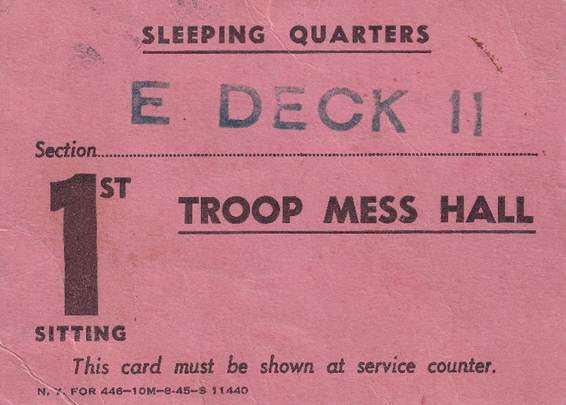
Figure 3: Pink Sleeping Quarters card.

Figure 4: Reverse Pink Sleeping Quarters card.
2 Mark Darlehenskassenschein – without red underprint, with red seal
Item Details[iii]
Name: 2 Mark Darlehenskassenschein – without red underprint, with red seal
Production: Banknote issued between 1914 and 1922. Disused during the hyperinflation in Germany in 1923. Demonetized 29 April 1924.
Classification: Visual and Verbal Communication, official documents
Materials: paper, ink
Techniques: Printing
This bank note is German currency used during World War 1. It origin is unknown. Private Zimmerman did not serve in Germany as part of the Occupation Forces November to December 1918.
Approximate value today: $5.00 CAD.
| Features[iv] Issuer Germany (1871-1948) Issuing entity Reichsschuldenverwaltung Emperor William II (1888-1918) Type Standard circulation banknotes Year 1914 Value 2 Mark Currency Mark (1873-1923) Composition Paper Size 110 × 70 mm Shape Rectangular Demonetized 29 April 1924 Number N#208392 Help References P# 53, Rosen/Grab# 52a, 52b |
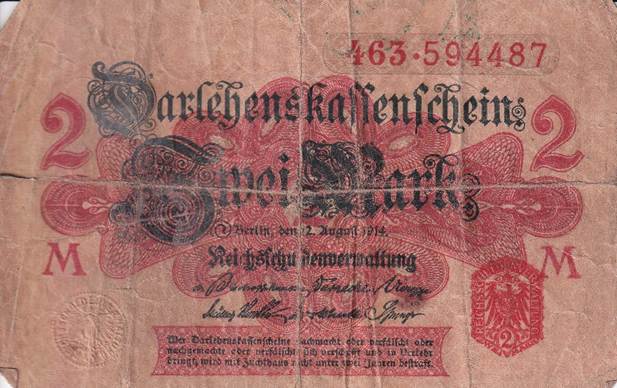
Figure 5: 2 Mark Darlehenskassenschein – without red underprint, with red seal.
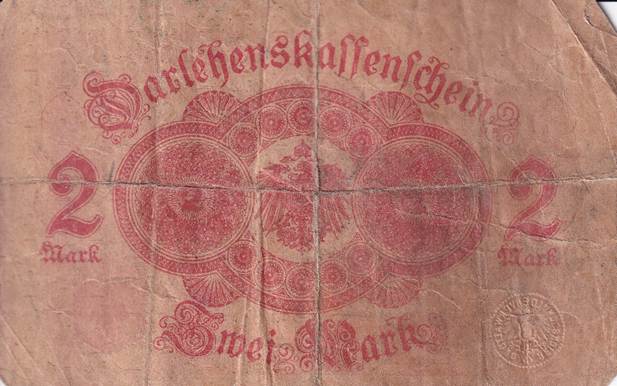
Figure 6: 2 Mark Darlehenskassenschein – without red underprint, with red seal. Reverse.
| Obverse Text and ornament Red seal at bottom right No underprint Lettering: Darlehenskassenschein Zwei Mark. 2 M 2 M Berlin, den 12. August 1914 Reichsschuldenverwaltung Wer Darlehenskassenscheine nachmacht oder verfälscht oder nachgemachte oder verfälschte sich verschafft und in Verkehr bringt, wird mit Zuchthaus nicht unter zwei Jahren bestraft. Translation:[v] Loan certificate Two Marks. 2 M 2 M Berlin, August 12, 1914 Imperial Debt Administration Anyone who counterfeits or falsifies loan certificates or procures counterfeit or falsified loan certificates and puts them into circulation will be punished with imprisonment for not less than two years. Reverse Imperial eagle with crest shield. Lettering: Darlehenskassenschein. 2 2 Mark 2 2 Mark Zwei Mark. Translation: Loan certificate. 2 2 Marks 2 2 Marks Two Marks. Watermark Cross flowers Comments For similar notes with underprint and red seal, see P#54. For similar notes with a blue seal, see P#55. „Darlehenskassenscheine“ were banknotes issued between 1914 and 1922 by the Reichsschuldenverwaltung (Reich debt administration). They were in use until the hyperinflation in 1923. These banknotes were not legal tender, however they had to be accepted by all public treasuries. Their value was guaranteed by loans on industrial and agricultural goods. Even without the status as legal tender Darlehenskassenscheine were a de facto currency widely used as a parallel currency to the Goldmark during WWI and the beginning of the Weimar Republic. |
IDENTIFICATION TICKET, KINMEL PARK, RHYLE
Item Details[vi]
Name: IDENTIFICATION TICKET, KINMEL PARK, RHYLE. No. 1 Military District Concentration Wing.
Production: Circa 1919. Used to quantify the meals a soldier would eat at this camp.
Classification: Visual and Verbal Communication, official documents
Materials: paper, ink
Techniques: Printing
This ticket was issued to a soldier and controlled his whereabouts in the camp. It may have been used as a meal ticket, and the punches start on the 13th and ending at Dinner on the 16th.
Private Zimmerman arrived at this camp on 12 February 1919 and left for repatriation to Canada on 22 February 1919.
The Kinmel Park Riot did not occur until 4-5 March 1919.
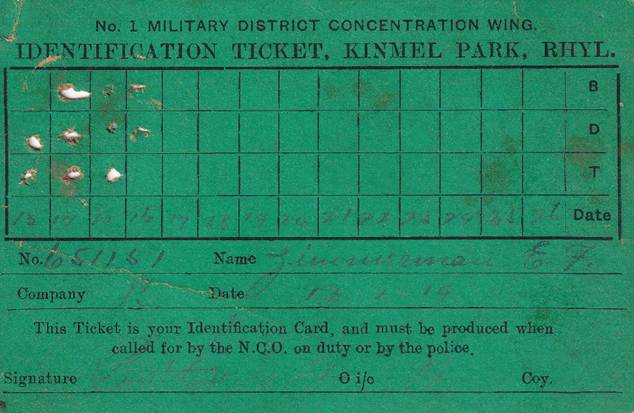
Figure 7: IDENTIFICATION TICKET, KINMEL PARK, RHYLE. No. 1 Military District Concentration Wing.
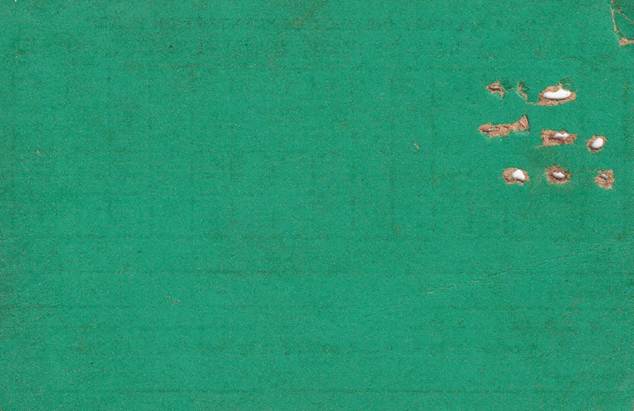
Figure 8: IDENTIFICATION TICKET, KINMEL PARK, RHYLE. No. 1 Military District Concentration Wing. Reverse.
Railway Warrant for Journeys in the United Kingdom
Item Details[vii]
Name: Railway Warrant for Journeys in the United Kingdom
Production: McC. & Co. Ltd. Lon-.; printing firm; 1918; United Kingdom
Classification: Visual and Verbal Communication, official documents
Materials: paper, ink
Techniques: Printing
This travel warrant for use on railway journeys in the United Kingdom is part of a collection of official and personal papers which document the military service of Private E. F Zimmerman Second Canadian Expeditionary Force from enlistment to repatriation.
The significance of this object lies in its ‘typicality’ as illustrating processes and experiences undergone by many thousands of Canadians during the First World War.
Notes
- Issued 20 January 1919. From Milford, Wales to Belfast, Ireland, via Fleetwood, England (ferry).
- N0. 939773.
- Stamp 4th Canadian Reserve Battalion, Orderly Room.
- Stamp Kingstown RTO (Railway Transport Office) Holyhead. Probably when he boarded or changed trains.
- Stamp CANADA.
- Reverse side:
- In pencil: 4th Res. B’n. 651151 Pte. Zimmerman. Signature
- Authority of Journey: In pencil. Illegible.
- Signature of Officer in pencil.
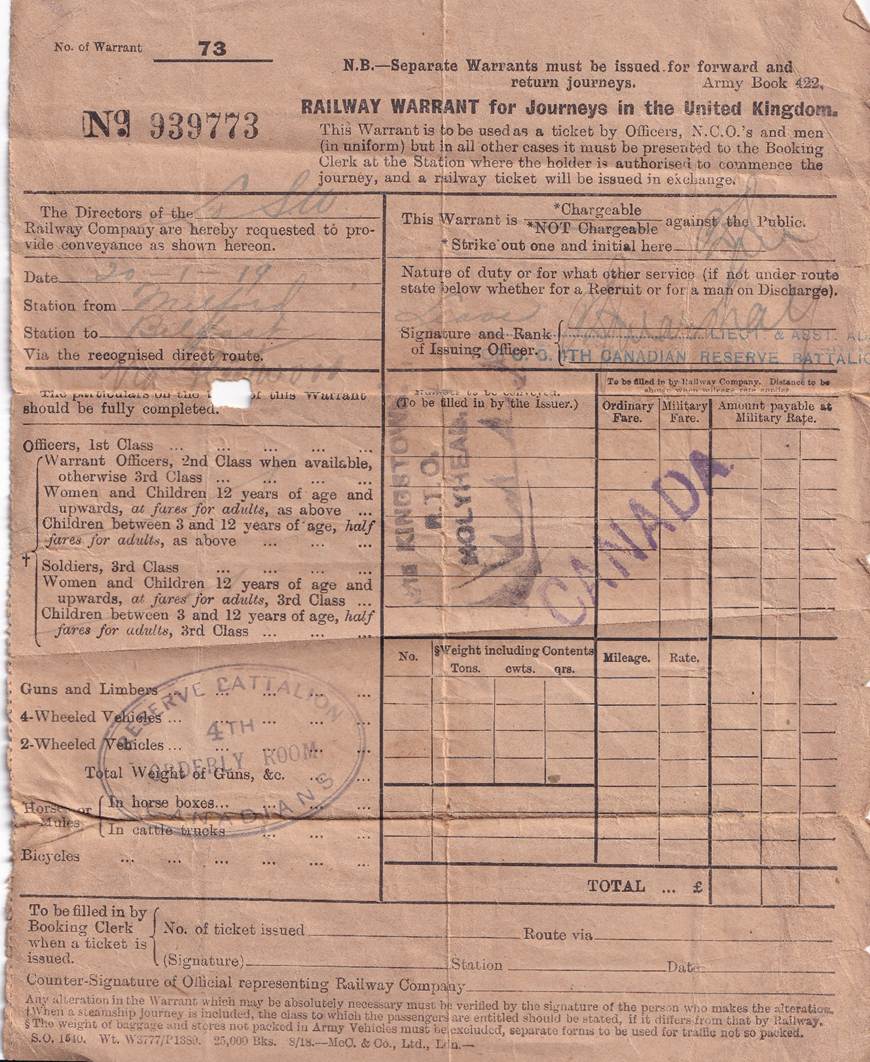
Figure 9: From of Railway Warrant
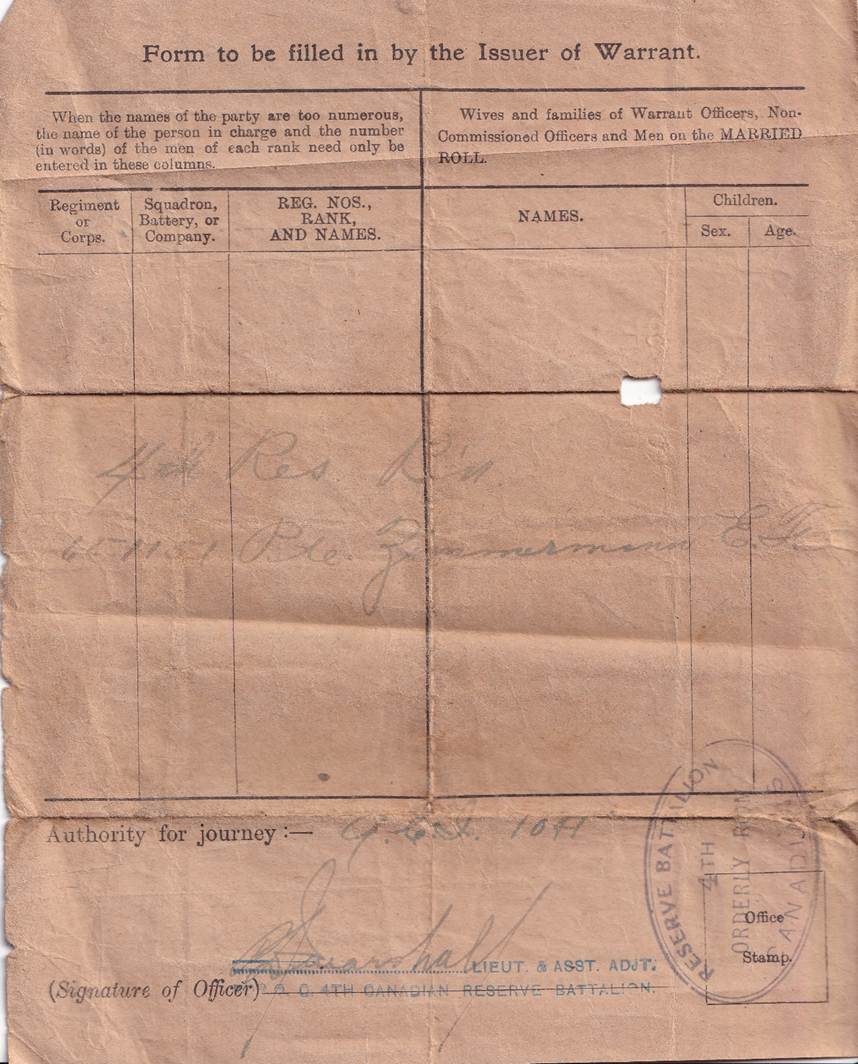
Figure 10: reverse of Railway Warrant.
Hammock Assignment, SS Belgic
Item Details[viii]
Name: Hammock Assignment, SS Belgic
Production: Unknown printer. Circa 1919.
Classification: Visual and Verbal Communication, official documents
Materials: paper, ink
Techniques: Printing
This hammock assignment was used to assign a soldier to a specific sleeping space in the ship.
He was allowed one hammock in Section H of the ship and was assigned table 176 for messing. There is a space for the assigned boat or raft used in case of evacuation during an emergency, which is blank.
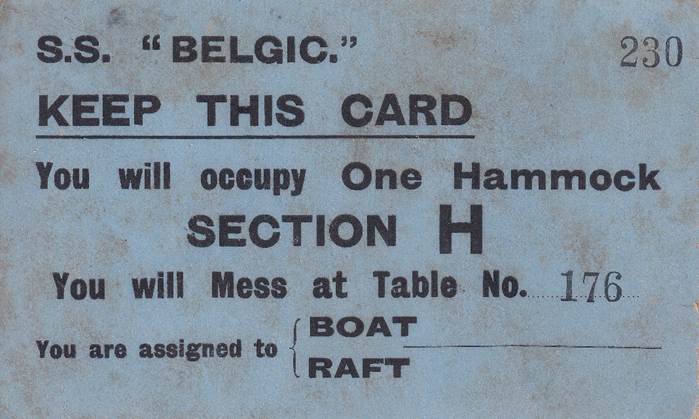
Figure 11: Hammock and berthing assignment. SS Belgic. 1919.

Figure 12: Reverse Hammock and berthing assignment. SS Belgic. 1919.
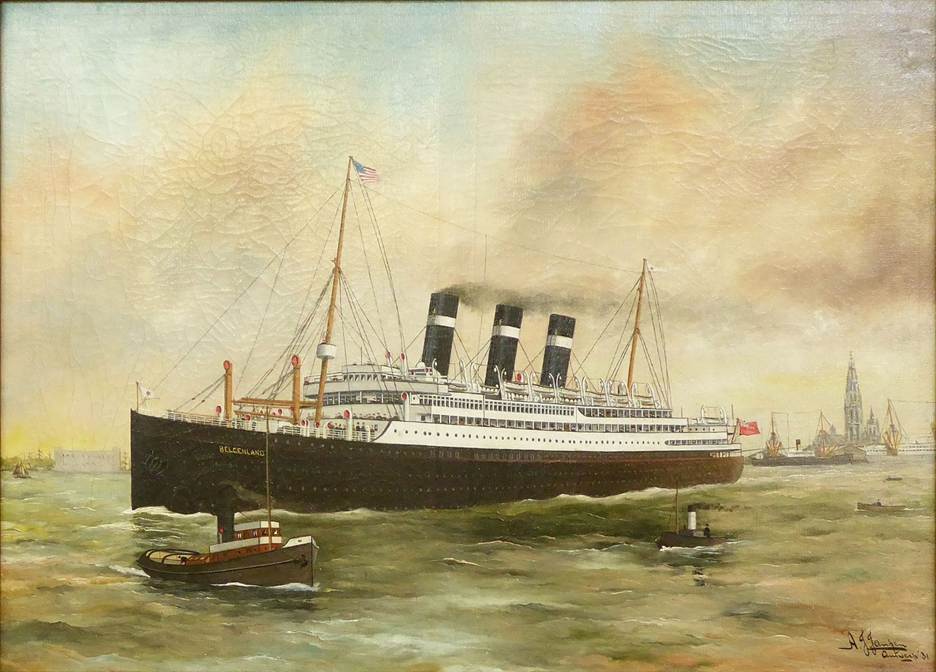
Figure 13: A. J. Jansen – SS ‘Belgenland’ of the Red Star Company Antwerp 1931-b.jpg via Wikipedia
The SS Belgic was a ship used to transport troops between United States, Canada and England during the war. She was converted for troop transport with a capacity of 3,000 troops. On one voyage she had 3,400 troops.
Welcome Gallant Boys from the Citizens of Halifax
Item Details[ix]
Name: Welcome Gallant Boys from the Citizens of Halifax. Presented by the Red Cross Society, Halifax Citizens Committee, Y.M.C.A., Knights of Columbus
Production: Unknown printer. Circa 1919.
Classification: Visual and Verbal Communication, official documents
Materials: paper, ink
Techniques: Printing
A card of appreciation and recognition to the personnel of the Canadian Expeditinary Forces upon their return to Canada from the citizens of Halifax, Nova Scotia. This is where the Belgic arrived after the transatlantic voyage from Liverpool starting on 23 February 1919.
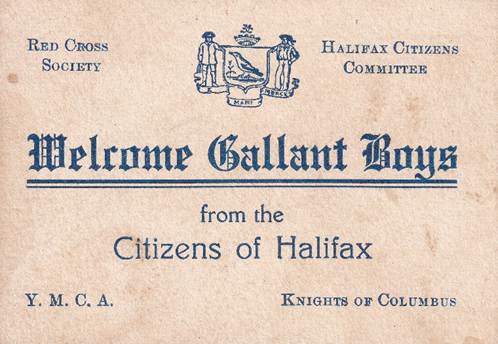
Figure 14: Welcome Gallant Boys from the Citizens of Halifax.

Figure 15: Welcome Gallant Boys from the Citizens of Halifax. Reverse.
Photographs of Private Edward Frederick Zimmerman, reg. no. 651151
Item Details[x]
Name: Three photographs of Private Zimmerman taken circa 1919.
Production: Unknown photographer and printer. Circa 1919.
Classification: Visual and Verbal Communication, official documents
Materials: paper, photograph
Techniques: Photograph development.
Three photographs taken post-war circa 1919, possibly near Neustadt, Ontario of Private Zimmerman.
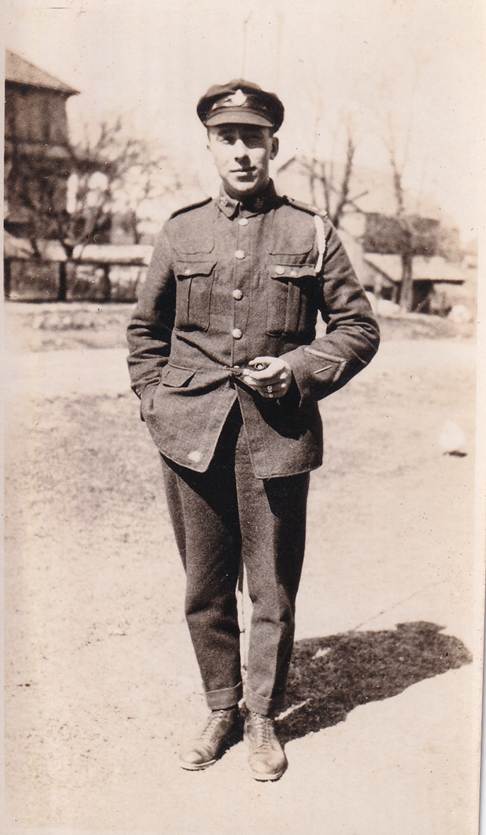
Figure 16: Photographs of Private Edward Frederick Zimmerman, reg. no. 651151.
Of Note:
He has:
- Good Conduct Badge. Chevron in left arm. A good conduct badge was issued for exemplary service with no infractions in his record for two years. There is no notation in his service record for this badge, but it was not unusual for this badge to be awarded and not noted in his service record.
- One gold vertical wound stripe denoting his wounding in action on 11 October 1918 with a severe GSW to his right thigh.
- An aiguillette of undetermined colour. Origin and purpose unknown.
- A round badge of unknown purpose on the left chest pocket.
- A five-button tunic that would have been issued after the war ended.
- Canada flash on epaulettes.
- Collar dogs and hat crest present but not legible.
- Location of photograph unknown
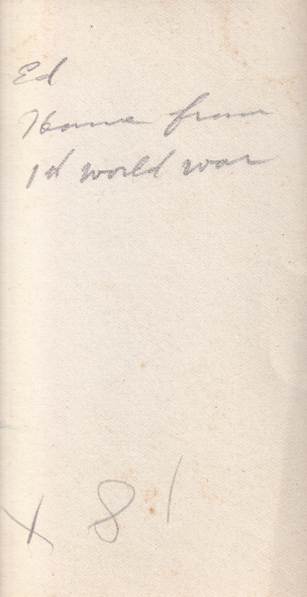
Figure 17: Photographs of Private Edward Frederick Zimmerman, reg. no. 651151. Reverse. “Ed Home for 1st World War.”
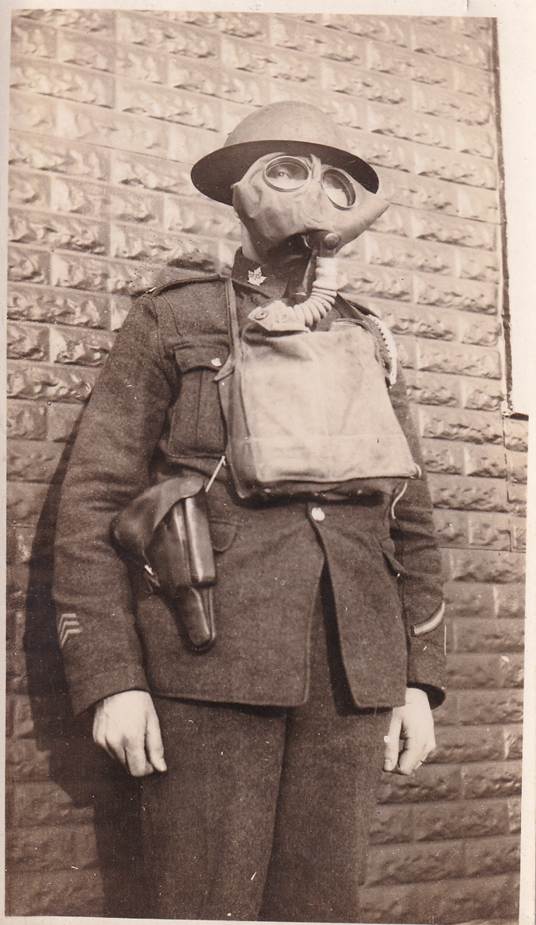
Figure 18: Photographs of Private Edward Frederick Zimmerman, reg. no. 651151. Displaying war souvenirs.
Of Note:
He has:
- 3 Service Chevrons denoting his three-years of service. He enlisted on 31 December 1915 and was discharged on 25 March 1919. This is 1,180 days of service equalling three whole years and 84 days of service.
- A holster holding a German 1908 luger and a spare magazine. With cord.
- A Small Box Respirator with Gas Mask. It appears to be a pattern in use in 1917.
- Maple Leaf Collar Dog. Not able to see details of dog.
Figure 19 Photographs of Private Edward Frederick Zimmerman, reg. no. 651151. Reverse. “18 x or +.”
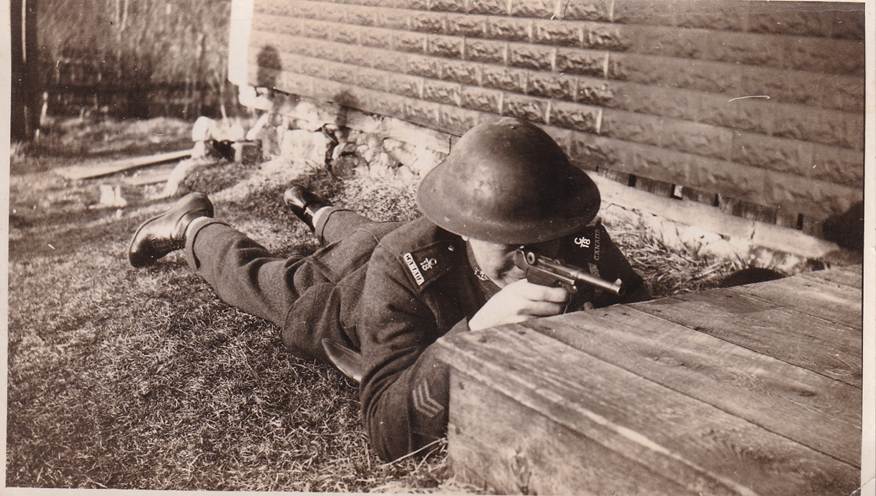
Figure 20: Photographs of Private Edward Frederick Zimmerman, reg. no. 65115. With souvenir, a 1908 German Luger.
Of Note:
He has:
- He is wielding a 1908 German Luger pistol in a unrealistic manner.
- His “Canada” shoulder flashes and C/18 insignia are in plain sight.
- The C/18 Battalion insignia and a later design, replacing the Maple Leaf design issued earlier in the war. This design was cheaper to produce and was issued to troops later in the war as new and replacement to soldier’s who needed to replace the earlier design.
- He is located at the same building and steps from the previous photograph.
Figure 21: Photographs of Private Edward Frederick Zimmerman, reg. no. 65115. With souvenir, a 1908 German Luger. Reverse. “18 X or +.”
[i] Adapted from the Museum of New Zealand. https://collections.tepapa.govt.nz/object/1270754?page=1&rtp=1&ros=1&asr=1&assoc=all&mb=c
[ii] Adapted from the Museum of New Zealand. https://collections.tepapa.govt.nz/object/1270754?page=1&rtp=1&ros=1&asr=1&assoc=all&mb=c
[iii] Adapted from the Museum of New Zealand. https://collections.tepapa.govt.nz/object/1270754?page=1&rtp=1&ros=1&asr=1&assoc=all&mb=c
[iv] https://en.numista.com/208392
[v] https://en.numista.com/208392
[vi] Adapted from the Museum of New Zealand. https://collections.tepapa.govt.nz/object/1270754?page=1&rtp=1&ros=1&asr=1&assoc=all&mb=c
[vii] Adapted from the Museum of New Zealand. https://collections.tepapa.govt.nz/object/1270754?page=1&rtp=1&ros=1&asr=1&assoc=all&mb=c
[viii] Adapted from the Museum of New Zealand. https://collections.tepapa.govt.nz/object/1270754?page=1&rtp=1&ros=1&asr=1&assoc=all&mb=c
[ix] Adapted from the Museum of New Zealand. https://collections.tepapa.govt.nz/object/1270754?page=1&rtp=1&ros=1&asr=1&assoc=all&mb=c
[x] Adapted from the Museum of New Zealand. https://collections.tepapa.govt.nz/object/1270754?page=1&rtp=1&ros=1&asr=1&assoc=all&mb=c
Discover more from History of the 18th Battalion CEF, "The Fighting Eighteenth"
Subscribe to get the latest posts sent to your email.
 History of the 18th Battalion CEF, "The Fighting Eighteenth"
Leave a comment