Source: Court martial database at LAC.
Family Search: Corporal James Keith Armstrong was born on 10 October 1887, in Paisley, Renfrewshire, Scotland, United Kingdom, as the son of James Armstrong and Isabella. He registered for military service in 1915. In 1915, at the age of 28, his occupation was listed as labourer in Thorold, Welland, Ontario, Canada. He died on 10 November 1917, in Passendale, Zonnebeke, West Flanders, Belgium, at the age of 30, and was buried in Ieper, West Flanders, Belgium.
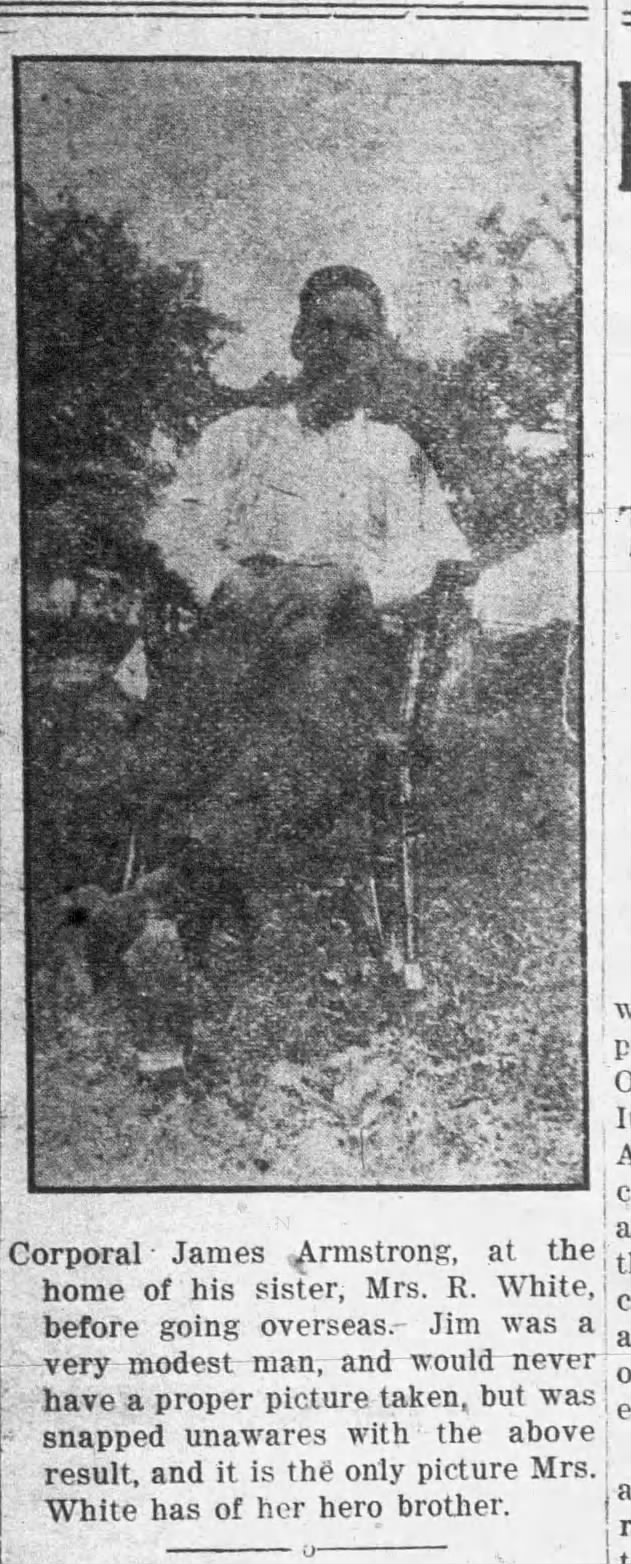
THE LATE CORPORAL JAMES ARMSTRONG
Mrs. Robert Whyte has received the following letter from the lieutenant in whose platoon her late brother, Corp. Armstrong, was, at the time of his death, accompanied by a splendid photograph, which she treasures very much, as she treasured no picture of her brother in his military uniform, as explained in our sketch of two weeks ago:
France, 19th Nov., 1917.
“My dear Mrs. Whyte: You no doubt have received the official notification of your brother, Corp. J. Armstrong, having been killed in action the 10th of this month.
“May I have the honor, though a very sad one, of giving you the particulars. Corp. Armstrong was killed instantly by a shell during a very heavy German bombardment. He was the senior corporal in my platoon, and I thought very highly of him. His work was very valuable. He was well liked and highly respected by the officers and men, and I assure you he is greatly missed.
“I hope it may be some consolation to you to know that he was a real man and a brave soldier, and died the death of a hero, without pain or suffering. He gave up his life for the cause for which we are proud to be fighting. It is no doubt needless for me to tell you that he was always bright and cheerful, even under the worst circumstances, and he always had the desire to help and cheer the men under him.
He was buried on the Passchendaale Ridge, close to the centre of Passchendaale. The exact spot is on record.
“Will you please accept my sincere and heartfelt sympathy in your sad loss, and believe me to be
“Yours sincerely,
“Hunter C. Duff, Lieut. “No. 10 platoon, C Co., 18th Bn. Canadians, B. E. F., France.”
The Thorold Post. Tue, Dec 11, 1917 ·Page 4.


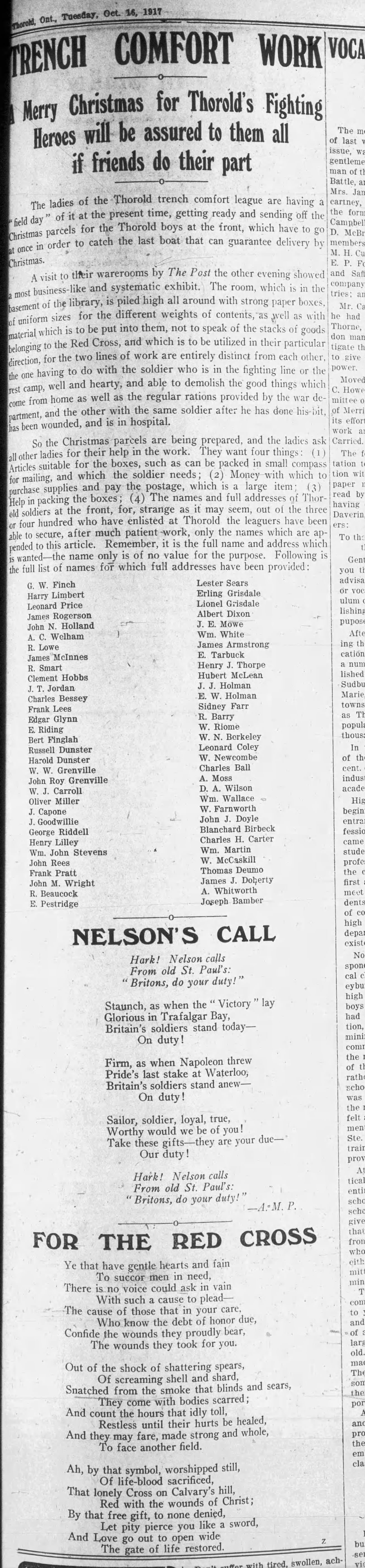
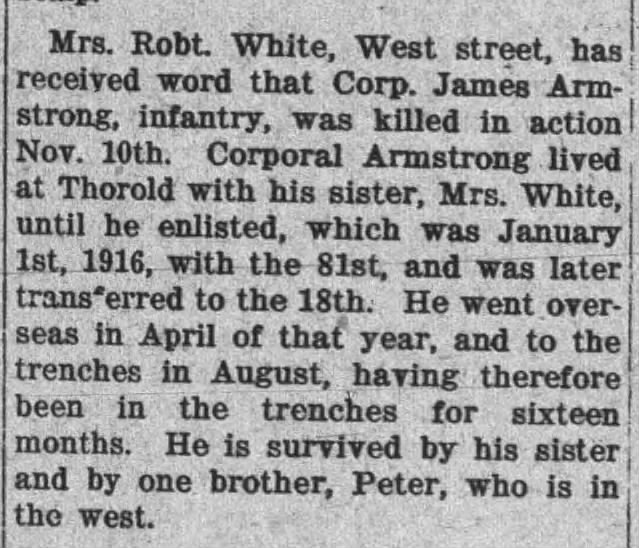

Summary of Service for Private James Armstrong, reg. no. 159663
| Date | Event | Remarks |
| October 10, 1887 | Born | Born at Paisley, Scotland. |
| December 28, 1915 | Enlists | Enlists with the 81st Battalion at St. Catharines, Ontario. He is 28-year-old labourer standing 5’5” tall. He has prior militia experience and lists Mrs. Robert Whyte, his sister, as his next-of-kin. She resides in Thorold, Ontario. |
| January 1, 1916 | Confined to Barracks | CB for 2-days per DO #16. |
| March 15, 1916 | CB | CB for 3-days per DO #57. |
| April 28, 1916 | Unit Leaves for England | Unit to sail for England aboard the SS Olympic from Halifax, Nova Scotia. |
| May 1, 1916 | Unit Sails | Unit leaves Halifax. |
| May 6, 1916 | Unit Arrives | Unit arrives Liverpool and unit goes to West Sandling Camp. |
| June 18, 1916 | Completes Will | He assigns all his personal possessions to his sister. |
| June 20, 1916 | Transferred | Transferred to 18th Battalion. |
| June 29, 1916 | Arrives | Arrives Etaples, France at the Canadian Base Depot. |
| July 12, 1916 | Proceeds to Join Unit | |
| July 14, 1916 | Arrives | Arrives at the 18th Battalion in the field. The Battalion is a Quebec Camp in Ypres, and the War Diary relates on that day: “Battalion parade for Pay. LIEUTs. E.R.V. LLYOD and H.D. DUNNETT proceeded on leave. CAPT. C.H. EMERY takes over duties of paymaster. 2 o.r.s. admitted to hospital.” |
| September 18, 1916 | Appointed | Appointed Lance-Corporal as C. Allan, reg. no. 54273 promoted to Corporal. |
| April 9, 1917 | Promoted | Promoted Corporal as Lance-Sergeant E.W. Sifton killed in action. |
| May 3, 1917 | Special Remittance | Special remittance of $100.00 to his sister. He has not assigned any pay to a recipient. |
| October 12, 1917 | Granted Leave | Granted 10-day’s leave to England. |
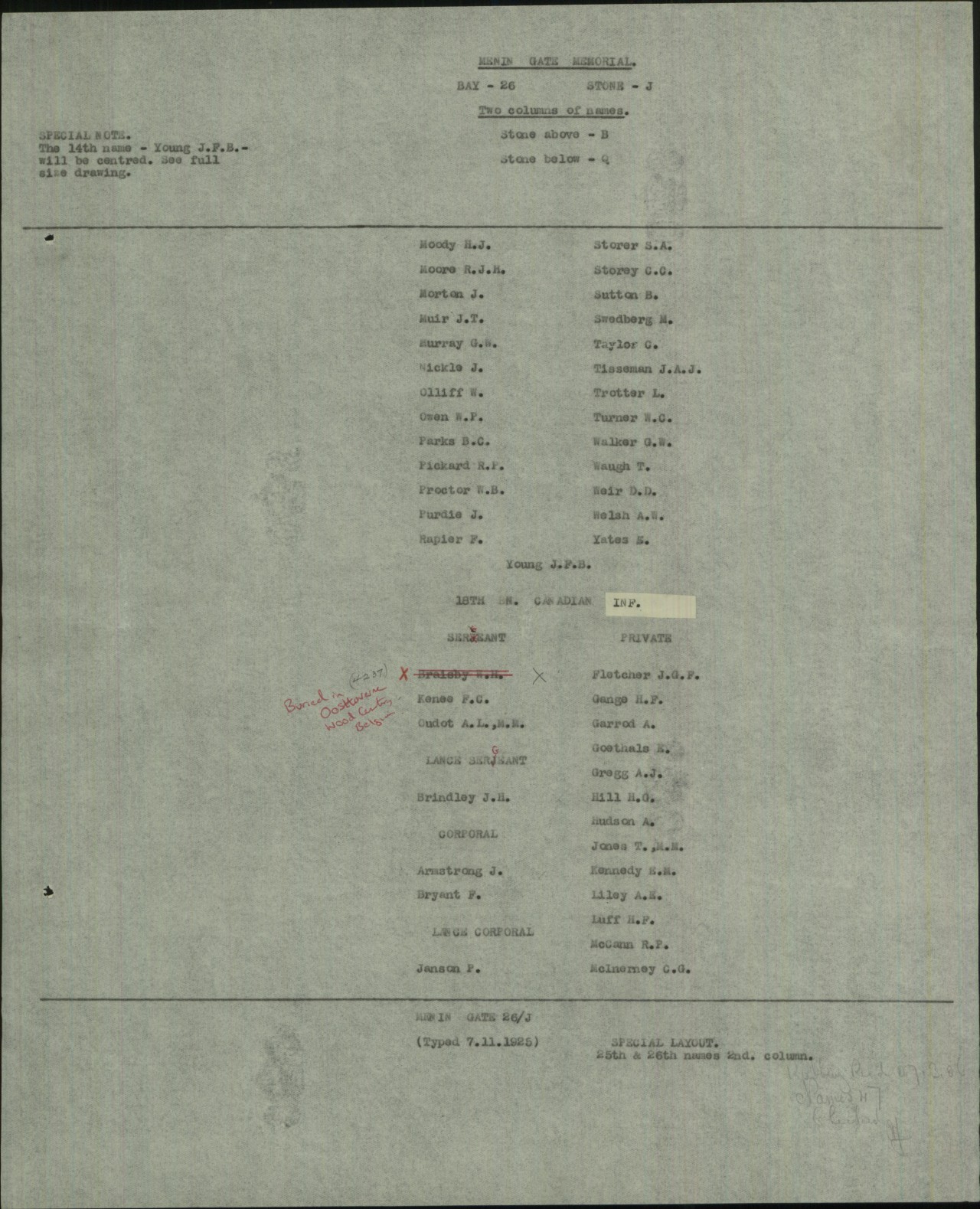
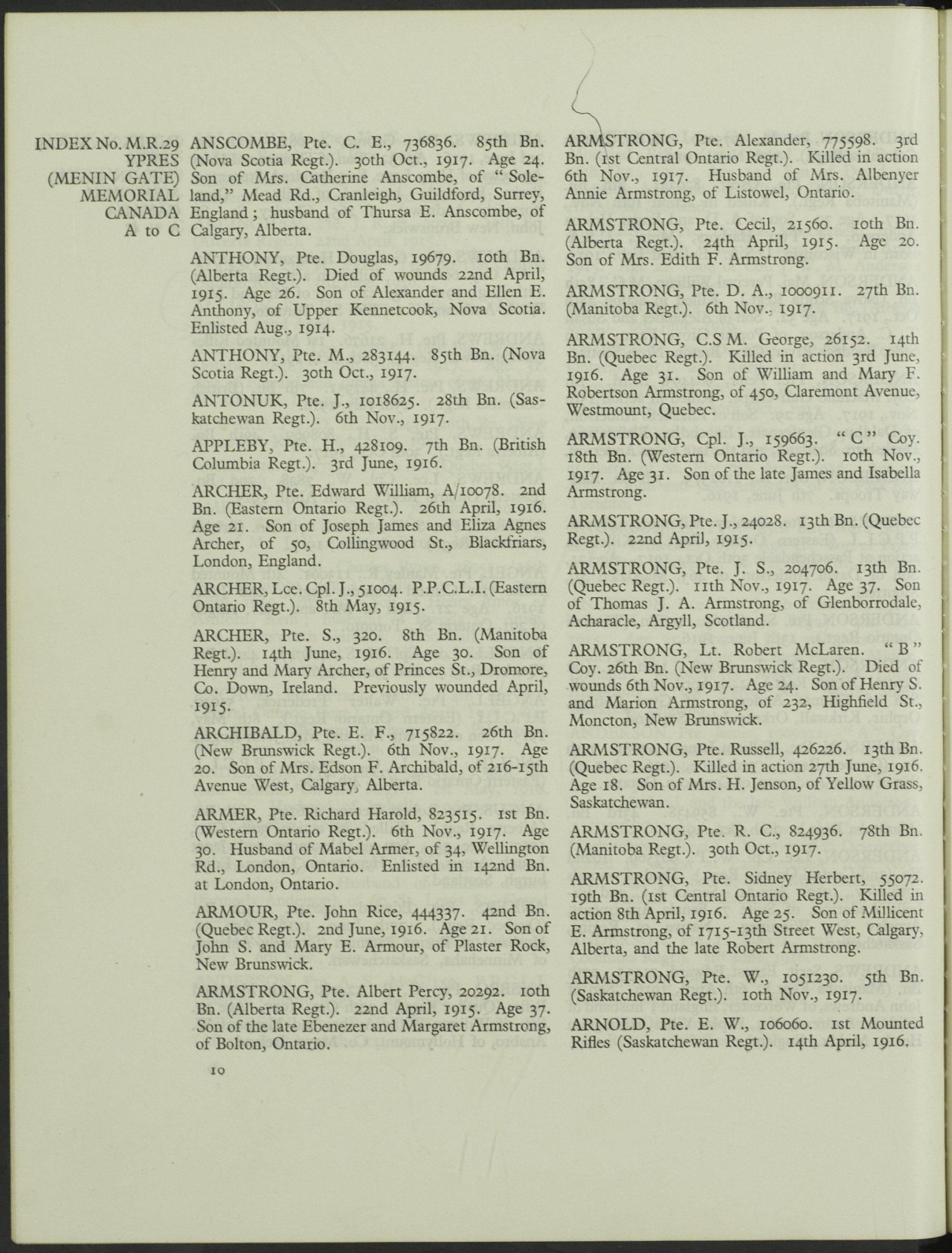
| November 10, 19117 | Killed in Action | Killed in action at Passchendaele. The War Diary relates for the dates spanning from the 9th to 12th the following: “During the whole of this tour the Officers and men held this part of the line under the most severe conditions possible. Great difficulty was experienced in the evacuating of casualties from the front line to R.A.P.s and dressing stations. Front line trenches were subjected to frequent barrages and the rear country [area] was also heavily shelled and bombed. The supports on this front were reached by a series of tracks, being trench mat walks, and rations had to be carried by mules up these tracks. Each track being subjected to continual shellfire, the transport and ration parties were fortunate in escaping with the loss of 3 men killed and 1 mule which fell off the duckboard track and owing to the depth of the mud had to be shot. Splendid work was done by the Battalion Stretcher bearers in tending and evacuating the wounded.” He is commemorated at the Menin Gate on Panel 10-26-28 along with 51 other members of the 18th Battalion. |
| 1920/1921 | Medals and Decorations | Medals and Decorations sent to his sister, Mrs. Robert Whyte of Box 647, Thorold, Ontario. Victory Medal, plaque and scroll despatched. |
Acronyms
| AWL | Absent Without Leave: Generally, a soldier would be deducted 1-days pay for every day absent. In some cases, the soldier would be confined to barracks. Sometimes it was a combination of both. |
| A Classification | Medical Board Classification that determined your fitness for duty. A1, A2, A3 and A4 were assigned to different units with the expectation that these men would be able to serve with active combat units. See this link for more information. |
| B Classification | Medical Board Classification that determined your fitness for duty. B1, B2, and B3 were assigned to different service units such as railway and forestry corps. See this link for more information. |
| D Classification | See this link for more information. |
| CAMC | Canadian Army Medical Corp |
| CB | Confined to Barracks: a punishment for minor infractions. |
| CCD | Casualty Convalescent Depot: a depot at a base where men, in their final stages of convalescing, would be prepared for duty depending on their rating. |
| CCH | Casualty Clearing Hospital |
| CCRC | Canadian Corps Reserve Camp |
| CCS | Casualty Clearing Station: this facility was attached to rail transportation from the front to hospitals on the coast of France |
| CDC | Canadian Dispatch Camp |
| CFA | Canadian Field Ambulance/Canadian Field Artillery. Most common usage would be Canadian Field Ambulance. |
| DAH | Disorderly Action of the Heart |
| DRS | Divisional Rest Station |
| GSW | Gun Shot Wound – this was a generic term for all projectile penetrating wounds. |
| In the Field | This term relates to a soldier arriving at an active-duty unit after transporting from England, to France, and then to his duty assignment. The routing varied from soldier to soldier and could take 2-3 days to several months. |
| MD | Military District |
| PUO | Pyrexia of Unknown Origin: This was a term used for any illness that could not clearly be identified and typically was related to influenza symptoms. |
| SOS | Struck Off Strength |
| TOS | Taken On Strength |
| CAMC | Canadian Army Medical Corp |
| CCH | Casualty Clearing Hospital |
| CFA | Canadian Field Ambulance |
| DRS | Divisional Rest Station |
| GSW | Gun Shot Wound – this was a generic term for all projectile penetrating wounds. |
| MD | Military District |
| PUO | Pyrexia of Unknown Origin |
| SOS | Struck Off Strength |
| TOS | Taken On Strength |
| WORD | Western Ontario Regimental Depot |



 History of the 18th Battalion CEF, "The Fighting Eighteenth"