Source: April 30, 1918 war diary entry for Italian Bronze Medal for Military Valor.
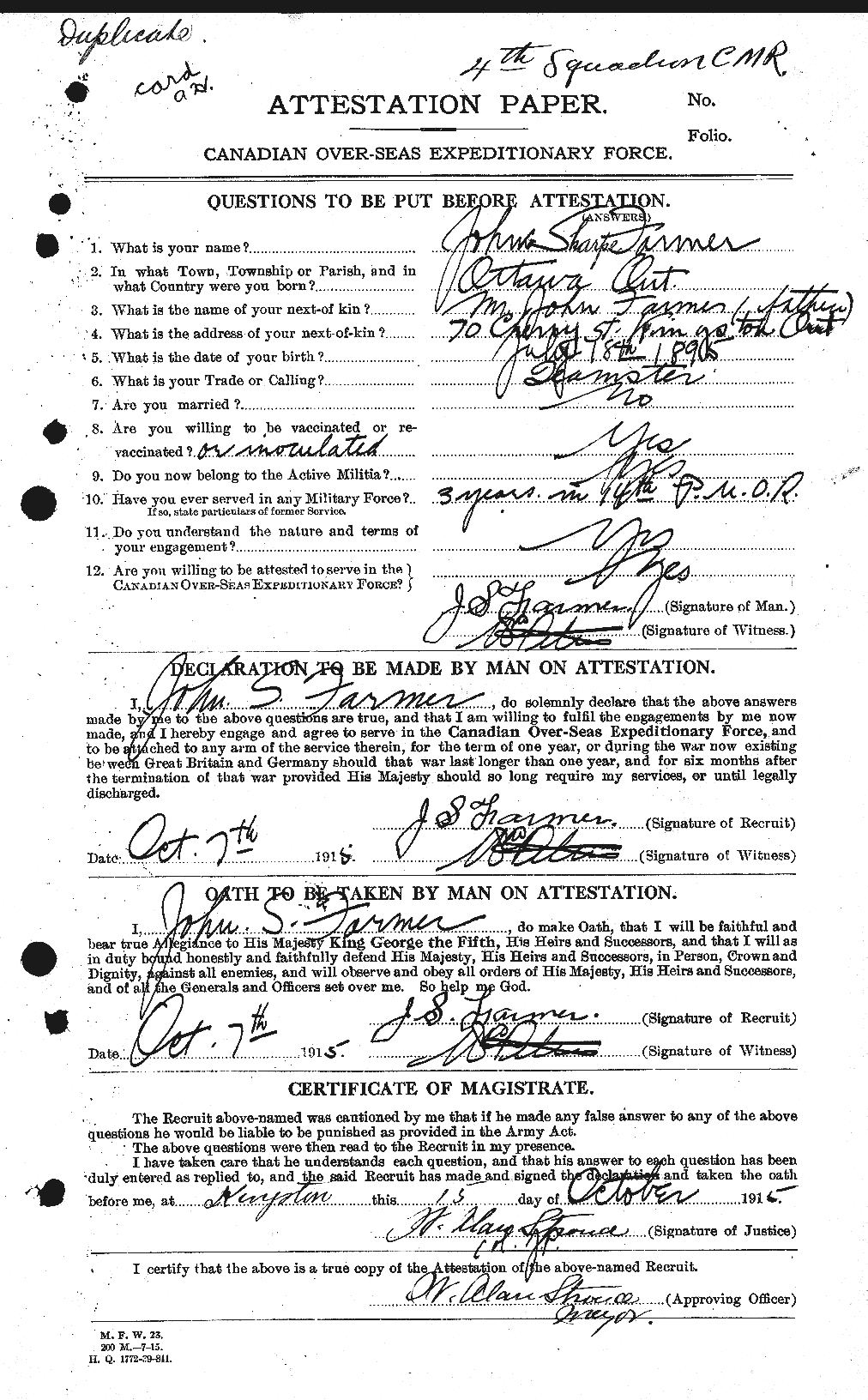
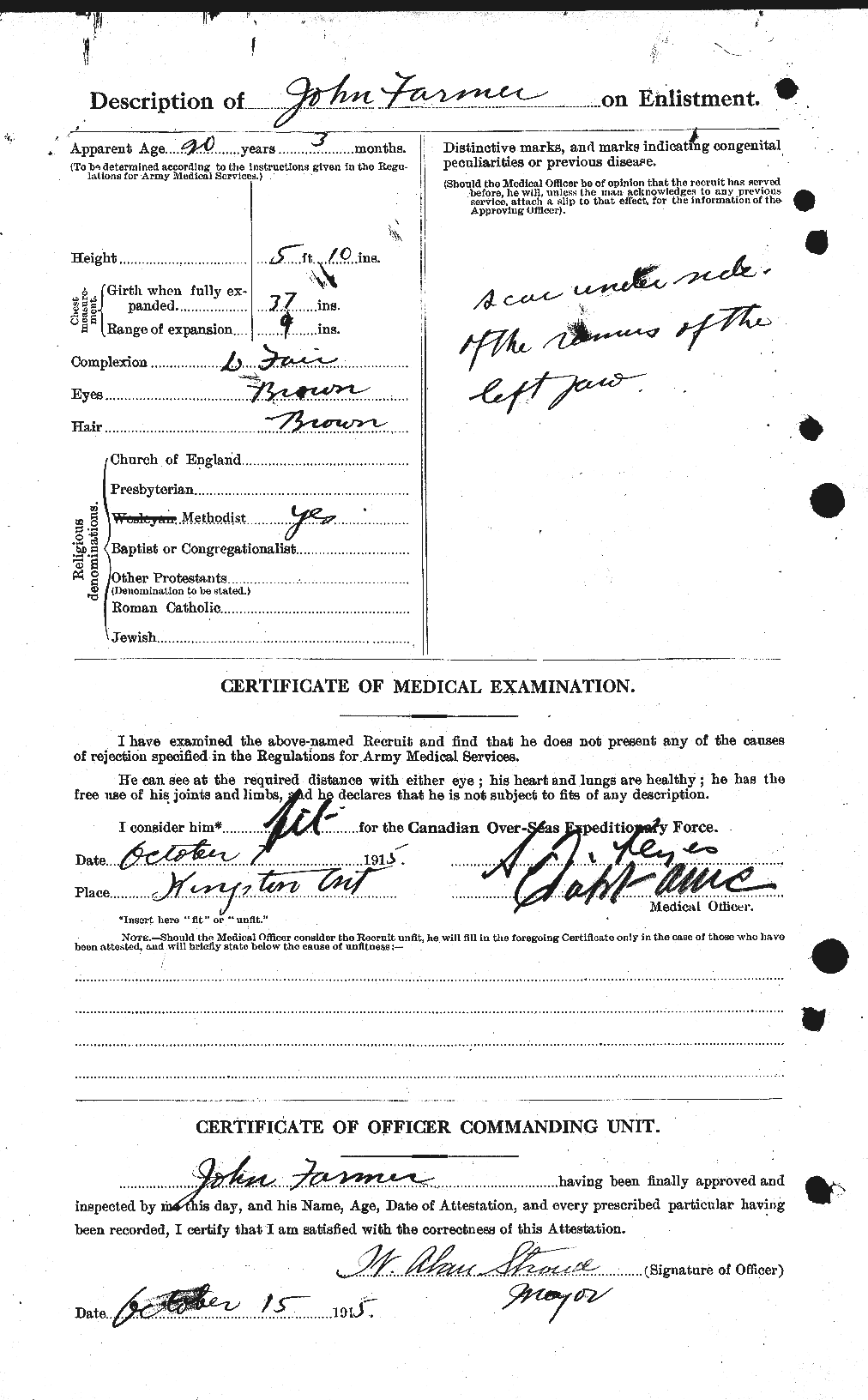
Family Search: When Sergeant John Sharpe Farmer was born on 18 July 1895, in Gloucester, Carleton, Ontario, Canada, his father, John George Farmer, was 31 and his mother, Elizabeth Sharpe, was 30. He lived in Carleton, Ontario, Canada in 1901 and Russell, Prescott and Russell, Ontario, Canada in 1911. He registered for military service in 1918. In 1918, his occupation is listed as sergeant in canadian infantry 18th bn. (western ontario regiment) in Rivière, Pas-de-Calais, France. He died on 14 April 1918, in Neuville-Vitasse, Pas-de-Calais, France, at the age of 22, and was buried in Arras, Loir-et-Cher, France.
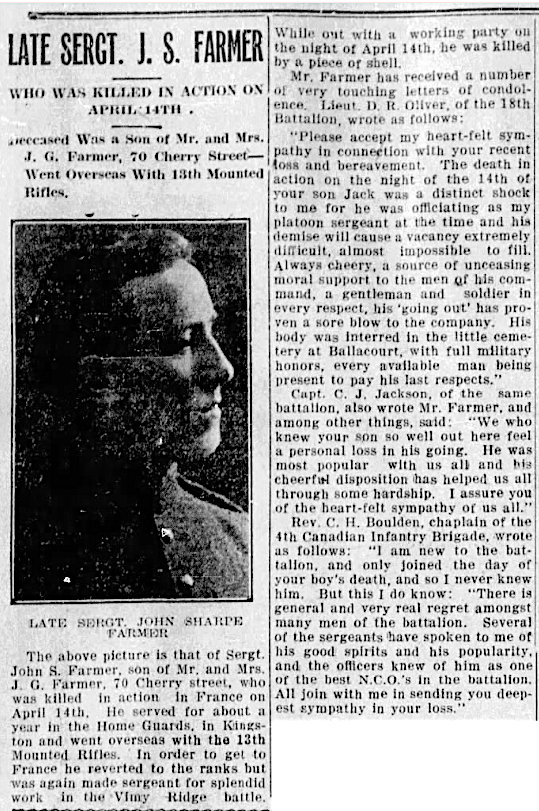
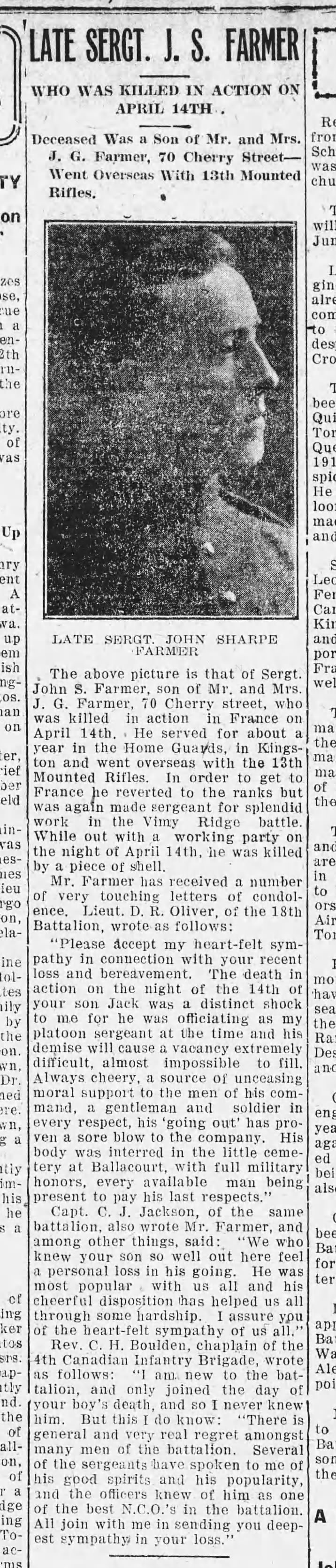
LATE SERGT. J. S. FARMER
WHO WAS KILLED IN ACTION ON APRIL 14TH.
Deceased was a Son of Mr. and Mrs. J. G. Farmer, 70 Cherry Street—Went Overseas With 13th Mounted Rifles.
While out with a working party on the night of April 14th, he was killed by a piece of shell.
Mr. Farmer has received a number of very touching letters of condolence. Lieut. D. R. Oliver, of the 18th Battalion, wrote as follows:
“Please accept my heart-felt sympathy in connection with your recent loss and bereavement. The death in action on the night of the 14th of your son Jack was a distinct shock to me for he was officiating as my platoon sergeant at the time and his demise will cause a vacancy extremely difficult, almost impossible to fill. Always cheery, a source of unceasing moral support to the men of his command, a gentleman and soldier in every respect, his ‘going out’ has proven a sore blow to the company. His body was interred in the little cemetery at Bailleulcourt, with full military honors, every available man being present to pay his last respects.”
Capt. C. J. Jackson, of the same battalion, also wrote Mr. Farmer, and among other things said: “We all knew your son so well out here feel a personal loss in his going. He was most popular with us all and his cheerful disposition has helped us all through some hardship. I assure you of the heart-felt sympathy of us all.”
Rev. C. H. Bignell, chaplain of the 4th Canadian Infantry Brigade, wrote as follows: “I am new to the battalion, and only joined the day of your boy’s death, and so I never knew him. But this do I know: ‘There is general and very real regret amongst many men of the battalion.’ Several of the sergeants have spoken to me of his good spirits and his popularity, and the officers knew of him as one of the best N.C.O.’s in the battalion. All join with me in sending you deepest sympathy in your loss.”
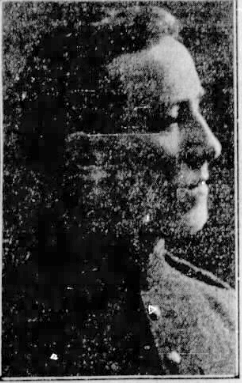
(Image of Late Sergt. John Sharpe Farmer)
LATE SERGT. JOHN SHARPE FARMER
The above picture is that of Sergt. John S. Farmer, son of Mr. and Mrs. J. G. Farmer, 70 Cherry street, who was killed in action in France on April 14th. He served for about a year in the Home Guards in Kingston and went overseas with the 13th Mounted Rifles. In order to get to France he reverted to the ranks but was again made sergeant for splendid work in the Vimy Ridge battle.
The Kingston Whig Standard. 18 May 1918. Page 5.

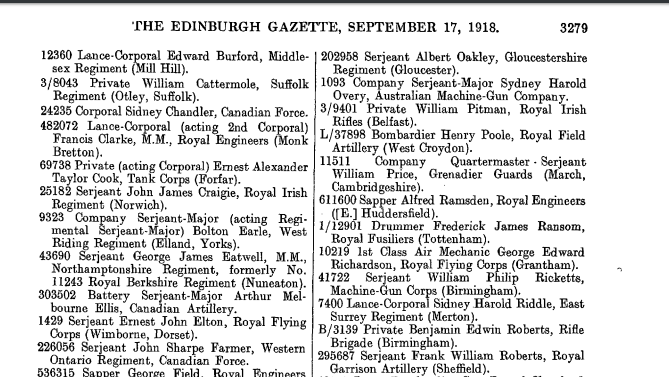
“Medaglia Al Valore Militare di Bronzo (Bronze Medal for Military Valour – Italian) Incorrectly listed under regimental number 226056.
The Medaglia Al Valore Militare is a commendation created in 1833 by Carlo Alberto Amedeo di Savoia, King of Piedmont-Sardinia, to recognize exceptional valour in battle (but which does not warrant the award of the Military Order of Savoia). The medal has three levels: gold, silver, and bronze. Arthur Webber, who received the bronze medal, is the only member of the Newfoundland Regiment to have been honoured with this award.
During the First World War, this circular medal depicted the royal shield of Savoia under a crown. The recipient’s name was engraved on the reverse of the medal with the words “GUERRA DI 1915-1918” (War of 1915-1918). The medal was worn on a blue ribbon. For each subsequent act of valour, the recipient was awarded a bar to wear on the ribbon.





 History of the 18th Battalion CEF, "The Fighting Eighteenth"
