Source: See photo below and this post for more details. his father, Jack R. Matthews served in the 18th Battalion with him.
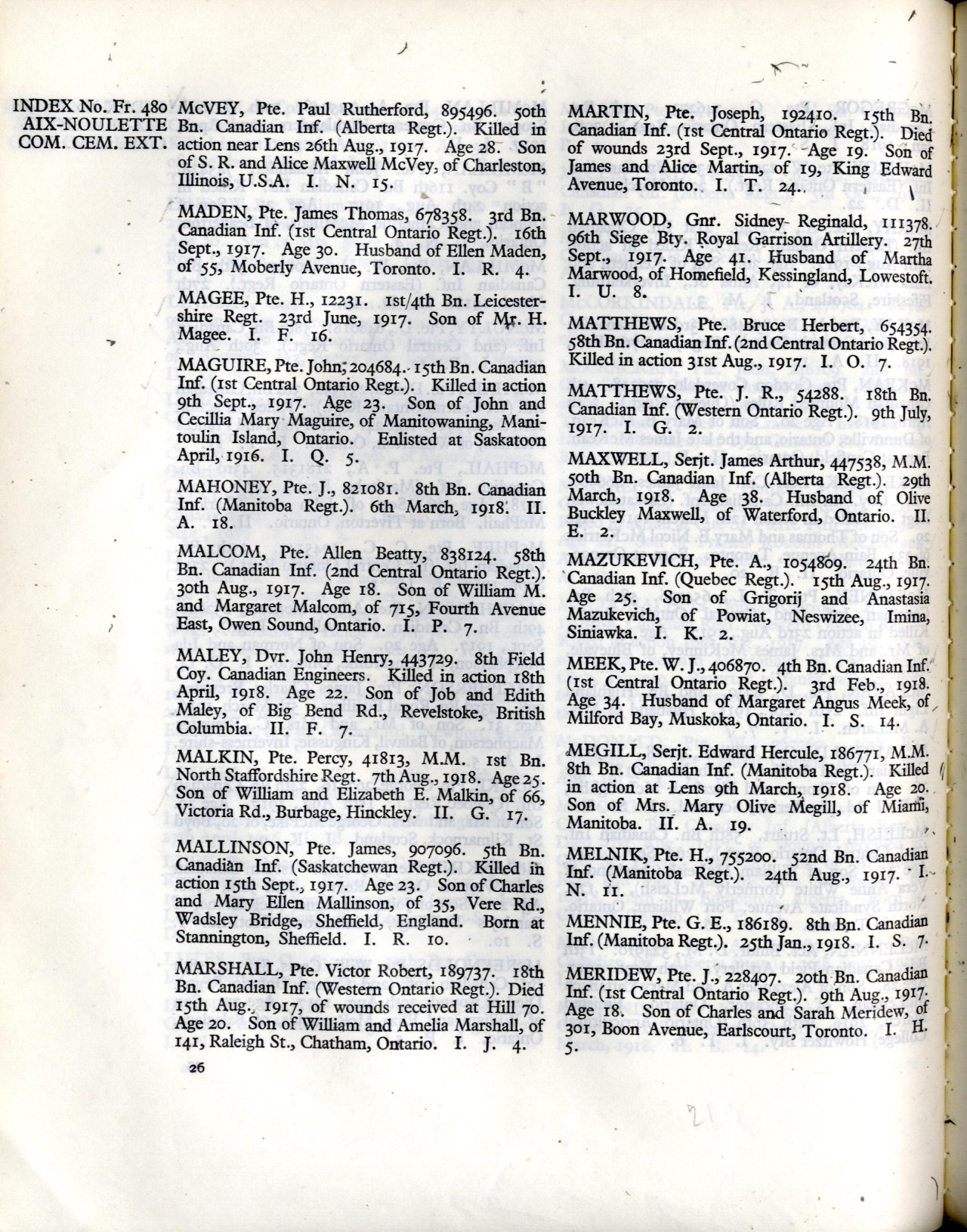
Family Search: When Private John Richard Matthews was born on 7 September 1896, in Stratford, Perth, Ontario, Canada, his father, John Richards Matthews, was 23 and his mother, Lillian Elizabeth Wisby, was 23. He lived in London, Ontario, Canada West, British Colonial America in 1911. He registered for military service in 1915. In 1915, at the age of 19, his occupation is listed as boilermaker in Stratford, Perth, Ontario, Canada. He died on 9 July 1917, in Bouvigny-Boyeffles, Pas-de-Calais, France, at the age of 20, and was buried in Aix-Noulette, Pas-de-Calais, Nord-Pas-de-Calais, France.
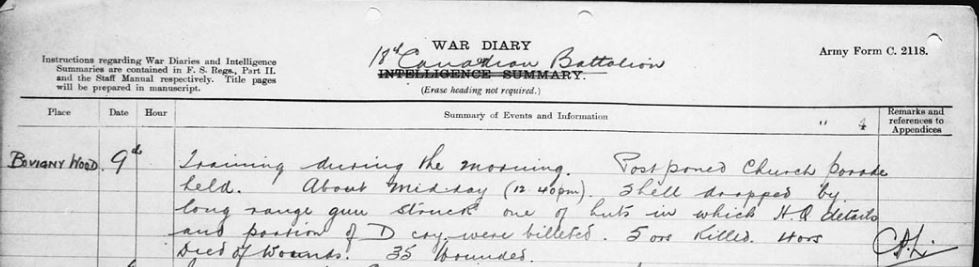
Was in the same hut with Private William Dewar when the shell that killed him hit.
Service Summary
Private John Richard Matthews, reg. no. 54288 was born at Stratford, Ontario to John Richard Matthews and Lillian Elizabeth (Wisby) Matthews on 7 September 1896.
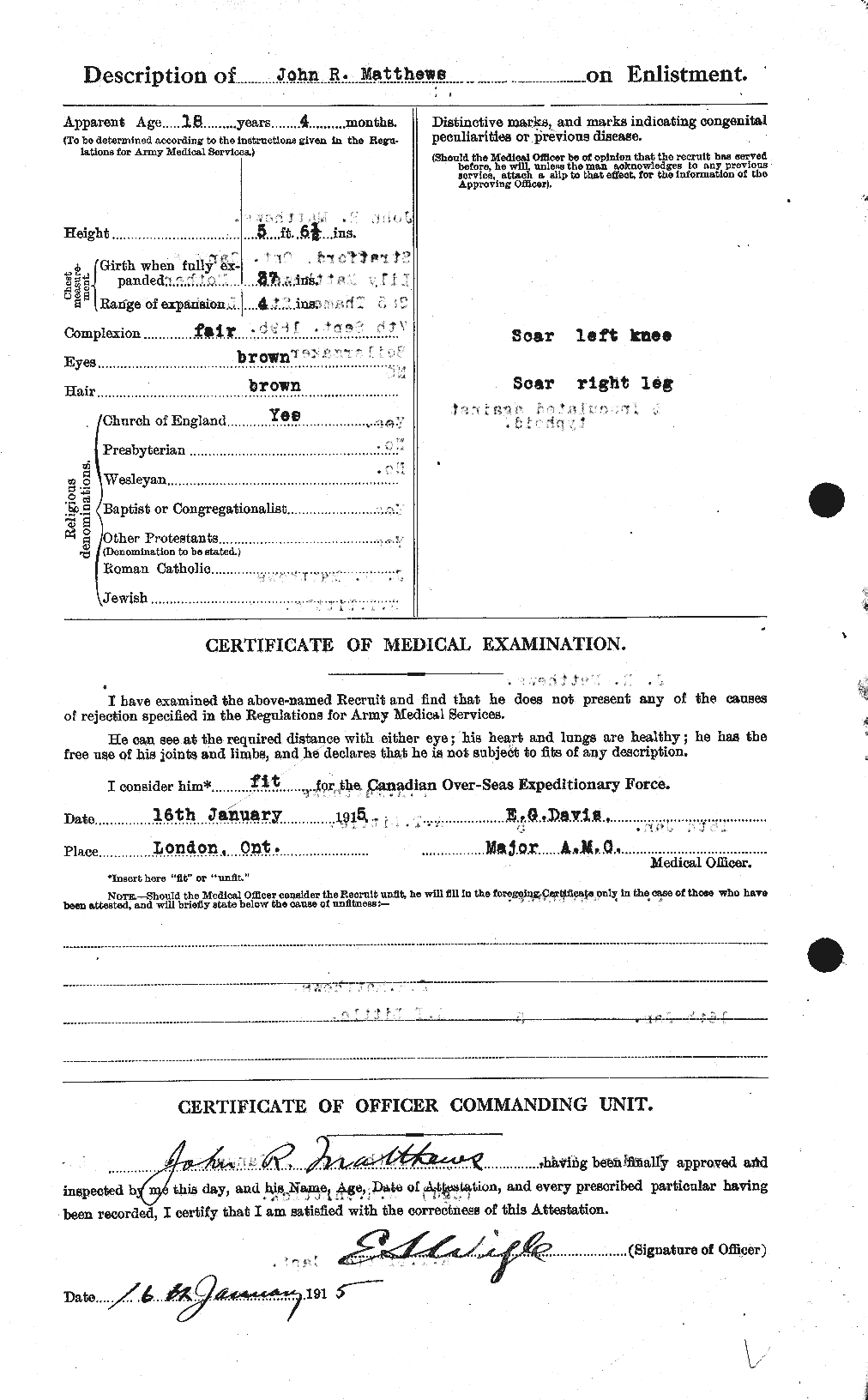
He was a boilermaker working in Stratford and decided to enlist with the Canadian Expeditionary Forces. He went to London, Ontario and on 15 January he enlisted with the 33rd Battalion and was transferred to the 18th Battalion 9 March 1915 as its roll was increased in preparation for going overseas.
Unmarried, he was only 18 years and 4 months old, he stood 5 foot and 6 inches tall.
He served with the 18th Battalion until 2 April 1916 when he was sent to the rear for treatment of “shell shock”. It appears that a GSW contusion was discovered, and his treatment was extended to take care of this leading to this discharge from hospital and return to combat duty on 28 April 1916.
Less than a month later he needed treatment for a carbuncle on his neck on 22 May 1916 and his treatment took a week.
Serving at the hell of the Somme in September 1916 he was transferred on 12 November 1916 to the 4th Field Company, Canadian Engineers for a temporary assignment lasting until 16 December 1916.
Returning to the 18th he served with the Battalion until he was granted 10-day’s leave pn 24 December 1916, just in time for Christmas. He probably went to England for his leave and returned to combat.
Two months later he became ill with influenza (2 February 1917) and five days later returned to his unit.
On the 18th of February his influenza returned and was serious enough for him to be evacuated to No. 6 Casualty Clearing Station, but he recovered and returned to service 4 April 1917 after a relatively long convalescence.
He was able to participate in the Battle of Vimy Ridge and served until he was “Killed by enemy shell bursting in billet,” the same shell that wounded my grandfather, Private William Robb Dewar, 53902. The billet was located at Bouvigny-Boyeffles, Department du Pas-de-Calais, Nord-Pas-de-Calais, France.
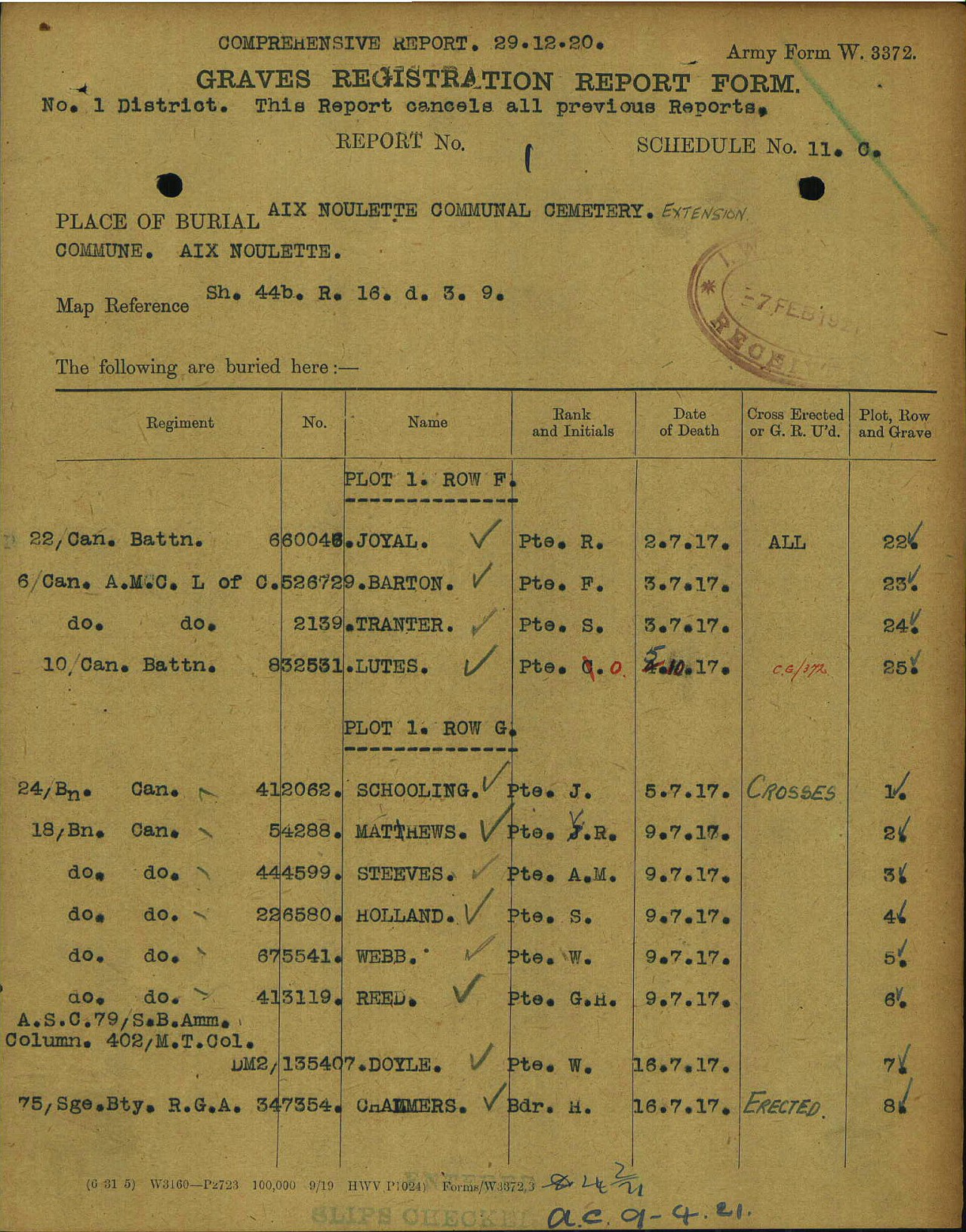
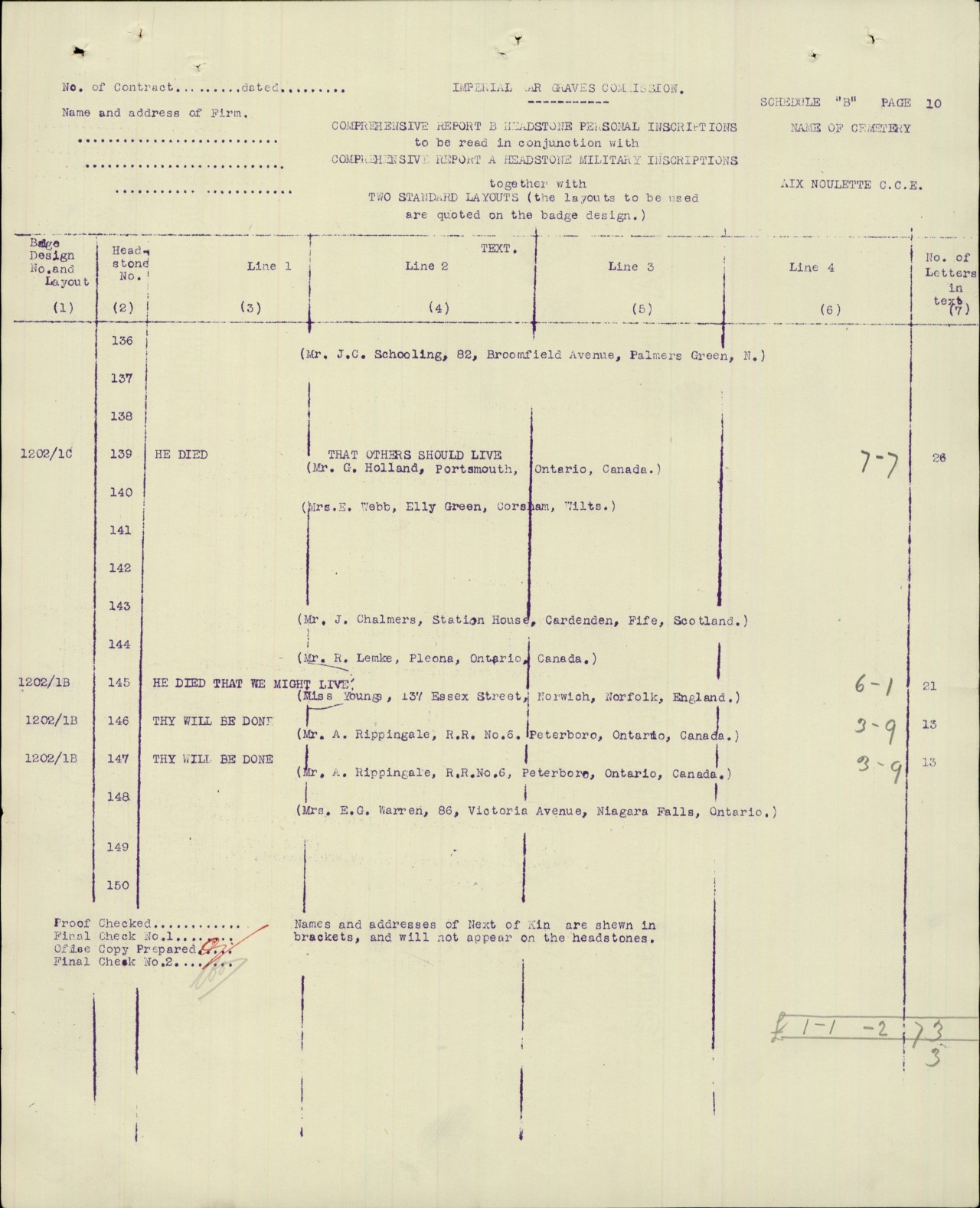
Private Matthew was buried at Aix-Noulette Communal Cemetery Extension, Aix-Noulette,
Departement du Pas-de-Calais, Nord-Pas-de-Calais, France with 22 comrades of the 18th Battalion.
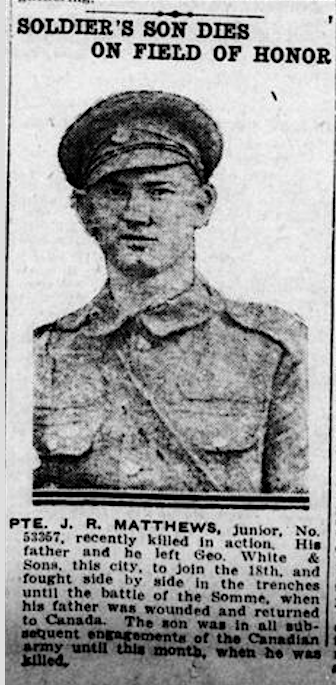
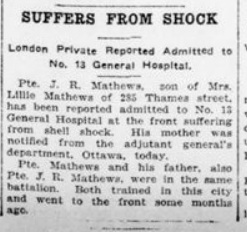
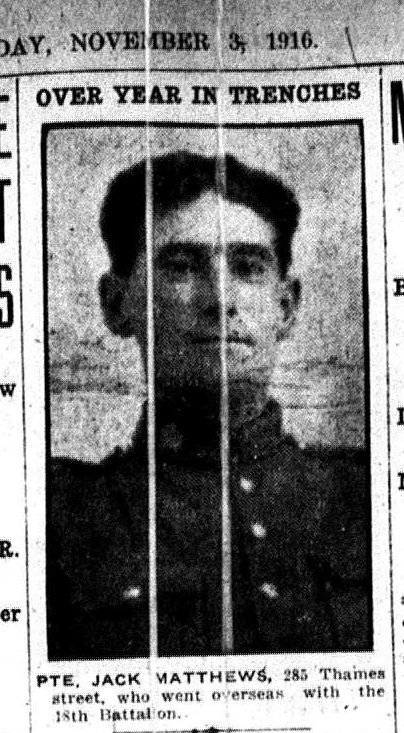
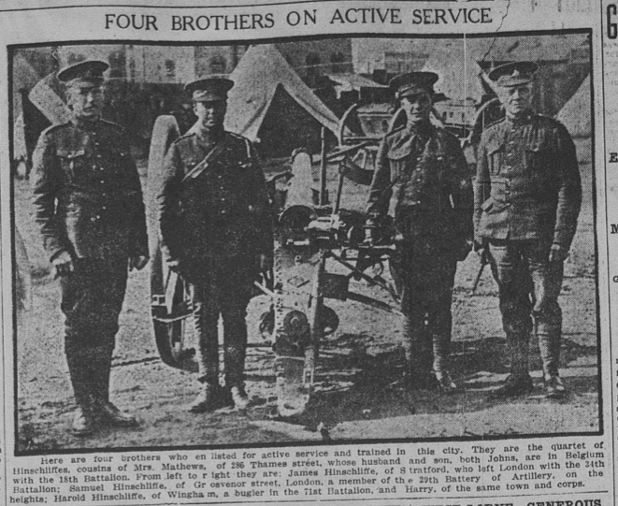
“Here are four brothers who enlisted for active service and trained in this city [London, Ontario]. They are the quartet of Hinschliffes [Hinscliffe], cousins of Mrs. Mathews [Matthews], of 286 [285] Thames street, whose husband and son, both Johns [Jack and John], are in Belgium with the 18th Battalion: From left to right they are James Hinschliffe, of Stratford, who left London with the 24th Battalion. Samuel Hinschcliffe, of Grovenor street, London, a member of the 29th Battery of Artillery, on the heights; Harold Hinschliffe, of Wingham, a bugler for the 71st Battalion, and Harry, of the same town and corps.”



 History of the 18th Battalion CEF, "The Fighting Eighteenth"
Leave a comment