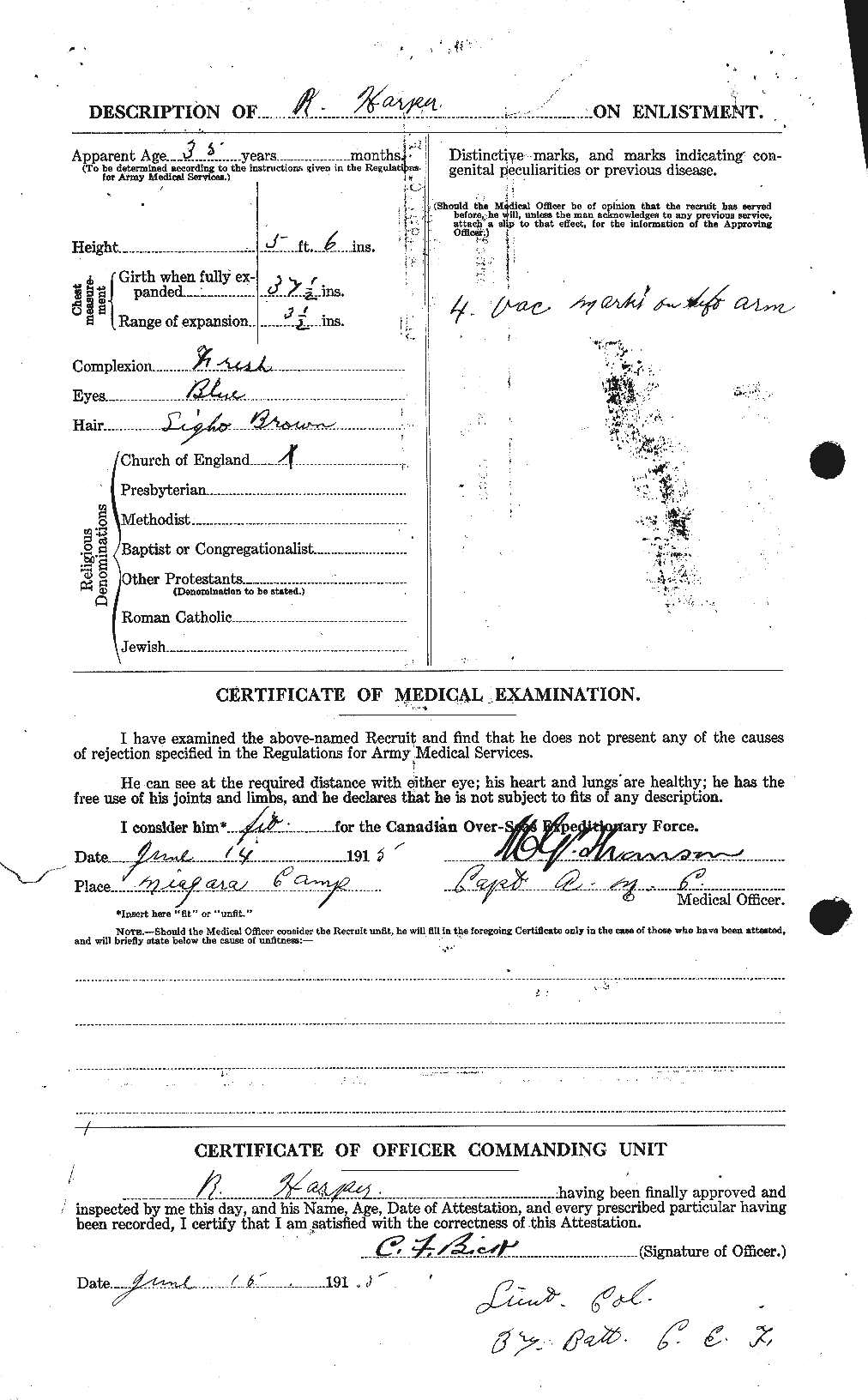
Source: Per service record of Sergeant Vernon H. Burns, reg. no. 775740.
Family Search: Sergeant Reginald Harper was born on 15 December 1879, in Chorley, Cheshire, England, United Kingdom as the son of John Harper. He married Jane Evelyn McNally on 12 November 1901, in Lancashire, England, United Kingdom. He immigrated to Canada in 1913 and lived in Far Sawrey, Cumbria, England, United Kingdom in 1922. He registered for military service in 1915. In 1915, at the age of 36, his occupation is listed as clerk. He died on 21 February 1924, in Haverthwaite, Lancashire, England, United Kingdom, at the age of 44, and was buried in St Peter’s Churchyard, Brackley, Northamptonshire, England, United Kingdom.More
MILITARY MEDAL.
For conspicuous gallantry and devotion to duty in front of PASSCHENDAELE on November 10th 1917. After his Platoon Commander and all the other N.C.O of his Platoon had become casualties during a very heavy enemy bombardment of the Sector, Sergt Harper took charge, reorganized the Platoon, established it in a new position and connected up the flanks. He personally placed the men in the new position and supervised the work of consolidation. By his courage and resource he maintained his position and saved many further casualties.

This man was killed in a motor vehicle accident. See news articles.
Motor Fatality at Haverthwaite.
ONE PERSON KILLED: TWO OTHERS INJURED.
CAR DASHES OVER A WALL.
[Photo. by Atherton, Barrow.]
At five o’clock last evening Haverthwaite was the scene of a serious motor car accident, involving the death of a passenger, and injuries to a second passenger and the driver.
It appears that the car, a Landseer hackney carriage, owned and driven by Charles Albert Smith, of No. 4, Prospect-place, Leyland, and carrying on business as a motor proprietor at Bowness, was returning from Ulverston, the occupants being Mr. Reginald Harper, 47 years of age, belonging to Ulverston, and residing with his father-in-law, the Rev. A. G. McNally, at the Old Vicarage, Far Sawrey, and Mr. Hugh Machell, solicitor, of Lakeside. In turning the bend at Cbeep Hill corner, near Haverthwaite Church, the bursting of the front off-side tyre caused the car to swerve suddenly to the right, and to be pitched over a wall eighteen inches in height into a field, with a drop of five feet.
The car turned a complete somersault, with the result that the three men were pinned underneath. With plenty of assistance at hand, the car was quickly lifted, and it was then found that Mr. Harper had been killed outright, his skull having been penetrated and fractured by some portions of the car.
The body was conveyed to the Angler’s Arms, close to the scene of the accident, and the driver, Smith, and Mr. Machell, who were suffering severely from shock, and cuts about the head and hands, were removed to the Ulverston Cottage Hospital, the former in Councillor Arthur Dickson’s car, and the latter in Miss Baldwin’s car.
On making inquiries at the hospital this forenoon our representative was informed that both patients were doing nicely.
It is expected they will be sufficiently recovered to give evidence at the inquest which has been fixed for to-morrow afternoon.
The Mail (Millom and South Copeland ed.)
Fri, Feb 22, 1924 ·Page 4

Fri, Feb 22, 1924 ·Page 4.
NORTH-WESTERN DAILY MAIL, MONDAY, FEBRUARY 25, 1924.
The Motor Smash at Haverthwaite.
Exhaustive Inquiry: Police Sobriety Test.
Driver Exonerated from Blame.
In the Haverthwaite motor-smash on Tuesday night last, in which Mr. Richard Norman Postlethwaite, of Ulpha, the death of whose son appears this week in our obituary columns, lost his life, the jury, at the inquest, held on Thursday afternoon at Haverthwaite by Mr. F. W. Poole, coroner for the Liberty of Furness, found that the deceased was accidentally killed, and exonerated the driver of the motor-car, Charles Norman Parker, of 33, Salthouse-road, Barrow, from all blame. The jury added a rider that Mr. P.J.P. Teasdale, of the General Post Office, should exercise more caution when acknowledging signals from motors. The deceased was identified by his father, Mr. Norman Postlethwaite.
Charles Norman Parker, the driver of the car, said that deceased, who was 24 years of age, resided at the old vicarage, Broughton-in-Furness, and was an auctioneer’s clerk and valuer. On Tuesday afternoon last witness drove his car from Barrow to Ambleside for the late deceased’s mother and Mr. and Mrs. Postlethwaite, and returned to Broughton Mills at 9.30 p.m. Witness went into the house with them and that was the last time he saw him alive.
A DAY OUT.
Charles Albert Smith, motor mechanic, 4, Back Salthouse-road, Barrow, said that on Tuesday last he accompanied Parker to drive a car from Barrow to Ulpha, returning at night. At about 10.30 p.m. he went with the witness and deceased back to Barrow, after having had supper. Deceased sat in the rear near side seat, and witness in the front off-side seat. They left Ulpha at 10.30 p.m. It was a fine night, and the roads were dry. They called at Broughton, where they stayed about an hour, and came on by way of Greenodd to Haverthwaite. About half-a-mile past the Haverthwaite Hotel they saw a motor-car with its off-side lamp alight. They drew out to their off-side, sounded their horn, and when the other car was about 20 yards off the driver dimmed his lights. Witness’s driver also dimmed his lights, and the next thing he knew there was a crash. The car had struck some obstacle and came to a stop. Witness got out and deceased was lying with his head and back across the near side of the car, and his legs were in the tonneau. He said, ‘I think I am finished.’
They lifted deceased out of the car, and with assistance from the other car they removed him to the Haverthwaite Hotel, where he died. Witness looked at the car, which had hit a tree stump. The glass windscreen was broken. He could not say what speed they were going at, but it was not excessive. He heard the driver shout, but could not say what he said. The horn was sounded several times after leaving Greenodd. The driver applied his brakes after he shouted. Witness got out on the near side after the car stopped, and the door was open.
Witness, in answer to Supt. Osborn, said that he saw the light on the car approaching them. The driver of the other car waited about ten minutes after the accident. Witness did not know if there was a light on the tree stump or not.
Cross-examined by Mr. F. J. Harrison (who appeared for Parker): We got into conversation with deceased as we were going along, and the driver joined in the conversation. When passing through villages the driver took great care. We did not go at excessive speed at all. After we left Greenodd the deceased started whistling. Witness knew the road pretty well, and he was with the business from the time we left Ulpha. We did not have any intoxicating liquor from the time we left Ulpha. Deceased was quite sober, and while we put the deceased into the car to go to Haverthwaite Hotel the deceased seemed to fall against the witness and the driver, and deceased exclaimed: ‘Oh! my head.’ We saw by a vivid flash that we had passed the off side light of the car coming towards us.
ASKED TO GET OUT.
Thomas Atkinson, platelayer, who resided on the side of the road, said that he heard a car stop, and heard voices, and saw a side-car lamp alight. The driver shouted three or four times, and then he heard another car coming along the road. The car kept on sounding its horn. Witness saw it pass his door, and it was going at a good speed.
Cross-examined by Mr. Harrison: He went to bed about 10 p.m. on Tuesday. He heard a motor pull up opposite his house, and he heard shouting. He got out of bed and looked out of his window, and he saw a stationary car with a light on the off-side facing Haverthwaite. He heard shouts of ‘Get out.’ He did not see anyone get out. He heard another car approach from the direction of Greenodd, and it was sounding its horn repeatedly. It passed his house, and he should say that it sounded as a speed of 25 to 30 miles an hour. Just as it passed he heard a shout of ‘Hi! look out!’ It sounded like an extra loud shout. Witness distinctly heard the warning shout. He heard the application of brakes and a crash. The stationary car did not move. It was standing on its near side. He heard it start again, and saw it did not stop at the scene of the accident. After the crash he heard a voice shout, ‘Hi, come back!’ and the car went towards Haverthwaite. He did not hear a driver ask another driver to get out of the way. He heard the shouts from the stationary car before the other car got in sight. The two cars were about 25 to 30 yards apart when they passed. The stationary car was showing a good light. The horn was sounded for about a quarter of a mile. It never ceased this speed. He did not hear any shouting after the crash. He was quite satisfied that the driver of the car which passed his house was placed on what is the wrong side of the road. He would not have had time to get into his proper place before reaching the stationary car. He was quite clear that the first car was a settled car. He did not know Mr. and Mrs. Teasdale. He had not heard about it having happened before that night.
Replying to the Coroner, witness said he saw the driver of the second car after the smash. Witness asked, ‘Are you on the wrong side of the road now,’ and he might have been slightly dazed, for he replied, ‘I hope not.’ The deceased was not taken out of the car until after witness had a little conversation at Haverthwaite. They then got the deceased out, and he was unconscious. They had to wait for about ten minutes for Mr. and Mrs. Teasdale to bring their car up the road. They had reversed it back. The Coroner: What was the state of the driver?—Perfectly calm and cool.
The Coroner: What do you estimate the speed at?—Between 25 and 30 miles an hour. Witness said it was a dark night. The stationary car had its side light on. He saw no tail lamp.
LOSS OF STEERING GEAR.
P.C. Brown, stationed at Haverthwaite, spoke to the deceased at the hotel. He seemed to be suffering from shock and pain. He said to witness, ‘The car swerved from one side of the road to the other, and the driver suddenly losing hold of the steer.’ He had hold of the steering with both hands.
The driver of the car said that he lost control of his steering gear. Deceased was quite sober.
DRIVER’S STORY.
Charles Norman Parker, the driver of the car, said he was a motor engineer, and had been driving a car for six years. He was perfectly sober on the night in question. He corroborated the evidence of Smith. He had driven over the road several times before. When about a quarter of a mile from the scene of the accident, he saw a light ahead which he took to be that of an approaching car, but as he got nearer he found that it was stationary, and as he approached he saw it was on the right hand side of the road. It seemed as though it was an ordinary touring car. It was about nine feet from the hedge, and he allowed a clear space of seven feet to pass. He did not notice anything unusual about the car.
On his journey, he was correctly sounded his horn. When he was about 15 yards from the stationary car, he saw a flash of light go past the windscreen of the other car. He immediately applied both his brakes, and the next thing he knew the car had struck the tree. He had his foot on the brake all the time, on coming down the incline.
Witness, continuing, said: I did not see any person get out of the car. When I got to the car on Thursday, he had a test to see if he could turn the wheel of the car. He could not turn the steering wheel at all. He jacked up the car to see if he could turn it then. The off-side wheel could not be moved at all. He then examined the near-side wheel and it was jammed. He came to the conclusion that if the wheel had not been jammed he would have had no difficulty in turning it. He had a look at the tree and he noticed the bark had been newly torn from it. He also noticed a rut in the road made by the wheel of his car, which showed that the car had swerved. He did not see any lights in Atkinson’s house. He pulled up on hearing the shout, but he thought someone was warning him. The road was quite wide enough for his car to pass. He was going at about 20 miles an hour when he passed the other car. It was the first time he had known the steering gear to go wrong.
Mr. F. J. Harrison: When you saw the light of the car was it on its proper side?—It was. Then when you got near it seemed to get over to its wrong side of the road?—Yes.
But when you got to within 20 yards of the stationary car you found it was on its right hand side?—Yes. When you were passing did you hear any shout?—Yes, but I did not know where it came from.
What did you think was the cause of the accident?—I cannot account for it except that the steering gear gave way at that psychological moment.
You did not hear any warning shouts from the stationary car?—No.
But you heard Atkinson shouting to you?—No, I did not hear Atkinson shout.
Cross-examined by Supt. Osborn: How long did you stop at Broughton?—About an hour.
And did you have any drink there?—No, I had nothing to drink from 4 o’clock in the afternoon until I arrived in Barrow that night.
Replying to the Coroner, witness said he saw two persons in the stationary car. He saw a man’s head above the side of the car, and then he saw the flash of light.
CORONER’S QUESTIONS.
The Coroner: What was your conversation about?—Nothing to distract me from driving or my attention whilst driving. I can’t tell you the conversation.
Do you usually go at 25 or 30 miles an hour with anybody when getting tired on the road?—No.
Have you ever known the gear to go wrong on this car before?—No.
Did you not think it was a strange proceeding for a car to be pulled up on its wrong side of the road with only its off-side light on?—Yes.
Did you not say to Police Constable Brown that you could not account for the accident except that you got blinded by the head light of the other car and you pulled over too far?—No, I didn’t get blinded by the head light of the other car. I was past the flash before I pulled over. I saw a long dark object on the road. I could not see what it was, and the next thing I heard a crash. I think what I said to the constable was that the lights of the other car confused me, not that they blinded me. That is all.
Were you driving too fast?—No.
The Coroner: I want you to tell the jury definitely what was the cause of this accident?—I cannot account for it. The Coroner: I must have it from you. You are the driver. Was the steering gear out of order?—Yes, it was out of order, and I must have run on to the stump before I had a chance to apply my brakes. That is what I think.
In reply to a juryman, witness said the car was his own property.
In answer to another juryman, witness stated that he thought the flash of light came from the dash lamp of the other car. He was driving on the extreme near side of the road when he passed the other car.
DRIVING TOO FAST?
P.J.P. Teasdale, an official of the General Post Office, who was in charge of the car, stated that he was going from Ulverston to Backbarrow. Opposite the house occupied by the last witness, Atkinson, his accumulator went wrong, and he had to stop to put it right. He had to stop about five minutes. He drew up on the wrong side of the road, because it was dangerous to draw up on the other side at this place, and the other car could see him better. He heard the other car coming for about a quarter of a mile. He heard it coming at a high speed, and he thought there might be a ‘dead topper,’ and he said to his wife, ‘Let us get out.’ They got out, and as the car passed, it was only about two feet from their car. Witness shouted ‘Look out,’ and he tried to get the driver to stop, but he continued on at about 25 to 30 miles an hour. He had a clear view of the road, and if he had gone at 15 miles an hour he would have been all right, and the accident would not have occurred. He did not hear any word or any detail, and looked quite all right.
The Coroner: What was the use of shouting to the driver when you knew he could not stop?—I wanted to get the driver to slacken speed. The car was 30 or 40 yards from the corner of the road.
Mr. Harrison submitted that there was no case to answer of culpable negligence.
Supt. Osborn: So far as you could see, you were driving at a reasonable speed?—Yes, I was.
The Foreman of the Jury (Mr. W. Thompson), Mr. Geo. Tyson, and Mr. E. France, asked several questions, and after a long consultation in private the Foreman announced the verdict as stated above.
POLICE SERGEANT’S TESTIMONY.
Police-Sergt. Baxter, stationed at Ulverston, said he received a report of the accident at 12.30 a.m. on Wednesday morning, and at once proceeded to the scene. He examined the car and he found the steering gear was locked. Witness also examined the driver of the car (Parker), who was perfectly sober, and he was quite normal in his manner. The road at the point where the accident occurred was 24 feet wide from hedge to hedge, and the car had a clear passage of 14 feet. The road was straight for about 200 yards, and there was no danger. He found that the car was owned, insured, and driven by Parker. He thought the steering wheel would not move. He examined the car, which was a five-seater Armstrong, and was practically new. He found that the steering gear had jammed, and could not be moved. The off-side front wheel was buckled, the axle twisted, the spring shackle broken, and the steering rod bent. He could not say when the gear was broken. The roads were good, and there was no necessity to drive at the speed the car was travelling at. There was plenty of room to pass the stationary car on the proper side of the road, which was about nine feet from the hedge, and there was a good seven feet to pass. He came to the conclusion that the driver must have lost his nerve and seen the stump too late. He found the car which ran into the stump was a heavy touring car. The tree was eight feet from the hedge. The road for a hundred yards on each side was very straight. He saw the tracks of the car which had swerved from the near side to the off-side. There was no sign that the brakes had been applied with any force. He applied to the driver the usual sobriety test. He made him walk a chalk line, and he was perfectly steady on his feet, and his speech was distinct.
THE POLICE TEST.
‘I had no doubt,’ continued the witness, ‘that he was sober and was quite capable of driving the car. His breath did not smell of drink. He was most straightforward in his statement, and told me that he would have passed the car all right had it not been for the steering gear giving way. He drew up on his proper side. The stationary car was on its wrong side. It was a very dark night. A car on its wrong side would certainly have a dazzling effect on anyone approaching. He saw where the car swerved. He sounded his horn and dimmed his lights. He examined the car on Thursday with Parker. He found it was impossible to move the off-side wheel. It was locked. He then examined the off-side front wheel and he found a piece of metal wedged in the steering gear, which must have been there before the smash. It had been carried from the road, and when it got in it locked both the steering gear and the off-side front wheel. It was a piece of an old spring which must have come off another vehicle. He considered that the driver of the car had no chance. It was a pure accident. No one could be blamed for it. He found a mark on the tyre where the piece of metal had caught it. The driver said his car was in good order when he left Barrow. He had driven it for about 2,000 miles. He said that the piece of metal must have got into the steering gear just before the accident. He was quite satisfied that the party in the car was sober. The driver’s story was quite consistent and straightforward.’
Dr. W. N. D. Inman, of Grange-over-Sands, said he was called to the hotel at 12-40 a.m. on Wednesday, and found the deceased lying on a sofa. He was dead. Death was due to a fracture of the base of the skull. The man must have died instantly. He had since made a post-mortem examination. The deceased was aged 24. He drove a car himself. He knew the road very well. The injuries he saw were consistent with the deceased being thrown against some hard object in the car, or being thrown out of the car, and his head coming in contact with the ground.
The Coroner said that it was for the jury to say whether the driver was guilty of negligence, and if it was so, it was their duty to say so. He did not think it was a case of criminal negligence.
JURY’S QUESTIONS.
The Foreman: Did you have any conversation with the driver?—Yes, he said he was going at a moderate speed, and he was quite prepared to take the consequences.
Another juryman: Did you not consider it was a dangerous thing to do what the driver did?—The Coroner: No, I do not. He was on his proper side of the road. He had a right to be there. The other car had no right to be there.
Mr. Harrison explained the working of the differential gear of a motor-car, and said that when one wheel was locked the other would go round all the faster, and the car would swerve to one side. He submitted that there was absolutely no blame to be attached to Parker.
THE CORONER’S SUMMING UP.
The Coroner said that this was one of the most exhaustive inquiries he had held for a very long time. It was a sad case, and they must all sympathise with the relatives. It was one of those cases where it was difficult to say how the accident had occurred. The driver of the car which caused the accident seemed to have given his evidence in a very straightforward manner. He (the Coroner) was of opinion that the jury would have no hesitation in finding that the deceased died from injuries received by being thrown out of a motor-car, and that no blame could be attached to the driver. The driver of the stationary car had said that the other car was travelling at an excessive speed, but the driver of the other car had denied that. He (the Coroner) thought that the driver of the stationary car was not to be believed. He had given his evidence in a very unsatisfactory manner. There was no doubt that the car was travelling at a fair speed, but he did not think it was an excessive speed. The road was straight and wide, and there was plenty of room to pass. The driver of the stationary car had said that he shouted to the other driver to stop, but he did not do so. He (the Coroner) did not believe that. He believed the driver’s story that he did not hear him shout. He did not think that the driver of the stationary car was to blame for the accident. He thought the whole blame of the accident was due to the fact that the steering gear of the car had given way. The police had given their evidence in a very clear and concise manner, and he was of opinion that a photograph which had been taken of the car would be of great assistance to the jury in coming to a decision. He would like to say that he had received a letter from Mr. Teasdale, who wrote that he had been detained at Barrow, and could not attend the inquest. The letter was read. Mr. Teasdale stated that he was not the owner of the car. He was prepared to accept any blame that the jury might attach to him. He was of opinion that the jury would be quite justified in finding a verdict of ‘Accidental death.’

Mon, Feb 25, 1924 ·Page 3


 History of the 18th Battalion CEF, "The Fighting Eighteenth"