Source: 18th Battalion Nominal Roll, April 1915.
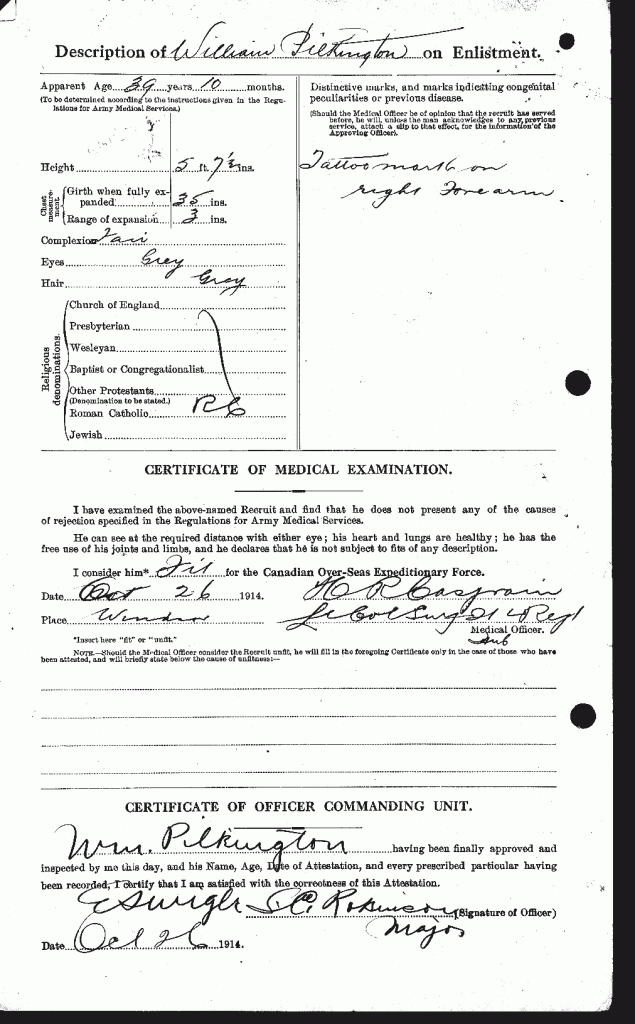
Family Search: When Sapper William Pilkington was born on 10 December 1874, in Liverpool, Lancashire, England, United Kingdom, his father, William Pilkington, was 30 and his mother, Mary Alice Lister, was 31. He lived in Pendleton, Lancashire, England, United Kingdom in 1891 and Los Angeles, Los Angeles, California, United States in 1921. He registered for military service in 1914. In 1914, at the age of 40, his occupation is listed as shipwright. He died on 27 May 1932, in New York City, New York, United States, at the age of 57, and was buried in The Evergreens Cemetery, Brooklyn, Kings, New York, United States.

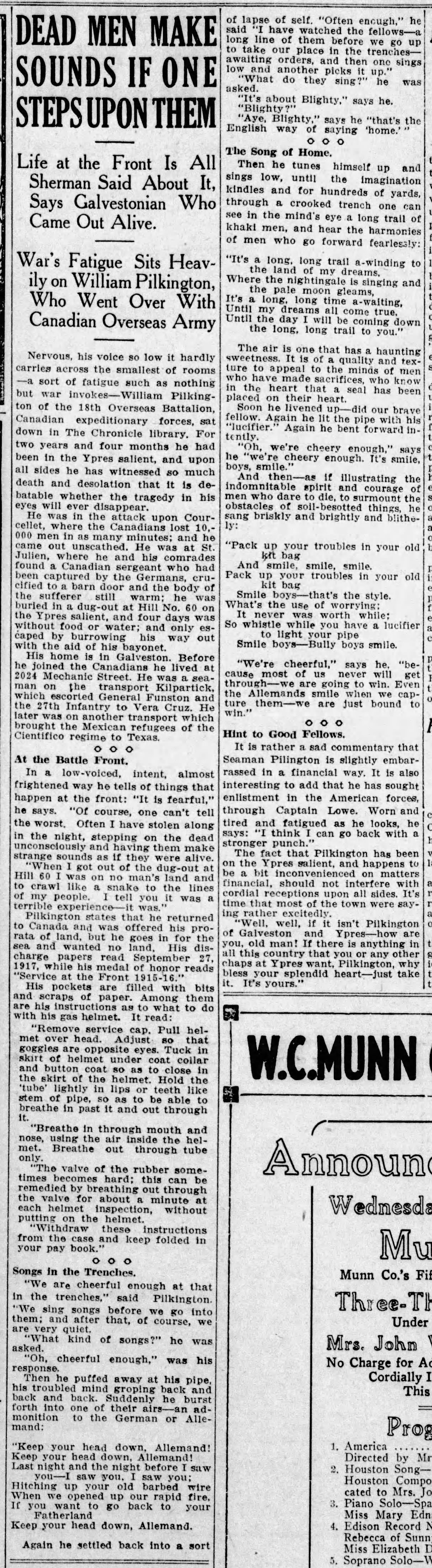
DEAD MEN MAKE SOUNDS IF ONE STEPS UPON THEM
Life at the Front Is All Sherman Said About It, Says Galvestonian Who Came Out Alive.
War’s Fatigue Sits Heavily on William Pilkington, Who Went Over With Canadian Overseas Army
Nervous, his voice so low it hardly carries across the smallest of rooms—a sort of fatigue such as nothing but war invokes—William Pilkington of the 18th Overseas Battalion, Canadian expeditionary forces, sat down in the Chronicle library. For two years and four months he had been in the Ypres salient, and upon all sides he has witnessed so much death and desolation that it is debatable whether the tragedy in his eyes will ever disappear.
He was in the attack upon Courcellet, where the Canadians lost 10,000 men in as many minutes; and he came out unscathed. He was at St. Julien, where he and his comrades and a Canadian sergeant who had been captured by the Germans, crawled out to a barn door and found the sufferer still warm; he was buried in a dug-out at Hill No. 60 on the Ypres salient, and four days was without food or water; and only escaped by the body of his comrade with the aid of his bayonet.
His home is at Galveston. Before enlisting with the Canadians he lived at 2024 Mechanic Street. He was a seaman and served through the siege of Vera Cruz with General Funston and later with another transport which brought the Mexican transport crew who were coming to Texas.
At the Battle Front
In a low-voiced, intent, almost frightened way he tells of things that happen at the front: “It is fearful,” he says. “Of course, one can’t tell the worst. Often I have woken in the night, stepping on the dead unconsciously and having them make strange sounds as one walks over them.
“When I got out of the dug-out at Hill 60 I was on no man’s land and crawled like a snake to the lines of my people. I tell you it was a terrible experience—it was.”
Pilkington states that he returned to Canada and was offered his pro rata of land, but he goes for the sea and wanted no land. His discharge papers read effective July 5, 1917, while his medal of honor reads service from April 1915 to July 5, 1917.
His pockets are filled with bits and scraps of paper. Among them is the instruction as to what to do with his gas helmet. It read:
“Remove service cap. Pull helmet over head. Adjust so that goggles are just over the eyes. Button skirt of helmet under coat collar and button coat so as to close completely at neck. Hold the edge of skirt lightly in lips or teeth like a pipe, so as to exhale breath in the past it and out through it.
Breathe in through mouth and nose, using the air inside the helmet. Breathe out through the valve.
The valve of the rubber sometimes becomes hard; this can be remedied by breathing out through the valve for about one minute at each helmet inspection, without putting on the helmet.
Withdraw these instructions from the case and keep folded in your pay book.”
Songs in the Trenches
“We are cheerful enough at that in the trenches,” said Pilkington. “We sing songs before we go into them; and after that, of course, we are very quiet.”
“What kind of songs?” he was asked.
“Oh, cheerful enough,” was his response.
Then he puffed away at his pipe, his troubled mind groping back and back and back. Suddenly he burst forth into one of their airs—an adaptation to the German or Allemand:
“Keep your head down, Allemand!
Keep your head down, Allemand!
Last night and the night before I saw you—I saw you, I saw you!
Hitching up your old barred wire
When we opened up our rapid fire.
If you want to go back to your Vaterland
Keep your head down, Allemand.”
Again he settled back into a sort of lapse of self. “Often enough,” he said “I have watched the fellows—a long line of them before we go to take our place in the trenches awaiting orders, and then one sings low and another picks it up.”
“What do they sing?” he was asked.
“It’s about Blighty,” says he.
“Blighty?”
“Aye, Blighty,” says he, “that’s the English way of saying ‘home.’”
The Song of Home
Then he tunes himself up and sings low, until the imagination kindles and for hundreds of yards through a crooked trench one can see in the mind’s eye a long trail of khaki men, and hear the harmonies of men who go forward fearlessly:
“It’s a long, long trail a-winding
To the land of my dreams,
Where the nightingale is singing
And the moon so gleams.
It’s a long, long time a-waiting,
Until my dreams all come true,
Until the long, long trail to you.”
The air is one that has a haunting sweetness. It is of a quality and an expression that sticks with men who have made the sacrifices, who have looked death squarely and had been placed on their heart.
Soon he inquired—did our new fellow again he lit the pipe with his “lucifer.” Again he bent forward intently.
“Oh, we’re cheery enough,” says he “we’re cheery enough. It’s the songs, smiley.”
And then—as if illustrating the indomitable spirit and courage of men who dare to die, to surmount the obstacles of soil-bestowed things, he sings briskly and brightly and blithely:
“Pack up your troubles in your old kit bag
And smile, smile, smile.
Pack up your troubles in your old kit bag,
Smile boys—that’s the style.
What’s the use of worrying?
It never was worth while:
So whistle while you pucker a lucifer to light your pipe,
Smile boys—Bully boys smile.”
“We’re cheerful,” says he. “Because most of us never will get through—we’re smiling ‘em down. The Allemands smile when we capture them—we are just born that way.”
Hint to Good Fellows
It is rather a sad commentary that William Pilkington is slightly embarrassed in a financial way. It is not interesting to add that he has sought enlistment in the American navy through Captain Lowe. Worn and tired and fatigued as he looks, he says: “I think I can go back and hit a stronger punch.”
The fact that Pilkington has been on the Ypres salient, and happens to be not inconvenienced on matters financial, should not interfere with his cordial receptions upon all sides. It’s really a book upon modern warfare,” says the rather excitedly.
“Well, well, if it isn’t Pilkington of Galveston and Ypres—why, man, you, old man! If there is anything in this old country that you or another needs at Ypres want, Pilkington, why bless your splendid heart—just take it. It’s yours.”
The Houston Chronicle. Tue, Nov 13, 1917 ·Page 3.




 History of the 18th Battalion CEF, "The Fighting Eighteenth"