Source: Elgin Genealogical Society.
Family Search: When Lieutenant John William Such was born on 12 June 1894, in Burton upon Stather, North Lincolnshire, Lincolnshire, England, United Kingdom, his father, Arthur Cyril Such, was 30 and his mother, Alice Annie Thompson, was 23. He married Alice Ann Thompson on 18 June 1919, in Hull, Yorkshire, England, United Kingdom. He immigrated to Canada in 1909 and lived in Elgin, Ontario, Canada in 1911. He registered for military service in 1914. In 1914, at the age of 20, his occupation is listed as dairyman. He died in 1956, in Barrie, Simcoe, Ontario, Canada, at the age of 62, and was buried in Saint James Cemetery, Crown Hill, Springwater Township, Simcoe, Ontario, Canada.
Brother to Arthur Such, reg. no. 53742.
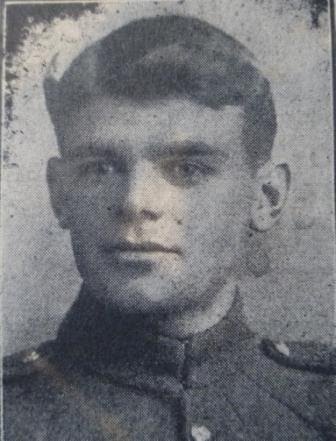
John William Such
53743 John William Such
William’s name appears in a letter printed in the Aylmer Express, November 26, 1914 from “the Aylmer Boys” while in London awaiting their journey overseas. His name is not included in any previous lists of recruits, nor is his place of residence given on his attestation paper. John was born on June 12, 1894 at Barton-on-Stather, Lincolnshire, the son of Arthur Cyril Such (1862-1898) & Alice Thompson, who were married in Lincolnshire in 1889. Arthur died in Lincolnshire in 1898, and Alice was remarried to Arthur Waddingham in 1900. John is found on the 1901 census in England with Alice & Arthur Waddingham, living in South Ferriby, Lincolnshire.
William Such emigrated to Canada about 1909 and is found on the 1911 census in Bayham township census as a farm labourer living with Cicero & Mary McConkey. John was a nephew of Harry & Florence (Thompson) Hewbank of Richmond.
He enlisted for service on October 29, 1914 in St. Thomas. He was a dairyman and was not married. He had served one year in the boys’ brigade in England. He names his next of kin as his mother, Alice Waddingham, of #1 Greek Street, Hawthorne Ave., Hazel Road, Hull, England.
Before returning to Canada after the war, William was married on June 18, 1919 in Yorkshire to Doris Booth, of Hull, Yorkshire.
It is believed William & Doris returned to Aylmer, where there were living when a son was born in 1921 and a daughter in 1924. The Aylmer Express records the birth of a daughter to J. W. Such, of Brigden, in 1928, so it appears they had left Aylmer by that date.
Their marriage was reported in the Aylmer Express, August 14, 1919:
SUCH – BOOTH
Interesting Wedding of Former Aylmer Man in England
A very pretty wedding took place at Hull, Yorkshire, on June 18th last, when Regimental Sergeant-Major J. W. Such, 18th Canadian Battalion, of Aylmer, became united in marriage to Miss D. Booth, of Hull, Yorkshire. The Rev. W. H. Hewitt, M.A., officiated. The bride, who was given away by her father, was daintily attired in a dress of Crepe Rajah with bead and silver trimmings. She wore a bridal veil and carried a sheaf of roses. The bridesmaids were the Misses B. Woodmansey, friend of bride and D. Waddington, sister of the bridegroom, and Kathleen Sales, cousin of bride. The two elder bridesmaids were attired in dresses of pale grey with blue trimmings and hats to match and carried bouquets of sweet peas. Little Kathleen wore a dress of pale blue with tiny pink rose buds and carried a basket of sweet peas. Lance-Corporal C. Such, N.F., brother of the bridegroom, acted as best man. The bridegroom, who is an Aylmer boy, joined the 18th Canadian Battalion in 1914 and has since been overseas. He served in France with that unit until wounded in September 1916. He expects to return with his bride to Aylmer where they will settle. They were the recipients of many presents. A short honeymoon was spent in Lincolnshire. Previous to enlisting, Mr. Such resided with Mr and Mrs H. Hewbank, his uncle and aunt.
A letter from William Such was printed in the Aylmer Express, July 1, 1915:
ENGLAND FULL OF SOLDIERS
Says Bugler Wm. Such, of Aylmer, in an Interesting Letter
Aylmer Boys with the 18th all Well, and Anxious to get a Crack at the Germans
Sandling West, Hythe, Kent, England. June 8, 1915
To the Editor:
D
ear Sir – Having a few spare moments I thought I would write a few lines for your valuable paper. Well, we the Aylmer boys are here in England yet, and like everything fine, but one thing I am sorry to say, and I think I speak for nearly everyone, and that is we may be here too long. Everyone seems anxious to get a crack at the Germans while the weather is good. Before I go any farther I must say that the trip across the Atlantic was splendid. The weather was good, the water was calm, and the numerous boats that passed made things exciting. The trip took about two weeks from leaving London, Ont. until we reached Sandling. We were escorted by H.M.S. Cumberland and three or four torpedo destroyers, and we had to travel without lights at night. There is only one thing I didn’t like about the trip, and that was some 20 of us had the mumps, but none were very serious. We docked at Havenmouth about 9 a.m., April 30, and I am sure I never saw prettier scenery than I saw there, and it is equally as nice where we are now.
Sandling is about five miles from Folkestone, which is a summer resort. The buildings there are magnificent. For about ten miles around here is nothing but camps, in fact I think England is full of soldiers, it seems as if khaki were the fashion for men this year, in fact it is for women as well.
The Germans have made on an average about two raids a week on England since we have ben here, but have not done much damage. They have been as close as 20 miles to our camp. British aeroplanes and dirigibles are seen often around here.
Private houses have been given up in large numbers for use as hospitals and for the comfort of the soldiers. There are a large number of Belgium and French refugees at Folkestone, and they seem to be very sociable to the overseas contingent.
There are soldiers’ clubs at every camp, put there by Lord Kitchener, Sir John French, Admiral Jellioce and such men. These clubs furnish a dry canteen, writing tables, in fact, everything to aid in making things comfortable. We haven’t the slightest idea when we will go over to the continent, but I hope it will be soon.
Now I think I have said sufficient, so I will conclude with many thanks to the people of Aylmer for what they did before we left.
I remain yours very sincerely,
Bugler Wm. Such, 18th Battalion.
Another letter from William was printed in the Aylmer Express, November 18, 1915:
AYLMER BOYS IN FRANCE ALL WELL AND HAPPY
Have Not Seen any Severe Fighting Yet, But are Ready
Somewhere in Belgium, Oct. 31, 1915
To the Editor of the Aylmer Express:
While I have a few moments to spare, I thought I would dash a few lines to Aylmer. This is Sunday night and although the wind is blowing quite cold, and the rain beating on the roof of our little shack, it does not make any difference to the volley of the big guns, and the cracking of the rifles. We can just step outside of the hut and see the star shells going up, which light up both our trenches and the enemy’s. Sometimes these lights put me in mind of Toronto or London exhibitions, or even Aylmer fair at night when they have fireworks. But these lights and guns going off are the real thing, therefore it makes it much more interesting than the fall fairs.
The Aylmer boys are all well and happy. We are enjoying this life fine, considering the conditions here. We have not seen any real severe fighting yet, but I think we are ready for anything that comes along. All the boys are on the lookout for souvenirs. Some have been lucky enough to find a German helmet, others have found rifles, etc.
I think this is about all for this time. Hoping this finds everybody well in Aylmer as it leaves us all the very best.
Yours very truly,
Bugler J. Wm. Such, No. 53743 C. Co., 18th Canadian Batt.
A letter written by William from an English hospital was printed in the Aylmer Express, October 26, 1916:
GERMANS ARE DIRTY FIGHTERS
Writes Bugler Wm. Such, a Former Malahide Boy in a Letter to An Aylmer Friend
Was Wounded in a Battle on the Somme and is Now in an English Hospital
British Firing Five Shells to the Huns One
Ward No. 3, East Leeds War Hospital,
Leeds, York, England, Sept. 25th, 1916
Dear Friend –
A few lines to let you know I am progressing fine. I suppose you will wonder why I did not write, but of course I have been travelling quite a bit lately, from France to England, into several hospitals. Things have been very inconvenient to settle down to anything. I am pleased to say I am not wounded very seriously, although quite bad enough. I was wounded with shrapnel in the left side and back. The shrapnel penetrated quite deep and stopped about one inch from my spine, so I consider myself very lucky.
I was operated on at Etaples, France at No. 1 Canadian General Hospital and had shrapnel taken out. I was about one week there and then moved to England to this hospital. You see Leeds is only about 50 or 60 miles from my home, so I am very lucky. No doubt some of the folks will come up to see me. I expect I can get up in a day or two. I am anxious to hear whether Dick and Art are well, also Bill Turner, although when I was wounded they were still safe.
Oh, my! that was one awful battle. The dead fairly covered the ground (mostly Germans though). We lost a lot who were killed, of course. In fact, the biggest share of the Battalion were wounded or killed. It was certainly an awful sight, men blown all to pieces. Arms and legs here and there. I was real lucky to get out alive and no doubt about it, but really I wouldn’t have missed it for anything.
We took hundreds of prisoners, but really it’s a shame to take them prisoners. Every one should be killed but of course you can’t find time to kill them all, as we have to get to our objective as quickly as we can. I had a chance to get some dandy souvenirs, but you see I couldn’t be bothered with them. I am used real well by the nurses. Lots of comforts and all that. Well the lights are being turned out so I will have to finish this in the morning.
Sept. 26, 1916
Well, here we are again after a good night’s sleep and a good breakfast. I understand the Zeppelins were over again last night and also hear they were at Hull. They brought two down about nights ago [sic].
The people are very frightened at night in England, but really there is no real need to be, because they don’t do much damage, but of course I suppose they can’t tell where the bombs will light. The morning of the big battle, the shells were coming over in hundreds, all around us. Of course the casualty list will show that. But the Germans certainly got five shells back tot heir one, or even more. They got one good licking that morning and no mistake about it. I wouldn’t have wanted to be on their side. The Huns threw up their hands as soon as we got close tot hem, but in some cases that didn’t save them. There was one German prisoner very badly wounded, so he asked one of our men if he would give him a drop of water and dress his wound, so he took pity on him and began dressing his wound, and as soon as he turned his back to attend to him, one of the other Germans shot at him, so he left this man and went after the other damned coward, and he threw up his hands and said ‘mercy kemerad’, but he took no mercy and showed none after that. They are a dirty lot of fighters, in fact they won’t fight with the bayonet.
Well, think this is about all for this time. Will write again in a day or so. Love to all,
I remain as ever, William Such
Bugler J. Wm. Such, No. 53743, enlisted with the 18th Batt., and left London, Ont., April 18th, 1915 for overseas. Trained at Sandling Camp until Sept. 12th 1915, when he left for the firing line. Went in the trenches the 20th of Sept. 1915, and was wounded on the 20th Sept. 1916.
William Such writes again in October, and his letter was printed in the Aylmer Express, November 23, 1916:
AYLMER MAN IN AN ENGLISH CONVALESCENT CAMP
Bugler Wm. Such, of Aylmer, Was Wounded the First Day the Famous British Tanks Were Used
Had A Close Shave From Death
England, 30-10-16
To the Editor of the Express:
Dear Sir –
As I have a few minutes to spare I thought I would just sit down and write a few lines to the home paper. I sincerely hope these few lines will find the people of Aylmer in good health and spirits, as it leaves me in very fair condition, considering what I, along with the rest of the boys have gone through in the last year. I do not know exactly who was wounded among the Aylmer boys with the 18th while at the Somme, but I hope they are no more serious than I. My wound was only slight, although a very close shave, as it just missed my spine. However, ‘all is well that ends well’. I can assure you the 18th Batt. can be proud of what they accomplished in the ‘Big Push’. They made their assault on the morning of the 15th of September, just one year from the time they landed in France. They took large numbers of prisoners, who came over with a smile on their faces. I can quite understand why we take so many prisoners. Our artillery is so much superior to the enemy’s, and our ammunition supplies are abundant. We have full control of the air, and the ‘tanks’ above all things are without a doubt, a wonderful invention. The morning of the 15th September was their first wonderful work. The Huns were terrified to death almost, and no wonder, for what they do not kill with their guns, the tanks crush. I think their speed limit in action is about four to five miles per hour.
I was wounded quite early in the morning and was conveyed to a hospital (Canadian) where I was operated on. From there I went to a hospital in good old England, where I received the best of care until the wound was healed. Then I was sent down here to a Canadian Convalescent camp. It is a very nice place, and at present I am employed as bugler.
We are having rather nasty weather at present, so much rain. I hope, as does everybody else, that this campaign will soon be over so that we can all get back to dear old Aylmer once again. Wishing you the best of health and success,
Yours sincerely, Bug. J. Wm. Such, 5373 18th Can. Batt.
B. 84 Div. Convalescent Hospital, Woodcote Park, Epson, Eng.
William Such died on December 25, 1956 at the age of 62. He is buried with his wife, Doris Booth (1898-1988) in St. James Anglican Cemetery, Crown Hill, Vespra Township, Simcoe County. In addition to the family monument, a military stone with the following inscription marks his resting place: “John W. Such, Flight Lieutenant, R.C.A.F. 25 Dec 1956 age 62″


 History of the 18th Battalion CEF, "The Fighting Eighteenth"