Source: 18th Battalion Association Memorial Booklet and Awards.
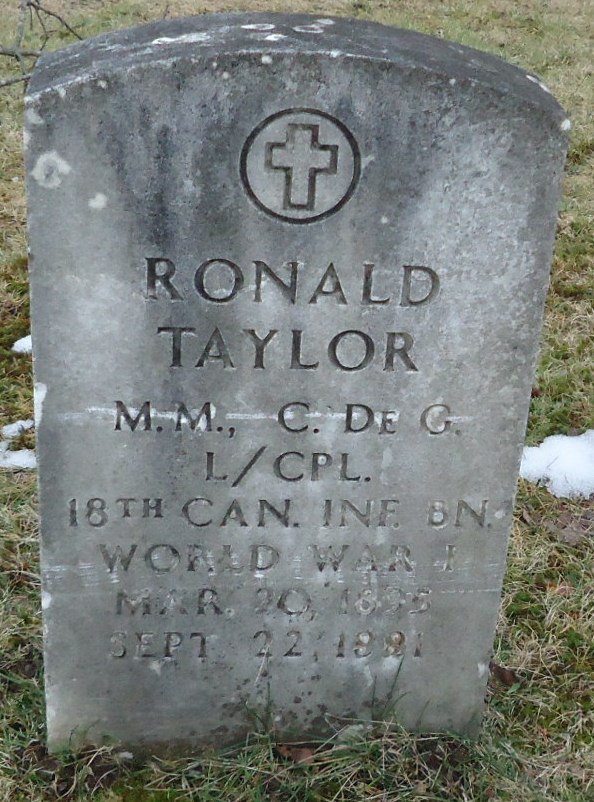
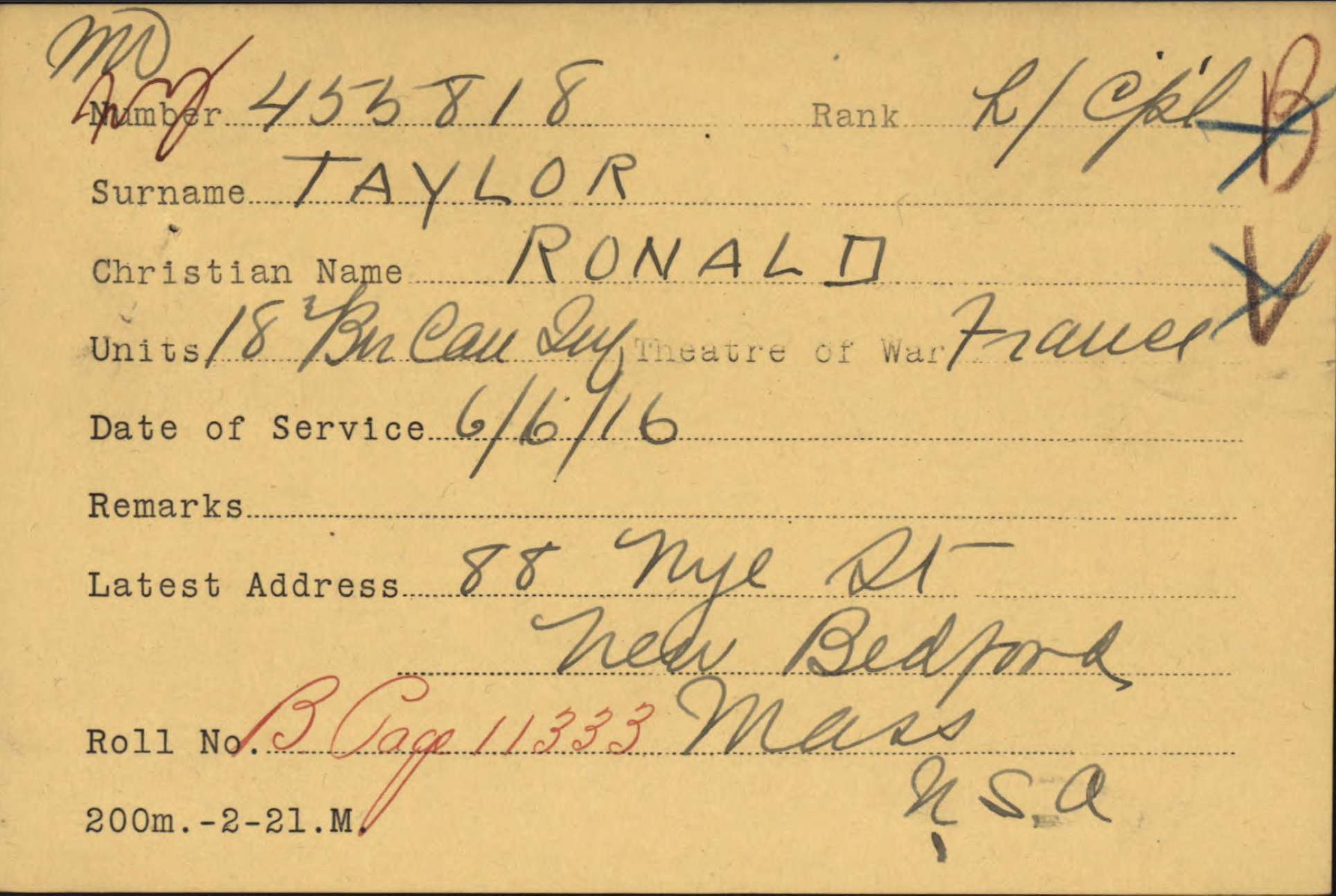
Family Search: When Lance-Corporal Ronald Taylor was born on 20 March 1895, in Walsall, Staffordshire, England, United Kingdom, his father, George Taylor, was 32 and his mother, Christina Cleghorn, was 31. He married Etta Perrin on 26 June 1924, in New Bedford, Bristol, Massachusetts, United States. He lived in Bedford, Middlesex, Massachusetts, United States in 1922 and New Bedford, Bristol, Massachusetts, United States for about 10 years. He died on 22 September 1981, in Bristol, Massachusetts, United States, at the age of 86, and was buried in New Bedford, Bristol, Massachusetts, United States
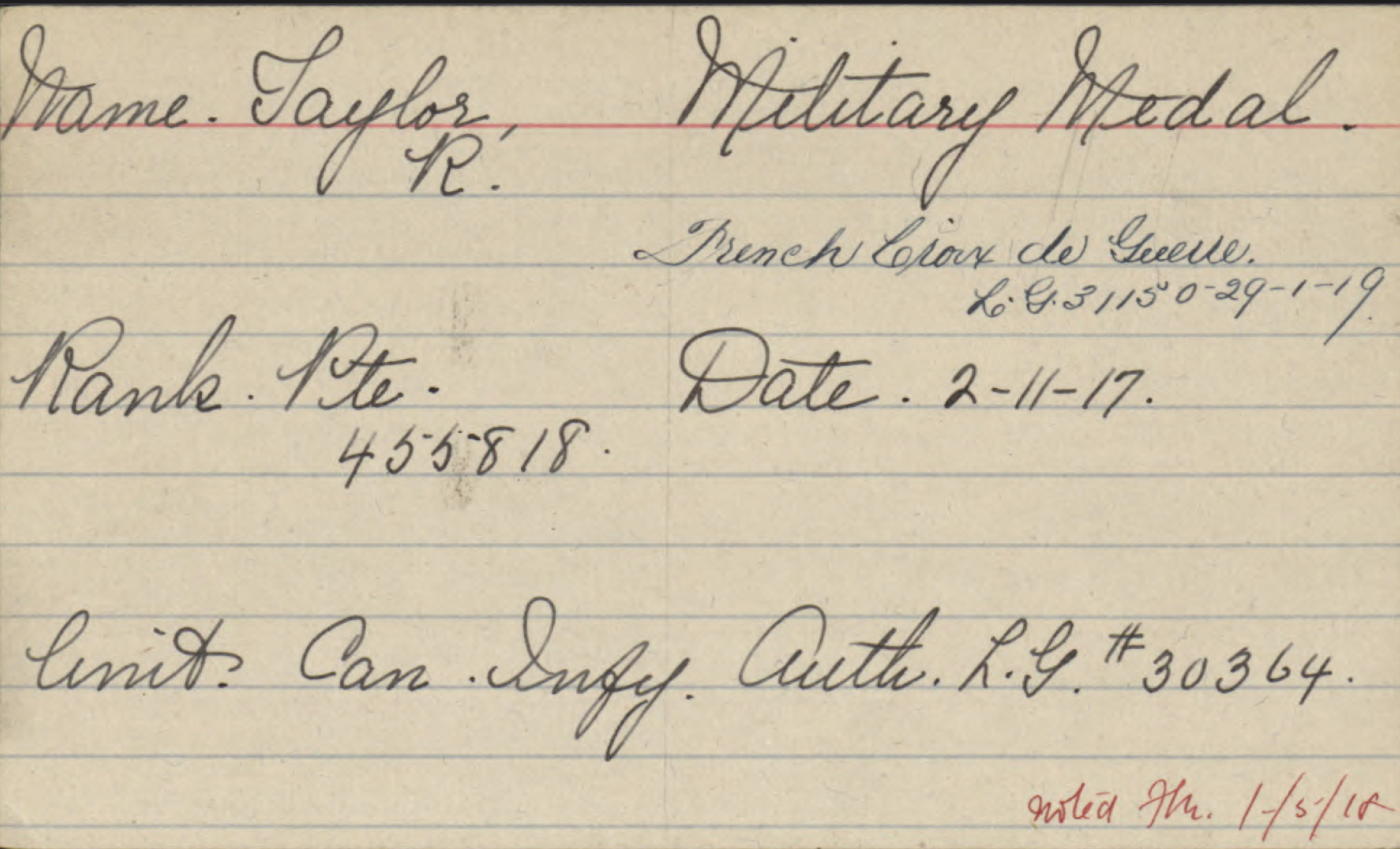
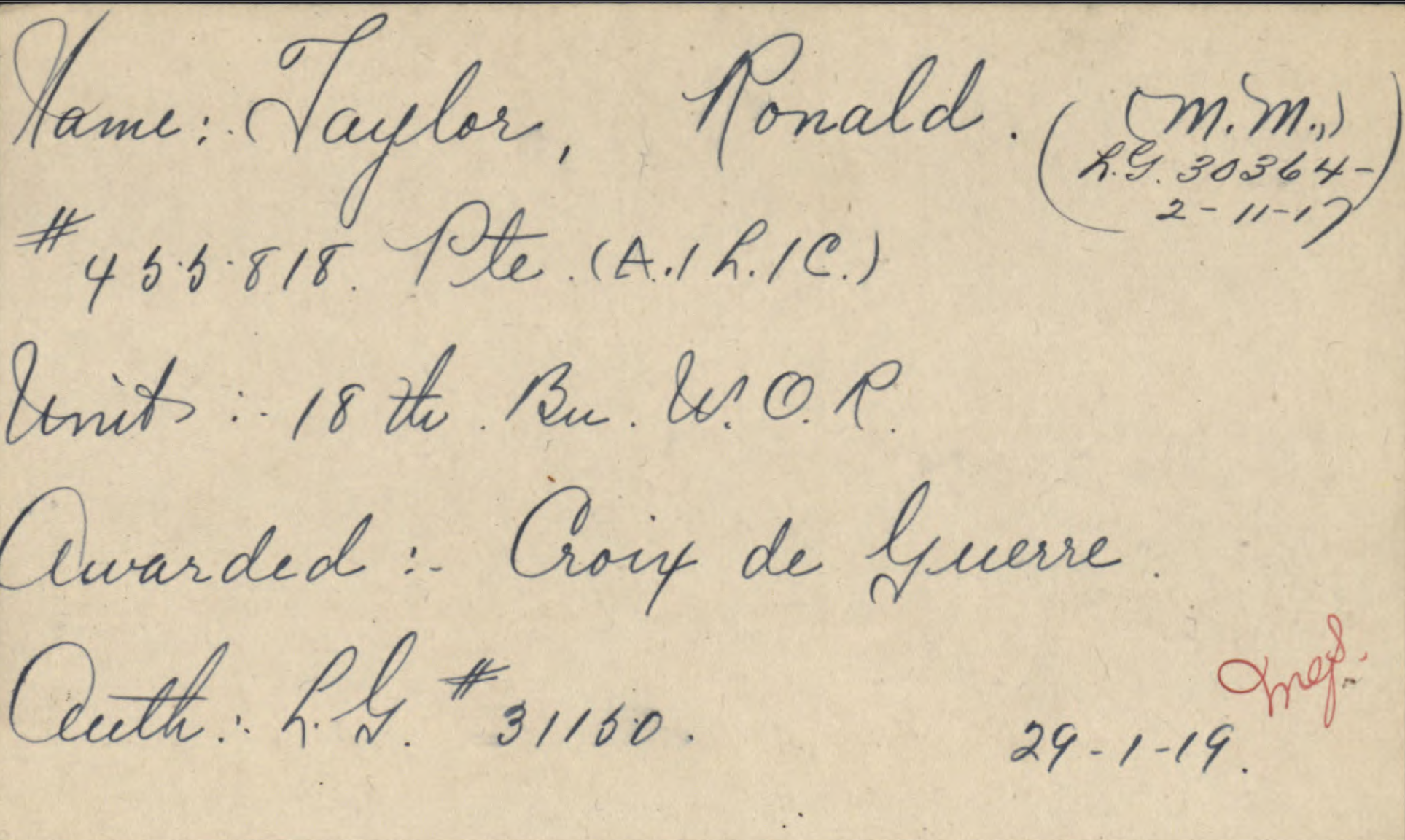
Military Medal, Croix De Guerre (France)
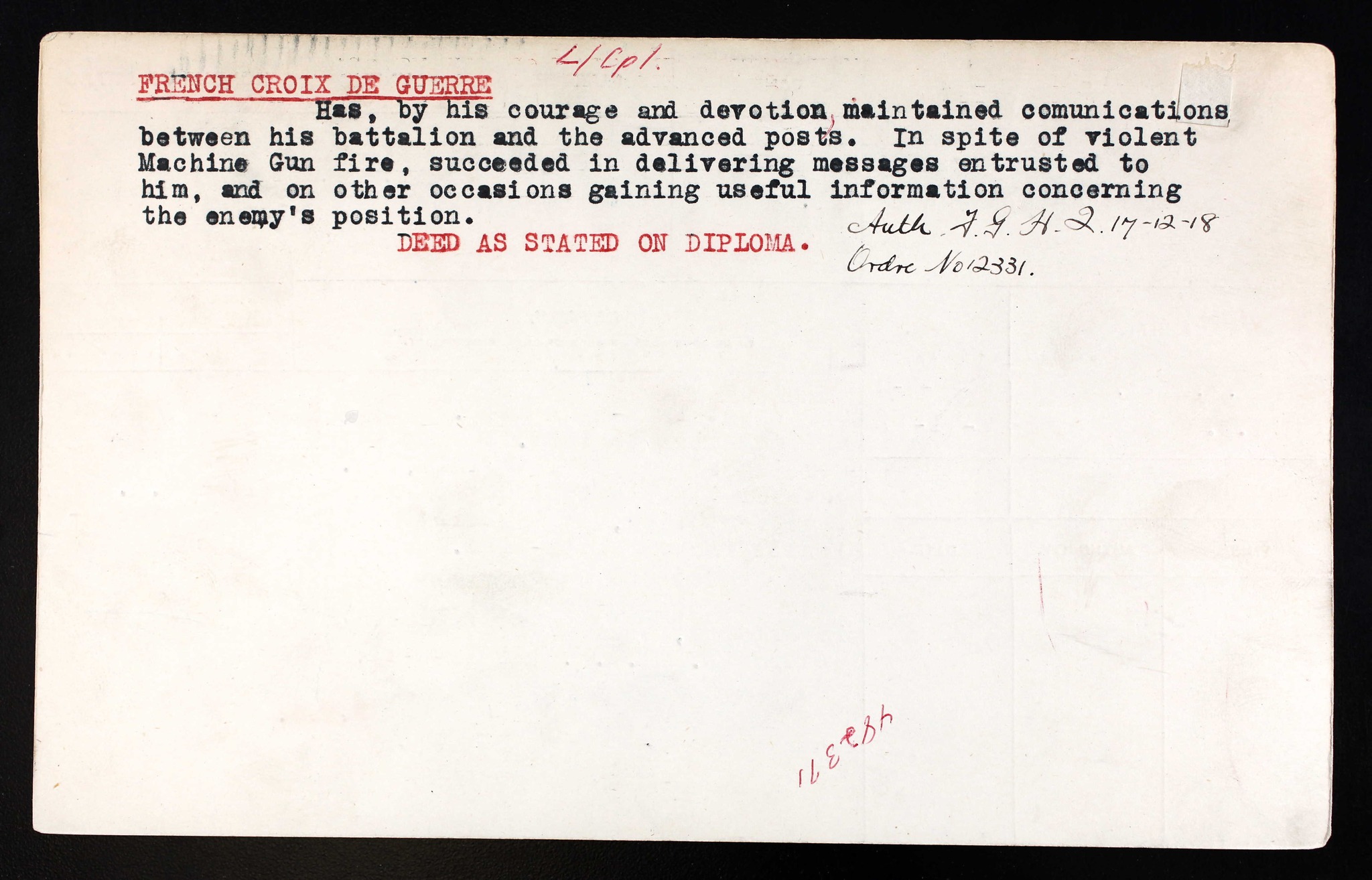
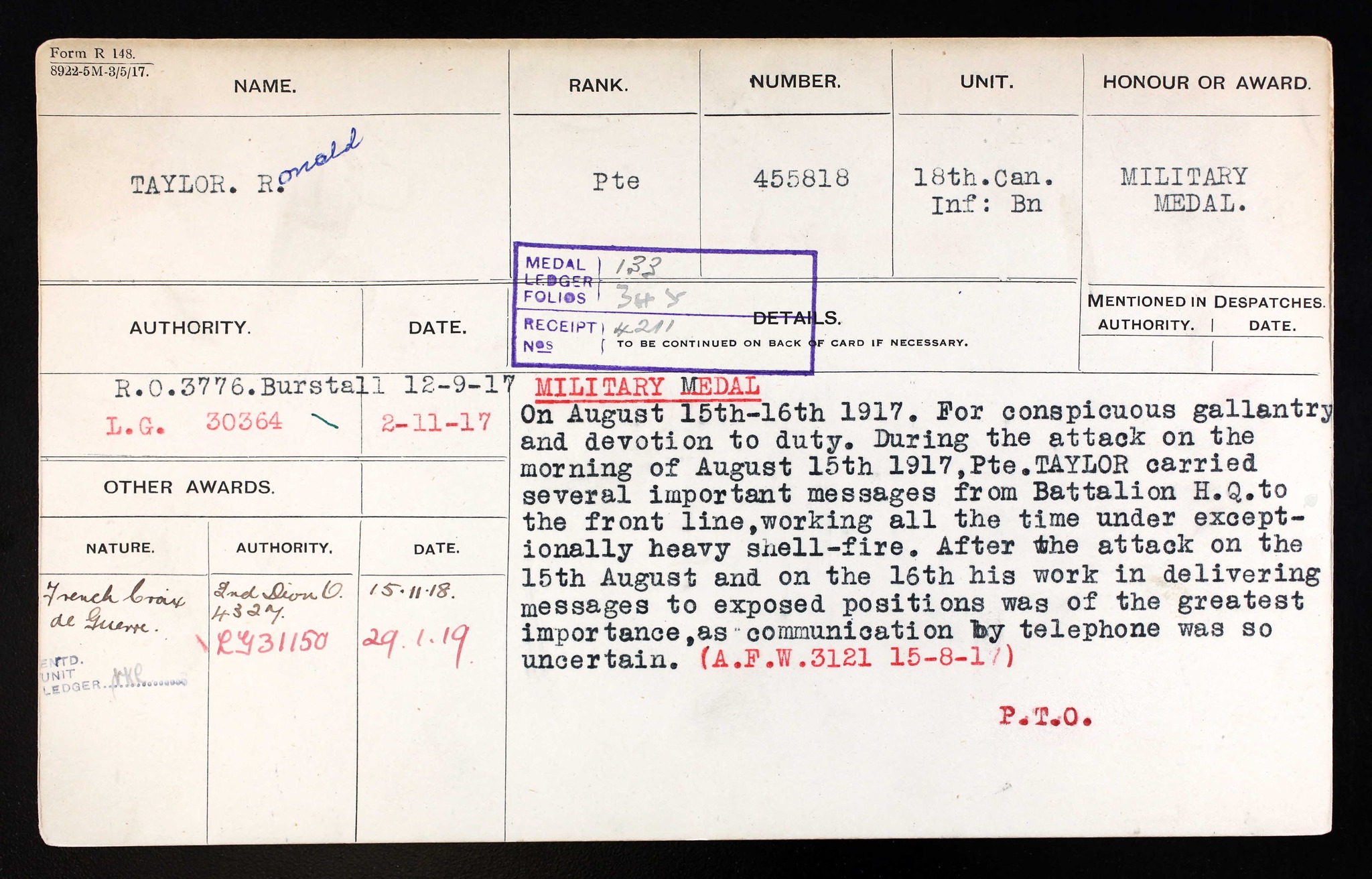
Military Medal Citation
NAME: TAYLOR, Ronald
RANK: Pte
NUMBER: 455818
UNIT: 18th.Can. Inf: Bn
HONOUR OR AWARD: MILITARY MEDAL
AUTHORITY: R.O.3776. Burstall 12-9-17 DATE: DETAILS: MILITARY MEDAL
MENTIONED IN DESPATCHES: AUTHORITY: DATE:
OTHER AWARDS: NATURE: French Croix de Guerre AUTHORITY: 2nd Div. Ord. DATE: 15-11-18. AUTHORITY: 2931150 DATE: 29.1.19
DETAILS: On August 15th-16th 1917. For conspicuous gallantry and devotion to duty. After the attack on the morning of August 15th 1917, Pte. TAYLOR carried several important messages from Battalion H.Q. to the front line, working all the time under exceptionally heavy shell-fire. After the attack on the 15th August and on the 16th his work in delivering messages to exposed positions was of the greatest importance, as communication by telephone was so uncertain. (A.F.W.3121 15-8-17)
There’s also a purple stamp with some handwritten details that are a bit difficult to read clearly, but it seems to say:
MEDAL: 133 LEDGER: FOLIO: 304 RECEIPT: 4241 NOS:
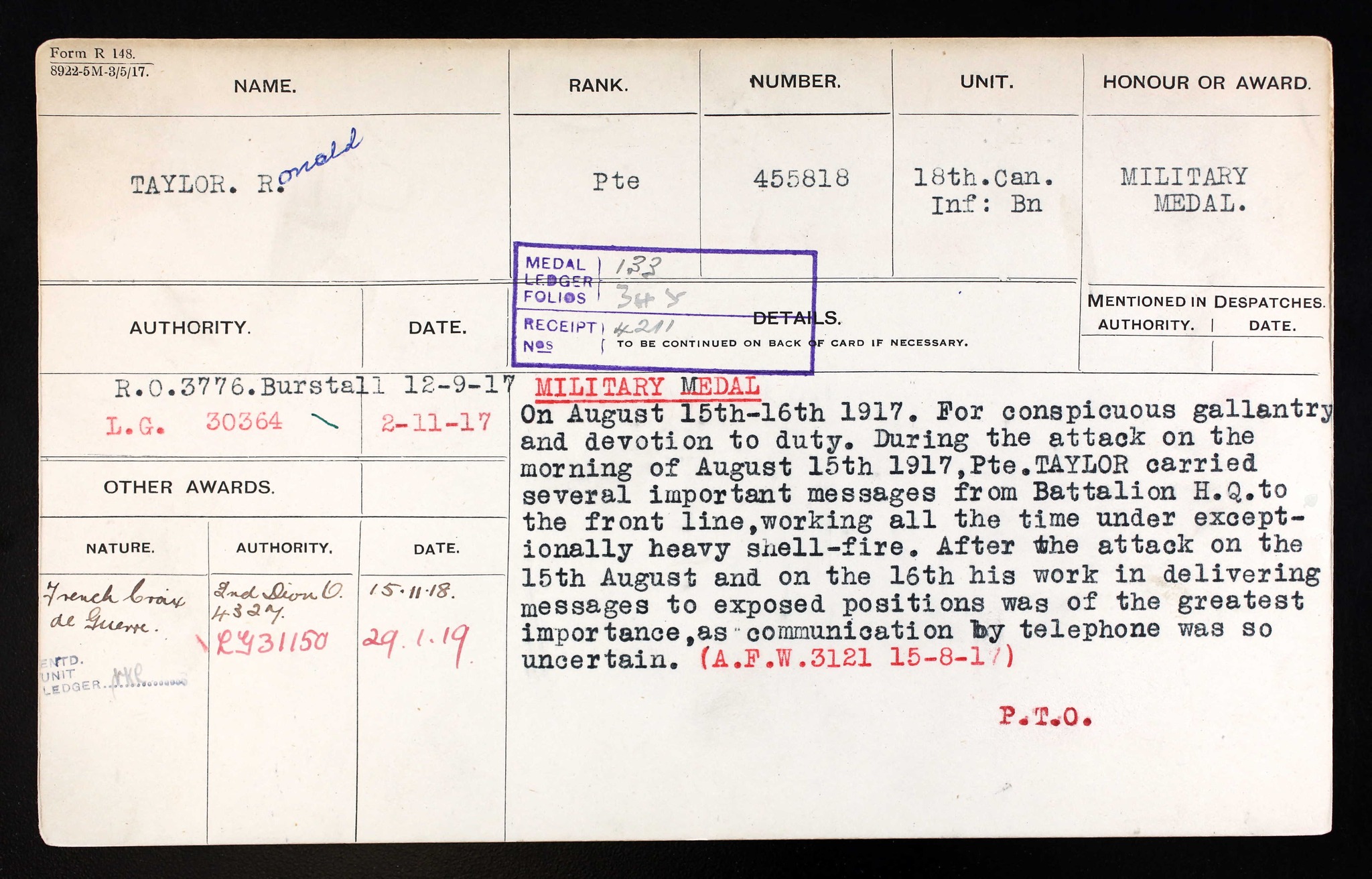
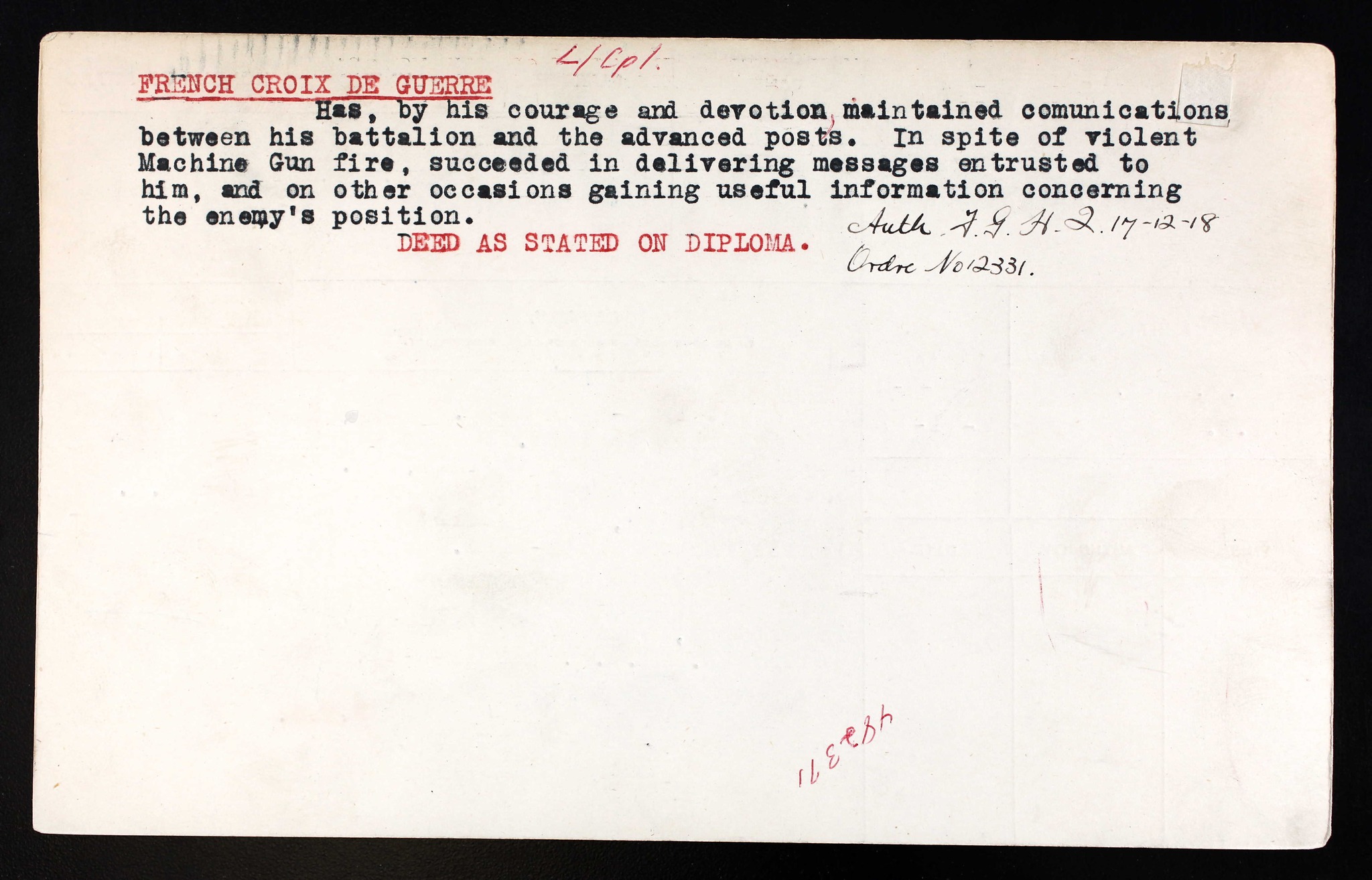
FRENCH CROIX DE GUERRE
Has, by his courage and devotion maintained communications between his battalion and the advanced posts. In spite of violent Machine Gun fire, succeeded in delivering messages entrusted to him, and on other occasions gaining useful information concerning the enemy’s position.
DEED AS STATED ON DIPLOMA.
Auth. 2.9.A. 2.17-12-18 Ordre No. 2731.
War Diary Entry for 15 August 1917
“C” and “D” Coys moved into their assembly positions along the outpost line. “A” & “B” Coys came into support. “A” coy with one platoon at N.7.c.1.4. and two platoons at approximately M.12.b.3.0.
At 4.25 a.m. the 18th Battalion in conjunction with other Units of the 1st, and 2nd Canadian Divisions attacked the enemy lines from N.13.a.9.6. to N.7.70.15. the object being to capture and consolidate the enemy support line (CHICORY TRENCH) from N.14.a.05.55. to N.13.b.60.0. thence Westerly to N.13.b.05.35. The attack was entirely successful and 26 minutes after zero hour (4.25 a.m.) we occupied our objectives, capturing some 65 prisoners (165 P.I.R.).
Lieuts. C.H. Biscoe and L.A. Bissell being wounded just as we reached the enemy front lines.
On the right by arrangement with the 21st Canadian Battalion we held CHICORY TRENCH up to N.14.c.15.65. and on the left pushed our posts forward to N.13.b.0.15. and controlled the railway cutting. Consolidation was rapidly proceeded with. At. 2.30 p.m. the enemy made a very strong bombing attack on the left of our Battalion and the right of the 21st Battalion and succeeded in entering a portion of our newly won trenches. During this enemy counter attack Lieut. A.A. McLean was killed. He had gathered a few men together and was leading up the LENS-BETHUNE road to give what assistance he could and was shot by an enemy sniper and instantly killed.
As soon as the attack had gone forward, Lieut. T.R. Dougall and some men of the Scout Section started forward to make a reconnaissance patrol and to exploit success, they were held up for an hour by an enemy plane firing on them from immediately overhead. When the patrol reached the captured enemy position, it went forward approximately 300 yds from our newly won position.
Lieut. DOUGALL returned with some valuable information as to the enemy position and defences, as well as a complete Minewerfer [minenwerfer] crew of 20 men as prisoners.
Three platoons of the support Coys were sent up to reinforce “D” Coy. Lieut. J.M. Fisher with great judgement and coolness, prepared his counter attack in conjunction with the 21st Battalion.
The counter attack was launched at 5 p.m. with the assistance of the artillery and the lost trenches were easily regained. 10 prisoners were captured.
A/Capt. M. Dunsford.
This officer very gallantly led his men to the attack, and, although severely wounded shortly after entering the enemy front line trenches, he continued to encourage his men by his personal example. By his intimate knowledge of the situation he was able, although incapacitated himself, to direct his men until the objective was reached, refusing to be carried out until the more serious cases had been evacuated.
Lieut. G.G. Brachin [Brackin] arrived as reinforcement.
Night of 15tH
Upon Captain Dunsford being wounded, Lieut. H.B. Johnson took over command of the company. At night there were not attacks or counter-attacks, but enemy artillery was exceptionally heavy on all parts of our sector.
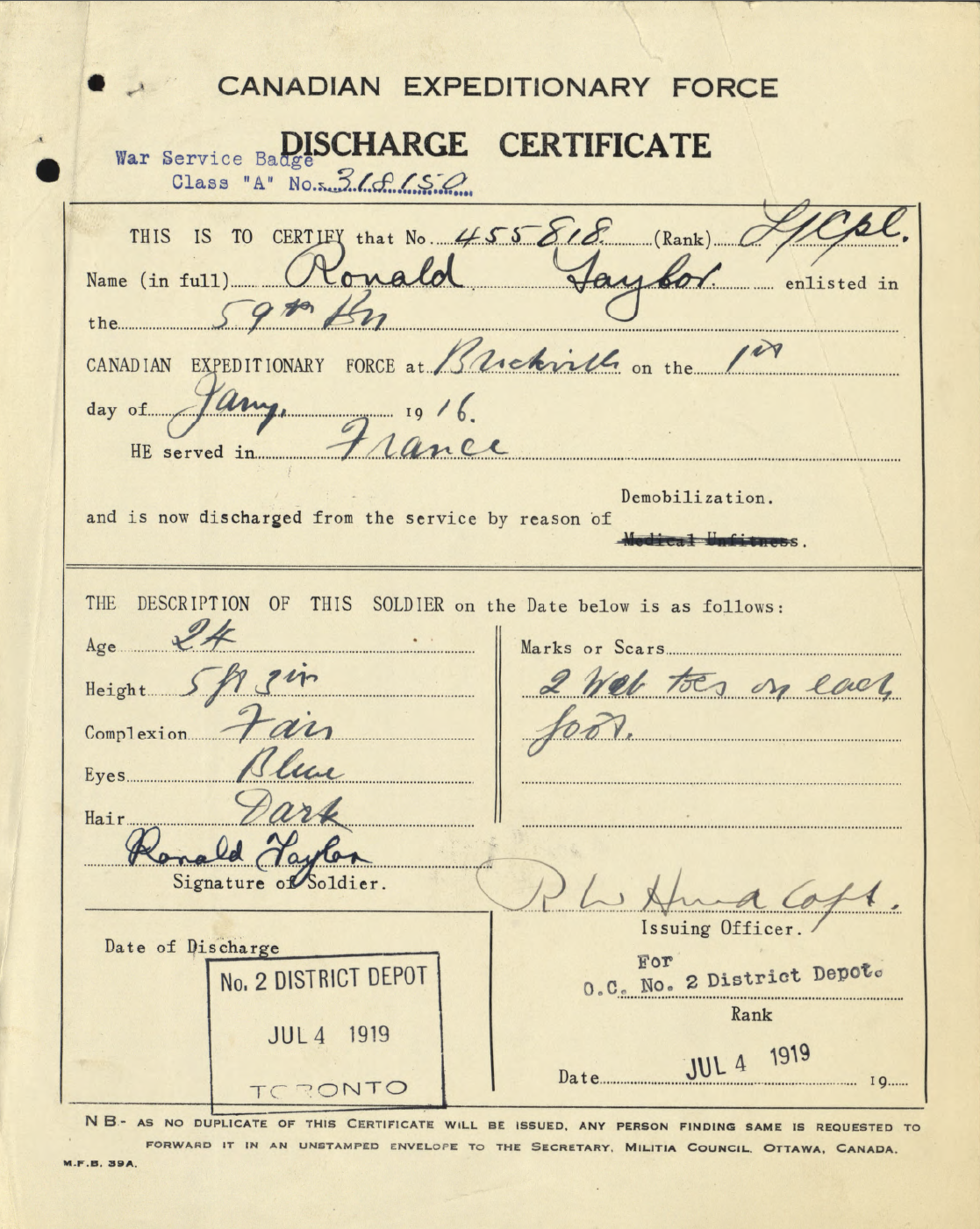
Lance-Corporal Ronald Taylor, reg. no. 455818.
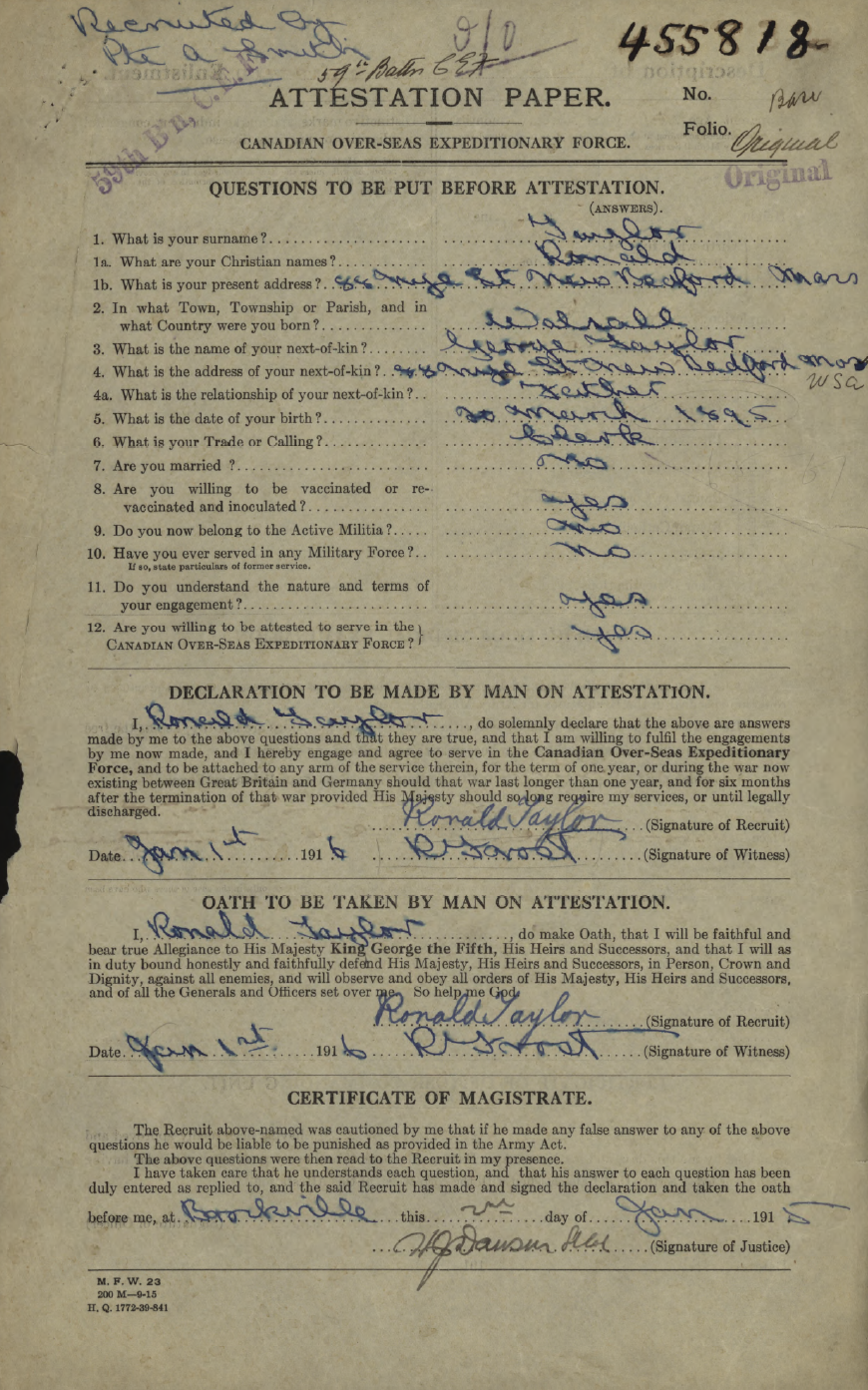
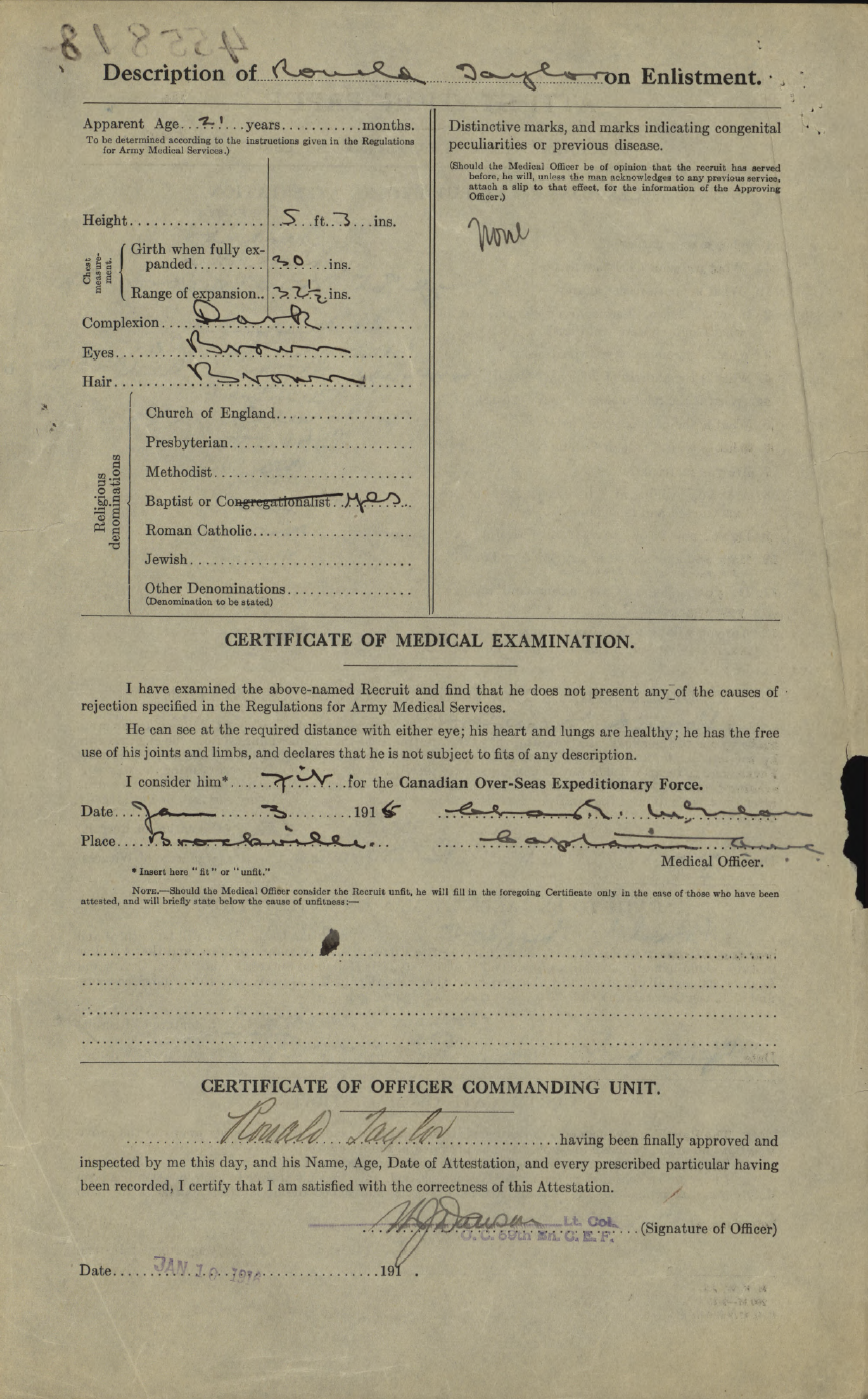
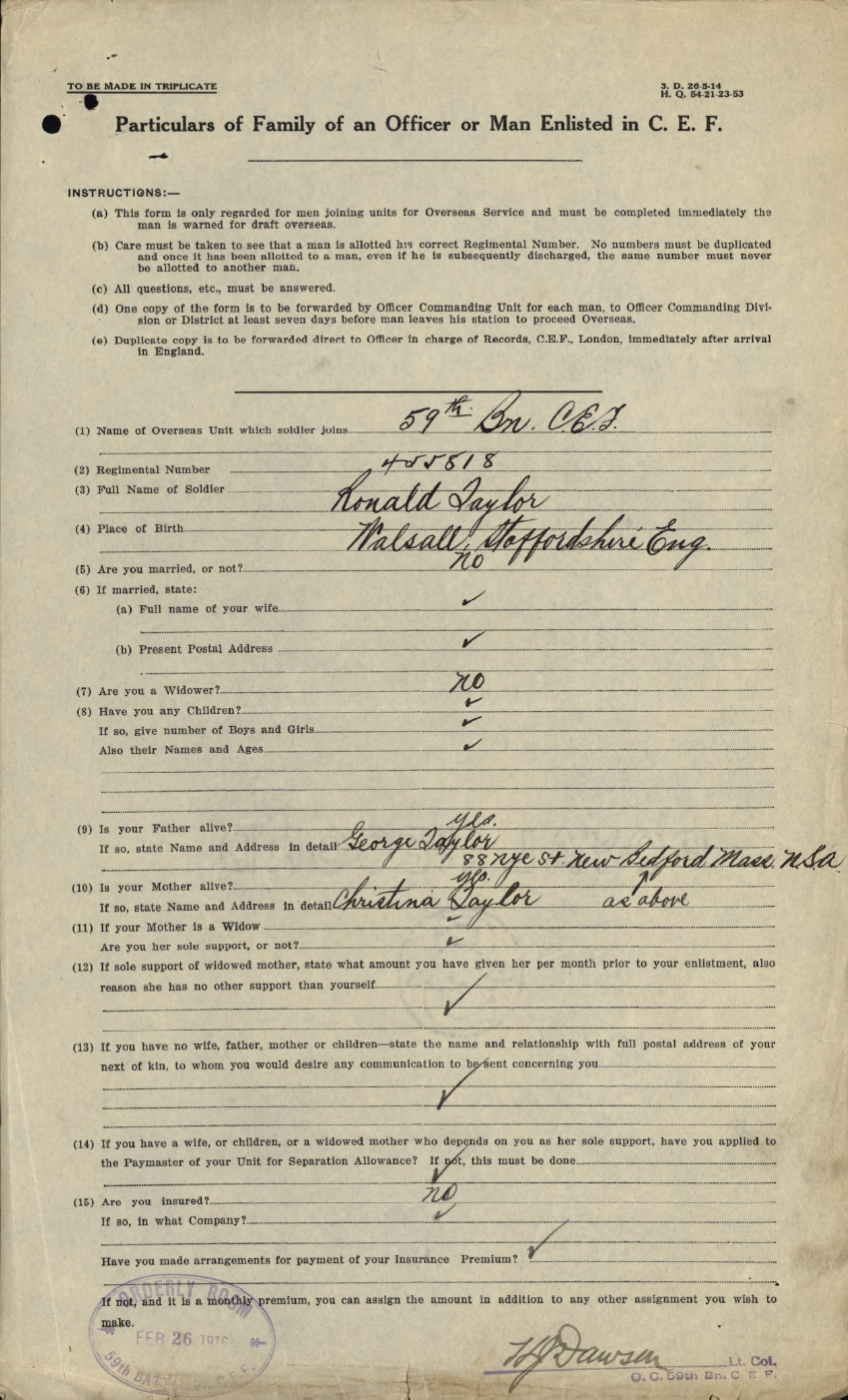
This man was enlisted with the 59th Battalion CEF at Brockville, Ontario on 11 January 1916.
He was a clerk and followed the Baptist faith.
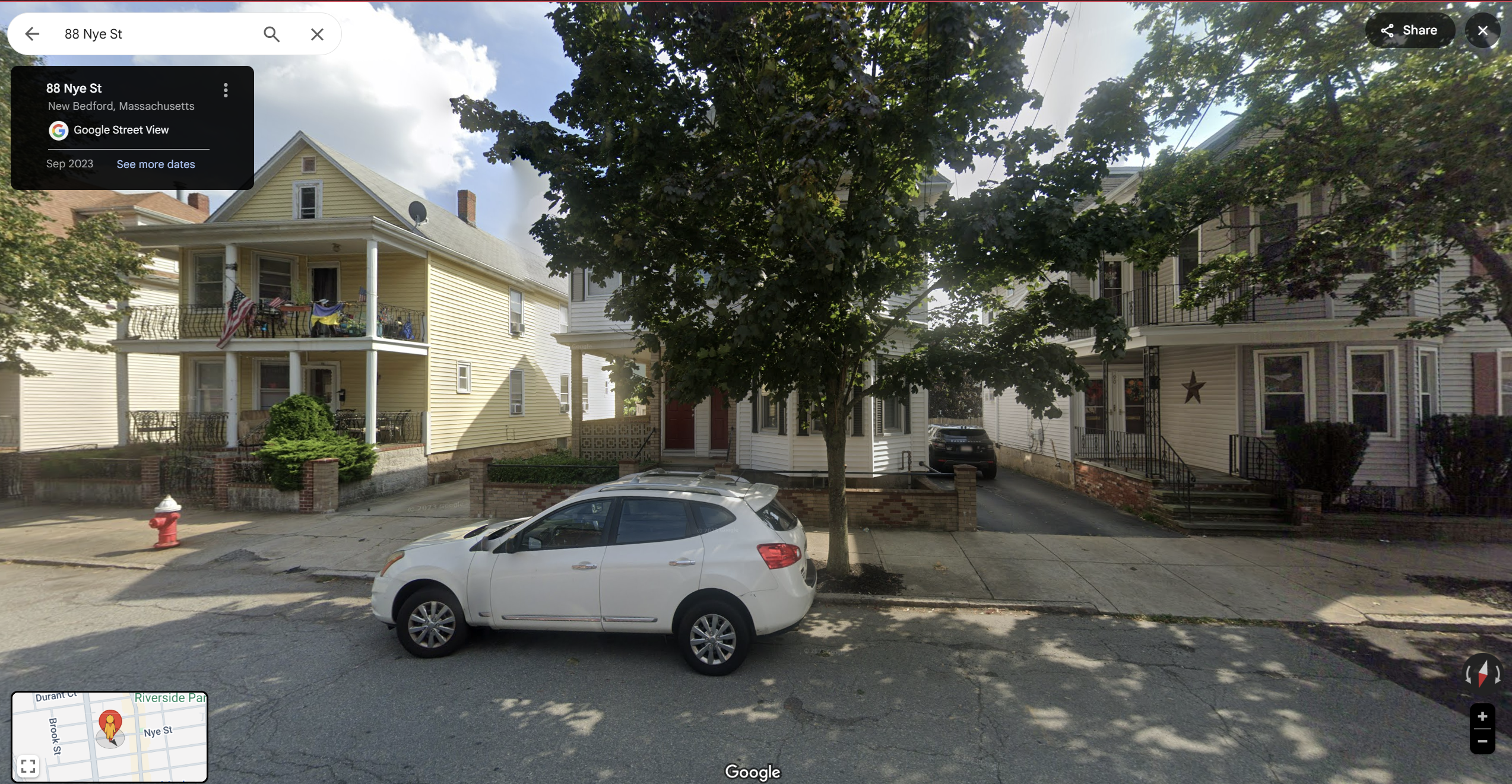
He was single and listed his father Mr. George Taylor of Bedford Massachusetts, as his next-of-kin. He had no prior military experience.
He arrived in England on 11 April 1916 and was drafted to the 18th Battalion on 6 June 1916 arriving for service 2 days later.
He had a series of ailments which had him in hospital off and on from lates August 1916 and later in January 1917, and again in August 1917.
He was awarded the Military Medal and his citation reads:
“On August 15th-16th 1917. For conspicuous gallantry and devotion to duty. During the attack on the morning of August 15th 1917, Pte. TAYLOR carried several important messages from Battalion H.Q. to the front line, working all the time under exceptionally heavy shell-fire. After the attack on the 15th August and on the 16th his work in delivering messages to exposed positions was of the greatest importance, as communication by telephone was so uncertain. (A.F.W.3121 15-8-17)”
He was appointed a Lance-Corporal on 30 December 1917.
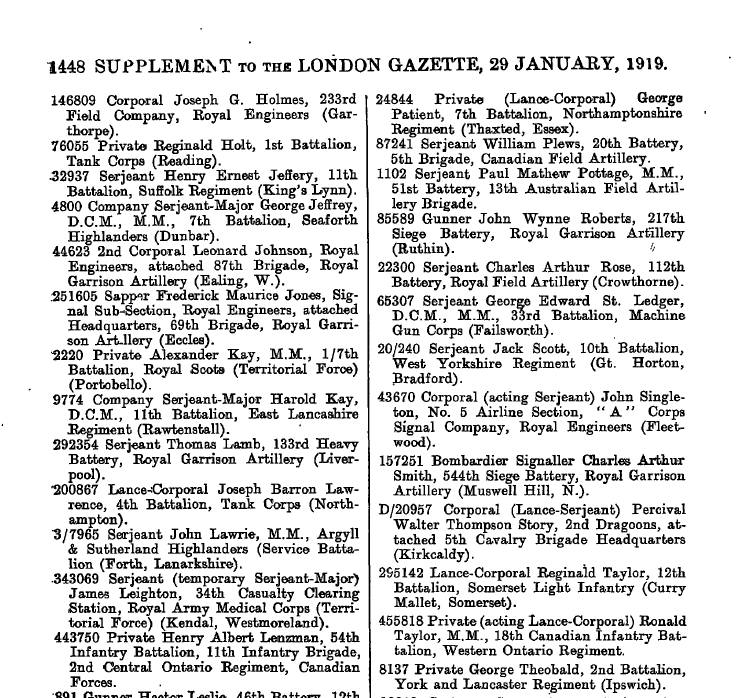
He was awarded the French Coix De Guerre at Rouen, France on 29 January 1919.
Returning to England he was returned to Canada on 23 June 1919.
He was discharged due to demobilization at Toronto, Ontario on 4 July 1919.
He was living in Bedford, Mass in 1922.
 History of the 18th Battalion CEF, "The Fighting Eighteenth"