
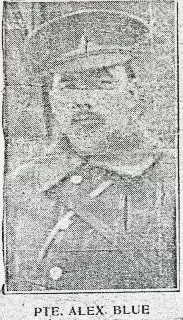
Private Alexander Edward Blue of Paisley, Ontario joined the 18th Battalion at it’s inception. On October 27, 1914 he enlisted and began his journey to war. He would become wounded on June 29, 1916, 612 days into his service with the Canadian Expeditionary Force. His war experience is offered in digital format which allows us to see a bit more of the man that joined to serve on that fall day in Walkerton, Ontario.
His service record offers another insight.
Many of the medical notes in the service records are written out in long-had cursive using grey lead pencil on a grey coloured paper. Invariably these note are nigh unto very difficult to read[i]. But, in the case of Private Blue, we have a fascinating medical note from his wounding during his service. He was wounded in the chest and after being evacuated from the front line his thread of treatment began until his eventual release back to active service in June, 1917. It is fascinating as it overviews the wound, its condition, is legible, and offers a hand-drawn sketch of the wound.
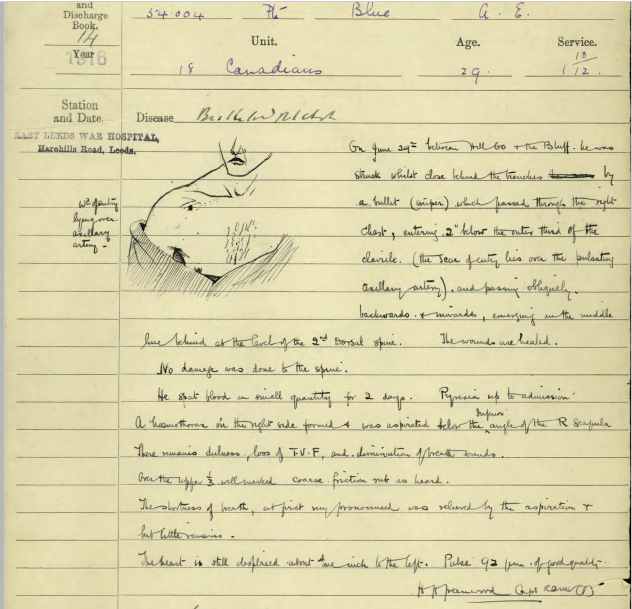
The notes are made at the East Leeds War Hospital[ii], Harehills Road, Leeds. The of the notes are from at, or about, July 28, 1916 and read as follows:
Disease: Bullet [Wound]
On June 29th between Hill 60 and The Bluff he was struck whilst close behind the trenches by a bullet (sniper) which passed through the right chest, entering 2” below the outer third of the clavicle (the [tear] of entry is over the pulsating axillary artery) and passing obliquely backwards and downwards, emerging in the middle line behind at the level of the 2nd dorsal spine[iii]. The wounds are healed.
No damage was done to the spine.
He spat blood in small quantity for 2 days. Pyrexia[iv] up to admission. A pneumothorax[v] on the right side formed and was aspirated below the inferior angled of the R[ight] scapula. There remains dullness, loss of T.V.F[vi]., and diminution of breath sounds.
Over the upper 1/3 well marked coarse friction [rub] is heard.
The shortness of breath, at first very pronounced was relieved by the aspiration + but little remains.
The heart is still displaced about one inch to the left. Pulse 92 [firm], of good quality.
[Signed] H.H. Illegible, Capt. R.A.M.C.
There is an attached hand-drawn diagram showing a dot here the bullet entry point is, then, very lightly one can discern a double row of dots, probably outlining the location of the axillary artery, with the solid lines outlining the bone structure in the area of the wound.

The drawing is further interesting as it may be an actual representation of Private Blue’s physical make up. The subject of the drawing has a mustache and chest hair and it could be surmised that the doctor drawing the subject of the diagram would represent that person accurately. There would be no reason to add those details in the drawing if they were not actually there.
There is a small annotation to the left of the drawing and it appears to say: “wa of entry lying over axillary artery”

On August 15, 1916 a radiographic report was made to confirm the displacement of the heart. The form shows us that Private Blue was located at Killingbeck, in ward K26, bed 5 as of August 3, 1916. The report has a brief description of the case and Captain. L. Rowden, R.A.M.C. indicates: “X ray appearances of chest – normal. Heart now not displaced.”
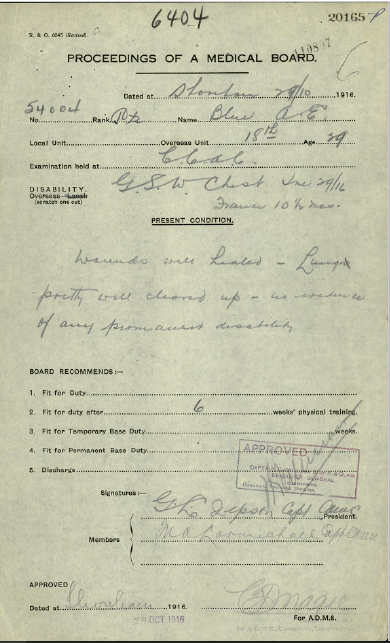
With the wounds healed and his heart now not displaced Private Blue convalesced until October 29, 1916 where he was declared fit for service after 6 weeks training by a C.C.A.C. medical board in Shoreham. The notes read: “Wounds well healed – Lungs pretty much cleaned up – no evidence of any permanent disability.”
With that, Private Blue was put back into the organization of the Canadian Army to be processed, retrained, and rehabilitated to the point where he could fight once again. The 6 weeks actually ended up being much longer, 32 weeks and 6 days until he was to rejoin the 18th Battalion. It is not clear as to the reason for the delay in returning to his unit. On November 1, 1916 he was assigned to Command Deport for 6 weeks and then served with the 4th Reserve Battalion in West Sandling from early February to May 1917 where he was detached to Etaples, France before he rejoined his unit. It is not clear from his service record why the discrepancy of time estimated by the medical board or 6 weeks translated into almost 33 weeks.
He served with the 18th Battalion and had other medical issues until the process of demobilization took hold and was to come back to Canada aboard the S.S. Adriatic landing in Halifax, Nova Scotia September 10, 1919, a full 1,780 days after he enlisted.


[i] This aspect of research is extremely frustrating.
[ii] The East Leeds War Hospital is now the Thackary Medical Museum.
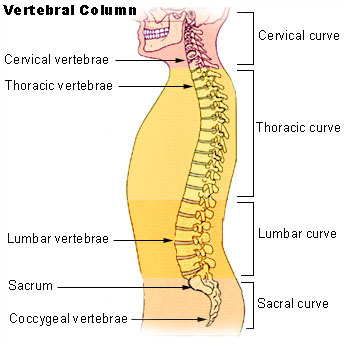
[iii] The term, dorsal spine, appears to be outmoded and replaced today by the term thoracic spine. It is the largest section of the spine and the exit wound would be at almost the same level of entry wound. The exit wound may have been very small as there appears to be no mention of it during the medical reports.
[iv] Increase of body temperature, possibly a fever.
[vi] Possibly are reference to tactile vocal fremitus. Indicates denser or inflamed lung tissue relating to the affects of pneumonia.
Discover more from History of the 18th Battalion CEF, "The Fighting Eighteenth"
Subscribe to get the latest posts sent to your email.
 History of the 18th Battalion CEF, "The Fighting Eighteenth"
Leave a comment