November 2, 1914…
The Berlin News Record, of the named city of Berlin (now Kitchener) Ontario, headline proclaims:

For, on 29 October 1914 the Turkish Fleet bombards Russian bases in Sevastopol, Feodosia, Yalta, Odessa and Novorossiysk and from that operation Russia declared war on Turkey effective 2 November 1914.[i]
With the Great War expanding and another enemy to fight, extending the geographic scope of this conflict to include the Middle East, it was evident that this war would not be over soon.
Perhaps this news spurred the efforts of Frank Oraszek to volunteer with the 18th Battalion on this day. but it was more likely that he wanted to join as his friends did, as reported in the same paper on the front page,
“Four More Boys Off to London
Messrs. William Sargent, George Allward[ii], John Neely[iii], and John Gerbig left this morning at 11:30 o’clock for London where they join the 18th Battalion for service at the front.
They will be joined tomorrow by Frank Oraszek, a former member of No. 6 Co., 29th Regiment.
Mayor Euler has presented these five men with a $10 gold piece which was much appreciated by the men.”[iv]

From the men’s attestation papers both Gerbig and Oraszek were “linemen” working as electricians for a business/manufactory or a local electrical utility and no man, save Oraszek, attested to having any military experience.
This motivation to join the Canadian Expeditionary Force is enhanced by the fact the Oraszek was of Polish descent. Though born in Detroit, Michigan with his family originally immigrating to the United States in 1882 the census data for the family shows that they identified as Polish, though the patriarch of the family, Andrew[v], was born in Eastern Prussia, then part of the German Empire.
Motivated by his Polish heritage and the fact that a fellow linesman enlisted Oraszek enlisted in Galt, Ontario on the 2nd of November 1914 just as the news clipping reported.
Private Oraszek of “D” Company arrived in the front lines near Wulvergem with the 18th Battalion and saw active service.
He was not a model soldier, being cited for being Absent Without Leave (AWL) in January 1915 and then several other infractions while he was training in West Sandling with two incidents record of him being AWL. Once overseas he was subject to 1 days of Field Punishment No. 1 on the 6th and 9th December 1915 for “Refusing to obey an order and obscene language to N.C.O.”[vi] He then ran foul of military justice on 16 January 1916 when he was subject to 28 days of Field Punishment No. 1 for “(1) Absent for guard; (2) Drunk on Active Service.”
There may have been a good reason for Private Oraszek’s resistance to military authority for on the second account for, on 20 December 1915 his friend, Private Gerbig, was killed in action being struck in the head with two machine gun bullets.
He felt so strongly about the importance of military service he wrote a letter to his mother expressing his sentiments and of the circumstances of his friend’s death,
“We Need All The Fellows We Can Get Here
The following letter was received a few days ago by his mother, from Pte. Frank Oraszek, who is on active service at the front:
Belgium, Jan. 4, 1915.
Dear Mother:
I got your letter O.K. and was glad to hear from you.
Well, we had a very quiet time on Christmas and New Years. We were in reserve trenches on Christmas, but there was no shooting.
I got your parcel and thanks very much. I was glad to get the parcel for we only had soup, and poor soup at that, for dinner.
New Year’s Day I was out for a good time with Ben Bayliss and his brother[vii]. We got a pass and went all around the country to the different little towns.
Say, Jack Gerbig was killed. Shot through the head; died instantly. Also another Berlin fellow.
Tell all those young fellows around there to enlist for we need every man we can get.
Best regards to all. I have not many things to write about as news is scarce.
Wishing you all a happy and prosperous new year. I remain,
Your loving son,
Frank.”[viii]

Private Oraszek suffered his field punishment and he had lost at least one friend to until he had enough. On 11 May 1916, just after the poorly executed operation at the St. Elois Craters in April 1916, he was sent to No.4 and then No. 5 Canadian Field Ambulance for “Shell Shock” returning for duty ten-days later. He would have a recurrence of “Shell Shock” on 7 June 1916 which took him out of the line for six-days.
The Berlin News Record reported his wounding,
“Another Berlin Boy Wounded
Another Berlin boy is reported wounded namely Pte. Frank Oraszek. The intelligence was received in the following telegram to his mother:
Mrs. Margaret Oraszek,
115 Strange St.,
Berlin.
Sincerely regret to inform you 53949 Pte. Frank Oraszek infantry officially reported admitted to No. 5 Field Ambulance May 11th shell shock. Will send further particulars when received.
Officer I-C Records Office”[ix]
The year of 1916 was not at all kind to Private Oraszek because he was to suffer a sever Gunshot Wound (GSW) to his back on 16 September 1916 during the Battle of Flers-Courcelette which required treatment in England as it is recorded he was sent by the Hospital Ship Jan Breydel.
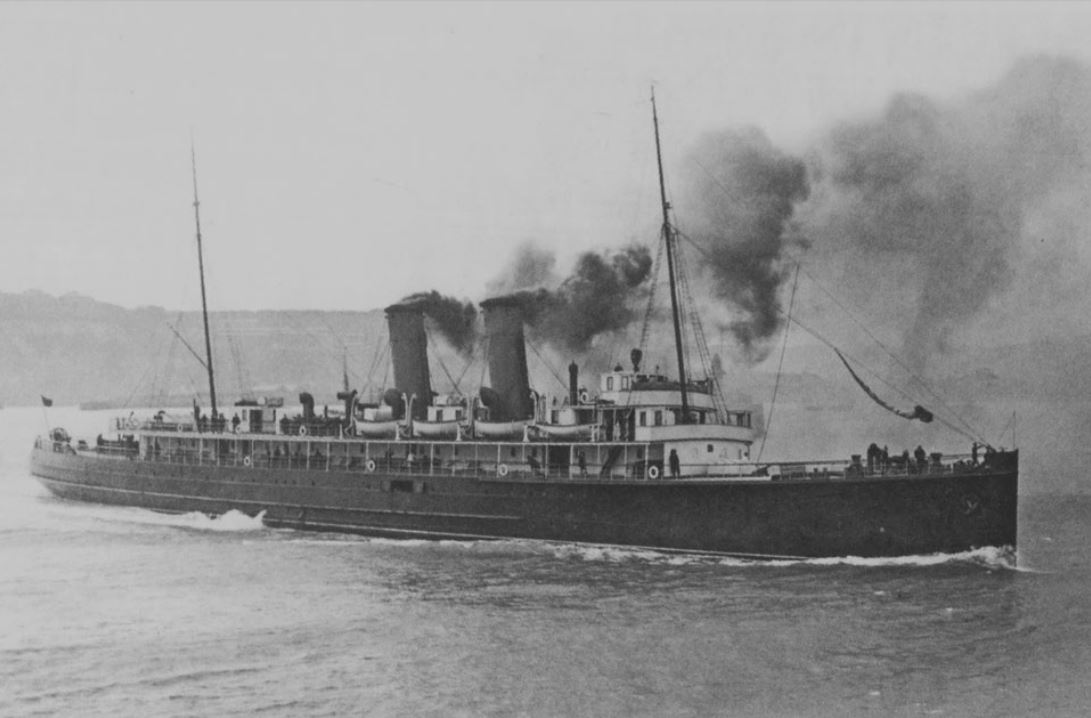
Having recovered enough to leave hospital he was discharged to the Canadian Casualty Depot on 31 January 1917 and it was not until recuperating in England for almost 11-months was he returned to active combat duty on 11 December 1917.
His health and well-being was again threatened when he was wounded on 18 June 1918 with an incise wound to the left leg. It was not serious enough to require transport to “Blighty” and after treatment at several Canadian Field Ambulance he was returned to service “in the field” on 1 July 1918 when the 18th Battalion was based at Lattre-Saint-Quentin. He probably missed the chance to experience the Dominion Day Sports Day as the 18th Battalion War Diary records that 4 officers and 150 men, about a quarter of the Battalion, attended this event leaving their billets at 07:45 AM and returning “about 7:00 PM”. The War Diary does record on other rank (OR) returning from hospital. This is Private Oraszek.
Private Oraszek’s war experience until his demobilization is awarded with a 14-day leave to England starting on 18 November 1918, perfectly timed to allow him to celebrate the new peace and his survival. It appears his leave was extended as he is recorded having returned on 10 December 1918, but there is a good chance that the “extension” was the time required for him to transit from England to the 18th Battalion’s occupation duty station at Allner, Germany. The 18th Battalion moved daily from 5 to 14 December when it finally arrived at Allner.[x]
On 24 May 1919 Private Oraszek becomes a civilian and returns to the town now called Kitchener to continue his life. He takes a job as a shipper at Dominion Tire and lives at 1 Oak Street with his family until his death on 18 August 1930 due to acute indigestion attributed to heart disease. He did not suffer long as his death certificate records he died “suddenly” at the residence of his brother-in-law, John White.
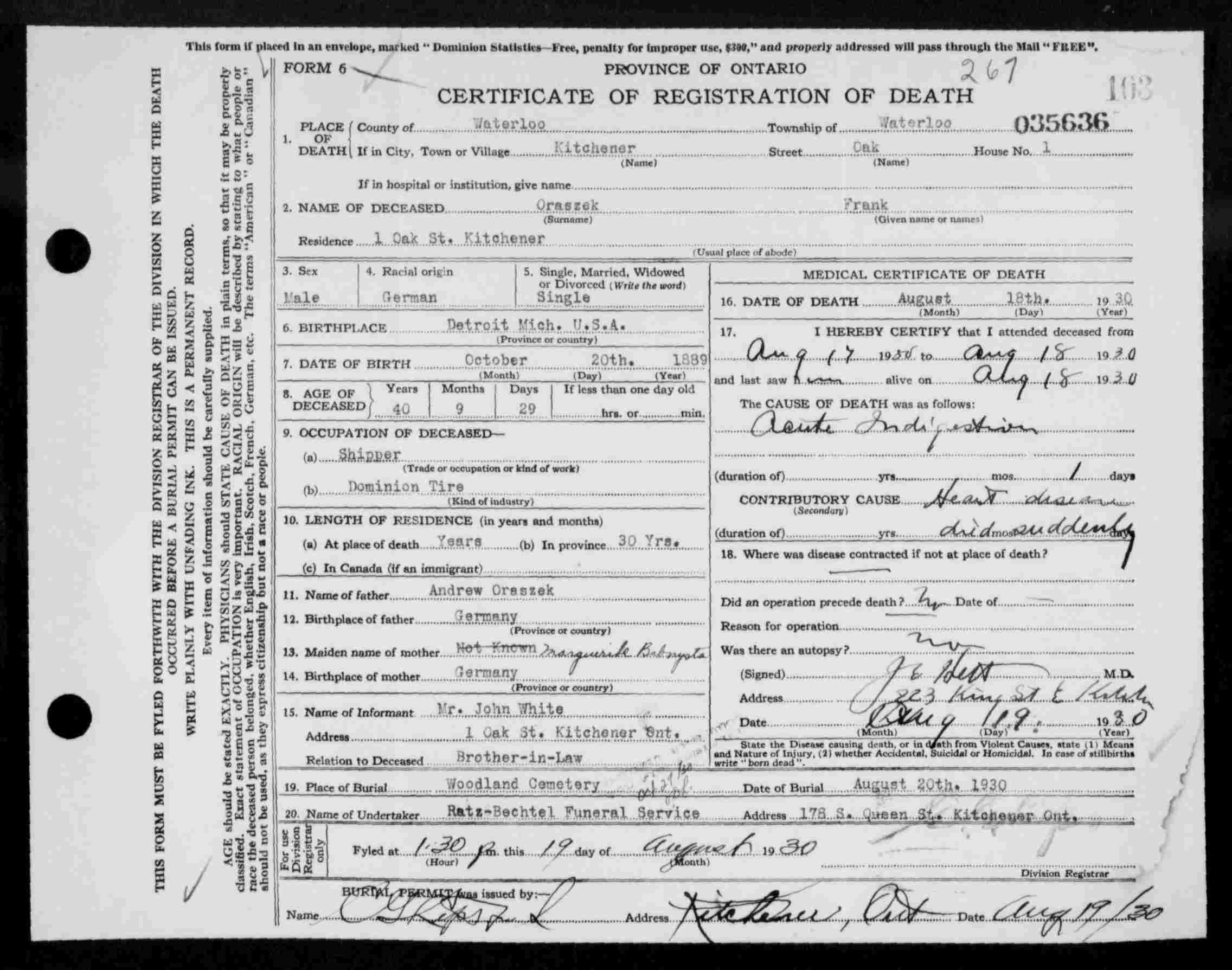
He rests in peace at Woodland Cemetery in Kitchener, Ontario.
[i] Turkey in the First World War. Dr. Altay Atl (n.d.). Chronology. Turkey in the First World War. https://turkeyswar.com/home/chronology/
[ii] There is no record of this man enlisting. His name was also spelled as ‘Alward’ in another article dates 20 October 1914 in the Berlin News Record. It appears he was born in 1872 and he could have been rejected for being over age.
[iii] This man enlisted with the 18th Battalion on the 27th of October 1914 at Galt, Ontario. He was sent to London, Ontario to train and was released from service as “Medically Unfit” on 13 March 1915 just before the 18th Battalion left for England. His regimental number is 53946.
[iv] (1916, November 2). Four More Boys Off to London. Berlin News Record, 1. https://www.newspapers.com/image/990524745/
[v] Andrew Oraszek, born 1846. Died 1909.
[vi] Service File for Private Oraszek, Frank reg. No. 53949 (p. 67). Government of Canada. http://central.bac-lac.gc.ca/.redirect?app=pffww&id=548419&lang=eng
[vii] Private George Edward Bayliss, reg. no. 57576 served with the 20th Battalion, which was a sister battalion to the 18th as both were members of the 4 Canadian Infantry Brigade.
[viii] (1916, January 29). “We Need All The Fellows We Can Get Here”. Belin News Record, 2.
[ix] (1916, June 1). Another Berlin Boy Wounded. Belin News Record, 1.
[x] See War Diary, December 1918.
Discover more from History of the 18th Battalion CEF, "The Fighting Eighteenth"
Subscribe to get the latest posts sent to your email.
 History of the 18th Battalion CEF, "The Fighting Eighteenth"
Leave a comment