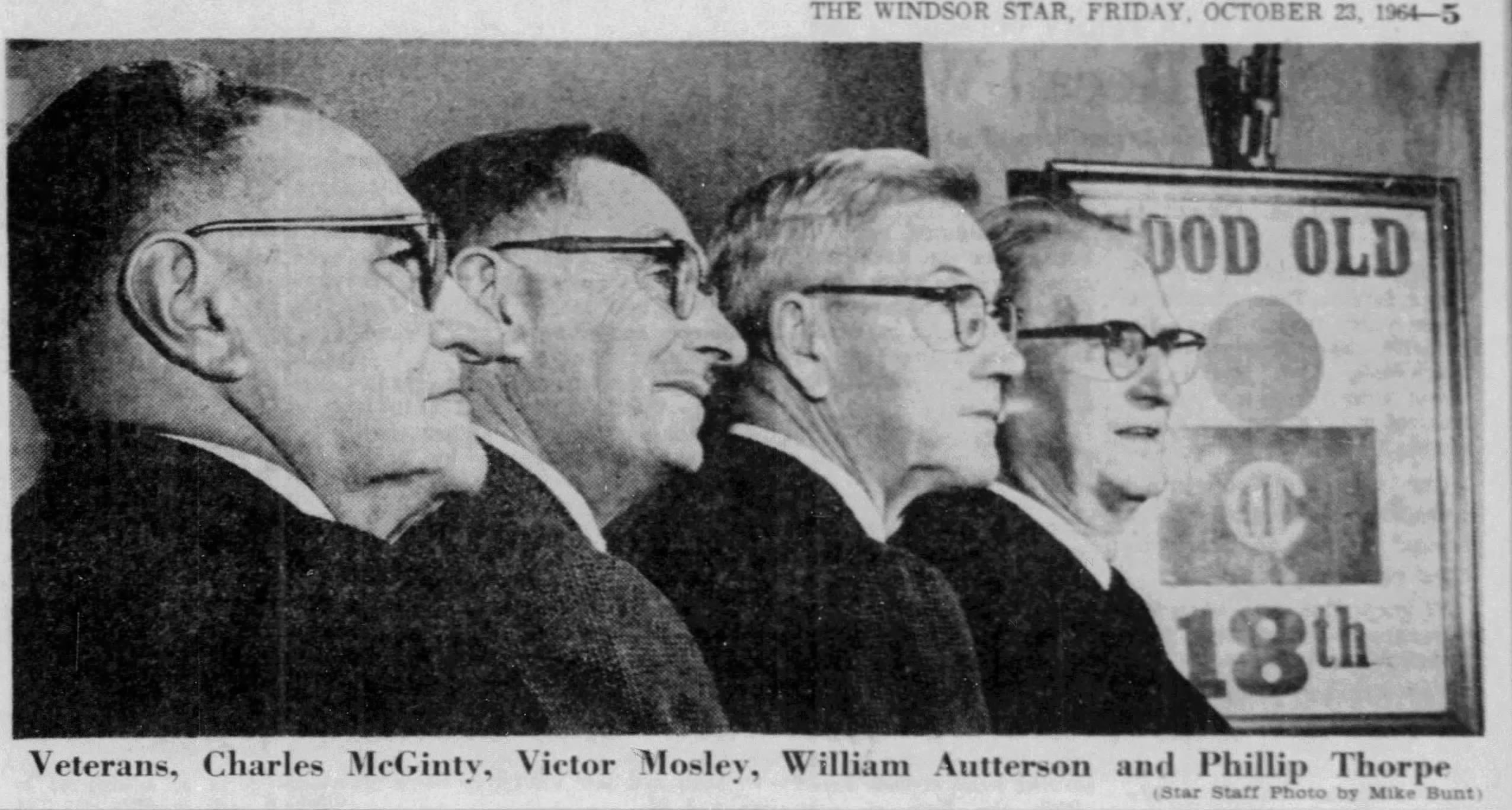
The 18th Battalion Association was an outcrop of the creation of the Great War Veterans Association, later to become the Royal Canadian Legion. The member ship was active and had reunions at their various chapters.[i]
One such reunion occurred on 22 October of 1964 recognizing the 50th anniversary of the start of the Great War.
A short article offers quotes from the veterans attending and many of them are identifiable as members of the 18th Battalion and these men are well represented in the article with eight men being clearly identified as having served with the 18th Battalion. Of the eight, five of men are 18th Battalion “originals” having enlisted at the formation of the battalion between October 1914 and April 1915. Their regimental numbers are 5,000 series numbers. The other men came to the 18th Battalion after it was sent “overseas”[ii] to the Continent.
The reunion took place at Branch 644 Royal Canadian Legion[iii] located at 1570 Marentette Avenue, Windsor, Ontario and several veterans are quoted with their memories.
Though the article does not attribute a quote with a veteran one can estimate the era and location of some of the quotes.
For example:
“… I went to Egypt first and then to France for the battle of The Somme in 1916. The next year, I was shipped to Greece. I was wounded, just a flesh wound, in the foot at The Somme and I got malaria in Greece. I didn’t win any medals and I went in as a private and came out as an older man.”
This veteran most likely served with the British Army, or possibly the Canadian Army Medical Corp and was seconded to a British unit. The Royal Newfoundland regiment served at Gallipoli and was based in Egypt before this operation but never served in Greece.
“I guess that was when the Germans launched their first attack with poison gas.”
This quote would be attributed to a member of the 1st Canadian Contingent and it was involved in the first action where poison gas was used, at the Ypres, Belgium on 22 April 1915.
Others, Stanley Hurst, Jack Fiddles[iv], Jim Handyside[v], Percy Lemmon[vi], Izzy Reid[vii] and Charles Jackson talked about their first padre of the battalion, Rev. Arthur Carlisle[viii].
“I think he was one of the best speakers I ever heard. I could have listened to him forever some of those nights when we weren’t sure what would happen tomorrow.
The presence of an Army Chaplain was a comfort to the soldiers. The role of religion was much more evident during this part of the last century and many men to solace in being able to rely on the religious support and guidance of a chaplain. Reverend Carlisle served with the 18th Battalion upon its inception in October 1914 to about July 1916 when he was released from active duty and returned to Canada.
Many men of the 18th Battalion offered their praise and admiration for this man of faith who supported the men of the 18th after the war ended, attending many post-war function and even having men of the 18th Battalion act as pall bearers for his sister when she died as reported in the Windsor Star on 31 October 1939.
This article gives snippets of the experiences of the veterans of the Great War, and though it does not illuminate much of the soldiers’ broader war experience is shows the most immediate points of memory they wished to share with the reporter and this reporter chose these statements deliberately to give his audience some sense of the veterans’ war experience.
Perhaps the most telling quote is, “It’s not good to talk about it.”
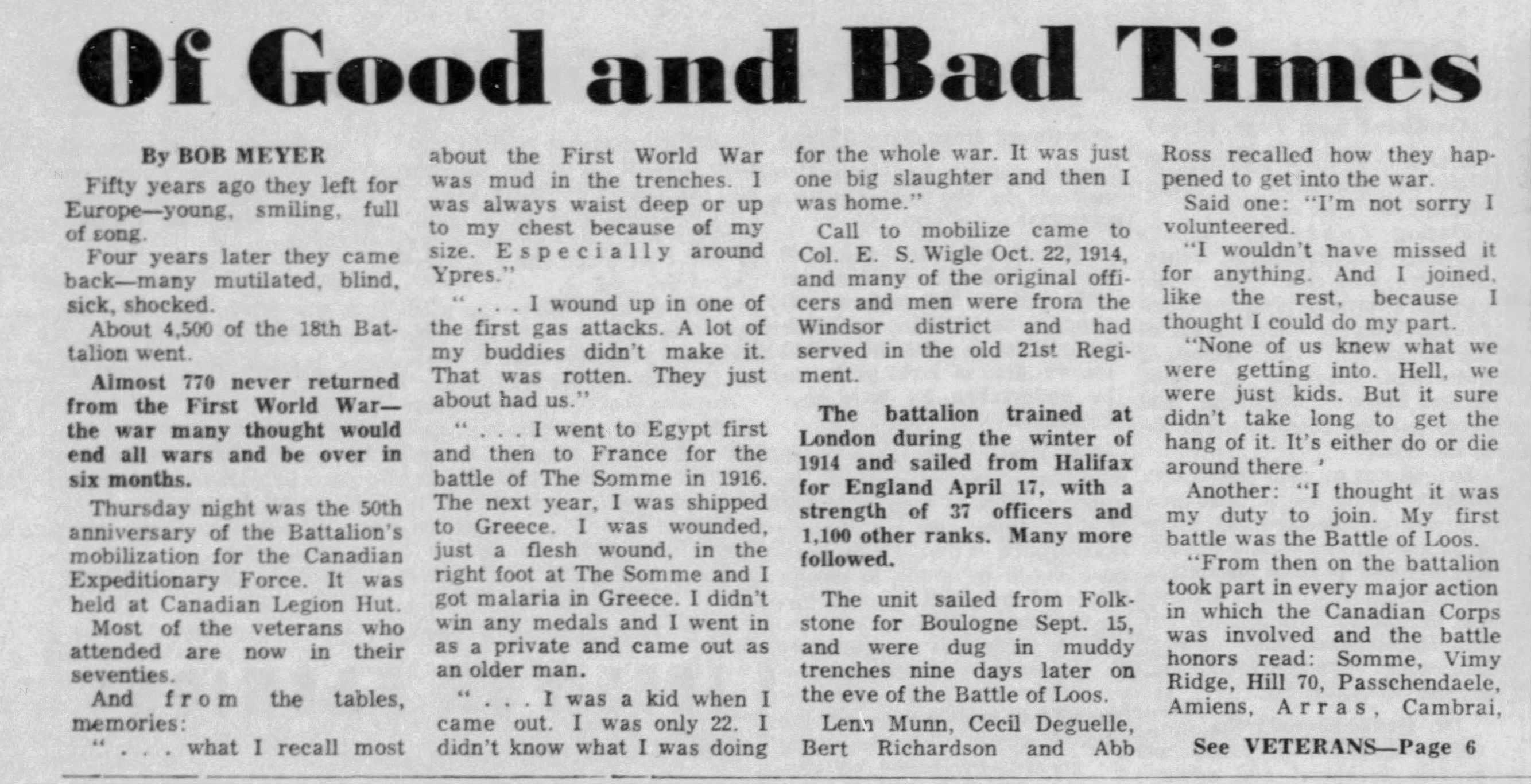
Of Good and Bad Times
By BOB MEYER
Fifty years ago they left for Europe—young, smiling, full of song.
Four years later they came back—many mutilated, blind, sick, shocked.
About 4,500 of the 18th Battalion went.
Almost 770 never returned from the First World War—the war many thought would end all wars and be over in six months.
Thursday night was the 50th anniversary of the Battalion’s mobilization for the Canadian Expeditionary Force. It was held at Canadian Legion Hut.
Most of the veterans who attended are now in their seventies.
And from the tables, memories:
“… what I recall most about the First World War was mud in the trenches. I was always waist deep or up to my chest because of my size. Especially around Ypres.”
“… I wound up in one of the first gas attacks. A lot of my buddies didn’t make it. That was rotten. They just about had us.”
“… I was a kid when I came out. I was only 22. I didn’t know what I was doing for the whole war. It was just one big slaughter and then I was home.”
Call to mobilize came to Col. E.S. Wigle Oct. 22, 1914, and many of the original officers and men were from the Windsor district and had served in the old 21st Regiment.
The battalion trained at London during the winter of 1914 and sailed from Halifax for England April 17, with a strength of 37 officers and 1,100 other ranks. Many more followed.
The unit sailed from Folkstone for Boulogne Sept. 15, and were dug in muddy trenches nine days later on the eve of the Battle of Loos.
Len Munn[ix], Cecil Deguelle [De Guelle][x], Bert Richardson[xi] and Abb Ross[xii] recalled how they happened to get into the war.
Said one: “I’m not sorry I volunteered.”
“I wouldn’t have missed it for anything. And I joined, like the rest, because I thought I could do my part.
“None of us knew what we were getting into. Hell, we were just kids. But it sure didn’t take long to get the hang of it. It’s either do or die around there.”
Another: “I thought it was my duty to join. My first battle was the Battle of Loos.
“From then on the battalion took part in every major action in which the Canadian Corps was involved and the battle honors read: Somme, Vimy Ridge, Hill 70, Passchendaele, Amiens, Arras, Cambrai, Hindenburg Line, Pursuit to Mons.”
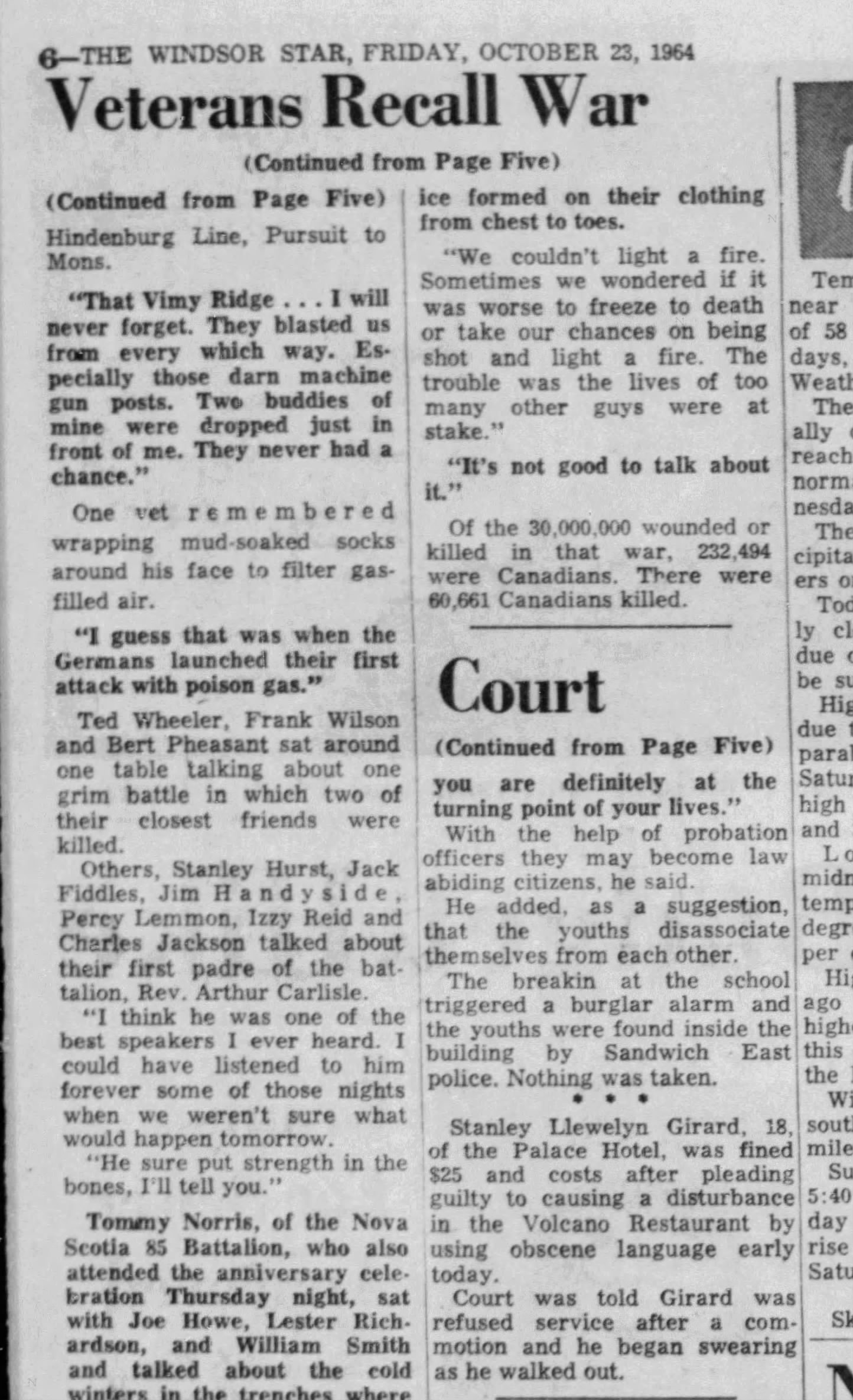
“That Vimy Ridge… I will never forget. They blasted us from every which way. Especially those darn machine gun posts. Two buddies of mine were dropped just in front of me. They never had a chance.”
One vet remembered wrapping mud-soaked socks around his face to filter gas-filled air.
“I guess that was when the Germans launched their first attack with poison gas.”
Ted Wheeler[xiii], Frank Wilson and Bert Pheasant[xiv] sat around one table talking about one grim battle in which two of their closest friends were killed.
Others, Stanley Hurst, Jack Fiddles [Fiddes], Jim Handyside, Percy Lemmon, Izzy Reid and Charles Jackson talked about their first padre of the battalion, Rev. Arthur Carlisle[xv].
“I think he was one of the best speakers I ever heard. I could have listened to him forever some of those nights when we weren’t sure what would happen tomorrow.
“He sure put strength in the bones, I’ll tell you.”
Tommy Norris, of the Nova Scotia 85 Battalion, who also attended the anniversary celebration Thursday night, sat with Joe Howe, Lester Richardson, and William Smith and talked about the cold winters in the trenches where ice formed on their clothing from chest to toes.
“We couldn’t light a fire. Sometimes we wondered if it was worse to freeze to death or take our chances on being shot and light a fire. The trouble was the lives of too many other guys were at stake.”
“It’s not good to talk about it.”
Of the 30,000,000 wounded or killed in that war, 232,494 were Canadians. There were 60,661 Canadians killed.
The Windsor Star. Friday, Oct 23, 1964 ·Page 5.
[i] Chapters existed in Windsor, London, Chatham, Toronto, Niagara Falls, to name a few.
[ii] The use of the term “overseas” was used by the Imperial Forces to denote service in any theatre, other than Great Britian. Thus, a soldier based in Great Britian that was transferred to service in France/Belgium was noted as being “overseas”.
[iii] Branch 644 was created by the amalgamation of Branches 12 and 143 in 2022. This amalgamation is indicative of the challenges the Royal Canadian Legion has with the changing demographics of Canada.
[iv] John “Jack” Fiddes, reg. no. 53799.
[v] James “Jim” Handyside, reg. no. 54226.
[vi] Percy William Lemmon, reg. no. 880420.
[vii] Islay “Izzy” Stanley Reid, reg. no. 1045097. He later attested as a lieutenant and served with the 15th Battalion.
[viii] Honourary Captain Arthur Carlisle.
[ix] Leonard Archibald Munn, reg. no. 189457.
[x] Cecil Stanley DeGuelle, reg. no. 123972.
[xi] This soldier was not found.
[xii] Probably Abbot Ross, reg. no. 53187.
[xiii] Edward “Ted” Charles Wheeler, reg. no. 54257.
[xiv] Herbert “Bert” Pheasant, reg. no. 53050.
[xv] Honourary Captain Arthur Carlisle.
Discover more from History of the 18th Battalion CEF, "The Fighting Eighteenth"
Subscribe to get the latest posts sent to your email.


Leave a Reply