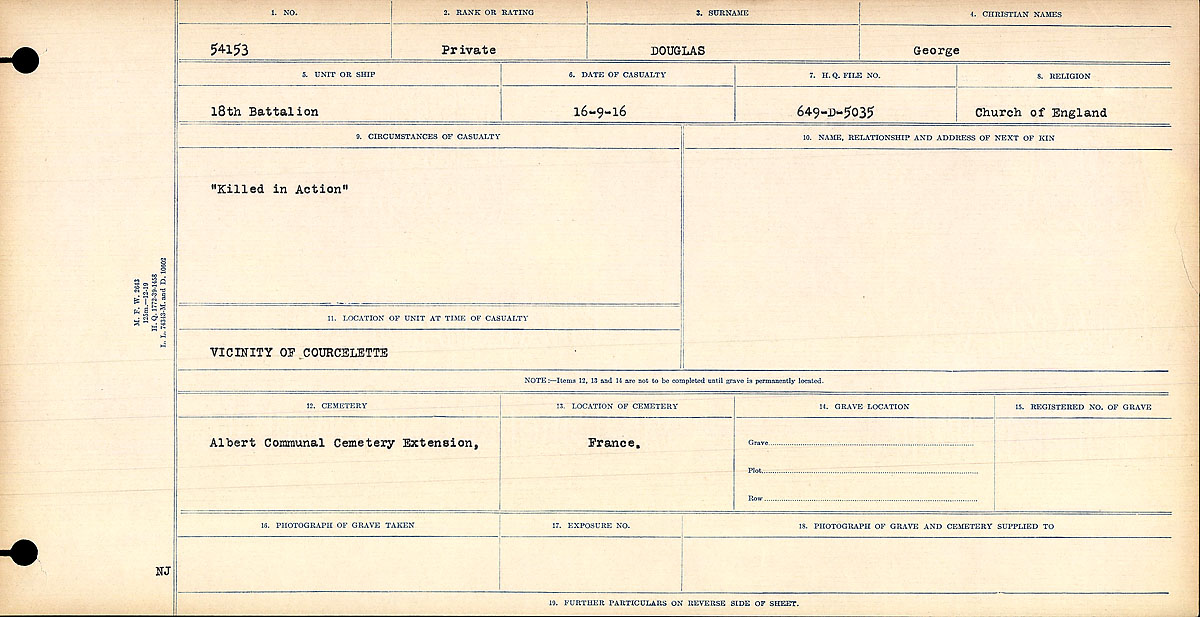
The Circumstances of Death Card for Private Douglas, reg. no. 54153 starkly relates that he “Killed in Action” in the vicinity of Courcelette on 16 September 1916 at the 18th Battalion’s first engagement at the Battle of Flers-Courcelette. The main attack occurred on the prior day and is noted in history for the first use of the modern battle innovation, the tank.
What is significant for Private Douglas is the fact that the men that helped him, the brave stretcher-bearers – many of whom were recognized for their bravery during this battle[i] – was witnessed by a Sergeant who was able to relate Douglas’ sacrifice and the stretcher-bearers’ effort and care to a wounded comrade.
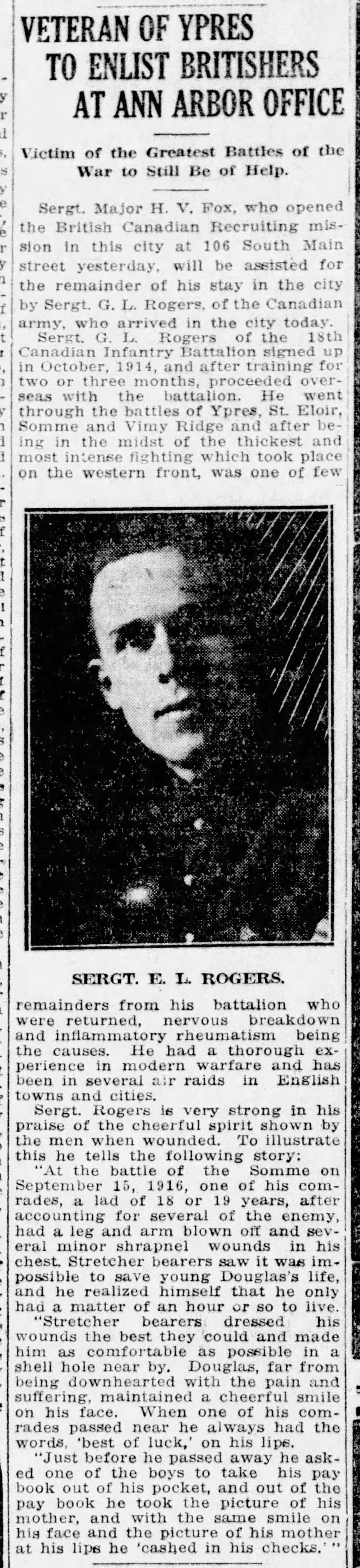
In an article from the Ann Arbor News on 25 April 1918, Sergeant Eric Langford Rogers, working for the British Mission, which was working to recruit British Subjects living in the United States of America for the war effort, relates to the reporter details of Douglas’ death:
‘Sergt. Rogers[ii] is very strong in his praise of the cheerful spirit shown by the men when wounded. To illustrate this, he tells the following story:
“At the battle of the Somme on September 15, 1916[iii], one of his comrades, a lad of 18 or 19 years, after accounting for several of the enemy, had a leg and arm blown off and several minor shrapnel wounds in his chest. Stretcher bearers saw it was impossible to save young Douglas’s life, and he realized himself that he had only a matter of an hour or so to live.
“Stretcher bearers dressed his wounds the best they could and made him as comfortable as possible in a shell hole near by. Douglas, far from being downhearted with the pain and suffering, maintained a cheerful smile on his face. When one of his comrades passed near he always had the words, ‘best of luck,’ on his lips.
“Just before he passed away he asked one of the boys to take his pay book out of his pocket, and out of the pay book he took the picture of his mother, and had the same smile on his face and the picture of his mother on his lips he ‘cashed in his checks.’”’
Douglas’ service record simply stated that he was “Dead on arrival at Main Dressing Station.”
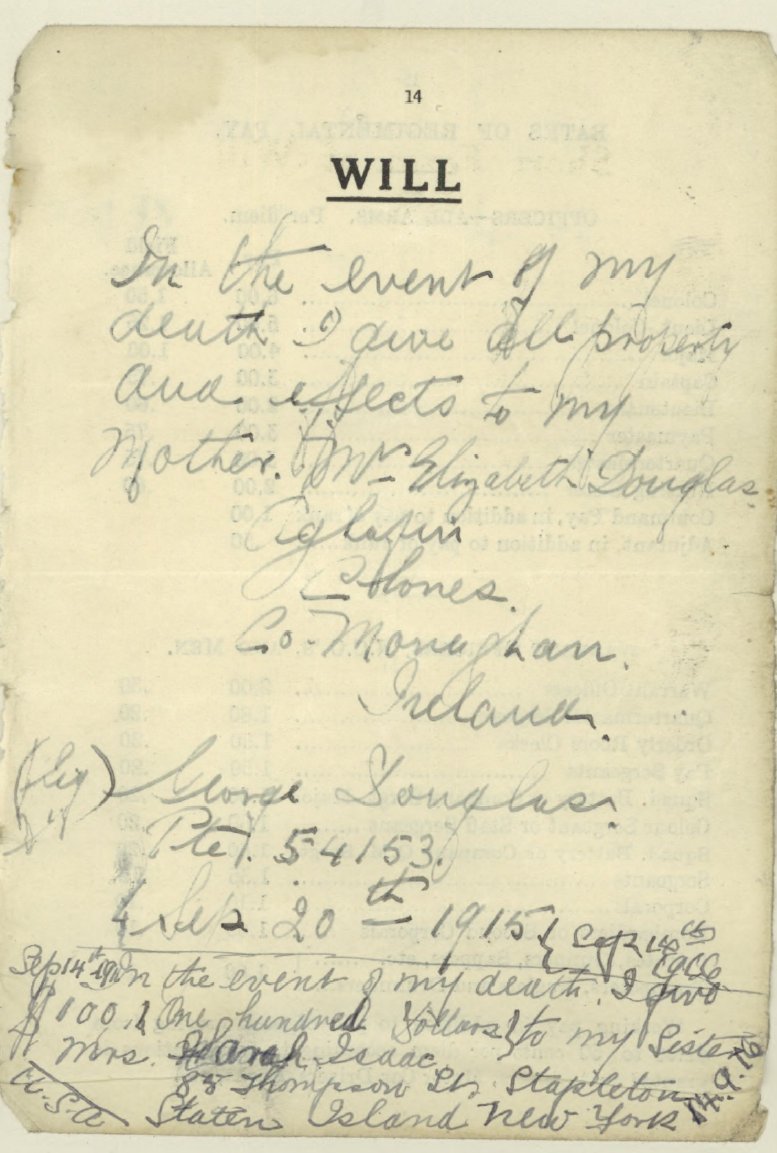
Private Douglas must have had a premonition that he was not going to make it. He amended his will[iv] on 14 September 1916, the day before the attack at Flers-Courcelette, to add his sister Sarah living on Staten Island, New York.
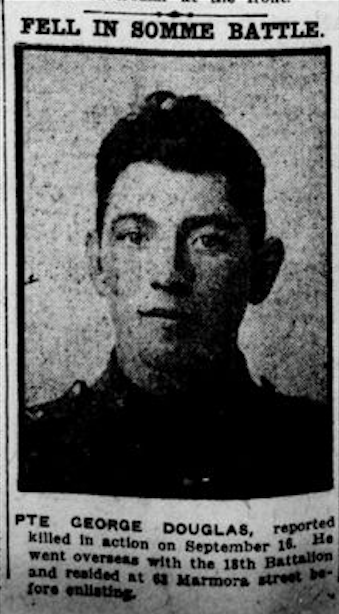
By sheer coincidence, this event would have been lost to history, but a member of the 18th Battalion Facebook Group posted the article, which led to the connection between Sergeant Rogers and the death of Private Douglas.
Private Douglas was an original member of the 18th Battalion having enlisted at London, Ontario on 14 December 1914. He was a good soldier, only showing pay stoppages for be Absent Without Leave for 2 days on 24 May 1915.
He is buried at the Albert Communal Cemetery Extension at Albert, France. He is the only 18th Battalion soldier of the 868 combatants buried there.
With this eyewitness testimony of a soldier who witnessed the passing of Private Douglas, we can see the important connection that the love between a son and his mother led to his last act, demonstrating his abiding affection for her.
It is poignant and sad.
And powerful.
[i] The October 1916 18th Battalion War Diary records that 14 men earned the Military Medal. Many of those men were stretcher-bearers.
[ii] Sergeant Eric Langland Rogers, reg. no. 53721. He was actually younger than Private Douglas by 2 years.
[iii] For context and supplemental information about this battle see https://18thbattalioncef.blog/2024/03/08/a-magnificent-spectacle-eye-witness-at-flers-courcelette/
[iv] Per his service record. Reference http://central.bac-lac.gc.ca/.redirect?app=pffww&id=358603&lang=eng&ecopy=296392a
Discover more from History of the 18th Battalion CEF, "The Fighting Eighteenth"
Subscribe to get the latest posts sent to your email.
 History of the 18th Battalion CEF, "The Fighting Eighteenth"
Leave a comment