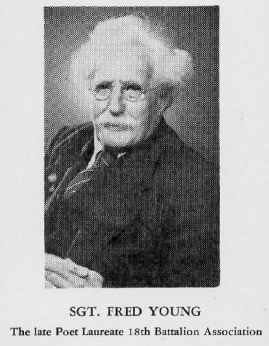
Private Fred Young wrote a letter on February 15, 1916 relating some of his thoughts and experiences as a member of the 18th Battalion, C.E.F. This may well have been the later Sergeant Fred Young who was to become the “poet laureate” for the 18th Battalion after the war. His poetry and efforts as a member of the 18th Battalion Association where highly regarded and it is the author’s contention that the follow letter is written by one and the same man. His poetry touches several themes, as does his letter: The Kaiser; the Lord’s Day Alliance; and his sense of humour reflected in the many poems and letters he wrote to The Border Cities Star post war. He was an active member of the Association and an advocate for Veteran’s rights after the war.
This letter was sent to a friend and was published in The Brussels Post. It is not known to what relation the friend is to Private Young and as he was from London, Ontario it is quite possible this was a reprint of a story from another paper and was inserted into the paper as men from the area where serving with the 18th Battalion.


Pte. Fred Your London, Writes from the Front
St. Valentines Day in the trenches held by the 18th Battalion was marked by a few iron souvenirs from Fritz, according to Pte. Fred Young in a letter home. He humorously refers to the exploding billet-doux[i] of the Huns as valentines and takes pleasure in announcing that none of the Western Ontario battalion “fell” for the blandishments of the German shells.
The day before this letter was written the Battalion’s War Diary relates: “Battalion relieved by 19th Can. Bn. Relief was delayed on account of heavy shell fire in BOIS CARRE Communication Trench. Battalion in Div. Reserve at LA CLYTTE. 2 other ranks returned from hospital. MAJOR NELSON admitted to hospital.” Thus, the recent shelling was on the mind of Private Young when he wrote this letter.
His letter follows:
“Godnoes,” Europe, February 15, 1916.[ii]
Did you get any valentines yesterday? So did we. The Canadian mail arrived last night, bring a few designed by Cupid, and Fritz tossed us over quite a few, designed by Krupp[iii]. In fact, he literally poured them over, but as the horseshoe was hanging on the door when he quit our stretcher-bearers drew a blank. We have learned to take his “spasms” philosophically.
Private Young takes the tact that the shells were like Valentines cards or flowers and makes light of the shelling on the 14th of February and relates that the “stretcher-bearers drew a blank,” indicating that the shelling resulted in no casualties for them. As Private Young served as a stretcher-bearer any action resulting in the wounding or death of a soldier would possibly involve him in that capacity.
“We have it doped out, too, that we know a few wrinkles about house keeping. The architects of our dugouts omitted the drawing-room and parlor, but we couldn’t have furnished them anyhow. Our dining-room furniture consists of a jackknife and spoon, our kitchen utensils a mess tin, and our bedroom suite is composed of a waterproof sheet and blanket. Bathroom equipment is one towel and a piece of soap. The washbowls in which we perform our ablutions, while not exactly made in Germany, are made by the Germans, by their favourite pastime of perforating our front door yard with shell holes. Jupiter Pluvius[iv] does the rest. Can you beat that for light housekeeping? We pay no rent, for its easier to move than pay rent.”
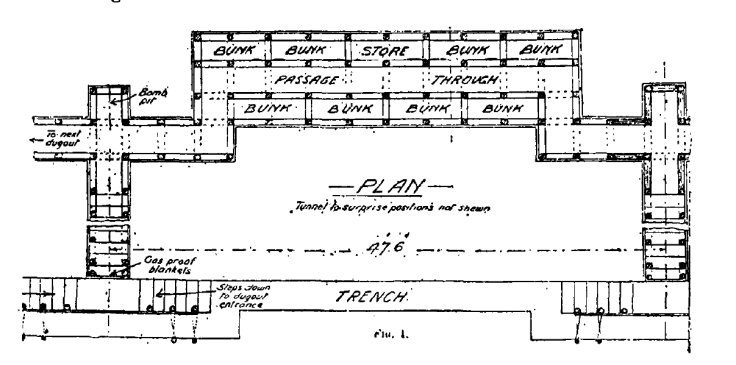
His description alludes to the spartan environment in which a soldier would live at the front line and the bare-bones and tentative nature of the occupation of the sector they are assigned to, as they could be moved and assigned to a new sector with little, or no notice. Not only are the living accomodations spartan but also the comforts by which a soldier partakes his eating and bathing. Of course, as is expected in Ypres sector, there is the constant rain referenced by Private Youngs reference to Jupiter Pluvius. He has is tongue firmly in cheek as when he says, “We pay no rent, for its easier to move than pay rent.”
“With the landscape behind the firing line yielding to the embrace of Spring, this wouldn’t be a bad country at all to wander in, if Fritz wasn’t so darned reckless about where he tosses shells. One Sabbath evening we were admiring the sunset and listening to the even-song of the thrush, when the too-familiar screaming of shells interrupted our reverie. We flopped. A salvo of high-explosive shells burst near us caused most of the real estate in our immediate vicinity to perform a fantastic ouchy-coochy dance. We joined the festivities by executing an enthusiastic shrapnel slide. And, believe me, there is nothing about that slide to confuse it with the hesitation waltz. The program was short but by the time we had disconnected ourselves from our surroundings, we had lost all further interest in in the beauty of the scenery. The censor emphatically refuses to allow us to repeat the uncomplimentary remarks we made about the German Empire. But we’ll get even.”
Even in the rear, where the country is “yielding to the embrace of Spring,” the ever-present danger of German artillery is present. No respite is given to the soldiers to pause and partake in watching a sunset to the song of the thrush as the shelling requires the men to initiate the so called “shrapnel slide” and that any hesitation on their part would result in injury or death.
“We are led to believe by the temperance columns of Canadian papers, that the Lord’s Day Alliance is intensely interested in the welfare of the Canadian Soldiers. As this happened on a Sunday, it is distinctly up to the Lord’s Day Alliance to camp on Kaiser Bill’s trail. He may ride roughshod over Hague treaties, but we can see him finish now.”
“In olden days, we read that nights went forward in shining armour, trusting in God, and his own strong right arm. The trust in God idea is still popular, but the strong arm stunt has no more chance in disputing the right o’way with a salvo of 9.2 [inch] shells than a celluloid dog would have at catching an asbestos rat in Daniel’s fiery furnace. Forward, the L.D.A.”
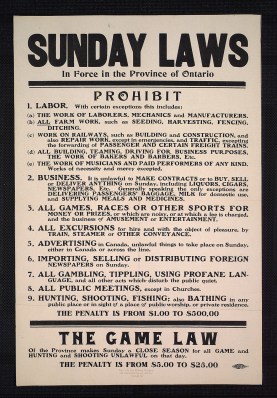
The next two paragraphs take aim at the Lord’s Day Alliance (L.D.A.), an organization engaged in the active protection of the Sabbath with a range of restricted activities during Sunday, such as imbibing in alcohol, engaging in watching sports, and other secular activities. Private Young is poking fun at the L.D.A. by indicating to them to apply their philosophy towards the Germans, in particular to artillery fire but that their efforts would have no effect. Private Young may also be taking a swipe at the L.D.A. for its support of temperance, something to which the men would not appreciate as it would effect their rum ration. His imagery involves a dog made of a material that would not survive in a furnace, against a rat that is protected from such heat.
“There was an interesting scene the other evening in the reserve lines, as the boys who had drawn the lucky numbers for leave lined up for transportation instructions. Less fortunate comrades, good-naturedly bombarded them with expression such as “Oh, you lucky devil” and “Yorkshire pudding for yours, next week pal.” Then, amid reciprocated salvos of “Good luck,” they swung off, with beaming faces toward dear “Old Blighty.” And the lads that had been left behind to “carry on” were soon hitting the trail with resolute faces set trenchward, blithely singing “Keep the Home Fires Burning.”
“The mud has disappeared to such an extent, that we can find places occasionally where we can travel on the earth’s surface, instead of the usual half-fathom below. To the optimists it sure is a happy omen, for they have always maintained that we call eventually emerge on top.”
Yours as ever,
Fred Young
Source: The Brussels Post. March 16, 1916. Page 5.
The letter ends with a lament towards those men who have earned leave to England and temporary salvation from the threats of the front. The ever-present threat of wounding and death pervade their existence and Private Young indicates that there may be some relief from the mud of Belgium and the water in which they wade in during their service on the front-lines due to the high water table in their sector.
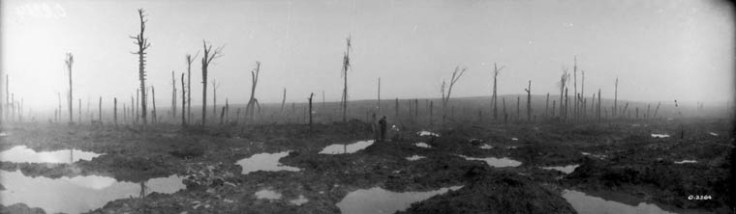
Private Young’s letter portrays a time of relative inactivity for the Battalion. The Battalion suffered 3 men killed in action at the end of February but the letter indicates that the threat of death was ever present and the mention of it in the War Diary indicates that the shelling on Valentines Day 1916 in their sector was unusual. From that experience, Private Young writes a letter that is descriptive and highly ironic in its tone. It shows the horror of war. It also shows the resilience of the human spirit as Private Young shares his experiences in this letter.
[i] Billet-doux – A love letter.
[ii] The Battalion was relieved by the 19th Battalion after serving in the front line from April 8. The Battalion returned to La Clytte, Belgium via communication trenches and the Battalion War Diary notes: “Relief was delayed on account of heavy shell fire in BOIS CARRE Communication Trench.”
[iii] Reference to the artillery and shells produced by the German Krupp industrial conglomerate.
[iv] A reference to rain fall.
Discover more from History of the 18th Battalion CEF, "The Fighting Eighteenth"
Subscribe to get the latest posts sent to your email.
 History of the 18th Battalion CEF, "The Fighting Eighteenth"
Leave a comment