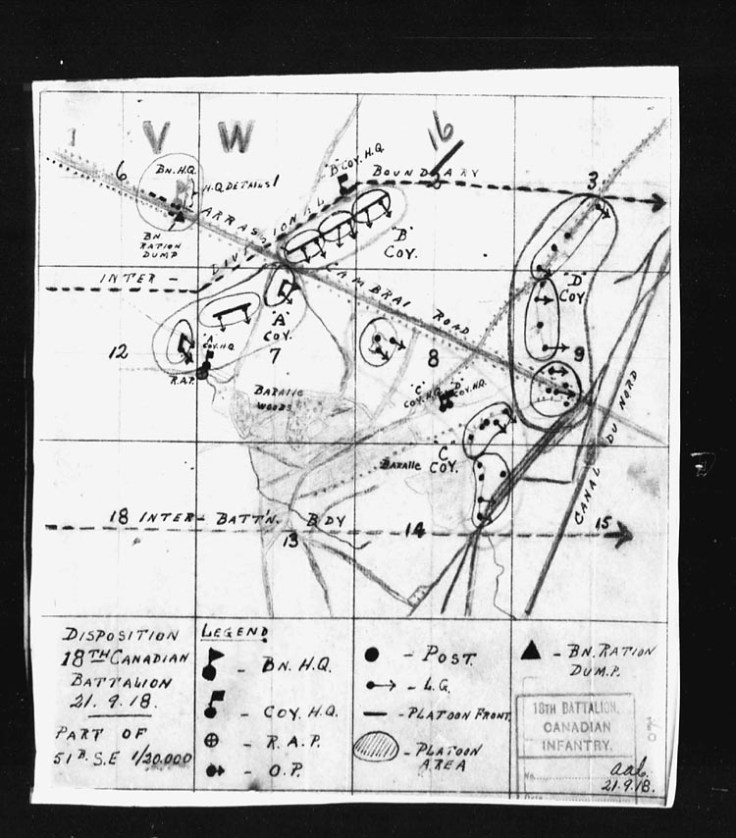
Appendix 16 of the September 1918 18th Battalion War Diary is described as “Disposition Sketch 18th Bn. on the 21st”. It is directly related to Battalion Operational Order No. D.242 dated September 20, 1918 detailing the relief by the 18th Battalion of the 21st Battalion in the “left front-line” on the night of the 2th and 21st. The relief was carried out and completed by 10.15 p.m. The Battalion now was stationed with its forward companies (“D” and “C”) against the Canal Du Nord, the next objective for the Canadian Corps to overcome during “The Last 100 Days.”
The map is of interest, partly due to its legibility, but also as it outlines graphically the nature of the manner in which a Canadian Corps Battalion disposed of its tactical resources. It also clearly places the positions of the men of the 18th Battalion in space and time and this disposition is affected and influenced by the geography in which the Battalion operates.
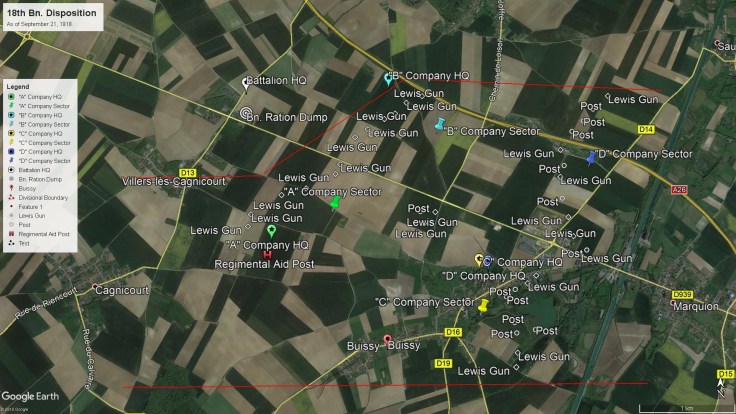
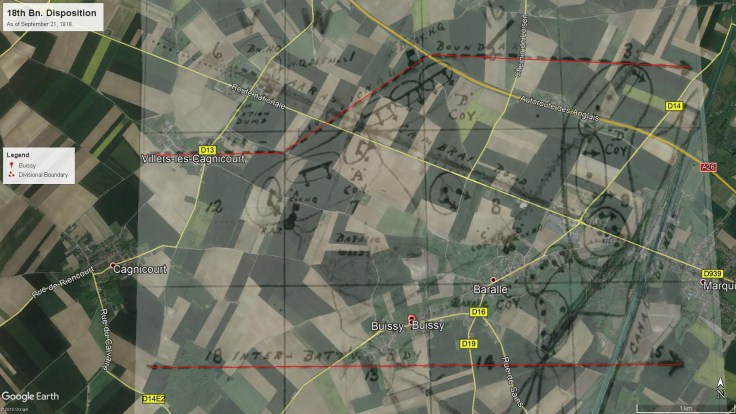
The main features of the map are:
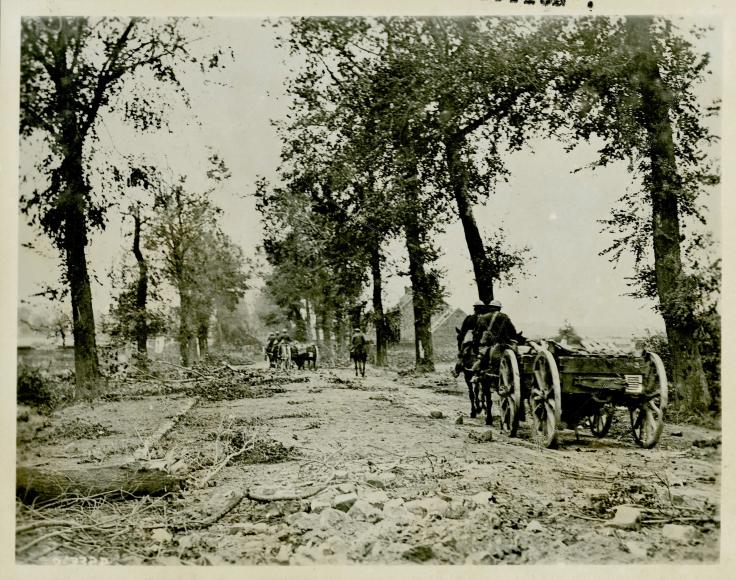
Arras-Cambrai Road: this road (D939) is a major east-west route between the cities of Arras and Cambrai. Currently, the road was a 2-lane road, often tree-lined. The road was a valuable asset to the advancing Canadian Corps as it allowed the transport of materials and men along the line of advance to the objective of Cambrai. The dots on both sides of the road on the map indicate trees.
Canal Du Nord: The Canal Du Nord was incomplete as the beginning of the conflict stopped construction of the canal. Thus, the canal was a dry ditch that was a man-made tactical obstacle that made an effective line of defense for the German Army along its frontage.
Secondary Roads: Local road bearing roughly north-south (modern designations being the D14, D19, D13 and D956) roughly parallel the canal and are used by the Battalion for position and orientation of companies.
Paths and Tracks: Man-made paths, such as that used by “C” Company south of the Arras-Cambrai road and other features such as a farm beside the Arras-Cambrai road as a strong-point to the left of the number “8” in the center of the map are utilized for defense and mutual support.
The Front-line
As the 18th Battalion had relieved the 21st Battalion it is likely that they adopted this scheme in situ, making adjustments and improvements to the positions as required or commanded by higher authority.
As there is no scale on the map the Battalion frontage can only be roughly estimated as 3.5 kilometres paralleling the Canal Du Nord. There is a series of outposts that appear not to be inter-connected by trenches along access roads with “D” Company being responsible for the north side of the Arras-Cambrai Road as well as the road itself. There appears to be three platoon areas with 2 to 3 outposts in each area and two Lewis Gun positions in each platoon area. The right-flank platoon area (Arras-Cambrai Road) is the most concentrated.
“C” Company is concentrated south of the Arras-Cambrai Road with a similar deployment save for, what appears to be, a strong-point immediately north of the village of Baralle and south of the Arras-Cambrai Road. Extrapolating the information from Google Maps this appears to be a farm or some other building and would make a ready strong-point for the Battalion. It also serves to connect the forward and rear areas of the Battalion sector. The strong-point has two Lewis Guns and one post.
The Support-line
The Support-line is approximately 3 kilometres in the rear of the front-line positions of “D” Company along the Arras-Cambrai Road. It is possible the line is located on rise in the land for better support, fields of fire for the Lewis Guns. The land in this sector is low slightly rolling fields and relatively flat and the orientation of the support-line would indicate some use of natural cover and topographic features to some defensive advantage.
The two companies in support “A” and “B”, appear to have short entrenchments holding each platoon as a unit with two Lewis Guns located at the end of each trench.
Support Units
The Battalion company headquarters for the front-line are adjacent to each other and centrally located to the rear of the battalions they command and almost equidistant from the front-line to the strong-point west of the canal. The Battalion company headquarters for the support-line are on the flanks with “A” in front of its lines and “B” to the rear. The Regimental Aid Post is adjacent to the “A” Company command post.
The Battalion Headquarters is immediately to the north of the Arras-Cambrai Road approximately 1 kilometre behind the support-line. The Battalion Ration Dump appears to be located slightly east of the Battalion Headquarters on the south side of the road.
The Tour
The War Diary relates the Battalion’s experiences during it tour in these positions from September 21 to the night of the 23rd.
On September 21, 1918 there was a daylight patrol commencing at 5:00 p.m. Corporal Brockbank left the lines and followed a railway track to a train station from which he observed the opposite side of the canal. Movement was identified at 7:00 p.m. but the enemy disappeared, and no other movement was detected. Enemy machine gun fire was noted to bey “very quiet” and the patrol returned without incident at 9:00 p.m. 3 men were wounded that day.
The following day, September 22, 1918 began with German shelling of the left-flank of “D” Company. No results or casualties were reported. “A” Company worked on improving their positions. A patrol led by Lieutenant Stokes covered the Battalion frontage and observed enemy machine gun emplacements from a forward position. No casualties occurred on this day.
The last day of the tour, September 23, 1918 involved an early morning artillery barrage with a large number of mortar (fish tails and rum jars) rounds being expended by the enemy. Both “A” and “B” Company improved their positions in the support-line and the front-line companies carried out “protective patrols” covering their company frontage during the night. The Battalion was then relieved by the 21st Battalion on the night of the 23rd and 24th and moved back the Buissy Switch in brigade reserve.


Above: Disposition of units with map coordinates and number of soldiers per position.
August and September 1918 had opened up the nature of the battlescape. The continuous line of trenches no longer existed and were replaced with aspects of open warfare. The 18th Battalion and the units of the Canada Corps adapted to this new situation and organized their defences using the advantages of the local geography to advantage. In this case, the Germans demonstrated an effective use of a man-made obstacle, the Canal Du Nord, as a barrier that temporarily delayed the advance of the Canadian and Allied units in this sector.
The map gives us an intimate look at the efforts and organization of those efforts to create a viable defense against a possible German counter-attack. Making use of the canal as a barrier the units of the 4th Canadian Infantry Brigade, represented by the 21st and 18th Battalions, created a local defense in-depth. These positions were never tested by a German infantry counter-attack and never became permanent in nature as the next phase of The 100 Days was about to begin in earnest.
Discover more from History of the 18th Battalion CEF, "The Fighting Eighteenth"
Subscribe to get the latest posts sent to your email.


Leave a Reply