On 3 June 1915, the Chesley Enterprise published a letter from an 18th Battalion soldier from the area. 219 days of military service had transpired by the time Private Harold Stanley Gardner’s[i] letter was published in the local paper. When he enlisted, he was a 23-year and 26-day-old man working as a furniture finisher at Chesley, Ontario.
(Full news clipping below main article._
His letter, reprinted as a single paragraph, gives us some interesting details of his service, one that, to the author’s knowledge, has never been published before.
Gardner’s letter covers the 18th Battalion’s trip to England from its departure in Halifax on 18 April 1915 to the writing of this letter, sometime in mid-May 1915.
He mentions the HMS Cumberland escorting them, as well as “two torpedo-destroyers” escorting them into Avonmouth. These two details are mentioned in other letters from soldiers of the 18th.
What is new is the mention of the 18th Battalion deploying its two Colt “Potato Masher” machine guns on the ship. Gardner states, “We had our machine guns mounted on the bridge in case we should see one and took turns in watching all through the day.” He should know; he was a member of the Machine Gun Section, responsible for manning these relatively modern weapons.
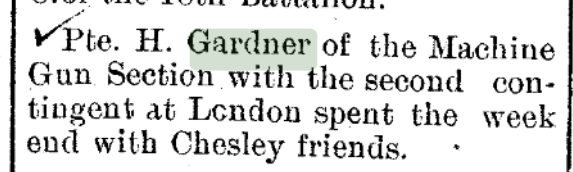
This is a fascinating observation, and though expedient, one wonders how effective these machine guns would have been against a German submarine. Not likely to be very effective, and probably not much of a deterrent if seen by a German through a periscope. However, it was thought to be a good idea and certainly would have boosted the morale of those on the SS Grampian during its crossing. Certainly, the machine gun section of the Battalion would have been excited to put their weapons to use in the defence of the ship that was transporting them to war.
He mentions the important process of leave-taking to see families, and this, too, is a first mention that the 18th Battalion set aside four days to allow soldiers to visit families in the United Kingdom, as many of the men of the Battalion were born in the UK. Gardner was one such man, born in Westbury, Shropshire, England. His parents lived at 112 Abbey Foregate, Shrewsbury, England, during and after the war, approximately a 12-hour trip by train from West Sandling.
He makes mention of several men he knows that are overseas, and it shows how tight friendship and comradeship was for the “local boys” that he makes an effort to find these chums, some of them who do not serve with the 18th Battalion, but probably were close at hand due to the concentration of 2nd Canadian Contingent units in the Sandling/Folkestone/Hythe area.
He is not the first to mention what would be eerie to hear, the sounds of artillery fire from Belgium coming across the Channel and being heard by the soldiers. He does not differentiate when they hear the guns, but they can differentiate between this ominous sound and that of thunder.
Highlighting his recent trans-Atlantic crossing, the story of the sinking of the Lusitania, resulting in the loss of the wife of Regimental Quarter Master Sergeant Edgar Vincent Herbert aboard this ship, serves as a reminder of the potential danger such a trip would have during this stage of the war.
Private Gardner covers a wide range of topics, never delving too deeply into what is a brief, chatty letter. Yet he gives us a glimpse of what was important and topical to him at the time.
A spot of leave. Machine guns on a ship. The death of a comrade’s wife by the “U-Boat Scourge”.
All these items place him at several points in time, personalizing his experience and life.
He would not live another day after this letter was published. He was “Previously reported missing, now Killed in Action” on 2 March 1916. The 18th Battalion suffered a heavy German barrage, resulting in the deaths of five men (other ranks), including the now Sergeant Gardner. The intensity of the bombardment can be measured, as Sergeant Gardner is initially listed as missing. His body was identified and retrieved, and he is buried in the Ridgewood Military Cemetery, along with 41 of his 18th Battalion brethren.
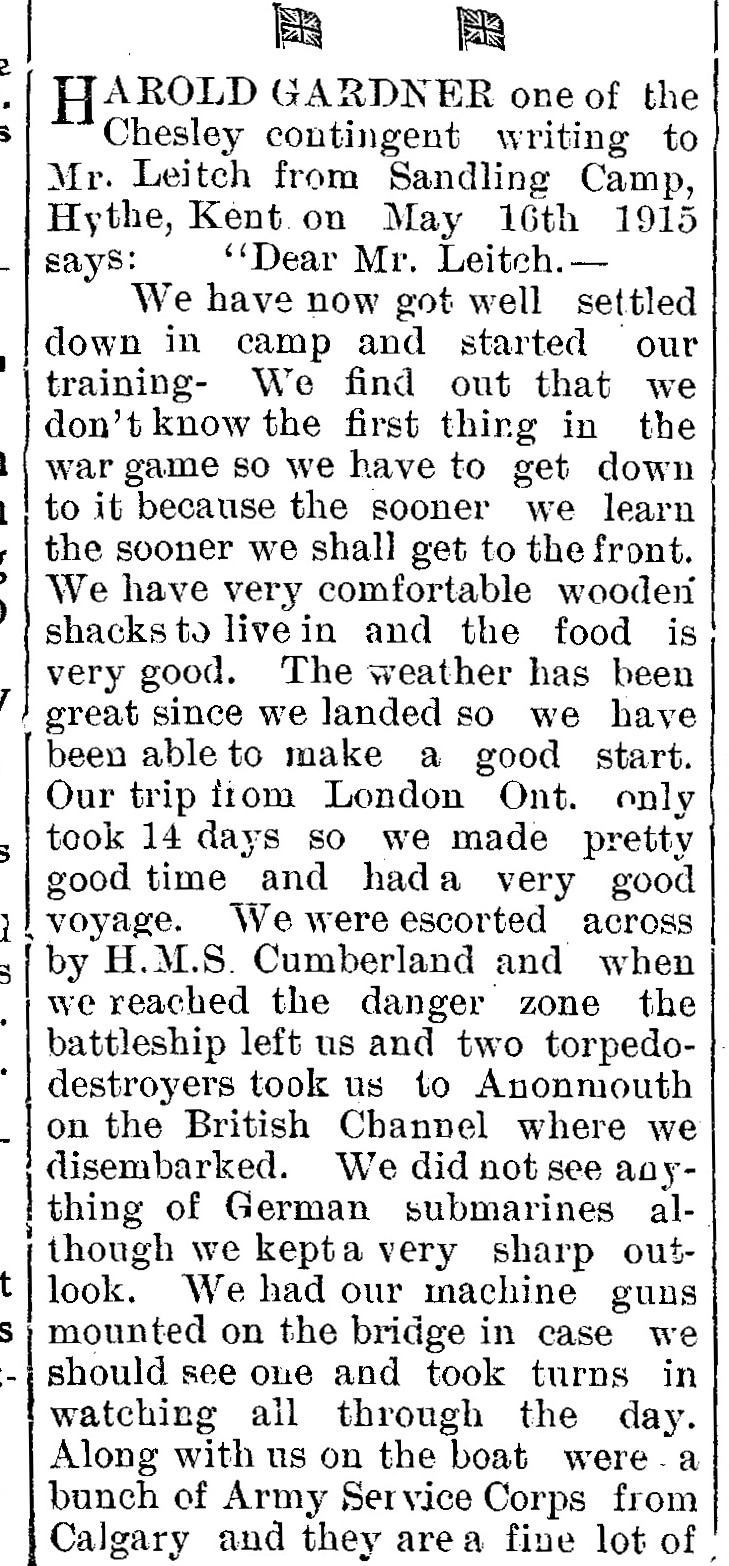
HAROLD GARDNER one of the Chesley contingent writing to Mr. Leitch from Sandling Camp, Hythe, Kent on May 16th 1915 says: “Dear Mr. Leitch.—
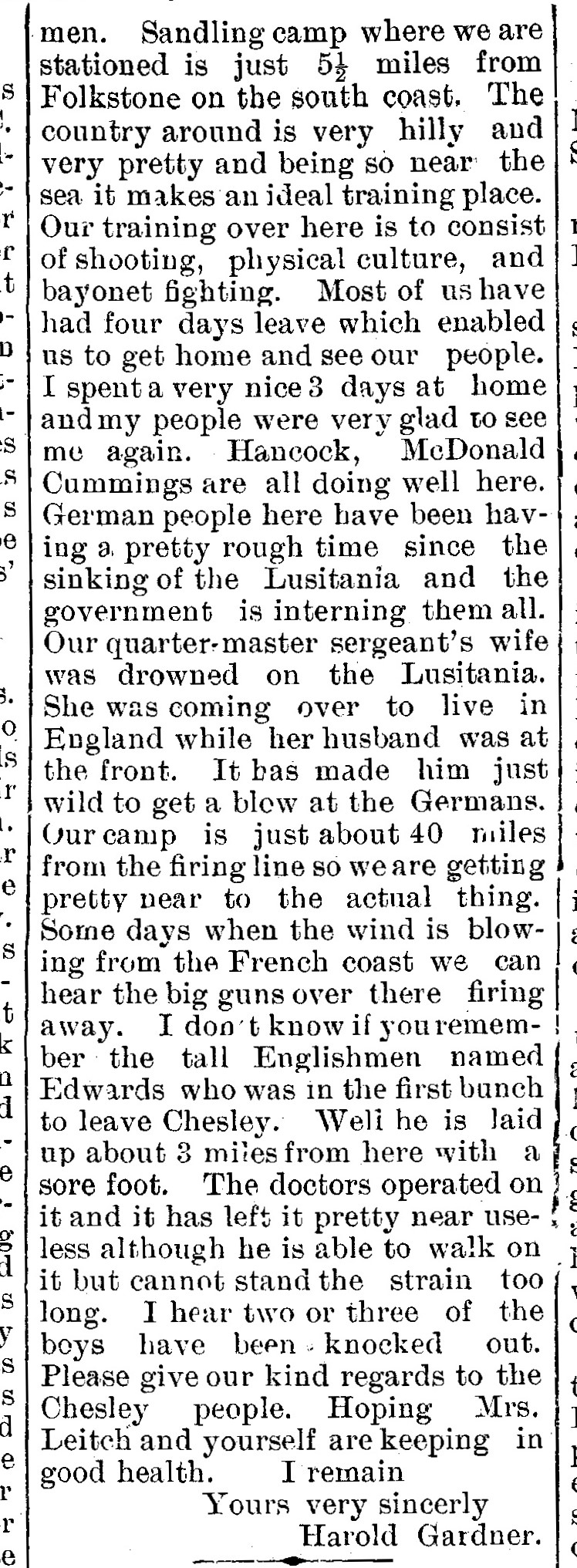
We have now got well settled down in camp and started our training. We find out that we don’t know the first thing in the war game so we have to get down to it because the sooner we learn the sooner we shall get to the front. We have very comfortable wooden shacks to live in and the food is very good. The weather has been great since we landed so we have been able to make a good start. Our trip from London Ont. only took 14 days so we made pretty good time and had a very good voyage. We were escorted across by H.M.S. Cumberland and when we reached the danger zone the battleship left us and two torpedo-destroyers took us to Avonmouth on the British Channel where we disembarked. We did not see anything of German submarines although we kept a very sharp outlook. We had our machine guns mounted on the bridge in case we should see one and took turns in watching all through the day. Along with us on the boat were a bunch of Army Service Corps from Calgary and they are a fine lot of men. Sandling camp where we are stationed is just miles from Folkstone on the south coast. The country around is very hilly and very pretty and being so near the sea it makes an ideal training place. Our training over here is to consist of shooting, physical culture, and bayonet fighting. Most of us have had four days leave which enabled us to get home and see our people. I spent a very nice 3 days at home and my people were very glad to see me again. Hancock, McDonald Cummings are all doing well here. German people here have been having a pretty rough time since the sinking of the Lusitania and the government is interning them all. Our quarter-master sergeant’s wife was drowned on the Lusitania. She was coming over to live in England while her husband was at the front. It has made him just wild to get a blow at the Germans. Our camp is just about 40 miles from the firing line so we are getting pretty near to the actual thing. Some days when the wind is blowing from the French coast we can hear the big guns over there firing away. I don’t know if you remember the tall Englishmen named Edwards who was in the first bunch to leave Chesley. Well he is laid up about 3 miles from here with a sore foot. The doctors operated on it and it has left it pretty near useless although he is able to walk on it but cannot stand the strain too long. I hear two or three of the boys have been knocked out. Please give our kind regards to the Chesley people. Hoping Mrs. Leitch and yourself are keeping in good health.
I remain
Yours very sincerely
Harold Gardner.
Chesley Enterprise. 3 June 1915
[i] Later Sergeant. Promoted on 3 January 1916 as Sergeant R. Ray, 53382 invalided to England.
Discover more from History of the 18th Battalion CEF, "The Fighting Eighteenth"
Subscribe to get the latest posts sent to your email.


Leave a Reply