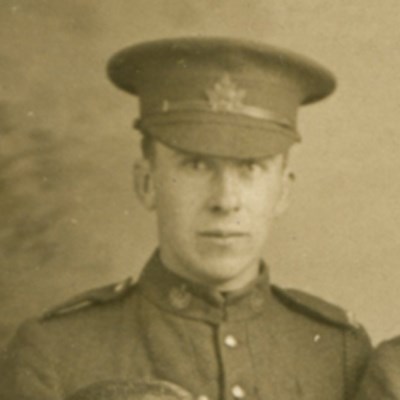
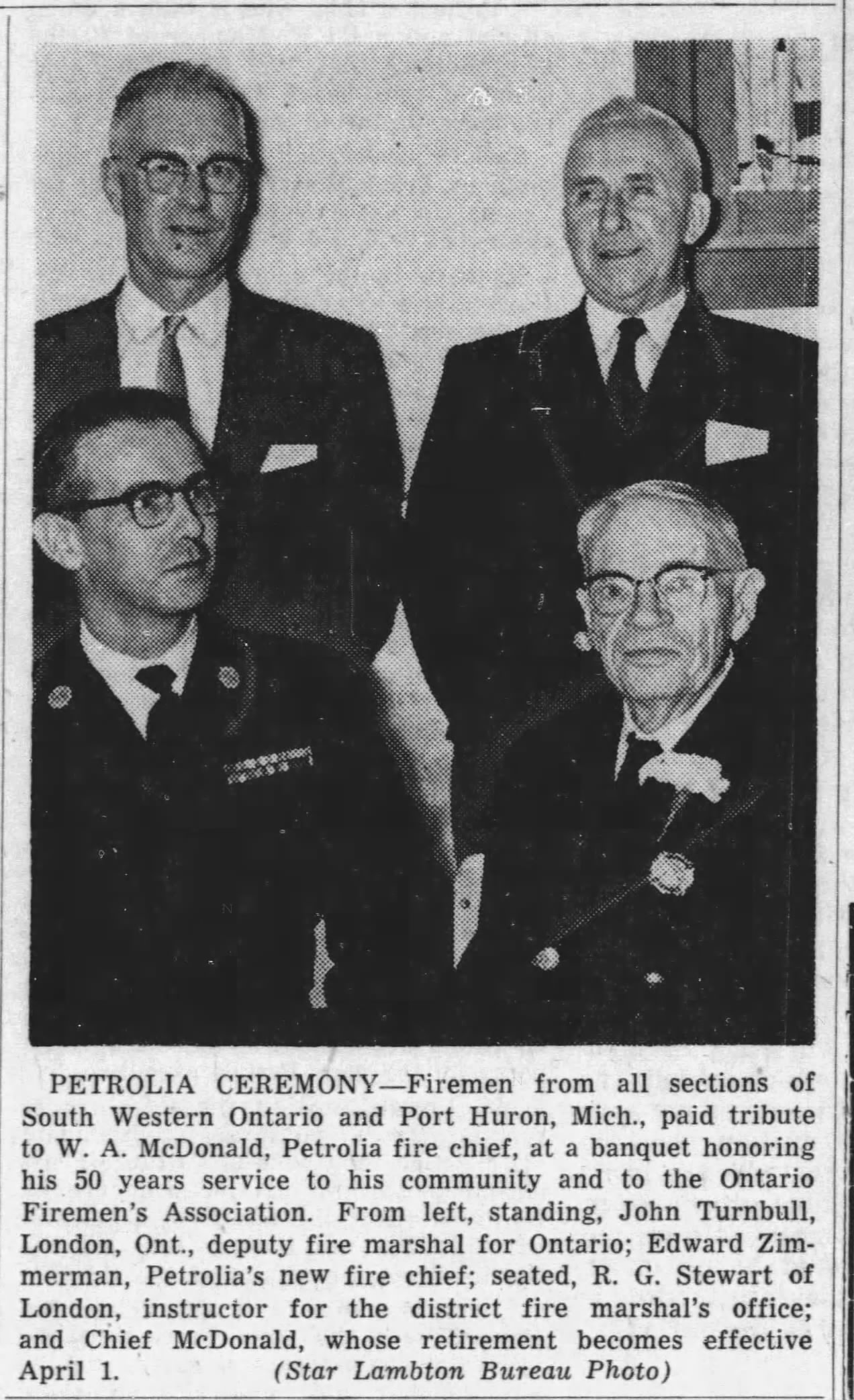
It was the last Thursday of the year. In fact, it was the last day of the year when a 22-year-old moulder enlisted with the 160th Overseas Battalion at Southampton, Ontario. From Neustadt, Ontario, the reason for this man enlisting at Southampton was that he lived and worked there, though he originally was from Cargill, Ontario. His motivation to enlist was turned into action on 31 January 1915. With this action, Edward Frederick Zimmerman joined the Canadian Expeditionary Force.
His attestation papers indicate that his next-of-kin was his father, George, with a telegraphic address of “Neustadt, Ontario” stamped on the first page of the form. The newly minted Private was born on December 28, 1894, at Neustadt, Ontario and was willing to be inoculated and/or vaccinated as part of his terms of service. He had no prior military experience and was not married. He further assented to the nature and form of his military engagement and also assented to serving overseas. He signed the first page of the form, and the second form of his attestation papers reveals that he stood 5’ 6.5” tall with a chest of 34” and a chest expansion of 3.5”. He was described as having a dark complexion, grey eyes, and brown hair and his religious affiliation was listed as Presbyterian. His medical exam found him fit, and with a flourish of a pen by Lieut.-Col. Adam Weir[i], Zimmerman was no longer a civilian.
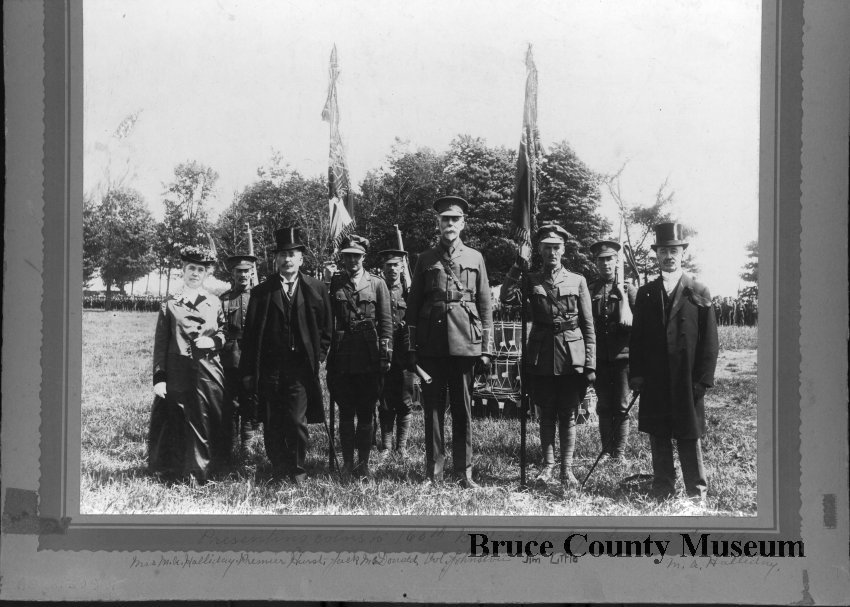
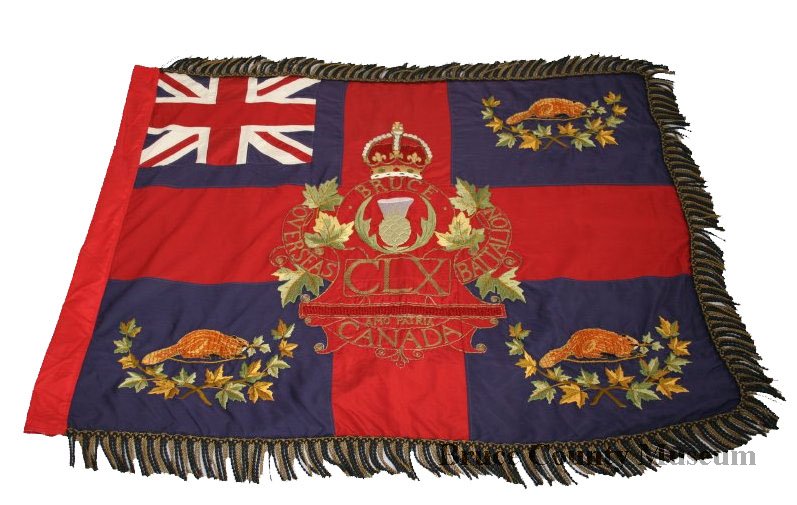
He was part of “A” Company, made up of men from Walkerton, Paisley, Cargill, Port Elgin, and Southampton.[ii] In May 191,6 the 160th Overseas Battalion was based at Walkerton for training, and it is recorded that on 4 June 1916, the Battalion marched from Walkerton to Chesley to receive its Colours from Premier William Howard Hearst, a Tara Native. From there, it was sent to London, Ontario, for further training for the summer.
During this time his records show that he had a clean record with no demerits or punishments accorded to him. In fact, he must have been a promising soldier as he was appointed a Lance-Corporal on 17 July 1916 per W.O. 169.
As Autumn approached, the soldiers of the 160th must have known their time to embark for England, and the next stage of training would be coming. At the beginning of October, preparations for boarding train transport would commence, and by 17 October 191,6 the Battalion was on its way to England aboard the SS Metagama, having embarked at Halifax, Nova Scotia. In conjunction with this preparation, the soldiers of the 160th would assign a portion of their pay to a family member or their spouse. In the case of Private Zimmerman, he assigned $15.00 of his pay per month to his mother, Eva Zimmerman, residing at Neustadt, Ontario. As a private he earned $1.00 per day when not in active service and $1.10 per day while in active service, effectively portioning almost 50% of his pay to his mother.
The SS Metagama arrived safely at Liverpool on 28 October 1916, and the 160th Battalion was moved to Witley Camp for the next stage of its training. The hope of the officers and men of the 160th was to be kept as a complete battalion and be sent over to fight with one of the 4 Canadian Divisions as part of the Canadian Expeditionary Force. But this hope would not be realized.
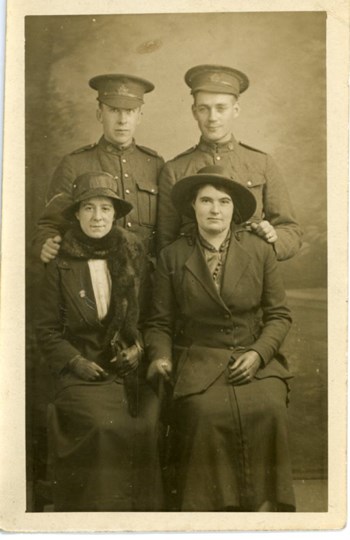
The recently arrived Lance-Corporal Zimmerman and a buddy, Private Charles Reed (reg. no. 651593) had an opportunity for some leave and went up to Glasgow, Scotland for some rest and relaxation. There they met “two girls from Glasgow”. This was related in a picture postcard[iii] from Private Reed with a photograph of the two Canadian soldiers standing behind the Scots lassies. Private Reed relates:
“Glasgow
November 11, 1916
This is my mate L. Corp. Ed Zimmerman, myself and two girls in Glasgow just taken for fun. The girls are thick here and like the Canadians.
Charlie”
It was, perhaps, on that leave, that Lance-Corporal Zimmerman partook in a carnal experience which resulted in him contracting a common social disease amongst the soldiers of the British Imperial Forces, venereal disease. He was admitted to Connaught Hospital on 27 November 1916 and was then discharged after treatment on 8 December 1916.
It is not clear if he was reinfected or if his initial treatment was not fully effective, as he returned to the Connaught Hospital on 2 March 1917 until 9 April 1917 for further treatment.
For Lance-Corporal Zimmerman, it is recorded that he was reverted to the rank of Private on 3 August 1917 in preparation for serving in a front-line battalion, and this action was further followed up with his transfer to the 4th Canadian Reserve Battalion on 23 August 1917, cementing his fate. It was not to be fighting with his Battalion as a group of men from the Bruce County area, but to be one of several replacements from the 160th Overseas Battalion to make up for losses suffered by the 18th.
The now Private Zimmerman was to have one more need for medical attention when he contracted impetigo brought on by a shaving nick to his face. He required treatment at Bramshott from 21 to 29 September 1917, as he was sufficiently recovered to return to duty.
The 18th Battalion, known as “The Fighting 18th”, had been active since mid-September 1915 and had been blooded in the Ypres Sector with follow-up service at the Somme and had participated in the attack of Vimy Ridge on 9 April 1917, as well as other actions. It had men from the Bruce as part of its complement, so the men from the 160th would not be unfamiliar to the men and officers of the 18th. But the hope to serve as a cohesive battalion was dashed by the larger need for replacements for the existing battalions and support units of the Canadian Corps.
Private Zimmerman served with the 4th Canadian Reserve Battalion until 28 March 1918, when he was “Stuck-off-Strength” (SOS) with this unit until the 18th Battalion. He proceeded from England to No. 2 Canadian Infantry Base Depot (CIBD) the very next day and was forwarded to the Canadian Corps Reinforcement Camp (CCRC) on 3 April 1918. He served at this unit for a longer than usual time[iv] and was released for active service with the 18th Battalion, arriving on 31 August 1918, just after the intense combat at Telegraph Hill and Guimappe. During the month of August 1918, it is recorded that 132 men of the 18th died, most of them in relation to the combat it experienced that month.
It is in this context that Private Zimmerman was to begin his active combat service.
He was to serve with the 18th Battalion until 11 October 1918. At Iwuy, France, the 4th Brigade, 2nd Division of the Canadian Corps, comprising the 18th, 19th, 20th, and 21st Battalions, was engaged in intense combat in open country against a well-deployed German disposition of machine guns and the last use of tanks by the Germans. This combat resulted in the wounding of Private Zimmerman, and the 18th Battalion War Diary relates to the date of his wounding, the following:
“At 06:00 hours the Battalion assembled in T.20.a. & d. advancing to jumping off position in T.c.n.d. [?] from which position they jumped off under cover of an Artillery Barrage at 0.7:00 hrs. Battn. Hdqrs. was located in a funk hole in the railway cutting, at T.10.d.40.50. The 19th. Battalion was on the right and the 6th Bde. on the left. The Barrage was not good, the progress of the troops being retarded half an hour on account of our own shells breaking just ahead of the jumping off positions. “A” and “B” Companies (Left and Right respectively) led off, “D” Co’y in support, “C” Co’y, in Reserve. “A” Company reached old trenches in T.10.b. and T.11.a. but further progress was stopped by enemy M.G. fire from the left flank. The Brigade on the left not having gotten forward. “B” Co’y reached the river at T.11.b & d. where a line was formed and held. About 13:00 hrs. the 19th. Battalion with Calvary patrols were successful owing to the intense M.G. fire and the fact that our Artillery was out of range at this time. At 14:00 hrs. Lieut. L.E. Boulton with nine men went forward and established a post in railway embankment at T.11.b.50.60, east of ERCLIN RIVER which was found to be dry. No further attempt was made to advance during the day. During the days fighting the Battalion casualties were Lieut. W.A. Cash and 6 O.R.s killed in action, Lieuts. W. Spyer, M.M. Wilson[vi], and A.E. Babcock and 70 O.R.s wounded. Lieut. J.C. Little and Batman were reported missing[vii]. 3 O.R.s were admitted to hospital to-day. The night passed very quietly.”
The battle was so intense that Lieutenant Douglas Robert Oliver of the 18th Battalion related, “…the machinegun fire was so violent you could lie on your back and watch the berry bushes being clipped off above your head… We couldn’t move at all.”[v]
Out of approximately 650 men of the Battalion, half of them were committed to battle and of those 70 men were wounded in action, one of them, Private Zimmerman.
As it was, Lieutenant Little and his Batman had been captured by the Germans, and they were repatriated after the war.
Private Zimmerman’s service records show he suffered a severe Gunshot Wound (GSW)[viii] to his right thigh. There is some chance that the wound occurred on 9 October 1918, but there is no evidence to conclude this with certainty. The outcome, whether he was wounded on October 9 or 10, was the same; he was out of the fight and now part of the thousands of Canadian soldiers who required treatment for wounds received in combat during the war.
By 13 October 1918, he was transferred to No. 18 General Hospitals at Camiers, France. The medical records from the treatment of this wound do not survive, but his medical examination before demobilization records that the nature of the wound was that of a “flesh wound” and consequently the nature of the care resulted in him being cared for in France and not transferred to England, as more serious and prolonged medical cases often were. By 25 November 1918 he was transferred to “Base” via the 3rd Imperial Discharge Depot and arrived at the Canadian Infantry Base Depot (probably at Etaples, France) the next day. He is then transferred back, on paper, to the 18th Battalion “in the field” on 8 December 1918 and is attached to the CCRC on the same date.
It appears he remained attached to this unit until he was Stuck Off Strength (SOS) to the Western Ontario Regimental Depot, where he returned to England and was SOS to the 4th Canadian Reserve Battalion, effective 28 January 1919 and stationed at Kinmel Park Camp.
On 12 February 1919, he was transferred to Military District No. 1 Wing at Kinmel Park as he, along with thousands of his compatriots, was processed through the military bureaucracy as part of the process leading to his repatriation to Canada after the war’s end. Ten days later, he was Taken On Strength at Kinmel Park for return to Canada and he was assigned to the HMT Belgic, leaving Liverpool on 23 February 1919 and arriving at Halifax on 2 March 1919.
Travelling by train, Private Zimmerman arrived at London, Ontario and was discharged on 25 March 1919 on “Demobilization”. His discharge papers reflect his service in France with the 18th Battalion and there is an interesting note in the “Marks or Scars” section. It notes Zimmerman had a “G.S.W. RIGHT THIGH” and a McBURNEY’S SCAR”. This is a reference to a type of surgical incision developed for an appendectomy described by American surgeon Charles McBurney in 1894. It is recorded that he had an appendectomy in 1914 on his medical discharge documents.
From this point, Private Zimmerman was free to return home to his family and return to his life
[i] “Lt. Colonel Weir was the former commanding officer of the 32nd Bruce Battalion of Infantry, a militia regiment. He received permission to organize the 160th on Dec. 2nd, 1915. He led the battalion to Britain on Oct. 17th, 1916. He returned to Canada May 16th, 1917.” Source
[ii] A Company 1914-1918 (no date) Bruce Remembers. Bruce County Museum and Cultural Centre. Available at: https://bruceremembers.org/company/a-company160th-battalion/#:~:text=The%20160th%20Bruce%20Battalion,native%2C%20Premier%20William%20Howard%20Hearst (Accessed: October 29, 2022).
[iii] Private Edward Frederick Zimmerman (no date) Bruce Remembers. Bruce County Museum and Cultural Centre. Available at: https://bruceremembers.org/soldier/?4174 (Accessed: November 12, 2022).
[iv] In this author’s opinion. The CCRC was a place to ensure a soldier was properly equipped and trained before they moved into the line. In some cases, this may be several days but in Zimmerman’s case this could indicate that his training was substandard, thus the delay. Or his training experience was leveraged, and he became an instructor at the CCRC. His service records give no indication of the reason.
[v] A7V – late actions?. Axis History Forum. (n.d.). https://forum.axishistory.com/viewtopic.php?f=10&t=74932 (Note: this quote has not been verified as of 21 April 2026.)
[vi] Died of wounds.
[vii] Taken prisoner on 10 October 1918. Repatriated on 12 December 1918. Per research by Kent Kraemer.
[viii] GSW pertains to any wound caused by a penetrating object such as a bullet, shell fragment, or shrapnel ball. Note that very few wounds were the result of bayonets as this type of contact was rare, and often fatal.
Discover more from History of the 18th Battalion CEF, "The Fighting Eighteenth"
Subscribe to get the latest posts sent to your email.


Having a German surname and coming from a community called Neustadt must have been a handicap.