There are times when old and not-so-old soldiers embellish their military experiences. There have been several examples of 18th Battalion soldiers, returned from war, making up a military career that was in conflict with the facts. Some were so in conflict with the facts that one wonders how they would have the temerity to claim service that was not there. Other cases involve, perhaps, defective memory. Many are the result of poor newspaper reportage and transcription. Or just bad fieldwork by reporters trying to get their copy in on time.
An extreme example of the “facts” not closely relating to reality was the post-war reportage of a former member of the 18th Battalion, Private Gordon Wellington Wilder.
In a news clipping published in the Los Angeles Herald Examiner on 23 November 1916, Wilder made an outrageous claim, “A graphic story of the fighting at Loos was related by Gordon Wellington Wilder, sole survivor of the famous Fighting Eighteenth battalion…”
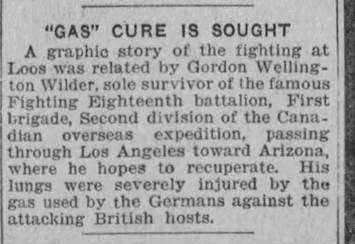
This “fact” was in direct contradiction to the actuality of the status of the 18th Battalion. It was very much alive and present and would be so for the entire war. Wilder is certainly an example of the extreme lengths a person will go to bend the truth, in this case to garner sympathy with the public, as Wilder was up on charges of vagrancy at the time of publishing, and he appears to be using the press, though it is probably a willing participant, to get column inches with a juicy story.
Wilder would have more than one run-in with the law, including a murder trial and a death under suspicious circumstances.
In the case of Arthur F. Taylor, ex-member of the 18th Battalion, Canadian Expeditionary Forces is reported that, “He was living near Detroit, he recalls, when he took off in the autumn of ’14 to cross into Canada and enroll in the dominion’s army at London, Ont. He was assigned to a famous regiment—Princess Patricia’s own, destined to become known as the Princess Pats.”[i]
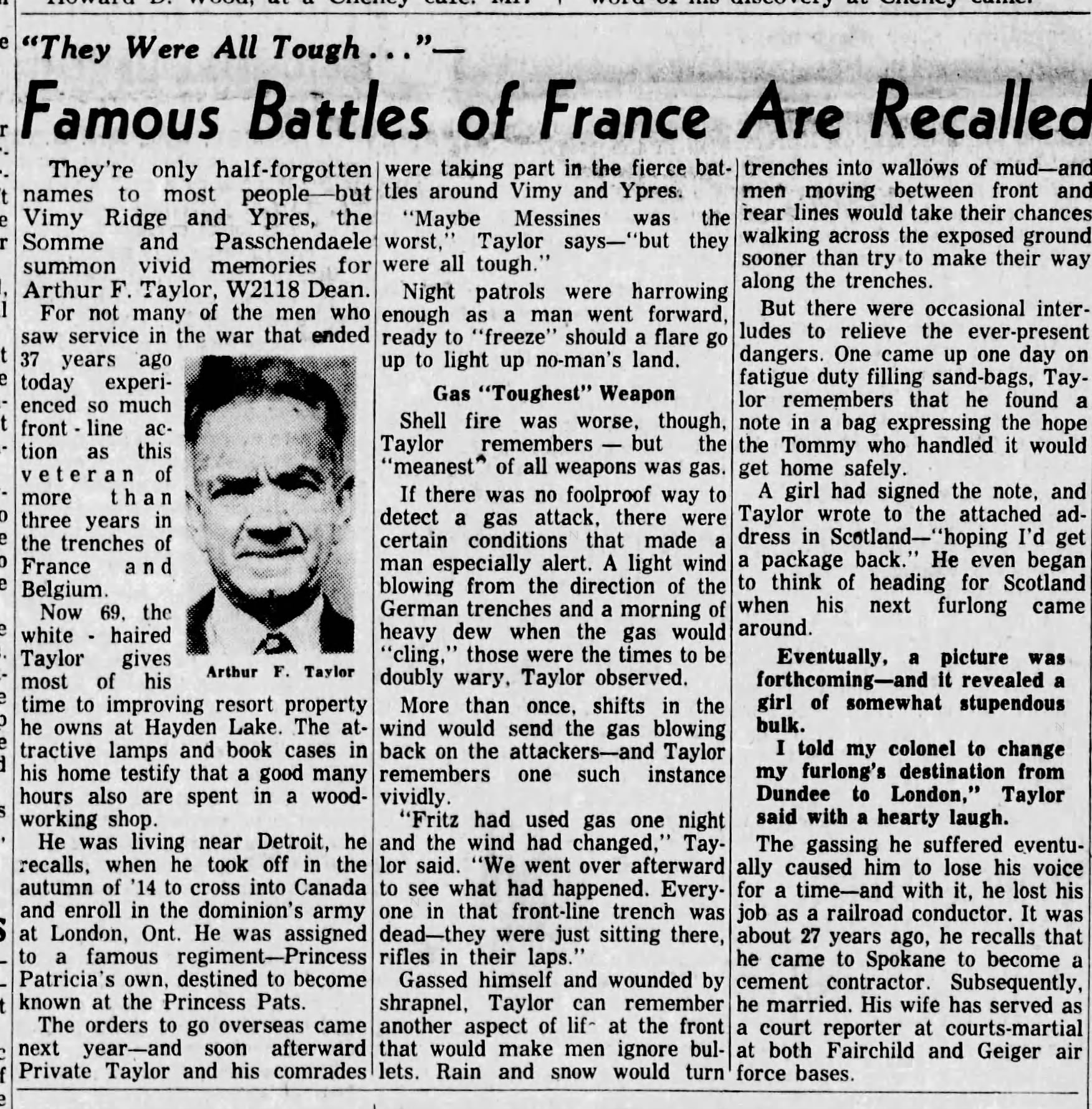
This paragraph suffers from one inaccuracy; Taylor never served with the Princess Patricia Canadian Light Infantry (PPCLI). His service records verify the key aspects of this statement. He attested at London, Ontario on 2 April 1915. His wife followed him and was living at 661 Central Avenue in London at the time of his attestation. It is not possible to verify his residency in Detroit before 1914, but he is shown to have been living in Windsor, Ontario at or about 18 November 1918.
He was never assigned to the PPCLI. He served with the 18th Battalion until he was taken off strength with the 18th Battalion effective 23 August 1917, as he was being discharged on compassionate grounds. The service record does not state the nature of the grounds but was probably related to his wife and her health.
Why Taylor would be connected to the PPCLI is unknown. The reporter probably had no credible method to confirm any of the information Taylor related to him. As the reasons for this embellishment to Taylor’s war experience is unknown, it could have simply been that the reputation of the PPCLI in the United States would be much greater than that of the “Fighting 18th”. Certainly, the romantic notion of the creation of the PPCLI and it presence in the 1st Contingent CEF was better known than that of a battalion raised in Southwestern Ontario.
He appears to connect his war service with the 18th’s participation at Passchendaele. He had left before the 18th bore the hellish experience at that place in November 1917.
Perhaps the distance of time led to these memories being confused. Or he listed the battles the 18th Battalion participated in, and the reporter simply included them without proper context.
The article says, “The orders to go overseas came the next year…” Taylor was on his way to England on the 16th of April 1915, only days after he enlisted. There was not been a year since his enlistment.
His reference to the Battle of Messines is problematic. Canadian support for this battle was primarily with mining/tunneling resources, and no infantry units participated in this battle (7-14 June 1917).[ii]
His recollection of being gassed and wounded may have a basis in fact. He may have been gassed with the 18th Battalion, but any wounds he sustained were not recorded in his service file. He did, however, suffer and was treated for an ingrown toenail and a pyrexia of unknown origin (the flu), as these are the only two medical conditions mentioned in the war diary.
There is a great vignette about Taylor finding a note in a sandbag from a Scots girl. This may well be true. This practice may have been officially frowned upon, but it makes sense that a person might leave a patriotic missive in the form of a note showing encouragement and support for the “boys” on the frontline.
If this story is correct, there are some interesting notes to take from it.
He was granted a 10-day leave effective 4 February 1917. This length of leave indicated a leave to Paris, not to England, which was normally a 14-day leave. But he was married at the time, so perhaps it was not only the looks of this bulky girl that led to a change of mind. Perhaps the temptation to stray would be satisfied by abstinence or alternative female companionship in Paris?
Though this news clipping is not a true representation of aspects of Private Taylor’s service, he did serve honourably and in combat with the 18th at Ypres, the hell of the Battle of the Somme (Battle of Flers-Courcelette) and Vimy Ridge. He may not have been physically wounded to the point of requiring medical treatment in the rear, he was present and available to serve and suffered the same risks as any other member of an active combat unit.
Perhaps the embellishments were initiated by the reporter? Or were they added without appropriate context? Or the need to keep the story pithy and topical led to an edit that butchered the content to the point where it was more readable at the expense of accuracy.
The reasons for the inaccuracies in the news clipping are interesting, and this is not an indictment regarding the character of Taylor. It shows that sometimes people don’t tell the entire truth; there were many men of all armies worse than Taylor with their tall tales and outright lies and fabrications. Motivations we cannot understand can cause this. The distance in time. He was 69 years old at the time of the article, and memories fade and meld.
Taylor had found a place to live and contribute. He owned a well-known lakeside hotel at Hayden Lake, remarried after his first wife’s death and had children and grandchildren. I think there is no need to forgive Private Arthur F. Taylor’s contribution to the news article. Though the information is inaccurate. acknowledging his service and his humanity as is his due for this service to our Country is now our duty. He did his.
“They Were All Tough …”— Famous Battles of France Are Recalled
They’re only half-forgotten names to most people—but Vimy Ridge and Ypres, the Somme and Passchendaele summon vivid memories for Arthur F. Taylor, W2118 Dean.
For not many of the men who saw service in the war that ended 37 years ago today experienced so much front-line action as this veteran of more than three years in the trenches of France and Belgium.
Now 69, the white haired Taylor gives most of his time to improving resort property he owns at Hayden Lake. The attractive lamps and book cases in his home testify that a good many hours also are spent in a wood-working shop.
He was living near Detroit, he recalls, when he took off in the autumn of ’14 to cross into Canada and enroll in the dominion’s army at London, Ont. He was assigned to a famous regiment—Princess Patricia’s own, destined to become known at the Princess Pats.
The orders to go overseas came next year—and soon afterward Private Taylor and his comrades were taking part in the fierce battles around Vimy and Ypres.
“Maybe Messines was the worst,” Taylor says—”but they were all tough.”
Night patrols were harrowing enough as a man went forward, ready to “freeze” should a flare go up to light up no-man’s land.
Gas “Toughest” Weapon
Shell fire was worse, though, Taylor remembers — but the “meanest” of all weapons was gas.
If there was no foolproof way to detect a gas attack, there were certain conditions that made a man especially alert. A light wind blowing from the direction of the German trenches and a morning of heavy dew when the gas would “cling,” those were the times to be doubly wary, Taylor observed.
More than once, shifts in the wind would send the gas blowing back on the attackers—and Taylor remembers one such instance vividly.
“Fritz had used gas one night and the wind had changed,” Taylor said. “We went over afterward to see what had happened. Everyone in that front-line trench was dead—they were just sitting there, rifles in their laps.”
Gassed himself and wounded by shrapnel, Taylor can remember another aspect of life at the front that would make men ignore bullets. Rain and snow would turn trenches into wallows of mud—and men moving between front and rear lines would take their chances walking across the exposed ground sooner than try to make their way along the trenches.
But there were occasional interludes to relieve the ever-present dangers. One came up one day on fatigue duty filling sand-bags, Taylor remembers that he found a note in a bag expressing the hope the Tommy who handled it would get home safely.
A girl had signed the note, and Taylor wrote to the attached address in Scotland—”hoping I’d get a package back.” He even began to think of heading for Scotland when his next furlough came around.
Eventually, a picture was forthcoming—and it revealed a girl of somewhat stupendous bulk.
I told my colonel to change my furlough’s destination from Dundee to London,” Taylor said with a hearty laugh.
The gassing he suffered eventually caused him to lose his voice for a time—and with it, he lost his job as a railroad conductor. It was about 27 years ago, he recalls that he came to Spokane to become a cement contractor. Subsequently, he married. His wife has served as a court reporter at courts-martial at both Fairchild and Geiger air force bases.
Spokane Chronicle. 11 November 1955. Page 21.
[i] For specific information about the PPCLI in World War 1 please see this link: https://ppcli.com/ppcli-museum-description/regimental-history/first-world-war/
[ii] See this link for a paper on the Canadian contribution. https://share.google/a8PdsQhppJJcEVYDT
Discover more from History of the 18th Battalion CEF, "The Fighting Eighteenth"
Subscribe to get the latest posts sent to your email.


Leave a comment